No Sea Left Uncharted: Dante in Japan

What register should be used to translate a work so ancient, and yet so new?

In the seven hundredth anniversary of Dante Alighieri’s death, his works remain vividly alive. The ongoing stream of translations and editions of the il Somma Poeta, continuing to hold the world in rapture, is evidential of the text’s mutative and evolving qualities as it immerses itself in each discrete language. With this curiosity in mind, we are presenting a new Dante-centric series on the blog, taking a look at the Italian master’s works through the prisms of its variegating, global journey. First up is Professor Hideyuki Doi of Kyoto’s Ritsumeikan University, an accomplished expert on Italian literature. In the following essay, he traces the history of Dante’s presence in Japan, and discusses why the ancient texts continue to fascinate contemporary writers.

In order to understand Dante’s fortune in Japan, we must travel backwards exactly seventy years, when the first volume of Dante gakkai shi—annals curated by the Japanese Dante Society, founded the year before in collaboration with the Italian Dante Society of Rome—was published.

This release represented a validating acknowledgement of Dante Studies, or Italian Studies, in Japanese academia, reborn anew in the post-war period. For a long time, if the figure of Dante represented for the Italians questions of identity, for the Japanese, it posed questions of existence. In contributing to this cultural conception, there is a poem inspired by Dante’s work, composed by Akiko Yosano in the concise style known as waka or tanka:

Hitori ite  hoto iki tsukinu  Shinkyoku no  Jigoku no kan ni  warewo miidezu

Alone I breathe a sigh of relief having not found myself in the Inferno of the Divine Comedy.

This fragment, composed in 1921, restores the ancient form of thirty-one syllables subdivided into five units, and also shows how Dante touched Japanese readers closely. Yosano, today counted among the greatest modern poets, is the highest representative of that Japanese romanticism of the early twentieth century—considered a non-naturalistic aestheticism.

To draft that “Dantesque” poem, Yosano had read the first complete translation of the Comedy, edited by Heizaburō Yamakawa (1914, 1917, 1922), a Christian-inspired man of letters. Yamakawa, like many other Japanese people of that time, was spurred by a worldwide interest in the Florentine poet upon the sixth centenary of his death, as well as a curiosity cultivated by certain writers who had referenced Dante in their own works. For example, the modern novelist par excellence, Sōseki Natsume, in his autobiographic short story London tō (The Tower of London, 1905), described the imposing image of the famous Tower standing in the memories of his years spent studying in the capital—an image compared to that of Dante’s famous gate, which condemns to “eternal pain” those who pass through it. READ MORE…

Translation Tuesday: Four Poems by Pedro Mir

Will you admit you gave me a home / in the very inside of a fruit?

Pedro Mir (1913–2000), former poet laureate of the Dominican Republic, is often compared to Pablo Neruda and Derek Walcott for his lyricism and social engagement. Yet, as Jonathan Cohen demonstrates in his award-winning essay (selected by J.M. Coetzee for Asymptote’s Writers on Writers contest), Mir remains relatively obscure in the Anglophone world. In his essay, Cohen introduces us to this “Whitman of the Caribbean” who, at home and in exile, sang resplendently of the multitudes of islands and peoples in his fiercely political register. Ahead of Mir’s death anniversary on July 11, we are proud to showcase four poems translated by Cohen that reveal another face of Mir’s diamantine poetic personae, this time: the passionate lover, the rhapsodic suitor, the ecstatic agonizer. With surrealistic turns of phrases that surrender to an impassioned dream logic, these verses from his 1969 collection, Poemas de buen amor . . . y a veces de fantasía (Poems of Good Love . . . and Sometimes Fantasy), are charged with an eroticism not only for his beloved subject, but for language too and its capacity for image-making. They attest to why Mir should be counted amongst the best poets of the twentieth century. 

“Translating Pedro Mir’s love poems into English is both a critical and creative challenge. Like all his work, these poems are finely wrought constructions. The task for me was painful at times because discerning the exact meaning of certain words racked my brain, especially in surrealistic passages. The translator must often choose one over several possibilities. Not only that, the rhymes and metrics of the traditional poetic forms that Mir uses so beautifully, as in his ‘Sonnet of the Grateful Girl,’ are impossible to recreate without padding. Translation of these poems, at best, is an approximation. Yet it still is possible to make real poems in English, using Mir’s work as a blueprint, that are faithful to his verse—poems that give Anglophone readers the experience of the potent lyricism and originality of his voice, poems that sound like him and convey his intent. This has been my goal.”

— Jonathan Cohen

Invitation

To begin I offer you
                a bouquet of words
as an illustration and firelight and bubbling of a spring.
Then I give you the warmth of my hands
for the shiver of your belly.
Then I give you the chemistry of my blood
coursed through all the viaducts of oxygen
and the lime and nerves of my teeth.
And in addition my nutrients
                my iodine and my magnesium
my phosphorus and my salt
                my albumin and my sand.
And plus I give you
                my face dissolved
at the temperature of my genes
or my family.

And you won’t need anything more to receive
and keep forever
and maybe sob over for a brief moment
so as to acknowledge that now
that now you are saved from oblivion
and you are invulnerable to death. READ MORE…

Within This Language a Home: On the Linguistic Exiles of Minae Mizumura and Jhumpa Lahiri

We seek within language the stable perceptions of identification; we are looking for the words to pronounce ourselves.

Minae Mizumura was born speaking Japanese, adopted English upon moving to America, studied French diligently at the Sorbonne and Yale, then in adulthood, returned to Japan to become a novelist in her native tongue. Jhumpa Lahiri was born speaking Bengali, quickly gained fluency and rose to literary prominence in English, then in the mid-nineties, fell in love with the Italian language, and began a prolific transfiguration of translating and writing Italian texts. In this following essay, Blog Editor Xiao Yue Shan discusses these two accomplished writers in the varying, intriguing ways they’ve travelled through the realm of language, and how the possibilities of exile provide for a rediscovery of selfhood.

The art of self-introduction is a practice in brevity and precision. When I lived in China, I was Xiao Yue—yue as in moon. When my family moved to Canada, I became but you can call me Shelly. Later, when I carved a home-like enclave for myself in Japan, I learned the concise method of mental hyphenation: Shelly-Chinese-Canadian. Such is the way I moved through the world, always in dialogue with its perceptions. The self is not a distinct article of qualities, but a myriad web of associations—one spends a life following its appendix.

When an individual’s place in the world is rendered fluid by border-crossings and trans-oceanic migrations, it serves to learn that identity is not an indefatigable statement of presence, but a tenuous and mutable clay. Names, meant to be cemented by the fact of birth, become vulnerable to the phonetic insistences of other tongues. Language, the intact system by which to categorise the world, becomes scattered and dismembered with interruptions, contrarian rules, and adversarial vocabularies. One learns to see the multiplicities innate in all things—the layers of presence dispersed across the world, evoked by the differences in seeing. What you call that I call mine.

“‘My name is Minae’: how many times did I say this and then feel my mind go blank?” In Minae Mizumura’s novelised autobiography, An I-Novel, she peruses the same delicate network of memories, beliefs, and influences to reach herself. The three-hundred-some pages are held within the bookends of one day and night, perched on the structural lattice of phone calls with her sister, Nanae. The two sisters behold each other in both the comfort of familial intimacy and the strangeness of difference, made bolder by the contrast of similarity. Nanae, accustomed to American patterns, has settled into a life—however precarious—defined by an apartness from Japan, a homeland resigned to being occasionally ached for and remembered. Minae, however, spends the duration of this long, diaphanous day gathering pockets of assurances and assertions so that she may get up the courage to tell her sister about her decision to return to Japan—and their first language—to become a novelist.

The pull that Minae feels towards her birth country has everything to do with a knowledge that she has the power to excavate something profound and secret in the earth of Japanese language, a richness that the stone facade of English does not betray—“. . . the act of writing in Japanese transformed me to someone with knowledge of a rarefied world conveyed through the mix of different writing systems, knowledge inaccessible through English.” The lilting elegance of hiragana enchants her—writing its sweeping shapes embroiders her into the brocade of The Tale of Genji, calling towards a graceful world of balance, beauty, and softness. Even the repetitive, metronomic nature of learning kanji beholds an element of magic, displacing her into the transcendent history of the characters: “I felt like a monk in a temple, his body freezing in the bitter cold of winter, copying a sutra by candlelight.” Language—even beyond its purposes of notation and definition—is a gateway, a stage upon which the fantasies of self may spiral in its complex, infinite choreography. READ MORE…

Weekly Dispatches From the Front Lines of World Literature

The latest literary news from Poland, the UK, and Palestine!

This week, our intrepid team members report from around the globe as Poland honors one of the country’s greatest poets, UK independent publishers reckon with new tax regulations, and a Palestinian podcast kicks off with a special video presentation, which also serves as an introduction to some of the brightest lights in Arabic poetry. Dive in!

Julia Sherwood, Editor-at-Large, reporting from Poland

Long snubbed by Polish literary critics as popular literature, the satirical novel The Career of Nicodemus Dyzma (1932), about the accidental rise of an opportunistic swindler, by the political journalist Tadeusz Dołęga-Mostowicz (1898–1939) remained inaccessible to English-language readers until 2020, when Northwestern University Press brought it out in a translation by Ewa Małachowska-Pasek and Megan Thomas. Their commitment and excellent rendering of the book’s universality made the translator duo worthy recipients of the 2021 Found in Translation Award. Explaining the book’s importance and enduring relevance, Ursula Phillips notes in her #Riveting Review that its “resonance extends well beyond the Poland of 1932: in our age of misinformation, post-truth, fake news, the discrediting of expert knowledge and widespread conspiracy theories, it is not hard to recognise other Dyzmas.”

Modern Poetry in Translation has teamed up with the Polish Book Institute to mark the two hundredth birthday of Cyprian Kamil Norwid (1821–1883). Now recognized as one of Poland’s greatest poets, the visionary romantic spent most of his life in exile and died virtually unpublished, deaf and destitute, in Paris. Hoping to “ignite the gentle curiosity of the imagination of the viewer towards the legacy that this man left in writing and in art that was simply never validated in his lifetime,” animation supremos Brothers Quay have created Vade Mecum, a short visual tribute taking its title from Norwid’s poetry collection. On 21 June MPT released a special digital issue featuring Adam Czerniawski’s translation of Norwid’s last play, Pure Love at Sea-Side Bathing. Set by the French seaside, the play “anticipates Maurice Maetelinck’s Pelléas et Mélisande and Henry James’s late novels,” says Czerniawski, introducing this work by a “master of the implied, the half-said, the unsaid.” And the journal’s summer 2021 issue will present new commissions from poets Wayne Holloway Smith and Malika Booker, writing in response to Norwid. Back in Poland, as the Cyprian Norwid Prize celebrates its own twentieth birthday, Józef Hen, author of over thirty books, many film scripts and plays, as well as four TV series, has been named winner of the “Award for Lifetime Achievement”. Prizes in the remaining categories—literature, music, visual art and drama—will be announced in September.

READ MORE…

Memory in Present Tense: On Haruki Murakami’s First Person Singular

Murakami's latest collection returns to his perennial fixations with jazz music, baseball, and mysterious meetings with women and animals.

First Person Singular by Haruki Murakami, translated from the Japanese by Philip Gabriel, Knopf, 2021

In Haruki Murakami’s short story, “On Seeing the 100% Perfect Girl One Beautiful April Morning” (from his 1993 collection The Elephant Vanishes), the archetypal Murakami protagonist—an unreliable, doubtful man—fleetingly encounters an unfamiliar girl on the street and suddenly realizes she is the 100% perfect girl for him, though he has never spoken to her, nor finds her particularly beautiful. Instead, this melancholic, gently absurdist piece concerns itself with what the narrator would have said had he approached the girl. After dismissing a number of ridiculous ideas, the narrator decides on a long fabulist story, in which a young girl and young boy meet, discover they are one hundred percent perfect for each other, and separate to test their feelings. While apart, however, both lose their memories, and when they eventually encounter each other again, both only briefly acknowledge that they are perfect counterparts, but still go on to forever disappear from one another’s lives.

The story, which later served as inspiration for Murakami’s novel 1Q84, employs the author’s recurring narrative device of intermingling reality and unreality in the minds of his narrators, largely applied to the fleeting but transformative romantic encounters between men and women—most famously evident in his early bestselling novel, Norwegian Wood. It also reflects Murakami’s longstanding thematic concerns of loss, estrangement, doomed love, and loneliness. Notably, the young girl and boy not only become estranged from each other, but also from themselves in the loss of their memories; this theme of disconnection unites the stories in the author’s latest release, First Person Singular, fluidly translated from the Japanese by Philip Gabriel. The collection is his first since the English publication of Men Without Women in 2017, and returns to Murakami’s perennial fixations with jazz music, baseball, and mysterious meetings with women and animals. They are all narrated by an aged writer—resembling Murakami himself—who wistfully reflects on loosely chronological formative experiences. In this way, the stories blur not only dream and reality but also author and narrator, playfully employing the lens of memory to grapple with how we transcend—or fail to transcend— the disconnections that occur between others and ourselves.

READ MORE…

Announcing Our June Book Club Selection: FEM by Magda Cârneci

Cârneci's protagonist is a modern Scheherazade—or is she?

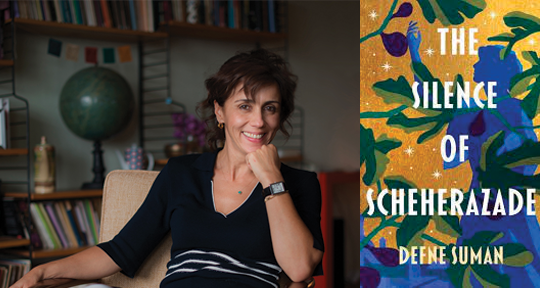
The persuasive potentials of storytelling don’t always hold the life-or-death thrill that they did for the mythical Scheherazade, who spun her narratives to stay alive, but as the profundities of Magda Cârneci’s FEM prove, there is always an enchantment in speaking one’s own experiences to another. Exalted with Cârneci’s celebrated poetics and visceral in its discernment of gendered bodies, our Book Club selection for June is a novel that speaks to our evolving understandings of physicality, sexuality, and selfhood as refracted in societal prisms of sex, femininity, and myth.

The Asymptote Book Club aspires to bring the best in translated fiction every month to readers around the world. You can sign up to receive next month’s selection on our website for as little as USD15 per book; once you’re a member, join our Facebook group for exclusive Book Club discussions and receive invitations to our members-only Zoom Q&As with the author or the translator of each title!

FEM by Magda Cârneci, translated from the Romanian by Sean Cotter, Deep Vellum, 2021

In the very first lines of FEM, the protagonist—a fictionalized version of author Magda Cârneci—compares herself to the mythical heroine Scheherazade, then immediately troubles the comparison: “A little, everyday Scheherazade in an ordinary neigh­borhood, in a provincial city; your personal Scheherazade, even if you won’t cut my head off in the morning, when I fail to keep you awake all night with extraordinary stories.”

How, then, is she like Scheherazade? She will indeed attempt to enchant her listener, a lover, with a string of stories—but are all women who tell stories like Scheherazade? It is not a simple affinity between the two women that gives meaning to the comparison, but, more fruitfully, the symmetry’s imprecision. Like the north ends of two magnets, the two storytellers’ refusal to meet tantalizes, inviting the reader into the no-man’s land, in which they may question—or even participate in this exchange of identities. Cârneci’s own active approach to living in a body, in fact, is exactly what she begs her listener/reader to adopt, and her appeal is so breathtaking, it’s a wonder anyone could refuse:

We are seeds sown into the brown-black loam of a terrestrial existence, and we must germinate and rise slowly from our fragile burgeoning, our green sprouting, through lay­ers of clay and stone, through bacteria, worms, and insects that wish to devour us, we must pierce through sheets of underground water and enemy root systems, our germi­nations are deviated by contrary forces, deceived by grav­itations and visions, by temptations and traps, but pulled upward by an atavistic, core instinct, along a fragile thread of light, pulled by an inverted, celestial gravity, we are tractable, attracted toward growth at any price . . .

READ MORE…

Translation Tuesday: “The Leaf” by Azza Maghur

I feared if I touched the leaf, it would either sting me, or its light would run through my body and melt me instantly

Can the story of a life be told through a single moment? What would it mean to, in William Blake’s words, “see a World in a Grain of Sand”? In Azza Maghur’s story, a single luminous leaf from a man’s childhood comes to define his entire life. Maghur’s prose is spare and understated; it is given a lovely cadence in Dr. Safa Elnaili’s translation, which lures the reader into a moment of beauty that is given a telescopic significance in the narrator’s reminiscence. Published in Arabic at the start of this year, this quiet piece received much praise for its resonances with reader’s experiences of the pandemic—its sensitivity to the tactile world, for instance, when a world was reckoning with the potency of touch.

All the rays of sunlight that day filtered through the trees onto a single leaf.

I swore to Mother that the sun rested on one leaf. I witnessed it shine as brightly as day against the dimness of its mother tree.

Mother was standing in front of the kitchen sink. She pulled her wet hands from under the running faucet, wiped them on the sides of her dress, and then smiled. She told me I was a little boy with a wild imagination. I had no idea whether I should give rein to my imagination or let it take me away on its wings.

I tell you this story because that leaf and my soul have become inseparable since that day. I searched for it my entire life. It was the size of my hand or slightly bigger, dark green, and so thick that even light couldn’t pass through it. Water droplets could rest on it undisturbed.

My only recollection of the tree was that its aura was dim, almost black. I learned as I grew up It must’ve been an emerald green tree, but I only remember the one particular leaf that soaked in the sun and captured all its strings of light as if it were planning to make something out of them. I reckon it’s the reason the tree was so dim.

I’ve roamed this earth; I’ve visited cities, villages, farmlands, and forests in search of the leaf but never found or seen anything that resembled it.

The sun’s light is boundless. It shines on earth with a fair and steady rotation, inflames the edges of leaves and homes, and draws shapes on sidewalks and rooftops. Its light and warmth sneak into concrete buildings and even shine through the tiniest holes in shirts or carvings on the soles of shoes. It stretches into the entrance of a dark cave but never dares to travel beyond it. Its light wrestles shadows. When it’s time to set, it departs leisurely, and its rays shine over the horizon. It yawns with heavy eyes and then sleeps until dawn to rise again.

I drove my car, parked it in the shade under a tree, and hopelessly looked for the leaf. I walked into forests and farms and searched for it among trees and bushes and even between the leaves of fruits but could never find it. READ MORE…

Strangeness, Discovery, and Adventure: An Interview with Enchanted Lion’s Claudia Bedrick

The publisher brings world literature to Anglophone children. Plus, three recommended titles.

Before 2020 became the annus horribilis, fans of Italian children’s author Gianni Rodari had awaited it with excitement, as it marked the one hundredth anniversary of Rodari’s birth. Countless events and celebration had been planned, many of which still took place virtually, but perhaps even more interestingly, new editions and translations of and about Rodari’s work were issued. Among these is the first complete English translation of Favole al telefono (Telephone Tales), translated by Antony Shugaar and illustrated by Valerio Vidali for the independent children’s press Enchanted Lion Books.

Although Rodari is arguably the greatest Italian children’s author and his fame extends well beyond Italy’s borders, especially in the former Soviet Union, Rodari was never read much in the United States and Anglophone world in general, partly because of his ties with the Communist Party. Intrigued by their choice to publish Telephone Tales now, I had a Zoom conversation with Claudia Bedrick, the publisher, editor, and art director at Enchanted Lion. We began by discussing Rodari and ended up talking about children’s literature in translation more generally.

Anna Aresi: How and why did you decide to publish Telephone Tales now? Of course there was the anniversary, but Rodari was never famous in the United States. Do you think readers are more receptive now? The book has been a great success!

Claudia Bedrick: Yes, maybe. In fact, it was only coincidentally that it was published for the anniversary. We thought it would be published a lot sooner. The translator and I started talking about Telephone Tales seven years ago, but there were delays and it just happened that it was published last year (in 2020). My interest in Rodari stems from The Grammar of Fantasy, which exists in English, translated by Jack Zipes. That’s a book that I’ve known for a long time, a book that I’ve read and relied upon in the formation of Enchanted Lion. So when the translator contacted me about Rodari and Telephone Tales, I was already familiar with him, and I think this was a major difference between me as an editor and other editors he had spoken with. Like you said, a lot of people in the English-speaking world have no idea who Rodari is, even though he is arguably the greatest children’s writer of Italian culture, or one of them in any case.

READ MORE…

Weekly Dispatches From the Front Lines of World Literature

Literary news from Europe, Argentina, and Sri Lanka!

As the world slowly reopens to possibilities made anew by the subsiding of pandemic restrictions, our editors are bringing you the latest from a summer of potentialities. In Argentina, bookstores are spotlit for their role in creating cultural spaces and dialogues, and virtual stages take full opportunity of their wide reach. In Europe, a Belgian festival dedicated to avant-garde poetry is proceeding at full speed, and new and noteworthy publications are hitting the shelves. In Sri Lanka, annual literary forum New Ink debates the definitions and reach of their national literature. Our editors are here with the full scoop!

Allison Braden, assistant blog editor, reporting from Argentina

The Feria de Editores is now accepting entries for its Bookstore of the Year award; the organization, which will host its annual festival of independent publishers on October 1-3, seeks to recognize the work of booksellers throughout Argentina, acknowledging that their cultural and curatorial role goes far beyond merely selling books. The prize, open to all bookstores that have been open at least one year, will honor a shop whose leaders and employees have worked tirelessly to promote intercultural exchange both inside and outside its physical space. “Bookstores,” says the invitation to enter, “are a focal point for fostering local culture and connection to international thought.”

Bookstores in Argentina and beyond will soon stock commemorative editions of Eduardo Galeano’s Open Veins of Latin America, a book of profound influence on international thought about the legacy of exploitation in the region. Galeano, a journalist and novelist who hailed from across the Río de la Plata in Montevideo, Uruguay, published the work in 1971, when authoritarian regimes on the continent still held sway. The book was banned by some, and even Galeano eventually came to think of it as poorly researched and written, but it nevertheless became a leftist classic with enduring appeal: It’s been translated into more than a dozen languages and shot to number six on Amazon’s best-sellers list after Venezuelan President Hugo Chávez gave a copy to U.S. President Barack Obama. In Argentina, the book’s fiftieth anniversary has provoked reflection on the relevance of Galeano’s thesis today.

Fundación Andreani, an organization that promotes cultural and educational programs to improve quality of life, and Universidad Nacional de las Artes joined forces this month to launch Paraísos Artificiales. Antología de poesía en la web (Artificial Paradises. Online poetry anthology). The series celebrates the web’s potential for creative freedom and brings attention to digital poetry and “technopoetics.” The first season, released this month and inaugurated with a virtual presentation, consists of three episodes, which focus on artists with various approaches to visual poetry: Rafaël Rozendaal, Ana María Uribe, and Belén Gache. The series is fuel for the Feria de Editores claim that cultural influence, especially in the age of Zoom, goes far beyond bookstore walls. READ MORE…

How the Void Fills: Soje on Translating Choi Jin-young’s To the Warm Horizon

I hope that the books that I translate collectively present a tapestry of Koreanness that challenges and upends orientalist views of the country.

Though the pandemic that serves as the catalyzing disaster in Choi Jin-young’s To the Warm Horizon seems immediate to our times, the novel was actually published in 2017—indicating towards the larger, lasting ideas and occupations alive beneath the tide of current events. Indeed, as Choi’s sensitive, dreamy narrative unfolds, the uncanny nature of its topicality is overshadowed by its larger, human concerns of foreignness, settlement, and the way we meet one another. In the following interview, transcribed from a live Q&A hosted by Asymptote Book Club Manager Alexandra Irimia, Soje shares their thoughts on translating the unique novel, and the many invisible challenges of translating Korean into English.

The Asymptote Book Club aspires to bring the best in translated fiction every month to readers around the world. You can sign up to receive next month’s selection on our website for as little as USD15 per book; once you’re a member, join our Facebook group for exclusive Book Club discussions and receive invitations to our members-only Zoom Q&As with the author and/or the translator of each title!

Alexandra Irimia (AI): From Italian opera and sound of the ocean, to radio static and the rain, To the Warm Horizon shapes a unique soundscape. The narrative relies a lot on its sensorial, synesthetic cues which usually demand a lot of skill and craft to be put into words and conveyed convincingly. Besides, as a reader, I felt a lot of intentionality in the author’s use of silence. Did you feel in this novel—or in the rest of your body of work—that there was any challenge particular to translating the musicality of the prose from the Korean into English? 

Soje: What a beautiful question! Virtually every translator of Korean literature has commented on this at some point, but repetition is a big deal in Korean literature. In prose, it becomes more noticeable because we, as readers, expect that kind of musicality more from poetry. One of the main stylistic things I noticed was the way Choi Jin-young breaks her sentences in staccato declarations, especially towards the beginning of the book where Dori is narrating her past life in Korea and journey to Russia. And because the fragmented nature of these sentences reflects the character’s state of mind, I tried to replicate every single beat in my first draft. But upon rereading and revising, I found that these dramatic pauses felt more gimmicky in the English than in the Korean, so I had to find a balance between the rhythm of the Korean and what the English language wanted me to do. My reasoning for this partly boils to the fact that the word count expands about 1.5 times from Korean to English, so the rhythm will absolutely change in translation unless details are cut.

There are seven speech levels in Korean, mainly indicated by the verb conjugation which comes at the end of the sentence. Korean novels usually employ the 해라체 (haerache), which means that every declarative sentence ends in the same syllable, 다 (da). So there’s almost this concealed rhyme, and I used to be so fixated on it that many of my sentences in English tended to parallel in structure. Thankfully, my excellent editors at Honford Star and translators such as Emily Yae Won and Anton Hur taught me to vary my sentence structures—something that I’m still honing as an early career translator.

AI: You manage to convey into English an intuition of lyricism that I often associate with East Asian poetry, and which I can imagine is deeply embedded in the original text. Is this lyricism something that flows naturally in your translation—an effortless emanation from the original text—or something that requires a deliberate attempt to preserve in the English version?

Soje: Wow, effortless emanation? I think that’s every translator’s wish! I probably struggled with this more because Horizon happens to be my first full length translation—the two poetry collections that I translated just happened to come out earlier. In the three years that it took to get this published, I think I did three or four major revisions, each time returning to the text with the knowledge I gained from working on the poetry projects. So maybe there’s some relevance there. READ MORE…

One’s Own Desire: Arab Women Writers Speak for Themselves in We Wrote in Symbols

This anthology provides a glimpse into a world that has been constantly made invisible or policed within systems of domestication and abuse.

We Wrote in Symbols: Love and Lust by Arab Women Writers, edited by Selma Dabbagh, Saqi Books, 2021

As an Egyptian, Arab, and Muslim woman, love and lust have largely occupied two separate worlds in my life. While I yearned for the elusive idea of love in my youth and pursued it in relationships, I had also deeply internalized that it had to end in heartbreak; I believed that love, like many ideas, could never be fully comprehended. But lust was different. Lust was an action—an action to avoid and repress, because it leads to sex, and sex is dangerous. When I started reading We Wrote in Symbols: Love and Lust by Arab Women Writers, I thought of my upbringing, of the two separate worlds I have built for love and lust, and the difficulties of reconciling them in my adult life. This anthology, edited by the British-Palestinian writer Selma Dabbagh and published by Saqi books, includes one hundred and one pieces by seventy-five different women from the Middle East and North Africa region, as well as from the diaspora. Most of the pieces are translated from Arabic, many are originally written in English, and the minority are translated from French.

In the book’s introduction, Dabbagh explains that translating works about love and lust is difficult, though we do not learn about the ways in which the various translations could have impacted the anthology. This is especially pertinent in the cases of translations from Arabic to English, which represent the majority of the works in the text; Arabic can be seen as a unifying language, but the subtleties and differences between the dialects dictate different cultural specificities and reflect a stark diversity in both place and community. In other words, unless the place of origin is clear, the readers lose a sense of place with the absence of dialect, and different geographies and contexts start feeling neutral.

In the introduction, Dabbagh contextualizes the largely overlooked history of erotic female writers in Arabic literature. Although names of ancient goddesses of love and fertility in the Arab region—such as Isis and Ishtar—are well known, the topic of female Arab sexuality still comes as a novelty for many. Similarly, despite the fame of certain Abbasid poets such as Abu Nawas, female poets in elite Abbasid literary salons are not famous, if known at all. This lack of awareness is further complicated by the total disappearance of women erotic writings during the fall of Andalusia in 1492; Dabbagh clarifies that women writing on love and lust faced a blackout for almost half a millennia, reappearing only in the late nineteenth century. By then, authors and novelists—like Zaynab Fawwaz—began challenging common misogynistic practices such as arranged marriages, and therein paved the way for many women Arab writers to discuss sexuality in various literary forms today. Ranging over three millennia, the long span this anthology covers is indicative of the two interests of my review: what lies beyond the celebratory—especially in relation to difficult and/or painful lust—and the limitations of the narrative linking love and lust as two sides of the same coin.  READ MORE…

Translation Tuesday: “Airports” by Daniel Saldaña París

on horseback / caught between one era and another

Selected in 2017 as one out of thirty-nine most promising Latin American writers under the age of thirty-nine, acclaimed Mexican writer Daniel Saldaña París is no stranger to our pages—read our review of his “exquisite” novel, Ramifications, for a start. This Translation Tuesday, we introduce to our readers another facet of Saldaña París, with a curious aviation-themed poem from the collection La máquina autobiográfica rendered in Louis Sanger’s translation. Curious because nothing takes flight: the poem’s airports are empty, its turbines are violent. What soars instead is the poem’s dynamic syntax which zigzags through a word’s widening valences, where Saldaña París defamiliarises for us the everyday uses of the word and the world. There is no timelier moment than today to reconsider what we know of the poem’s titular space.  

Airports

(1)

Empty airports.
Themselves, I mean.
But also: with hundreds.
Hundreds who could.
Or could have been, but weren’t.

Airports themselves, no?
containing all times.

What is there to say about “grain of the voice”—seed:
say the truth
about the unsaid. (Listen.)

For example, a voice that sows fields of sorghum
in front of
unorganized fields:
cities seen from above.
The plane does what it has to, like I said,
better late, even late in the day
with a sun that sets this late:
all I love
is visible, and growing old. READ MORE…

All Literature Is Worth Investigating: An Interview with Translator Stefan Rusinov

All cultures are exciting, both for their achievements and failures, for their beauty and nastiness.

In 1999, almost 170 years after his birth, Bulgaria honored publisher Hristo G. Danov’s legacy by establishing national literary awards in his name. In 2021, Stefan Rusinov, a translator who isn’t afraid to ask the important questions about the essence of his trade, won Best Fiction Translator for multiple books he had worked on over the course of twenty-four months. In addition to these admirable recent endeavors in Chinese prose, he juggles his work at Sofia University and his tasks as a freelance interpreter. Our conversation highlights his current projects, the importance of honest answers, and the value of simply “hanging out” with writers.

Andriana Hamas (AH): I would like to begin by asking you about your Бележка под линия (Footnote) podcast, thanks to which you meet fellow translators and discuss “behind-the-scenes torments,” the decisions they eventually have to make, and their inevitable missteps or failures. What have you learned so far?

Stefan Rusinov (SR): I’ve learned a lot, which was really the selfish reason to start this project to begin with. Private conversations with other translators and several years of translating gradually made me realize how case-specific this activity is and that mastery comes rather from accumulating solved problems than from learning universal principles (not to underestimate translation theory). That’s why I wanted to create a space where we won’t so much muse over the nature of translation and other such abstract questions, but we would dig into the specifics, where translators would be put in the position of explaining their considerations and decisions to someone who doesn’t know their working language. Nine episodes on, I’m even more certain that discussing actual problems encountered by translators from all kinds of languages is an important way to understand this activity (and also a major way to pump up my own translation skills).

I’ve learned, or rather, I’ve confirmed, that uncertainty is part of the game, and it should be. I find it very hard to trust a confident translator. There are tons of problems we need to solve and tons of decisions we need to make and, to borrow Wolfgang Iser’s idea of interpretation, the mere existence of these cases means that we are bound to create a gap between the original and the translation. So, in a way, we are bad translators by default.

I also learned that in French unfuckable means “incomprehensible.” READ MORE…

Weekly Dispatches From the Front Lines of World Literature

Hear about some of the most recent literary news from Taiwan and India!

This week, find out from our editors-at-large what has been happening around the literary world. Taiwanese literature appears in French translation, introducing a diverse swathe of writers across Taiwan’s linguistic backgrounds to French readers. India continues to reel from the impact of the pandemic, as the literary community remembers the writers they’ve lost, and many organizations stepping up to advocate for pandemic relief work. Read on to learn more.

Darren Huang, Editor-at-Large, reporting from Taiwan 

In February, the French publishing company L’Asiatheque released Formosana: Stories of Democracy in Taiwan, a collection of nine short stories by contemporary Taiwanese writers. L’Asisatheque is focused on making available books in translation from Asia, the Middle East, Eastern Europe, South America, and Africa to French readers. In 2015, the company launched a “Taiwan Fiction” series, led by editor Gwennaël Gaffric, who is also a Chinese translator and professor in China Studies at the University of Lyon. The series seeks to amplify Taiwanese literature with themes of environmentalism, cultural identity, Taiwanese dialects, gender, postcolonialism, and the impacts of globalization. The series has published a number of modern classics of Taiwanese literature in French including A City of Sadness by Chu Tien-wen and Wu Nien-jen, The Membranes by past contributor Chi Ta-wei (recently reviewed in our blog), and multiple works by Wu Ming-yi, including The Man With the Compound Eyes and his novella, The Magician on the Catwalk.

In Formosana, the writers grapple with turbulent periods in Taiwanese history, including that of Japanese colonialism, the White Terror, martial law, and democratization. The stories also contend with social issues, such as nativist movements, LGBT rights, and environmentalism. In a recent interview, Gaffric discussed his choice of centering the collection on the theme of Taiwanese democracy. He believes that though there is increasing coverage of Taiwan in the French press, most French people do not understand its historical and cultural intricacies. He states: “We attempt to allow people to understand the fate of Taiwan from the past to the future, through various types of literary works which provide different channels and voices.” For his next book, Gaffric plans to publish the works of indigenous writer, Syaman Rapongan, to introduce indigenous writing to French readers.

On May 29, Taiwanese literature was also highlighted in France when Chi Ta-wei was invited to join the ninth annual “Nuit de la literature,” organized by the Forum of Foreign Cultural Institutes in Paris (FICEP). A reading of Chi’s “Pearls,” one of the stories from his eponymous science-fiction collection, was conducted in both English and Chinese at the virtual event with the author and Gaffric. READ MORE…