
The naming of Abdulrazak Gurnah as our latest Nobel laureate in Literature is what’s topping headlines around the world this week, but there’s plenty more happening outside of the Swedish Academy. Our editors on the ground is bringing news of multi-media literary festivals, architecturally transformative contemporary art, Ukrainian translation forums, and the passing of a beloved Guatemalan writer. Read on to find out more.
MARGENTO, Editor-at-Large, reporting from Brussels
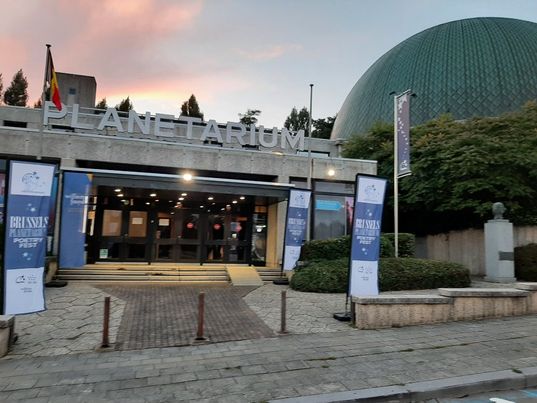
Brussels Planetarium Poetry Fest was hardly over when another literature festival was announced in Europe’s capital: Les Voix en Ville (Voices in the City), organized by Lettres en Voix. This year’s edition featured mostly collaborative projects involving writers, musicians, and filmmakers presenting concerts, readings, workshops, and “cinematic poems.” The venues were as diverse as cathedrals, museums, theaters, pubs, and public squares, while the works presented were more often than not site-specific. Maud Vanhauwaert, for instance, after recently receiving ovations at Planetarium Poetry Fest, participated by reading an “Ode to the Socio-cultural Worker” at the legendary literary cafe La Fleur en Papier Doré. The poem culminated in a work that went beyond the text per se, resulting in a video of the reading which featured images of the venue and a music soundtrack—an illustration in and of itself of the many “workers” who had contributed from behind the scenes.
In the meantime, Brussels’ literary and arts scene is frantically resurfacing from the lockdown. Among the 300 exhibiting artists, 150 workshops, 100 animations, and “concerts, live, dance, street art, performance, and literature” events inundating Ixelles (the arts quarter of Brussels), there was also a “coup de coeur” (heartthrob, sudden crush) exhibition at the animated Demeuldre art gallery. Among the highlights was Bert Mertens, a senior artist with a fresh eye for estranging details and collaged panoramas who mesmerized the visitors from the moment they entered with the hyperrealist light radiating from his paintings. The diversity of forms and approaches of other artists—ranging from graphic art to photography to sculpture to installations to comic strips—also succeeding captivating one’s attention. Still, what really overwhelmed the audience and kept visitors wandering the upper floors and attic of the 19th-century china shop for hours on end was the Talk C.E.C. exhibition, which reunited dozens of artists from France, Belgium, Italy, and elsewhere in a joint project converting the place—its architecture, its interior and exterior walls, the literal holes in the walls, the cafe, kitchen, and even the bathrooms—into a powerful collective manifesto revisiting and fusing sacred traditions, unorthodox spiritualism, and transgressive eroticism from an urgently environmentalist and culturally inclusive perspective.
Kristina Tatarian, Editor-at-Large, reporting from Ukraine
As summer ended festively with the thirtieth annual Independence day in Ukraine, a succession of literary events showcased new national literatures and opened up conversations about the changing trends in translation. Not long ago, the Ukrainian Book Institute established Translate Ukraine, the first translation initiative of its kind to be sponsored by the government, and which has helped literary festivals turn their focus towards an international audience. As a result, a record number of Ukrainian titles were translated into English in the past five years. M any Ukrainian publishers have noted that international literary festivals are not the only places to showcase the wealth of contemporary literature available in the country, stressing the importance of supporting local literary forums to better promote Ukrainian letters globally. Earlier this year, the famous literary festival Kyiv Book Arsenal hosted publisher B2B meetings to facilitate international translation deals and pitch the best of Ukrainian literature to publishers. READ MORE…
What’s New in Translation: August 2021
New work this month from Lebanon and India!
The speed by which text travels is both a great fortune and a conundrum of our present days. As information and knowledge are transmitted in unthinkable immediacy, our capacity for receiving and comprehending worldly events is continuously challenged and reconstituted. It is, then, a great privilege to be able to sit down with a book that coherently and absorbingly sorts through the things that have happened. This month, we bring you two works that deal with the events of history with both clarity and intimacy. One a compelling, diaristic account of the devastating Beirut explosion of last year, and one a sensitive, sensual novel that delves into a woman’s life as she carries the trauma of Indian Partition. Read on to find out more.
Beirut 2020: Diary of the Collapse by Charif Majdalani, translated from French by Ruth Diver, Other Press, 2021
Review by Alex Tan, Assistant Editor
There’s a peculiar whiplash that comes from seeing the words “social distancing” in a newly published book, even if—as in the case of Charif Majdalani’s Beirut 2020: Diary of the Collapse—the reader is primed from the outset to anticipate an account of the pandemic’s devastations. For anyone to claim the discernment of hindsight feels all too premature—wrong, even, when there isn’t yet an aftermath to speak from.
But Majdalani’s testimony of disintegration, a compelling mélange of memoir and historical reckoning in Ruth Diver’s clear-eyed English translation, contains no such pretension. In the collective memory of 2020 as experienced by those in Beirut, Lebanon, the COVID-19 pandemic serves merely as stage lighting. It casts its eerie glow on the far deeper fractures within a country riven by “untrammelled liberalism” and “the endemic corruption of the ruling classes.”
Majdalani is great at conjuring an atmosphere of unease, the sense that something is about to give. And something, indeed, does; on August 4, 2020, a massive explosion of ammonium nitrate at the Port of Beirut shattered the lives of hundreds of thousands of people. A whole city collapsed, Majdalani repeatedly emphasises, in all of five seconds.
That cataclysmic event structures the diary’s chronology. Regardless of how much one knows of Lebanon’s troubled past, the succession of dates gathers an ominous velocity, hurtling toward its doomed end. Yet the text’s desultory form, delivering in poignant fragments day by elastic day, hour by ordinary hour, preserves an essential uncertainty—perhaps even a hope that the future might yet be otherwise.
Like the diary-writer, we intimate that the centre cannot hold, but cannot pinpoint exactly where or how. It is customary, in Lebanon, for things to be falling apart. Majdalani directs paranoia at opaque machinations first designated as mechanisms of “chance,” and later diagnosed as the “excessive factionalism” of a “caste of oligarchs in power.” Elsewhere, he christens them “warlords.” The two are practically synonymous in the book’s moral universe. Indeed, Beirut 2020’s lexicon frequently relies, for figures of powerlessness and governmental conspiracy, on a pantheon of supernatural beings. Soothsayers, Homeric gods, djinn, and ghosts make cameos in its metaphorical phantasmagoria. In the face of the indifferent quasi-divine, Lebanon’s lesser inhabitants can only speculate endlessly about the “shameless lies and pantomimes” produced with impunity. READ MORE…
Contributors:- Alex Tan
, - Fairuza Hanun
; Languages: - French
, - Hindi
; Places: - India
, - Lebanon
; Writers: - Charif Majdalani
, - Geetanjali Shree
; Tags: - Beirut 2020 explosion
, - diary
, - disaster
, - Indian Partition
, - motherhood
, - recovery
, - social commentary
, - trauma
, - womanhood