Language: Portuguese

My 2019: Georgina Fooks

This year, I read more translated fiction than ever before, buoyed by my involvement in Asymptote

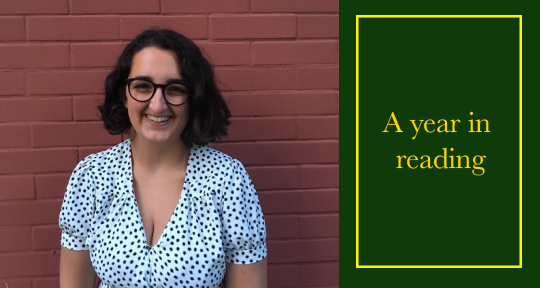
Here to continue our A Year in Reading series, please welcome Georgina Fooks, who made a conscious effort at the start of the year to expand her reading to include more women and non-European authors. Here is the result:

At the start of 2019, I consciously decided to read as much as possible. After several years of buying books and never reading them (a predicament neatly summed up by the Japanese word tsundoku), I resolved that this year, I wanted to read more books while buying less—so it is that I’ve done my best to read from my own shelves (although that doesn’t mean I have stopped buying books entirely).

The first half of this year was dominated by reading for academic purposes—so I read lots of French and Latin American fiction and poetry. My favourite author is Marguerite Duras, and I enjoyed Le Ravissement de Lol V. Steinthere’s something special about the atmosphere she paints through language, her evocative style, and the way she explores desire. Throughout the whole book, Duras keeps you guessing as to who’s in control, who holds power, and she never answers that question for you. I was also really moved by A lami qui ne ma pas sauvé la vie by Hervé Guibert, which is an emotional read that blurs the boundaries between fiction and autobiography. When published in France, it caused a media stir for recounting how Michel Foucault died of an AIDS-related illness, but beyond media sensationalism, it’s a heart-wrenching account that explores betrayal in all its forms—betrayals between friends, broken promises, and the betrayal of oneself when writing an account of your own life. 

Some of my favourite Latin American authors are from Argentina, so in addition to reading Borges and Cortázar, two of my favourites, I also enjoyed exploring Silvina Ocampo’s stories for the first time; she is famously overshadowed by Borges (a fellow writer) and Adolfo Bioy Casares (her husband), but she’s received a lot more attention in recent years. My favourite story of hers, “Tales eran sus rostros”, has now been translated into English and serves as the title of a new collection of hers in English: Thus Were Their Faces, published by NYRB Classics. It describes a supernatural phenomenon, and is haunting and ambiguous in the best possible way. She writes that no one knew if what happened was terrible, but became beautiful, or beautiful, but became terrible—but she leaves it up to the reader to decide.  READ MORE…

A Blazoned Book of Language: Poems from the Edge of Extinction in Review

The poets in this collection are intensely alert to their struggle, focusing on their work on the language's vulnerability and change.

I am beginning to write in our language,
but it is difficult.

Only the elders speak our words,
and they are forgetting.

So begins “C’etsesen” (“The Poet”), written in Ahtna, an indigenous language of Alaska, by John Elvis Smercer. In 1980, there were about one hundred and twenty speakers of Ahtna. At the time of this poem’s publication in 2011, there were about twenty. Today only about a dozen fluent speakers remain. Smercer’s lines reveal his urgent concern with the disappearance of his language and the weight of his task in preventing the language from slipping away. It is a race against time, between generations, for the young to learn the language before the old leave, taking the words with them.

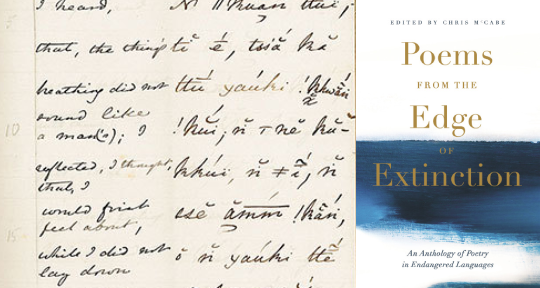
Chris McCabe, editor of the anthology Poems From the Edge of Extinction, has equally set out on such a task: to collect, record, and preserve poems from multiple endangered languages. The anthology grew out of the Endangered Poetry Project, launched at the National Library, at London’s Southbank Centre, in 2017. The project seeks submissions from the public of any poem in an endangered language in order to build an archive and record of these poems for future generations. Of the world’s seven thousand spoken languages, over half are endangered. By the end of this century, experts estimate that these will have disappeared, with no living speakers remaining. Language activism has been growing since the early 2000s, and the United Nations declared 2019 the International Year of Indigenous Languages (IYIL 2019) to raise global awareness of the consequences of the endangerment of indigenous languages. McCabe’s anthology, published to coincide with IYIL 2019, contains fifty poems, each in a different endangered language (as identified by UNESCO’s Atlas of the World’s Languages in Danger), presented in the original alongside an English translation; the result is an urgent and illuminating collection encompassing linguistics, sociology, politics, criticism, and philosophy that, in its totality, represents a manifesto of resistance.

READ MORE…

Translation Tuesday: “Theory of Affections” by Luca Argel

I always thought that this was a universal truth.

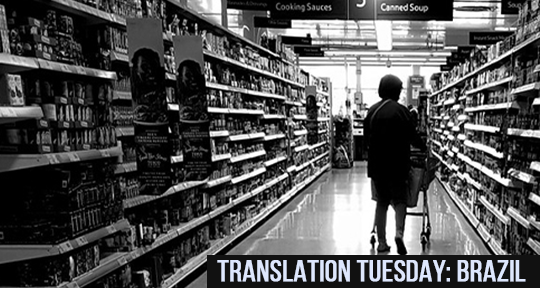
For this week’s Translation Tuesday, Luca Argel spins a simple observation into a theory of relation and attachment. Trafficking in clichés that are made vivid by honest prose, this piece of micro-fiction outlines an order of love in what is often considered an extremely sterile place, devoid of culture: the supermarket. For the narrator, the simple task of prioritizing food on a shelf based on the date it was produced or purchased leads to a revelation about duration and relationships. It is not often that fiction so accurately represents the metonymic understandings that are developed at young ages by considering relations between things and people. Argel’s writing suggests that metaphor is alive and well in the mind of a child; and these metaphors stay with us as comforting touchstones throughout our lives.

I’ve enjoyed supermarkets a lot more ever since I left my parents’ house. I remember my mother telling me that they always place the almost-expired products in the front, and the newer ones in the back. I always thought that this was a universal truth: “all supermarkets have a policy of storing newer products in the back and older products in the front, so customers grab the older ones first.” But that’s not always the case. Today, for instance, the peas on the back of the shelf have the same expiration date as the peas on the front of the shelf. Generally, in the canned goods section, this rule doesn’t apply. But it does in the bakery section; in the bakery section, it never fails! You always need to look for the fresher products, for the ones that will last longer. When we got home, my father would arrange the groceries like that: recently purchased food went to the back of the pantry, while everything that had been there for a while came to the front. At a certain point in my childhood, I began to suspect that my parents had met at a supermarket. One day, she was looking for the freshest heart of palm; he was in the aisle behind her, looking for the freshest mayonnaise, and when they got to the back of the shelf, they realized that the shelf didn’t have a back, one looking right at the other.

READ MORE…

Wind and Wood and Word Sonnets: Toward a Multilingual Tradition in Translation

Wind and Wood reveals new possibilities for translation and reinforces the maxim that the whole is greater than the sum of its parts.

Poetry is a living creature; the aim of translators is not to tame it, but to cut its reins so that it may run free. This exceptional variousness is exemplified in the quadrilingual edition of word sonnets by Seymour Mayne: Wind and Wood, published in English, Spanish, French, and Portuguese. This work is the second sequence of Mayne’s larger collection, Cusp: Word Sonnets (2014), which marked fifty years since his poetry first appeared in Montreal. A translation of the entire collection into Russian (translated by Mikhail Rykov, Silver Age press) was launched on October 24 at Library and Archives Canada. In this essay, Daniel Persia, Asymptote‘s Editor-at-Large for Brazil, discusses the new territory that this tremendous edition breaches, the generous particularities of Mayne’s form, and the dimensions of a single line, in different clothing.

Why settle for a good poem in one language when you can read it in four? Canadian poet and translator Seymour Mayne takes the art of the word sonnet to a new level in his quadrilingual collection Wind and Wood / Viento y madera / Vent et bois / Vento e madeira, published by Malisia Editorial (Argentina) just last year. In addition to an interview with Mayne himself—in which the author talks about the “intimate and creative relationship” between writer and translator—the collection brings thirty-three word sonnets, originally written in English, into Spanish (María Laura Spoturno et al.) French (Véronique Lessard and Marc Charron) and Portuguese (Maria da Conceição Vinciprova Fonseca). The project comes through the vision of María Laura Spoturno (Universidad Nacional de La Plata), who directed a collaborative effort in Spanish translation with sixty undergraduate students, successfully constructed bridges to Canada and Brazil, and served as general editor for the collection. Transcending the traditional two-language paradigm while exploring themes of aging, nostalgia, and the passing of time, Wind and Wood reveals new possibilities for translation and reinforces the age-old maxim that the whole is greater than the sum of its parts.

READ MORE…

Blog Editors’ Highlights: Fall 2019

Our blog editors pick their favorite pieces from the Fall 2019 issue!

Another issue, another record broken: Asymptote’s Fall 2019 issue features work from an unprecedented thirty-six countries. Looking for a point of entry? Consider our blog editors your guides. Their selections here, which range from Korean poetry to Russian drama, will set you off on the right foot. 

“Why do I think October is beautiful? / It is not, is not beautiful.” So goes a poem by the late Bill Berkson. It is not—as we know when the grey settles and looks to stay—a particularly delightful month, but if all the poems featuring October attests to something, it is that this time, its late and sedate arrival, is one that enamors poets. So it is that a vein of poetics runs through our Fall 2019 issue, and the poetry section itself is one of tremendous artistry and vitality. From the stoic and enduring lines of Osip Mandelstam to a brilliant translation of Sun Tzu-Ping’s strikingly visual language, Asymptote has once again gathered the great poets from far reaches. 

READ MORE…

Weekly Dispatches from the Front Lines of World Literature

This week’s literary news from Brazil, Texas, and Kashmir.

Our reporters take us to literary festivals in Brazil, to celebrations of Women in Translation month in Austin, Texas, and to Kashmir, where the voices of writers and journalists are revealing the urgency and importance of communication, free speech, and speaking out against injustice.

Daniel Persia, Editor-at-Large, reporting from Brazil

Identity, colonialism, and immigration were among the main topics discussed at the 7th edition of Litercultura (August 12-16), a week-long literary festival in Curitiba, Brazil. In conversation on this year’s theme, “Borders,” Italian writer and journalist Igiaba Scego explored her own family’s trajectory, tracing her parents’s migration from Somalia to Italy in the wake of Siad Barre’s coup d’état in 1969. Her novel Beyond Babylonrecently released by Two Lines Press, in a stunning English translation by Aaron Robertson—is a multigenerational story that explores the brutal dictatorship in Somalia and the challenges and discrimination still faced by Afro-descendants in Italy today. Scego seemed particularly at home with her Brazilian audience, perhaps because this was not her first time in Brazil; three of her books have been translated into Portuguese, and she was a headliner at the International Literary Festival of Paraty (Flip) in 2018. Other participants at this year’s Litercultura included Patrícia Campos Mello (Brazil), Leonardo Padura (Cuba), Bernardo Carvalho (Brazil), and Juan Cárdenas (Colombia).

While Scego was closing out Litercultura in Brazil’s southern city of Curitiba, the 13th International Book Biennial of Ceará was just getting started, over 2,000 miles away in the northeastern capital of Fortaleza. Under the theme “Cities and Books,” this year’s fair (August 16-25) will unite some of Brazil’s most cherished writers, including Maria Valéria Rezende and Raduan Nassar. The goal of the Biennial is to create space for artistic and literary exhibitions while engaging the wider public in conversations around books, literature, and literacy. In ten full days of programming, the Biennial will welcome over sixty authors, including international writers such as Mia Couto (Mozambique) and former Asymptote contributor Abdellah Taïa (Morocco). Over the past two years, the fair has averaged approximately fifty-five thousand visitors per day, including children, young adult, and adult readers.

Together, Litercultura and the Biennial of Ceará remind us of the sheer size of Brazil, a country that continues to discover new talent within and beyond its borders.   READ MORE…

Weekly Dispatches from the Front Lines of World Literature

The glorious fragrance of fresh literary works, hot off the presses from around the world.

It seems that national literatures around the world are shaping their next representatives as we receive further updates of new works by authors from around the globe. From publications by a Guatemalan indie press, to a remarkably young award honouree in Brazil, to a historic list of nominations for the most prestigious literary prizes in Japan, our editors are bringing you a glimpse of what is in yourand your bookshelf’sfuture. 

José García Escobar, Editor-at Large, reporting from Central America 

The biggest book fair in Central America, the Feria Internacional del Libro en Guatemala (FILGUA) is only a few weeks away. And like every year, on the days leading to FILGUA, the Guatemalan indie press Catafixia has been announcing its newest drafts. Mid-July, Catafixia will put out books by Manuel Orestes Nieto (Panama), Jacinta Escudos (El Salvador), and Gonçalo M. Tavares (Angola-Portugal). 

Additionally, this year’s FILGUA marks the tenth anniversary of Catafixia, which has helped launch the careers of poets like Vania Vargas and Julio Serrano Echeverría.

Last month, Costa Rican press los tres editores put out Trayéndolo todo de regreso a casa by Argentine author Patricio Pron, who won the Alfaguara Prize in 2019. los tres editores have previously published books by Luis Chavez, Mauro Libertella, and Valeria Luiselli. 

READ MORE…

Weekly Dispatches from the Front Lines of World Literature

This week in literary news, we recognize the ones who created the world we live in.

We are out for justice this week on “Around the World with Asymptote.” From Brazil, a question of diversity is in the spotlight of contemporary literature. In China, the hundred-year-old May Fourth Movement continues to captivate with its relevance. And over in the UK, the fight for the Man Booker is on. We’re taking you around the world to the major literary events and publications of today, and it’s pretty clear: there are still plenty of us out there fighting the good fight.

Daniel Persia, Editor-at-Large, reporting from Brazil

It’s been a controversial few weeks here in Brazil, as the Instituto Moreira Salles (IMS) canceled one of its upcoming events in Rio de Janeiro, scheduled to take place from May 7-9. The workshop, Oficina Irritada (Poetas Falam), received heavy backlash for the lineup’s lack of diversity; though the program claimed to represent “different generations” and “diverse trajectories,” not a single one of the eighteen poets invited was an author of color. Writers, readers and critics alike took to social media to comment—both on the event, and more broadly on the state of literary affairs in Brazil. In contrast, a successful twelfth iteration of FestiPoa Literária, in Porto Alegre, took on the theme of Afro-Brazilian literature, paying homage to writer and philosopher Sueli Carneiro.  

READ MORE…

Weekly Dispatches from the Front Lines of World Literature

Join us in Spain, Brazil, and South Africa this week as we take you on a literary escapade.

The tides of cultural change are reflected in the literary festivals of Spain, Brazil, and South Africa this week as our editors point us to the increased awareness of both past misrepresentation and the lack of representation altogether. As more dismal political news from around the world rolls in, such instances of rectification and progress from the cultural sphere are a source of light and comfort.

Layla Benitez-James, Podcast Editor, reporting from Spain 

April might be the cruellest month for some glum, English poets, but in Spain, spring has arrived and ushered in a blossoming book fair season. Alicante has just wrapped up its 2019 Feria del Libre with a refreshing theme of Mujeres de Palabra, celebrated from March 28 to April 7. The long week was packed full of readings, signings, booths, and workshops. This year, many activities were aimed at younger readers.

Among many great Spanish writers was a personal favourite, Murcian writer Miguel-Ángel Hernández, whose 2013 novel Intento de Escapada (Anagrama) was translated into English by Rhett McNeil (Hispabooks, 2016) as Escape Attempt and was also translated into German, French, and Italian. Compared to both Philip Roth and Don DeLillo, Hernández’s El dolor de los demás (Anagrama, 2018), which he was signing at the fair, is now high on the reading list.

READ MORE…

Weekly Dispatches from the Front Lines of World Literature

On our itinerary are independent bookstores in Boston, a bistro on the Tripoli port, and the curious outskirts of Paris.

This week, we’ve come across a spoil of literary riches! Big international names come to show in eastern USA, cultural collectives take full advantage of the historic wonders of Lebanon, and, in France, the académie Goncourt is always up to something. Our editors at the front are here to share the treasures.

Nina Perrotta, Assistant Blog Editor, reporting from the USA:

New York may be the undisputed publishing capital of the US, but the nearby city of Boston, just a few hours away by car, is also home to a thriving literary scene. Birthplace of the 19th century American Transcendentalism movement (notable members include Henry David Thoreau, Ralph Waldo Emerson, and Louisa May Alcott), Boston boasts one of the country’s richest literary traditions, and it remains a hub for writers and independent booksellers today.

Early last year, one of the city’s most prominent bookstores, the Brookline Booksmith, launched the Transnational Literature Series in partnership with Words Without Borders and the Forum Network. The series “focuses on books concerned with migration, displacement, and exile, with particular emphasis on works in translation,” and hosts conversations between writers and their translators. Previous Transnational Literature Series events have featured Ivana Bodrožić with translator Ellen Elias-Bursać, Olga Tokarczuk with translator Jennifer Croft, and Luljeta Lleshanaku with translator Ani Gjika.

READ MORE…

Weekly Dispatches from the Front Lines of World Literature

Start your spring off with literary dispatches from around the world!

With the arrival of spring comes a new slate of literary translations, festivals, and events all over the world. In Iran, we follow the sprouting of two new literary journals and several translations challenging the country’s censorship laws; in Hungary, we look forward to the 26th Budapest International Book Festival and the season of literary awards; and in Brazil, we discover a range of upcoming events celebrating such topics as independent publishing, the Portuguese language, and International Women’s Day.

Poupeh Missaghi, Editor-at-Large, reporting for Iran

March 20 marked the spring equinox, Nowruz (the Persian New Year), and the celebrations around it. To see the previous year off and welcome the new one, in addition to providing their readers with reading material for the holiday season, Iranian journals have long published special issues, each covering a range of diverse topics including, but not limited to: economy, philosophy, sports, film, and literature.

READ MORE…

Translation Tuesday: “Genealogies, Imprints, and Flights” by Ana Luísa Amaral

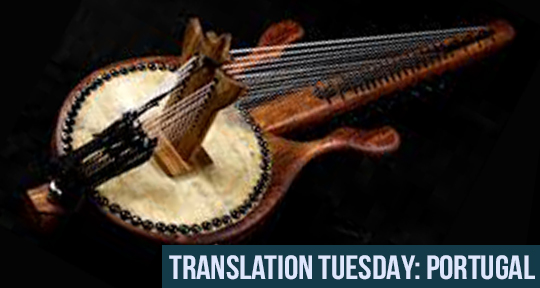
in an invisible layer: / an imperceptible figment of skin, and an inherited voice: / more kora than cello / and played to a European beat

In this week’s Translation Tuesday, we follow a moving lyrical meditation on family, belonging, and racial identity in an Angolan-Portuguese family as Ana Luísa Amaral traces the elements of a ‘glorious imperfection’ through music, photography, and the contours of the human face.

Genealogies, Imprints, and Flights

My great-great-grandmother was Angolan and black,
the other day I found her name on the reverse
not of a poem stuffed in a drawer,
but of a piece of paper imprinted
with silver salts and light
READ MORE…

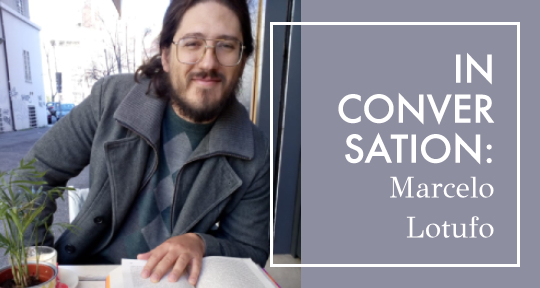
Be Small: An Interview with Marcelo Lotufo

That’s what I want for Jabuticaba. We do not want to grow. We just want to keep doing good books.

Marcelo Lotufo is a literary translator and founder of Edições Jabuticaba, an independent Brazilian press with a unique focus on poetry in translation. In today’s post, he sits down with Asymptote’s Editor-at-Large for Brazil, Lara Norgaard, to discuss the burgeoning indie publishing scene in São Paulo and the role of translation in Brazilian literature.

Lara Norgaard (LN): What was your vision when your started Jabuticaba? How did you see it fitting into the Brazilian publishing scene?

Marcelo Lotufo (ML): I had the sense that an indie scene was starting in Brazil. Lote 42, for instance, was a press that had started a few years before Jabuticaba. Editora Patuá had started around the same time. And Marília Garcia, who is a poet, she and her husband, Leonardo Gandolfi, who is also a poet, also started a press, LunaParque. The scene had been around for four, maybe five years before Jabuticaba started. Before, there were some smaller presses that didn’t last for very long. People would start self-publishing and then a bigger press would invite them to their offices and then they would close the press. You saw that happen with Daniel Galera and other groups.

Poetry has always been sidelined, though. Brazil doesn’t have a big poetry market in the big presses, so smaller presses tend to crop up and do a lot of poetry. 7Letras and Azougue, which are both from Rio, have been around for almost twenty years and they’ve done a lot of poetry. But for a long time there wasn’t exactly a scene.

READ MORE…

Translation Tuesday: “The Physiology of Memory” by Ricardo Lísias

The most torturing memories aren’t necessarily images, frozen, but films of about three minutes each.

In this haunting short story by Ricardo Lísias, the narrator contends with multiple stubborn memories, around which his narrative revolves. From an injured taxi driver in Buenos Aires, to overwhelming loneliness in Krakow, these memories are strung together to create a potent, overwhelming mixture.

I

I have determined why I am so upset by writers of clear sentences: they don’t struggle with memory. Their transparency denounces a simplistic intelligence. If someone cries because they are not able to render trauma into words then that person is a deep person.

I identified the root of my issue with clear-writing writers when I was in Poland. It is a very stark memory. I felt, standing more or less five hundred metres away from a small bus terminal in Krakow, the most intense loneliness I have ever experienced.

A year later, when I decided to dig up the loneliest moment in my life, I realized that it is not a bad feeling. It doesn’t hurt me or make me suffer.

READ MORE…