Language: Arabic

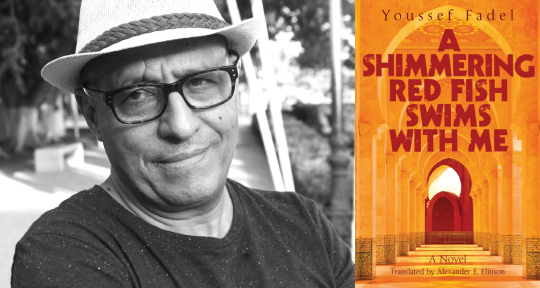
Teeming With Speech: Youssef Fadel’s A Shimmering Red Fish Swims with Me

In Fadel’s hands, the entire nonhuman world is brimming with life, and even with volition.

A Shimmering Red Fish Swims with Me by Youssef Fadel, translated from the Arabic by Alexander E. Elinson, Hoopoe, 2019

A massive construction project looms in the background of Moroccan author Youssef Fadel’s novel Farah (2016), beautifully translated from the Arabic by Alexander E. Elinson and published under the title A Shimmering Red Fish Swims with Me (Hoopoe 2019). The project in question is the building of Casablanca’s Hassan II Mosque, named after the Moroccan ruler who commissioned it. As Elinson explains in a concise and illuminating foreword to his translation, King Hassan II (r. 1962-1999) announced his plan to build a grand mosque on Casablanca’s Atlantic shoreline during his 1980 birthday celebrations. The mosque was inaugurated in 1993, on the eve of the Prophet Muhammad’s birthday. Designed by a French architect and built by a French firm, the mosque project required the labor of over thirty thousand workers, including thousands of master craftsmen who carved, chiseled, sculpted, and formed its dazzling array of tile mosaics, stucco moldings, and decorative woodwork. The structure that emerged from this massive effort accommodates up to one hundred and five thousand worshippers, making it the largest mosque in Africa and one of the largest mosques in the world—but such grandeur comes at a huge cost, both financial and human. The mosque came with a whopping price tag of over half a billion US dollars, and much of the financial burden fell on Moroccan citizens, who were required to help pay for the mosque through a public subscription program. The project also upended life in Casablanca, particularly for the people who lived in the densely populated neighborhood that was razed to create room for the new mosque.

These upheavals are at the heart of Fadel’s novel, which explores the experiences of the Moroccans who both lived in the shadows of, and contributed to, the construction project, and who were eventually displaced to make room for the massive mosque that they had helped build. A Shimmering Red Fish Swims with Me is Fadel’s tenth novel and the final book in a trilogy about contemporary Morocco. The novel centers on an ill-fated love story between two young Moroccans: Farah, who escapes her hometown of Azemmour and comes to Casablanca to pursue her dream of becoming a singer, and Outhman, who works with his father as a carpenter at the mosque. The lovers’ fate is sealed in the novel’s first chapter, where we learn that Farah is the victim of a brutal acid attack, witnessed by Outhman. The rest of the novel is devoted to unpacking the events leading up to the acid attack on Farah. The story is told through an intricate narrative structure that unfolds along multiple timelines and from multiple perspectives, meting out information in suspenseful portions whose full meanings do not become clear until the last page. Each of the novel’s seven sections opens with a chapter narrated from the perspective of a third-person omniscient narrator located in the present, some twenty-three years after Farah’s death. The internal chapters of each section are narrated in the first person from Outhman’s perspective, beginning at the time he met and fell in love with Farah while working at the mosque’s construction site. The last chapter of each section is narrated in the first person from the perspective of another character in the novel, such as Farah or Outhman’s mother. The result is a kaleidoscopic view of working-class life in Casablanca, one that uses the tragic love story between Farah and Outhman as a launch pad for exploring the tensions running through Moroccan society in the 1980s and ’90s and, in particular, for laying bare the tremendous costs that the Hassan II Mosque inflicted on the people living around it.

READ MORE…

Section Editors’ Highlights: Fall 2019

Our Section Editors pick their favorite pieces from the Fall 2019 issue!

Eleven days after its launch, Asymptote’s Fall 2019 issue continues to capture the zeitgeist. Many of its pieces, drawn from a record thirty-six countries, simmer with polyvocal discontent at the modern world, taking aim squarely at its seamy underbelly: the ravages of environmental degradation, colonial resource extraction, and media sensationalism of violence, in particular. If you’re still looking for a way in, perhaps our Section Editors can be of some assistance. Their highlights from the edition follow:

From Lee Yew Leong, Fiction, Poetry, and Microfiction Special Feature Editor:

Via frequent contributors Julia and Peter Sherwood, an excerpt from Czech writer and dramaturg Radka Denemarková’s latest Magnesia Litera Prize-winning novel, Hours of Lead, brings us into the bowels of a Chinese prison, bearing witness to a dissident girl’s defiance of state repression and censorship. Inspired by Václav Havel, the protagonist’s struggle is entirely private and self-motivated, untethered from any broader democratic collective or underground movement. Her guards are driven mad by her equanimity and individuality in the face of savage interrogation: “Even her diffident politeness is regarded as provocative. As is her decency. Restraint. Self-control. Humility. . . The guards find her very existence provocative.” Renounced by her parents and rendered persona non grata, “a one-person ghetto,” by the state, her isolation is both liberating and the ultimate gesture of self-sacrifice.

Meanwhile, poet Fabián Severo—the only Uruguayan writing in Portunhol, the language of the Uruguayan frontier with Brazil—revels in an act of presence just as radical and defiant of the mainstream, resisting the state’s attempted erasure of his language. Laura Cesarco Eglin and Jesse Lee Kercheval’s translation sings: “This language of mine sticks out its tongue at the dictionary/ dances a cumbia on top of the maps / and from the school tunic and bow tie / makes a kite / that flies / loose and free through the sky.” Don’t overlook the luminous poems of prolific French and Martinican Creole writer Monchoachi, whom Derek Walcott has credited for “completely renewing our vision of the Creole language.” “The Caribbean could be considered a workshop for the modern world,” he conveys in Eric Fishman’s English translation, “with its deportations, its exterminations, and also its ‘wildly multiple’ side, its ‘ubiquity of voices and sounds.’” READ MORE…

Translation Tuesday: “Don’t Cry” by Mohamed M. Farrag

“Men don’t cry, whatever happens.” And then he wiped my tears.

This week’s Translation Tuesday features the work of Mohamed M. Farrag. The prose is short, succinct, and hits like a hammer—much like the vision of masculinity embodied in the story. Enigmatic messages, the codes that construct subjects along certain lines, flow freely between a boy and his grandfather. These messages transport generational models of masculine repression as they are passed down; in just a few lines, Farrag aptly demonstrates the ways in which the social codes that dictate behavior are transferred. However, the end of the story leaves us with a question: can the script of behavior be broken by reflection and release? Or is this too a planned movement, derived from what came before? Regardless, the emotions captured here are delivered with an uncanny availability: the rhythms that the translator pulls from the original present an ordinary scene that makes one feel as if the answer to some pressing, universal question is close at hand. But the true answer is only a choice: to show or to hide.

He sat beside his dying grandfather; a man known for his cruel heart. He’d never seen him cry. ‎Gently, the grandfather caught his grandson’s hand. “Do you know, son, what my father ‎told me when he saw me crying on the day of my mother’s death?”‎

“No.” The young boy shrugged.

He said, “Men don’t cry, whatever happens.” And then he wiped my tears. “When my wife died your ‎mother was still young. Her death stung me, but I didn’t cry in front of her. I didn’t want her to fall apart. I ‎kept my tears inside.” READ MORE…

What’s New in Translation: September 2019

Looking for what to read next? Our staff share their latest discoveries in new translations.

It is another month bringing us various gifts in the form of translated literatures, and our editors have selected the finest. Read below to find reviews of a short story collection detailing the various and complex natures of India, a haunting and poignant Swedish novel, unsettling tales from Israel, and a poignantly feminist work from Palestine.

ambai

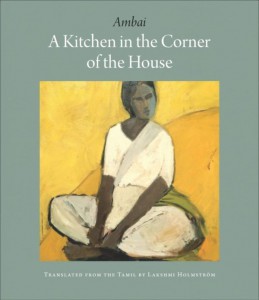
A Kitchen in the Corner of the House by Ambai (C.S. Lakshmi), translated from the Tamil by Lakshmi Holmström, Archipelago Books, 2019

Review by Ben Dreith, Assistant Editor

C.S. Lakshmi, who writes in English and Tamil under the pseudonym Ambai, is a scion of post-revolutionary Indian feminism and women’s studies researcher who was raised and educated in Mumbai, Bangalore, and New Delhi. Of her work, the most recent to appear in English is A Kitchen in the Corner of the House, a mellifluous and courageous work translated by Lakshmi Holström, a dedicated scholar who passed away in 2016. She will be missed, and her efforts, evident in the enduring legacy and themes of A Kitchen in the Corner of the House, may inform the concerns of Indian feminism in the English-speaking world for generations.

The book is a collection of stories, told from multiple voices and perspectives, which centers on the travails and aspirations of women across a broad socio-economic and linguistic spectrum. The voices in A Kitchen in the Corner of the House reflect the varied cultural expectations and norms that simultaneously thrive and jostle for distinction within the Indian nation, which can be too easily regarded as a seamless whole by outside observers. What unites the characters in the stories, though, is a keen sense of subjective solidarity amongst women who are draped in desperation—and hope.

READ MORE…

Celestial Troubles: Love and Transition in Oman

In Celestial Bodies, Alharthi takes us on a bewildering journey that is both specific to Oman and relatable in its experiences.

Jokha Alharthi’s Celestial Bodies was awarded the Man Booker International Prize earlier this year, making her the first author from the Arabian Gulf to win the prize. She was also the first Omani author ever to have her novel translated from Arabic into English. In the following essay, writer and anthropologist MK Harb examines how Oman’s overlooked history as an imperial dynasty, and its rapidly changing society are integral to the force of Alharthi’s novel.

The internal monologue of Abdallah is unnerving, and often unsettling. Lost between trauma and nostalgia, he repeatedly reflects on his fractured relationship with his father, a notorious merchant and slave owner. Situated in the balmy village of al-Awafi, Abdallah is one of the many members of an Omani family encountering the upheavals and changes of modernity brought on by the state. To some, Oman is an obscure country with an eccentric Sultan, whilst to others, its green pastures and monsoons represent a luscious geographic rarity in the Arabian Peninsula. Unknown to many is Oman’s long and complex history as an imperial dynasty. Oman’s history is as much African as it is Arab; with Zanzibar as its capital, the Sultanate ruled in East Africa from 1698 until the bloody revolution of 1963. Oman’s rule in East Africa represents a history of vernacular and mercantile economic systems that existed prior to the arrival of modern capitalism, but it also represents a racial history of manumission and slavery. Jokha Alharthi’s award-winning novel, Celestial Bodies, tells this history, unravelling the ghosts of an empire, and the precariousness of modernity in Omani society. READ MORE…

Weekly Dispatches from the Front Lines of World Literature

Follow our editors through Lebanon, Hong Kong, and France as they bring a selection of literary news of the week.

From the town nestled in the peaks of Lebanon, to the recent surge in Hong Kong streets, to the crystal waters of the Occitanie coast, our three literary destinations of the week bring forth an array of Lebanese love stories, reimaginings of home, and the rich culture of Mediterranean poetry. In the words of the great Sufi poet Yunus Emre, “If I told you about a land of love, friend, would you follow me and come?”

Ruba Abughaida, Editor-at-Large, reporting for Lebanon

The mountain town of Bsharri in Lebanon should see an increase in tourism following the Lebanese debut of a musical adapted from Gibran Khalil Gibran’s Broken Wings, published in 1912. Born in Bsharri in 1883, Gibran’s book The Prophet, published in the United States in 1923, is still one of the best-selling books of all time after ninety-six years and 189 consecutive print runs. Showing at Beit El Din Palace, a nineteenth century palace which hosts the annual Beiteddine festival, the musical tells of a tragic love story which takes place during the turn of the century in Beirut.

Closer to sea level, an evening of poetry in Beirut celebrated Lebanese poet Hasan Abdulla.  Born in Southern Lebanon, Abdulla was inspired by its natural beauty, and infused his poetry with observations of nature. His work, spanning over forty years, has been translated into English, French, German, Spanish, and Russian. 

READ MORE…

Long Forgotten Stories of Translation: Part Two

Those long-dead translators and scholars deserve to be celebrated for what they were, giants on whose shoulders we sometimes still need to climb...

In the second part of this previous post, Brother Anthony of Taizé continues to celebrate the forgotten thinkers of the early Arab world. Although Renaissance Europe turned its back on Arabic writing, two of Spain’s greatest thinkers, Averroes and Maimonides, had produced invaluable commentaries and philosophies based on the works of Aristotle, whilst Toledo became a literary epicenter for re-translations from Arabic into Latin and Spanish. Read on to find out more.

The golden age of Córdoba did not last long. In 997, the military leader Almanzor captured Santiago and soon became the effective ruler of southern Spain. He ordered the destruction of books related to philosophy and astronomy, which he considered contrary to Islam, leaving only those about medicine and mathematics. After his death in 1002, bands of marauding North African Berbers sacked Córdoba, sparking an exodus of Jews, in particular, to other cities. Later in the century, in 1085, the Christian kingdom of Castile captured the great city of Toledo. The Muslim leaders were forced to turn to the Almoravid dynasty in North Africa for help, likewise composed of fierce Berber warriors. In 1089, the Almoravids took complete control of Islamic Spain. Less than a century later, they were replaced by an even fiercer and more fanatical North African dynasty, the Almohads, who were especially intolerant of Jews and Christians. READ MORE…

Long Forgotten Stories of Translation: Part One

Anti-Islamic attitudes are not a modern phenomenon and the campaign to erase the Islamic contribution to modern thought began long ago.

Today, early Arabic thinkers are largely overlooked in discussions of the origins of Western philosophy. In this essay (the second part of which will be published tomorrow), Brother Anthony of Taizé brings the focus back to this period of prolific scholarship and translation, and remembers the most influential philosophers and Greek-Arabic translators of the Medieval Islamic world.

In a short story by Jorge Luis Borges, “La busca de Averroes” (1947), we find Averroes (ibn Rushd, 1126-1198), the great Spanish Arabic commentator of Aristotle, at a loss to understand the words “comedy” and “tragedy” he has found in Aristotle’s Poetics, because his own culture has no tradition of theatrical drama. He is given hints by the sight of children playing at being the muezzin in a mosque, as well as by an account of a theatrical performance in China given by a returning traveler, but he can make nothing of them. Borges then intervenes to make this a parable illustrating the impossibility of ever understanding anyone who lives in a radically different time and culture. In reading this story, we are confronted with our own (and Borges’s) inability to write and read the actual words for “tragedy” and “comedy” which Averroes was struggling with. Today’s widespread Western inability to read Arabic, Greek, or even Latin, should be a source of shame, although it doesn’t seem to be. Many of Borges’s readers might already be at a loss to imagine an Arab struggling to understand Aristotle, so unfamiliar the intellectual history of the Muslim world has become. READ MORE…

Blog Editors’ Highlights: Summer 2019

Our editors have you covered with a lovingly picked selection from the Asymptote Summer 2019 issue!

If you have yet to fully traverse the sensational depths of Asymptote‘s Summer 2019 issue: “Dreams and Reality,” you can step out on the roadmap written by our blog editors, who have refined their selections—with considerable difficulty—to a handful of their favourite pieces. Between an erudite Arabic mystery, non-fiction from Romania’s foremost feminist writer and theorist, and a tumultuous psychological short story which delves into our perception of sanity, this reading list is a doorway into the vast cartography of this issue, unfurling into the rich imagination and profundity of the heights in world literature.

Something about summertime makes me want to read detective fiction, so I was excited to learn that Asymptote’s Summer 2019 issue, released this past Thursday, features a murder mystery. I was even more intrigued when I learned that the story in question, “Culprit Unknown” by Naguib Mahfouz, was originally written in Arabic. Don’t get me wrong—I enjoy Swedish mysteries just as much as you do—but I think we can all agree that the Scandinavians have had a monopoly on detective fiction in translation for far too long.

“Culprit Unknown,” translated by Emily Drumsta, follows Detective Muhsin ʿAbd al-Bari as he tries to solve a series of grisly murders. Muhsin does everything he can, but each killing is a perfect crime: the murderer leaves not a single trace behind, and as the deaths pile up, the tension in the neighborhood becomes unbearable. Besides pacing the story perfectly, Mahfouz infuses “Culprit Unknown” with light humor and unexpected (but welcome) philosophical musings, as in the exchange below:

READ MORE…

Weekly Dispatches from the Front Lines of World Literature

This week, we’re talking about poetry in Transylvania, storytelling in Marrakech, and LGBT literature in Taipei.

It would be difficult for even the most hardened of cynics to bemoan the state of literature after having read the news coming from around the globe this week. Our editors report on a stunning international festival of poetry in Transylvania, the determined literary representation of an “unofficial” language in Morocco, and an abundance of musical, literary, and theatrical events taking place under the open skies of Taipei.

Xiao Yue Shan, Assistant Blog Editor, reporting from the Z9Festival in Sibiu, Romania

The forecast called for a 60 percent chance of rain, but the sun was still wispily gathered in the early evening, so rows were laid out in the courtyard and the fifth edition of Z9Festival, the young literature festival based in Sibiu, began.

Founded in 2015 and sponsored by the Lucian Blaga University of Sibiu, the festival gathers poets from nine countries around the world to share their work with the Romanian public; the name can be read as either New Zone or Zone Nine, in an ode to both its focus on writers under forty and its international reach. So it is that in mid-July 2019, writers from the UK, Poland, The Netherlands, Belgium, Germany, Italy, China, Russia, and Romania descended upon the picturesque landscape of Sibiu to join one another in a night celebrating poetry, and its inherent ability to dissipate borders.

READ MORE…

The Summer 2019 Issue Is Here!

Dive into new work from 30 countries!

Wake up where the clouds are far with Asymptote’s Summer 2019 edition—“Dreams and Reality” brings you stunning vistas from 30 countries, including new fiction from Nobel laureate Naguib Mahfouz, an exclusive interview with Edith Grossman, translator of Marquez’s Love in the Time of Cholera, and never-before-published translations of Nicole Brossard, recent winner of Canada’s Lifetime Griffin Trust Award for Poetry. In our Special Feature on Yiddish writing, published with the generous support from the Yiddish Book Center, you’ll find everything from Isaac Berliner’s dreams of ancient South America to Yermiyahu Ahron Taub’s modern-day America.

In Leonardo Sanhueza’s retelling of intimate life before, during, and after Chile’s Civil War, each poem an unforgettable portrait of a colonist, dreams are harbingers of death. In “A Rainy Tuesday,” Bijan Najdi’s nonlinear journey of grief, on the other hand,  dreams are bulwarks against the almost certain demise of missing loved ones. When the veil breaks, the real returns. Internationally acclaimed Korean poet Kim Hyesoon tackles the reality of violence head-on in her latest collection, reviewed by Matt Reeck. For artist Jorge Wellesley, the emptiness of slogans lies exposed in images of rotting, blurred, or blank billboards. In a candid essay, Fausto Alzati Fernández confesses to the rituals of drug addiction, some of which attempt “to grab hold of reality and strip it.”

READ MORE…

Intricacies Through Imagination: The Book of Cairo in Review

The Book of Cairo invites us to this very complex city without committing the crime of exoticizing it.

book of cairo

The Book of Cairo, A City in Short Fiction, edited by Raph Cormack, translated from the Arabic by multiple translators, Comma Press, 2019

The Book of Cairo, A City in Short Fiction, edited by Raph Cormack, is the newest addition to the “Reading the City” series published by Comma Press (Manchester, UK), collecting stories by local authors from cities around the world. Each story in the book (like those of the other books in the series) is translated into English by a different translator, which makes the book even more multi-vocal, introducing readers to not only writers, but also to translators working from a particular language into English, in this case Arabic.

The stories (except for one) were originally published between 2013 and 2018, making them of the present time and place, and giving us access into the current literary scene of Cairo. The authors are all born in the late 1970s and the ’80s, which makes them part of the young, hopeful generation who took part in the Tahrir Square protests, who made the Arab Spring possible, and who imagined a different future for their country. And it is through the diverse, imagined worlds in the present collection that they investigate the present moment of a city mutually rooted in history and moving toward the future.

READ MORE…

What’s New in Translation: June 2019

The best new reads from across the world, selected and reviewed by members of the Asymptote team.

Not sure what to read this summer? Our team has you covered with reviews of this month’s most anticipated literature in translation, including a Brazilian bestseller set in the favelas of Rio de Janeiro, an Egyptian writer’s take on life in the USSR, and an entertaining novel from a beloved Bengali author.

Picture1

The Sun on My Head by Geovani Martins, translated from the Portuguese by Julia Sanches, Farrar, Straus and Giroux, 2019

Reviewed by Daniel Persia, Editor-at-Large for Brazil

Look out for blowtorches and the BOPE in Geovani Martins’s debut, The Sun on My Head, a collection of thirteen short stories that bring us into the heart of twenty-first century life in Rio’s favelas. Tensions run high between the police, drug slingers and traffickers, and the men, women, and children trying to live their everyday lives. Martins shows us that the language of the favelas is just as legitimate as the language of the academy, keeping “literature” true to everyday form. Julia Sanches preserves this legitimacy in English, delivering a carefully crafted translation filled with colloquialisms, slang, and Portuguese. The result is “some real trifling shit”—a wild ride that exposes us to the complexities of life in the periphery and the complexities of translating that life from one language into another.

Published in Brazil just last year, 2018, O sol na cabeça became an instant bestseller—a literary sensation that brought the voice of twenty-six-year-old Martins into the spotlight. Martins draws on his experiences of living in a favela to paint a modern-day picture of an ever-evolving Rio—particularly around the time of two major international events: the 2014 World Cup and the 2016 Olympics. In “Spiral,” we see how racial and class profiling begins at a young age, and how irrational assumptions are perpetuated through inherited distrust. Those who live in the favelas are feared by the private school kids, the teenagers taking tennis lessons and the people waiting, anxiously, at the bus stop. “I remembered how that same old woman who’d trembled with fear before I’d given her reason to certainly hadn’t given any thought to how I probably also had a grandma, a mother, family, friends,” the narrator reveals, in a statement that demonstrates one of the overarching premises of the collection: to turn these stories on their head, to legitimize the experiences of those who face prejudice by representing them as whole human beings. The old lady walking on the street, clutching her bag, eyes turned sideways, isn’t the one telling the story anymore… READ MORE…

Transporting Poetry Across Borders: On Teaching Ethnographic Poetry in Japan

With its multiple writing systems, Japanese seemed to lend itself particularly well to the task of writing multilingual poems.

Educator’s Guides are published alongside each issue of Asymptote and include detailed lesson plans that can be used with students of literature, language, or writing. The Asymptote website has additional audiovisual materials, translator and author bios, and works in the original language, making it a valuable educational resource. The most recent issue of the Educator’s Guide can be found on the Asymptote for Educators page.

This article describes the lesson plan Language in Transit: Understanding Ethnographic Poetry from the Asymptote Summer 2018 Educator’s Guide. The piece, from House to House, consists of two poems, “House to House” and “Barjeel,” both of which were written and translated by Shamma Al Bastaki. These poems are part of her undergraduate senior project based on interviews she conducted with people living in the United Arab Emirates. Although she has translated the poems into English, some words or phrases are transliterated, while others are left untranslated and remain in the original languages. From the translator’s note, we discover more about the role of language in the piece:

. . . it is a project about language: language in translation, language as bearer of meaning and medium for story telling, language as a catalyzer of communion and communication, language as sound and a series of phonetics, and language as physical material, existent for its own sake.

READ MORE…