Posts filed under 'Seagull books'

What’s New in Translation: December 2025

The latest from Japan, Peru, Germany, Austria, Czechia, South Korea, Brazil, and Hungary!

In our final round-up of the year, we present a thrilling novel capturing the margins of Germany as the nation begins to veer into fascism, a collection gathering the voices of powerful Hungarian women poets, a Brazilian novel testifying to the colonial erasure of indigenous language and being, a series of essays considering the act of reading as an oppositional force against capitalism, and more!

kappa

Kappa by Ryonosuke Akutagawa, translated from the Japanese by Geoffrey Bownas, Pushkin Press, 2025

Review by Kaelie Giffel

Even if one is unfamiliar with his work, English readers will recognize the name Ryonosuke Akutagawa from the prestigious Japanese literary prize, named after him posthumously by a friend. Kappa is a novella published in the final year of the author’s life. Pushkin Press’s reissue of Geoffrey Bownas’s 1970 translation comes on the heels of a 2023 retranslation by Lisa Hofmann-Kuroda and Allison Markin Powell, published by New Directions in 2023. Multiple, competing translations indicate the continued importance of Akutagawa’s work, which has a renewed urgency in our time.

Kappa is a philosophical meditation on whether difference can be encountered without violence and how we might meet others in the strange in-between spaces. Structured as a frame narrative, its inciting incident is the testimony of a patient in an unnamed mental institution. The patient speaks about meeting strange creatures with tummy pouches called Kappas. The Kappas have their own cultural, historical, and philosophical institutions and orientations to life, and the narrator lives among them for a while, alternately admiring, baffled, or repulsed as he learns more about their existence. They oppose birth control for silly reasons; sacrifice workers who have been laid off by literally eating them; prohibit artistic performance because they believe the general public to be hopelessly stupid; and are generally misogynist—female Kappas are cast as libidinous huntresses that oppress male Kappas. The narrator is bewildered by the similarities and differences between himself (Japanese) and the Kappanese. Hence, the mental institution.  READ MORE…
What’s New in Translation: November 2025

New work from India, Serbia, France, Colombia, Mexico, Puerto Rico, Iran, Spain, Lithuania, Palestine, and the Vietnamese diaspora!

This month, we’re bringing reviews of eleven different titles from eleven different regions, from a trilingual text of experimental fiction that veers between Vietnamese and English, a visceral and psychically frenetic portrait of a marriage gone wrong, a rich collection from a master Iranian poet that gestures towards his remarkable life, and the latest metafiction from a Spanish literary giant. 

dog

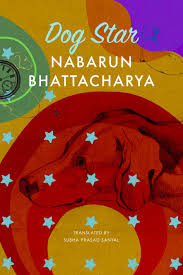
Dog Star by Nabarun Bhattacharya, translated from the Bengali by Subha Prasad Sanyal, Seagull Books, 2025

Review by Jason Gordy Walker

Something’s rotten in the city of Kolkata. A corrupt managerial class—within which mad scientists and war-mongers play a major role—has conspired with local authorities to capture, confine, and starve as many canines as possible. While the city’s “dead serf-servants and healthful, cellphone-carrying ever-connected mummies and balloons” stagger through their dystopia, the dogs have disappeared from the urban bustle, and no one cares. Animal rights groups have been eliminated, and in the way of Nazi death camps, the system targets even newborn pups. What’s a dog to do in these last dog days? “Bark! Bark!” replies the snappy refrain of Dog Star, the lyrical, subversive, and highly re-readable novella by Bengali writer and poet Nabarun Bhattacharya, delivered in a kinetic English by Subha Prasad Sanyal, who has doubtlessly advanced this innovative author’s reputation in world literature.

A self-proclaimed fable, Dog Star leads the reader through dark alleys where street dogs—“nerikuttas”—hide from “pincers,” form alliances, trade information about current dangers, and strategize escape plans, looking to the constellation “Lubdhok, aka Dogstar, aka Sirius aka Alpha Canis Majoris” for liberation. These survivors, along with their unlikely feline allies, are anthropomorphized in their emotions and dialogues, and their plight, although set in West Bengal, is familiar enough to seem representative of any place under political (dis)order. The Netanyahu regime’s genocide against Gaza comes to mind, for example, as do the active “detention centers” in the US: “They’ll yank and drag you by your neck with the pincers to the caged car. Then throw you in.” Bhattacharya does not avoid visceral descriptions of animal torture, but he balances its brutality with astute irony, giving the murderers absurd lines like: “We must pay heed that there aren’t ridiculous expenses.” READ MORE…

What’s New in Translation: October 2025

New titles from Haiti, Argentina, the Netherlands, Japan, Germany, Italy, Norway, Turkey, Mexico, Taiwan, Hungary, South Korea, and Latin America!

This month, we bring you thirteen reviews from thirteen countries: a poetry collection that reimagines friendships with long-gone revolutionaries, a tender and incisive rumination on disappearance, the latest novel on the inexplicability of love from a Nobel laureate, a story of Silicon Valley-fueled descent, a compilation of Latin American feminist thought, and much much more!

duels

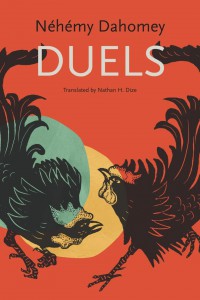
Duels by Néhemy Dahomey, translated from the French by Nathan H. Dize, Seagull Books, 2025

Review by Timothy Berge

Néhémy Dahomey’s Duels is set in 1842, thirty-eight years after Haiti’s independence—a storied liberation that came through one of the largest slave uprisings in history. France withdrew, but issued an absurd debt of one hundred and fifty million francs. Paying off a debt while attempting to modernize a new country was a tough balancing act, so Haiti imposed high taxes on its citizens and forced them into unpaid labor.

Duels takes place in Böen, a small town in the Cul-de-Sac Plain that evaded a census for several years. As a result, no one in the town had fallen victim to the government’s schemes—until a local official decides that he needs laborers for a new project. From there on, in the context of freedom, economic entrapment, and postcolonial growing pains, the events of Duels unfold. Nathan H. Dize’s translation reads like a yarn spun out by an old relative with a deft deadpan humor, aptly navigating the tense shifts between past and present, and generating a sense of perpetuity for these characters and their stories. Here, the historical and the contemporary connect and blur. READ MORE…

Collateral Damage: A Review of Return by Raharimanana

What would the symbols of the new nation be? Its language, its idioms, its tribes? And more, importantly, who isn’t Malagasy?

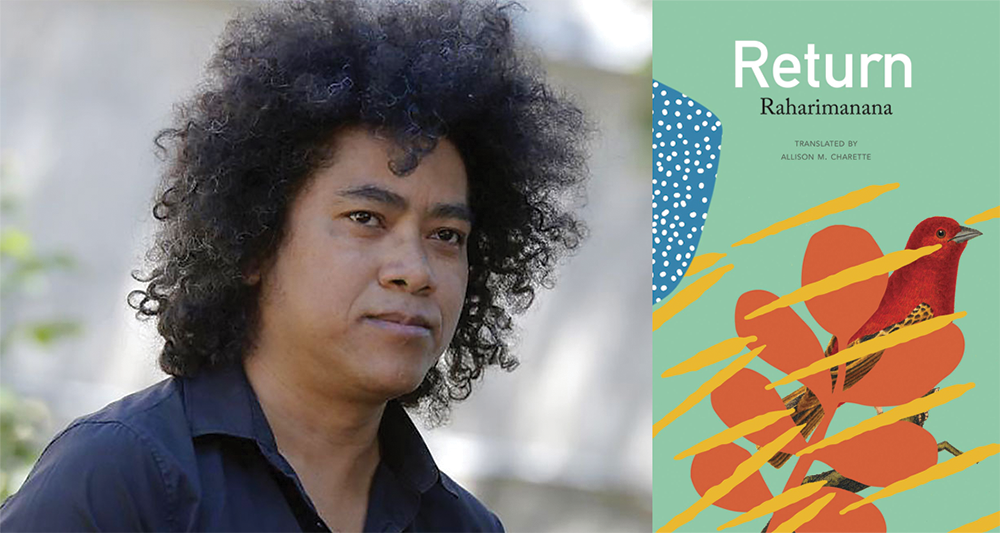
Return by Raharimanana, translated from the French by Allison M. Charette, Seagull Books, 2025

A newly independent nation. The visions of building. The sacrifices, people, losses. If this invigorating spirit is unwaveringly intoxicating, its effects are as much generational as they manifest in the present. In his novel Return, Raharimanana knits together a young man’s memories of his father and the spirituous strides taken to uphold truth against power in the aftermath of colonialism—specifically when the nascent country of Madagascar erupted in revolution in 1972 after gaining independence from the French in 1960. Hira, around whom much of the story revolves, is hailed as an oscillatory reminder of the time since Madagascar’s freedom, forming an autobiographical arc in Raharimanana’s own reconciliation with his childhood. The author’s writing also carries the artfulness of music, an art that he engages in alongside being a novelist, poet, and playwright.

In an earlier book, Nour 1947 (2001), Raharimanana penned a closer engagement with the 1947 Malagasy Uprising, dealing with the deadly killings of 87,000 Malagasys by the French colonial rule. Return, which was first published in 2018 in French as Revenir, now puts on a vivid image of Hira’s life as a touring writer and his recollections of the transitioning state of Madagascar. As he travels, he is disturbingly reminded of his father’s torture and the price paid by his family, and these fragmented recollections do not let him collate a neat history. Hence, the sections of the present are reeling with the irredeemability of time, a fracturedness that also speaks to the inability to write of a violence that is both collective and overpowering. As the novel moves on, this position culminates into renewed impetus for his writing, rife with image and poetic terseness. Being born after independence, Hira is part of a nation attempting to blossom a life out of the ruins—and this is true for Hira’s own family as well as for the country. For him, it is tiring: “But also weariness. He’d had enough of all of that. Being confronted with his country’s violence.” READ MORE…

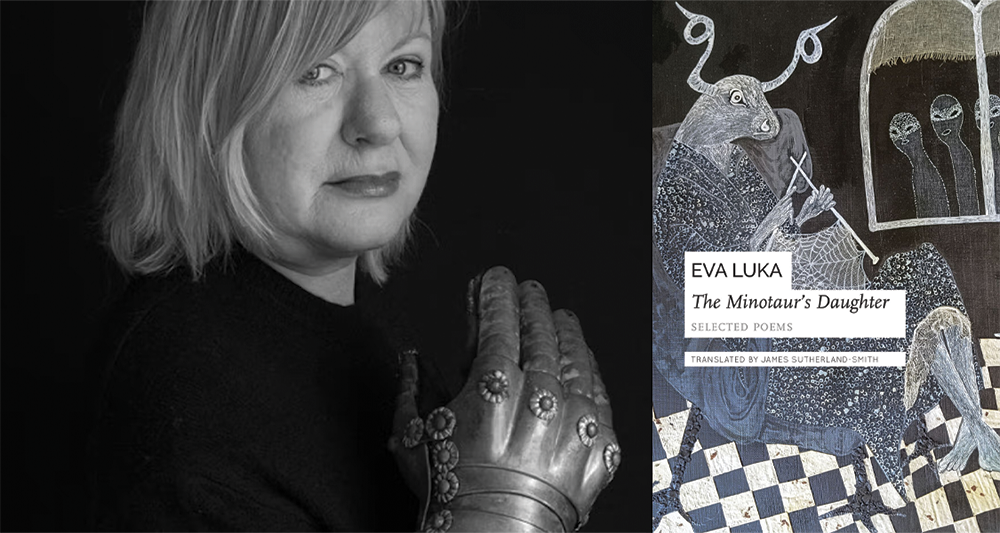
Transgressive, Phantasmagorical Banquet: A Review of The Minotaur’s Daughter by Eva Luka

. . . Luka's rendering moves beyond the Rilkean dream realm into a world of flesh and blood . . .

The Minotaur’s Daughter by Eva Luka, translated from the Slovakian by James Sutherland-Smith, Seagull Books, 2025

The Minotaur’s Daughter, the English-language debut of Slovakian poet Eva Luka, unfurls a tapestry of phantasmagoria, animism, resistance, and transgression. Born in 1965 in the town of Trnava, Eva Lukáčová’s career in verse began with the collection Divosestra (Wildsister), published in 1999, which was followed by Diabloň (Deviltree) in 2005 (upon which she began using the shortened version of her name), Havranjel (Ravenangel) in 2011, and Jazver (I-Beast) in 2019. The Minotaur’s Daughter contains work from the first three publications, compiling them in a immersive, wildly populated series that plunges their readers into a universe of vivid imagery and sensation.

From Divosestra, the title of a particular poem, ‘Diabloň’, became the title of Luka’s second collection; samely, ‘Havranje’ from Diabloň became the title poem of her third collection, from which the poem ‘Jazver’ (I-Beast) became the title of her fourth collection. This interconnectedness between the poet’s body of work reflects her continuity of themes and imagery—an ever-deepening quest to go into more complex levels of introspection. Prominently featuring various creatures and their biological transformations, Luka preserves throughout a distinct focus on water and the moist elements of body and nature. READ MORE…

What’s New in Translation: August 2025

The latest from Palestine, France, Germany, Brazil, Italy, Bulgaria, Japan, Canada, Cuba, Argentina, Slovakia, and China!

This month’s round-up of newly released titles spans twelve titles across twelve countries. We’ve got a profound and lucid collection compiled of diaries from the genocide in Gaza; a readdressing of womanly sacrifice in the domestic realm; an Argentinian novel reinventing the history of Italy’s famed “Park of the Monsters”; the long-awaited esoteric and experimental tome from German writer Michael Lentz; essays and textual riches from the father of surrealism; and much, much more. . .

9781917093064

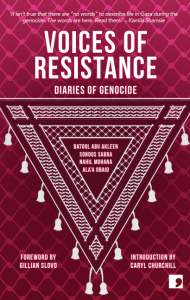
Voices of Resistance: Diaries of Genocide by Nahil Mohana, Sondos Sabra, Ala’a Obaid, and Batool Abu Akleen, translated from the Arabic by Basma Ghalayini and Ayah Najadat, Comma Press, 2025

Review by Justin Goodman

Similar to the intimate testimonies of Atef Abu Said’s Don’t Look Left and Plestia Alaqad’s The Eyes of Gaza, Voices of Resistance compiles the diaries of four Gazan women, tracing their thoughts as they mourn their martyred, fear their decimation, celebrate the Palestinian people, and sacrifice meals for the sake of birthday pastries. Together, Batool Abu Akleen, Sondos Sabra, Nahil Mohana, and Ala’a Obaid highlight what Gillian Slovo describes in her introduction as both a beauty “in [their] honesty and spirit” and a horror as they gain “a whole new vocabulary for describing the sounds of different bombs.” This latter is compiled by Mohana in a list running half a page long, as she distinguishes the subtleties between “Bouf” (aerial bombing) and “Dddof” (artillery shelling). Most importantly, however, she adds: “. . . we have begun to lose our hearing.”

READ MORE…

What’s New in Translation: July 2025

Newly released titles from Morocco, India, Norway, Haiti, Spain, Austria, Argentina, Egypt, Brazil, Germany, and Chile!

This month, we’re delighted to present eleven titles from eleven countries, including a lyrical litany of dreams from a Nobel laureate, a psychologically thrilling fiction-study of domestic violence and complicity, a rollicking novel on poverty and police repression in a Brazilian favela, a sharp and surrealistic collection that deeply probes the connection between death and poetry, and much, much more. . .  

1

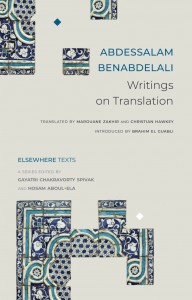
Writings on Translation by Abdessalam Benabdelali, translated from the Arabic by Marouane Zakhir and Christian Hawkey, Seagull Books, 2025

Review by Jordan Silversmith

“What is at stake in translation,” Moroccan philosopher Abdessalam Benabdelali writes, “is the strangeness of the other.” In Writings on Translation, a slim but resonant volume translated with clarity and philosophical sensitivity by Marouane Zakhir and Christian Hawkey, Benabdelali argues not only that translation is foundational to the development of Arabic and European thought, but that it constitutes a mode of ethical relation—a hosting of the stranger.

Composed of essays selected from two earlier Arabic-language works, this collection positions translation not as the failed transfer of meaning between stable tongues, but as a generative rupture in the myth of linguistic purity. Echoing Derrida and drawing on classical Arabic poetics, Benabdelali deftly critiques the nationalist drive to see language as a closed identity. “The instrument of translation is a living language,” he writes, “and its mirror is condemned to be broken.” It is in this shattering that thought is permitted to migrate.

What emerges then is a meditation on translation as both inheritance and resistance. Benabdelali revisits the Abbasid-era Bayt al-Hikma, critiques 18th-century French Orientalism, and confronts the ambivalence of Arabic literary modernity, where some authors write in expectation of translation while others fear its erasure. His essays resist binary framings of colonizer and colonized, instead advocating for a polyglossic hospitality in which meaning is always provisional and always in motion. READ MORE…

What’s New in Translation: May 2025

New publications from Italy, Denmark, the Netherlands, France, Hungary, Germany, Switzerland, Egypt, South Korea, Greece, and Poland!

This month, we’re introducing thirteen new publications from eleven different countries. A strange and visceral collection of poems that distort and reimagine the body; a contemporary, perambulating study of the contemporary city; a novel that forsakes linearity for a complex exploration of chance and coincidence; a series that splits the act of storytelling—and the storyteller—into kaleidoscopic puzzle-pieces; an intimate and unflinching look at motherhood and its disappearance of boundaries; and more. . .

Transparencies 2025 PROMO COVER

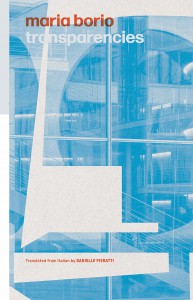
Transparencies by Maria Borio, translated from the Italian by Danielle Pieratti, World Poetry Books, 2025

    Review by Jason Gordy Walker

Italian poet Maria Borio’s English debut, Transparencies, transports us to an Italy defined as much by glass, screens, and holograms as it is by history and landscape. Divided into three sections—“Distances,” “Videos, Fables,” and “Transparence”—Borio presents a world where past, present, and future converge toward an audible silence, where the self presents itself as genderless, morphable—the I becomes you becomes we becomes they—and the poet plays not a character nor a confessionalist but an airy, elegant observer, as illustrated in “Letter, 00:00 AM”:

At the end of the video, soundless voices,
hollowed-out faces scroll like the ground stumps
of legend: even people with desires

emptied like furrows in tar can carry
a fable. The screams are timbers, old water
they turn to bark, white knots, even.

Danielle Pieratti’s translations preserve the glassiness inherent in the Italian originals; she has strived for accuracy of voice and image, as evident in “Green and Scarlet” (“Verde e rosa”), an eight-part poem that considers natural, national, and human borders: “Between the trees there’s the border’s furrow / the heavy sign that stopped them / all around shapes spring up like nations.” In an interview at Words Without Borders, Borio recalls how she and Pieratti chose to use “scarlet” instead of “pink” when translating “rosa”: “ . . . in English it’s literally ‘pink,’ but . . . the color referred to the luminous atmosphere of a sunset in the woods, so ‘pink’ would have given too sharp an impression . . . Danielle came up with the word ‘scarlet,’ which . . . feels softer, more delicate, with a gradual outpouring . . . .” Such close attention to diction permeates the collection.

Although the book examines the modern world and its technology—recordings, photos, videos, cellphones—Borio refuses to be glitzy (she’s no Twitter-verse poet). Describing the London Aquatic Centre, she pens lines like, “The transparent organs overhead open / become a soft line chasing itself, / cleansing the breath’s dark colors . . .” and “Life is everywhere, in the curved line / we inhabit as though thinking.” Simultaneously detailed and abstract, her verse brings to mind Eugenio Montale and Wallace Stevens, two influences that Pieratti mentions in her illuminating translator’s note—although there’s some European surrealism rolling through her veins, too: “The cactus spines clench their vertebra of water.” Such accents only add to her poetry’s dreamlike magnetism, its cultured mystique. READ MORE…

What’s New in Translation: March 2025

Reviews of eleven newly published books from Argentina, India, Austria, France, Japan, Chile, Bulgaria, Sweden, and Denmark!

This month, our selection of noteworthy titles include a collection of revolutionary Hindi poetry, an erotic thriller from an extraordinary Chilean modernist, an incisive novel concerning the disabled body in contemporary Japan, an intimate socio-philosophical contemplation of a loved one’s life and death by one of France’s foremost intellectuals, and more. 

bazterrica

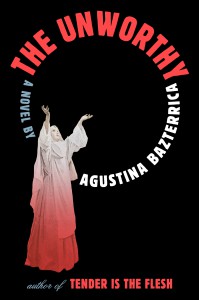
The Unworthy by Agustina Bazterrica, translated from the Spanish by Sarah Moses, Scribner, 2025

Review by Xiao Yue Shan

There’s something seductive about the nightmare, perhaps because fear is the most vivifying sensation, perhaps because beauty and horror are so finely intertwined. In Agustina Bazterrica’s The Unworthy, the night-terror has never looked so exquisite, so shimmering. With an eye for the luminous and ear for the otherworldly, familiar gothic tropes are here relieved from their muted gloom; a chimeric language sings the shadows awake, and in this chorus even the most basic signifiers of darkness regain their fearsomeness, mysticism, sensual enthrallment. The cockroach has a gleam, a crunch; a derelict cathedral is as diaphanous as a dragonfly’s wing. There are the recognisable plot-pieces—violent sacraments, echoing halls, and a wasted world—but those who command fear’s aesthetic know that the most disturbing capacity of pain and transgression lies not in their repellence, but their strange and unpronounceable allure. It is not the torturous that Bazterrica is adept at bringing to life, but the smile that slowly creeps across the face of the tortured, when they are somewhere we can no longer reach.

The Unworthy is a post-apocalyptic convent story, wherein the only known patch of livable land is occupied by the House of the Sacred Sisterhood, a cult that is at once spiritually vacuous and deeply devotional, with its faith reserved more for the House’s singular rites, rituals, and rules than any principle or entity. As is the standard for any secluded sect that positions oblivion as the only alternative to obeyance, the Sisterhood’s hierarchy is strict and immovable, the leaders are mysterious and merciless, the eroticism is violent, the violence is erotic, and the practices are senseless but methodical. The founder and head of the House is a man, but in the name of Sisterhood, all his acolytes are woman: some are servants, some are the Unworthy, some are Chosen, some are Enlightened—and only this latter group is given contact with the one known only as He. One guess as to what that means. Our nameless narrator wants to rise through the ranks, but stubborn fragments of selfhood prevent her from completely assimilating into the Sisterhood’s processions. She still has memories, desires—though they are but frayed remains. READ MORE…

What’s New in Translation: November 2024

Discover new work from Denmark, Mexico, Palestine, Spain, Argentina, Japan, France, and Taiwan!

In this month’s review of newly released titles, we’re looking at works from Denmark, Mexico, Palestine, Spain, Argentina, Japan, France, and Taiwan. From a haunting volume of ecopoetics to the first book in an acclaimed metaphysical septology, from powerful anticolonial verses to a meditation on the art of translating, read on for some of the best work being released now in English!

Balle CALCULATION vol1 rgb

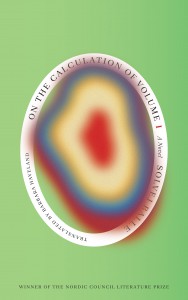
On the Calculation of Volume (Book I) by Solvej Balle, translated from the Danish by Barbara J. Haveland, New Directions, 2024

Review by Rachel Stanyon

After an unremarkable day spent on a business trip in Paris, Tara Selter is enjoying breakfast in her hotel when it strikes her that it is yesterday again. In the first book of Solvej Balle’s seven-part On The Calculation of Volume, Tara’s eighteenth of November begins repeating itself.

What possibilities exist upon the dawning of an old day? Are there wrongs to right, missed opportunities to seize, risks to take or temper? Balle’s heroine does not seem to perceive any such problems or desires; she likes her fairly routine job as an antiquarian book dealer, and works alongside her husband, Thomas, whom she loves. She does not seem to want for nor regret anything, and has blind faith in Thomas, who believes her when she tells him about her repeating days (at least the first umpteen times).

So why has her time “fallen apart”, and what can be gleaned from observing this procession of almost identical days—slowly, meticulously, rhythmically—through the diary Tara keeps? (In this version of eternal return, some of Tara’s physical imprints on the world remain indelible.) Book I details a year (the first of many?) spent haunting the all-too familiar patterns of her husband, all the while lost in loneliness and musing on the volume of her existence. Is she an all-consuming “beast, a pest” or a “tiny monster in an immense space”? READ MORE…

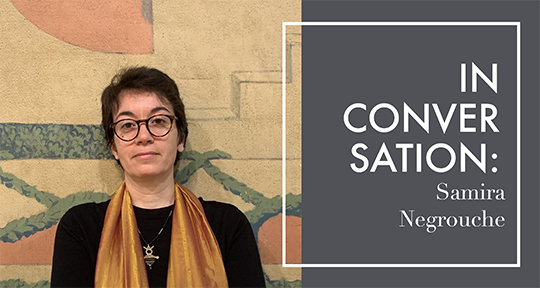
A Country Grey with Sunlight: Samira Negrouche on Francophone and Arabophone Algerian Poetry

We are part of a country, a region, a language, sometimes of a generation or an aesthetic, but as authors we also try to bring a singularity.

Labelled by scholar Ana Paula Coutinho as one of the most gifted writers of the new Maghrebian literary movement, poet and translator Dr. Samira Negrouche sails across Algerian French, Tamazight, and Algerian Arabic languages. She is part of a group of Algerian writers collectively known as The October Generation, and her poetic vision (as sketched by one of her Spanish translators, the Argentine-born French author Carlos Alvarado-Larroucau) is in the same league as Stéphane Mallarmé and Alejandra Pizarnik. Resembling the Mediterranean Sea plainly visible from her Algiers apartment, her artistry and activism are fluid and expansive—crusading for the spirited interchange of literary and cultural thought across languages, artistic mediums, landscapes, and aesthetic style. ‘More literally than many poets, Negrouche has had her fingers on the pulse of Algiers’, Jill Jarvis summarises in Decolonizing Memory: Algeria & the Politics of Testimony (2021).

In this interview, I spoke with Dr. Negrouche on her body of work as a poet and translator; the current Algerian poetry and literary translation scene in the Francophone, Arabophone, and beyond; and the milieu that informs her philosophy and practise as a writer and cultural worker.

Alton Melvar M Dapanas (AMMD): You translate Algerian writers working in Arabic and Tamazight into French, and in turn, your works have been recast into several European languages. I’m interested in the ethnolinguistic milieu you come (and write) from—and write against. 

Samira Negrouche (SN): I was born in Algiers, a city that has always been multilingual. Growing up in this city, I have been surrounded by these three languages that I like to call my mother tongues (although there is a traumatic history behind it). I am lucky to be part of a Berber-speaking family that has kept our ancestral language, and it is a language I keep using every day. There is Kabyle, the local daily language we use in my family, and also is the standard Tamazight, used and taught by a much larger group.

As a citizen of Algiers, I use our common daily Arabic that is often mixed with words from other languages—mainly Berber and French. This language has its own music and images. It has a lot in common with languages used in other parts of Algeria, but retains certain specificities. Finally, the Arabic we use in newspapers and universities is more standard.

French is still the main language for scientific studies in local universities, and it is also used in many other fields. It is a vivid language, especially in urban spaces. Additionally, English is starting to gain more attention among the youngest generations. READ MORE…

What’s New in Translation: October 2024

Discover new work from Turkey, Germany, Brazil, Argentina, Cameroon, Sweden, Chile, France, and Cuba!

In this month’s roundup of newly published translations, we introduce nine works from nine countries: Turkey, Germany, Brazil, Argentina, Cameroon, Sweden, Chile, France, and Cuba. From a politically tuned memoir embedded with a familial conscience to a series of poems that consider diasporic experience through the lens of spectatorship—read on to find out more! 

WaitingfortheFear

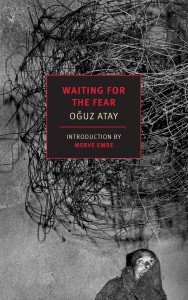
Waiting for the Fear by Oğuz Atay, translated from the Turkish by Ralph Hubbell, New York Review Books, 2024

Review by Christopher Higgs

The oft quoted line from Jean-Paul Sartre’s No Exit, “Hell is other people,” reverberates conceptually across Oğuz Atay’s Waiting For The Fear like a heavy skipping stone slumping across the surface of dark waters. Yet, in each of the collection’s eight stories, a confounding tension arises between the book’s Sartrean misanthropy and another seemingly competing desire: a strong craving to communicate, a yearning to connect. While Atay’s characters avoid human contact, holding deep disdain and even loathing for other people, they still thrum with a surreal pulse, a quivering mixture of rage and sadness in which their hatred comingles with a cry of the heart; they are desperate to embrace, to be accepted, to be acknowledged and valued, to be seen and heard by others. Six of the eight stories, for example, are epistolary, while the others rely on letters as plot devices. When the concept of written communication isn’t foregrounded, the narratives still hinge on concepts of storytelling, connecting, and sharing. READ MORE…

On a Deafening and Prolonged End of the World: Reading Makenzy Orcel’s The Emperor

The Emperor might come across as a novel of . . . personal torment, but it is concurrently an elegy of a failing nation.

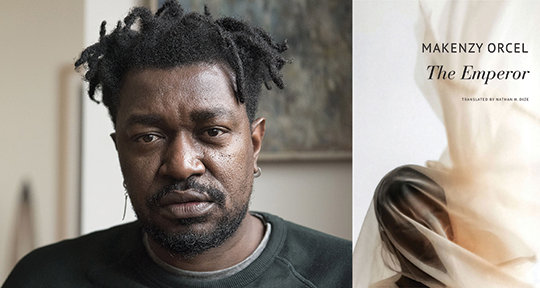
The Emperor by Makenzy Orcel, translated from the French by Nathan H. Dize, Seagull Books, 2024

Set in contemporary Haiti, Makenzy Orcel’s The Emperor arrives to the Anglosphere at a time when the Caribbean nation is in the news for ongoing political, economic, and humanitarian crises. In Nathan H. Dize’s translation, the words of Makenzy’s protagonist almost seem to presage the current moment as he articulates: “In short, this country is a sea of shit. A tomb. . .  we live in a black hole. We’d all leave if we could, every single one of us.”

The protagonist does not have a name—or more specifically, he cannot seem to remember it. Presumably abandoned by his helpless family in a hurricane-ravaged countryside, he is only given an alphanumerical code as an identity, and grows up in a lakou ruled by a self-fashioned, pseudo-spiritual leader—the titular Emperor, who occupies the most beautiful house in all of the lakou. The protagonist sketches: “The other houses planted around the Emperor’s are not homes but narrow sheep pens, ajoupas, huts, used to corral an entire flock of absent souls, followers who are forced-fed truths and falsehoods by the mystical master. . .” Amongst them, the protagonist—who is later christened “P” by the only woman he will ever love—is the least sheeplike. Celebrated as a drummer in the local Vodou rituals but equally subjected to the lakou’s terrors, the narrative follows his life as he manages to flee its confines, reincarnating himself as a newspaper deliveryman in the capital, Port-au-Prince.

The Emperor is written in a stream of consciousness style, and this design of P’s thoughts communicates the claustrophobic nature of his mental landscape, on which scurries a concoction of anger, anxiety, distrust, and a constant sense of imminent, lurking violence. Almost reminiscent of Kafka’s The Trial, the narrative is carried along an overarching tone of disconnection; in addition to his namelessness, the protagonist is also unaware of what he looks like. He ruminates on never having looked at his own reflection, and apprehends whether his appearance resembles the person he is inside. However, P is not the only one who remains nameless (and faceless); the host of characters he introduces—whether exploitative or comforting or everyday neutral—are never named. Fundamentally, this perhaps conveys the extent of withdrawal the protagonist embodies due to his past experiences, because such is how power shapes its subjects. P, whose only close companion is the “Other Within” (the voice inside his head), speculates: “How could I survive until now in this immeasurable solitude?” READ MORE…

What’s New in Translation: March 2024

New works from Alexander Kluge, Marjane Satrapi, and Jón Kalman Stefánsson!

The latest text from one of German New Wave’s founding members and all around heavy-hitter; a wide-ranging compilation of art and testimony championing the Iranian feminist movement from Marjane Satrapi; and a moving, braided narrative of grief and recovery from a lauded Icelandic author. Our editors review some of the most exciting works in translation coming to the Anglophone this month. 

kluge

The Book of Commentary / Unquiet Garden of the Soul by Alexander Kluge, translated from the German by Alexander Booth, Seagull Books, 2024

Review by Bella Creel, Blog Editor

Filmmaker, author, and philosopher Alexander Kluge’s most recent oeuvre, The Book of Commentary / Unquiet Garden of the Soul, is an act of rethinking. Born in Germany in 1932, Kluge blurs the edges of the many years of his life in this ambitious work, expanding beyond the first-hand, beyond generations, drawing connections between now and before, all in order to fully describe the experience of a single life. Alexander Booth offers a wonderfully dense and witty translation from the German, with no aversion to a confusing syntax that demands rereading and rethinking.

Kluge is trying to find the right words throughout this collection, which, in the process of its creation, must have been turned over and inside out, stretched to snapping and magnified to the molecular; reading it, in turn, requires a certain liquifying of the brain. This giving-in allows one to absorb the words, which only then can be reformed into some sort of meaning. Kluge himself seems to follow a similar process:

Where does all my ‘fluent speech’, my rabid desire to write, come from? I listen to others. And carefully! A word that flies towards me, an observation that charms me into conversation, a quotation that I read: all of this gets stored inside me for the long-term.

I usually tear books to shreds, marking any places that captivate me in colour pencil before ripping the page out. These I attach to other findings of mine with a paper clip. They’re often annotated. My flat is full of these piles of paper. My personal bastion against the ‘ignorance that shakes the world’.

READ MORE…