

Amongst the great gifts that translation brings us is an awareness to the alternation and variegations of perspective, informed by ever-shifting factors of fact, selfhood, relationships, and hearsay alike. In this month’s roundup of excellence in world literature, our selection of texts brings expansive voices to light in exquisite explorations in what it means to remember, comprehend, and believe: a luminous text on family history from Maria Stepanova, the reimaginings of folktales by Mia Couto, and a deft fiction on self-deceptions by Sònia Hernández.

In Memory of Memory by Maria Stepanova, translated from the Russian by Sasha Dugdale, New Directions, 2021
Review by Darren Huang, Editor-at-Large for Taiwan
In W.G. Sebald’s final novel Austerlitz, the protagonist Jacques Austerlitz—an art historian who arrived in Britain as an infant refugee from Czechoslovakia in the Kindertransport—searches for the fate of his parents, who were displaced and lost amidst the Holocaust and the Second World War. The novel is a poetic and digressive excavation of family history through the innovative hybrid of photography, travelogue, history, art criticism, and fiction, as well as a meditation on the horrors of the twentieth century, the unreliability of memory and memorialization, and the weight of the past on the present. This unique, peripatetic narrative method of ruminating over the past, which Sebald described as “documentary fiction,” is adapted by the highly acclaimed Russian novelist, poet, and essayist Maria Stepanova in her autofictional, essayistic memoir, In Memory of Memory, elegantly translated by Sasha Dugdale for New Directions. Like Sebald, and Theresa Hak Kyung Cha in her multi-genre novel Dictee, Stepanova adopts an oblique, multifaceted approach towards her central project of assembling a family history dating from the late nineteenth century. She lodges memoir like a puzzle box within cultural commentary, historical documents from her ancestors, philosophical discourse, and literary criticism; the result is a densely textured memoir-in-fragments that is alive to the limitations of its project—the lack of historical evidence, the inaccuracies in memory, the fraught relationship between the storyteller and her subjects, and the inevitable incompleteness of the family narrative.
The text is deliberately structured into three distinct portions: the first two sections alternate between cultural criticism, personal anecdotes, and historical documents. Certain “chapters,” wryly entitled “Not a Chapter,” are entirely composed of letters from her forbears, including her maternal great-grandparents, Sarra Ginzburg and Mikhail Fridman, her maternal grandparents, Lyolya and Lyonya, and her paternal grandparents, Nikolai Stepanov and Dora Stepanova, among others. The letters, chronologically arranged from 1942 to 1985, offer intimate glimpses into the personal lives of Stepanova’s family, and serve additionally as pieces of cultural history. They are redolent of a particular place and time, evoking what Stepanova calls “a feeling for the age.” Each epistolary “chapter” is accompanied by minimal context or commentary and separated from each other by essayistic inquiries into memory—ranging from such subjects as the photograph, Charlotte Salomon and her epic novel Life? Or Theatre?, Sebald and his writings on history, and the memory boxes of Joseph Cornell. In the first two sections of the text, this digressive arrangement interrupts the family narrative so that it only appears in decontextualized fragments. The effect of this bifurcated structure is that the family narrative remains mostly unexplored until the end of the second section and the third section, which consist of more conventional biographical accounts of family members. Stepanova’s delay in directly grappling with both her personal and family history reflects her anxieties about writing on the past. For example, she cites Marianne Hirsch’s concern that inserting archival photographic images might de- or re-contextualize them and distort their original realities. Therefore, the sections of cultural criticism represent the author’s hesitant, fitful attempts at approaching the past, which she finally accesses in the final third of the novel. In these critical chapters, Stepanova admits to “picking through different approaches to the past, as one might pick through dried peas, in search of one that might work.” READ MORE…





Translation Tuesday: “Marigô” by Cidinha da Silva
“Can I call you marigô, too?”
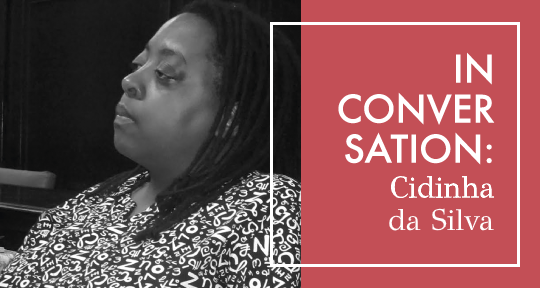
A lexical misunderstanding leads to a hilariously awkward exchange in Cidinha da Silva’s “Marigô,” our selection for this week’s Translation Tuesday. “Marigô” is an exemplar of the crônica form, a uniquely Brazilian genre of journalistic writing that combines slice-of-life anecdotes with (often ironic) social commentary. Cidinha da Silva, one of Brazil’s most dynamic and prolific contemporary writers and cronistas, utilizes the third-person present tense to capture the conversational nature of the form, mimicking the complex rhythm and set-up of a joke. Here the punchline not only provides laughs, but also a wry statement on Afro-Brazilian identities and the cultural importance of language.
Samantha worships her friend Dandara—for her beauty, her culture, her intelligence, her knowledge of the world, and, above all, her integrity of purpose. Samantha views Dandara as an activist even when talking with her mother on the phone. Every time Dandara calls—which isn’t just once a day—she greets her mother with an “Oi oi oi, Marigô, calling just to say hello!”
Samantha’s face lights up every time. Somehow she got it in her head that Marigô meant “mother” in Yoruba. At home, she wrote down the word in her small dictionary-diary, where she’s been recording the African words that circulate daily in Brazil. She has a ton already—it’s just a matter of finding the right time to start using them in her stories. Dandara thinks her co-worker is an Afro-nut, the kind of person who wants to transform anything and everything into an episode of African rebirth.
On Dandara’s birthday, her mother decides to surprise her and shows up at her work to take them to Rhinosaurus’s, her daughter’s favorite fast food joint. While waiting for her daughter in the parking lot, she amusingly reads Barack Obama’s biography. Samantha ends up leaving work before Dandara; when she sees two black hands behind a steering wheel holding a copy of the biography of the president of the United States, she goes Afro-nuts. Only a fascinating person would read such a book, she thinks. She has to introduce herself, has to get to know that woman so she can soak up all of her knowledge. READ MORE…
Contributors:- Ana Luiza de Oliveira e Silva
, - Daniel Persia
; Language: - Portuguese
; Place: - Brazil
; Writer: - Cidinha da Silva
; Tags: - anecdotes
, - Brazilian literature
, - Journalism
, - social commentary