
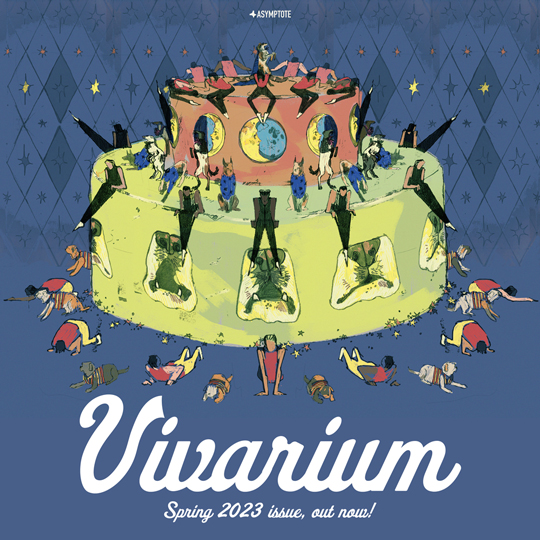
Experience the world anew through non-human eyes in “Vivarium,” our Spring 2023 issue! From macaques to marmots, muntjacs to mosshoppers and microscopic prokaryotes, a superabundance of literary life overflows from 30 different countries. In this thriving biosphere, you’ll find work from Estonia and Oman flowering in the same soil as Alaa Abu Asad’s Wild Plants and our first entry from Bolivia via Pulitzer Prizewinner Forrest Gander. The same Pangaean ecosystem sustains our animal-themed special feature headlined by Yolanda González, recipient of the 2001 Premio Café Gijón Prize, and 2018 Booker International longlistee Wu Ming-Yi. Alongside these, there are the always thought-provoking words of Italian poet Franca Mancinelli, which bloom in both the Interview and Poetry section—the latter also shelters Fernando Pessoa, whose brilliant co-translators Margaret Jull Costa and Patricio Ferrari have rendered him in one of his most mordant heteronyms, Álvaro de Campos.
Language: Romanian
Our Spring 2023 Edition Is Here!
Featuring Fernando Pessoa, Franca Mancinelli, Wu Ming-Yi, and Yolanda González in our animal-themed special feature
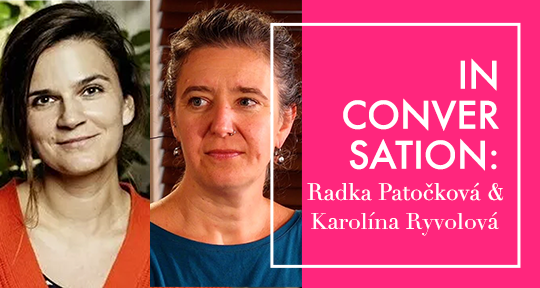
KHER, A Home For Roma Literature: In Conversation with Radka Patočková and Karolína Ryvolová
We have to keep exploring the potential of Roma literature so that we are still here in the years to come.
Roma literature has long been suppressed, persecuted, and overlooked in the Central European literary scene, despite its wealth of stories and importance. Founded in 2012, KHER—which means a house or a room in Romani—is the only independent publishing house in the Czech Republic to focus exclusively on the publication and promotion of Romani authors, a homeland for the support and respect of Romani writers’ creative endeavours. In this two-part interview, Asymptote’s Editor-at-Large Julia Sherwood has spoken to KHER’s co-founder and director Radka Patočková, and one of its editors, Karolína Ryvolová, first on the founding and development of KHER as a renowned publishing house, and then on Roma literature and identity in the broader literary scene.
Julia Sherwood: It must have taken some courage to found a press focusing exclusively on Roma writers, particularly in the Czech Republic, a country that—as you, Radka, put it in a recent interview—”has a long way to go in terms of its relations with the Roma.“ You went on to describe common reactions you received: “How many Roma authors do we have? Who would buy and read their books? What might the quality of Romani writing be like?” So my question is: What made you embark on this risky enterprise despite all these challenges, and what was the personal and professional path that brought you to this project?
Radka Patočková (RP): Let me start with the end of your question. Since the early days, when we founded the publishing house, our team at KHER has undergone some changes. In those days we were in our thirties, full of youthful enthusiasm and convinced by our previous experience that one could take action and effect change, rather than just talk about it. Had someone told us about everything this would involve over the years, and had we known what we would have to go through professionally as well as in terms of our private lives, we might have become disheartened. Some have gradually drifted away, but they continue to root for us from the sidelines and we are grateful to them for their time and enthusiasm at the start.
We met as students of Romani studies at Charles University, and our shared interest in literature brought us to publishing. Cultural and financial management, on the other hand—the nitty-gritty of publishing, marketing, and accounting—were areas we had to get into gradually. We learned that love of literature, closeness to the Roma people, knowledge of Romani and the realities of the life of the Roma, or friendly relations with authors—all of that is not enough to bring a book into the world. We had to blaze the trail slowly, one step at a time, sometimes going back or hitting a dead end, but now we feel increasingly at home in the vast area of activity that publishing entails. To sum up: in April 2023 we are much wiser but also more realistic than we were when we set up KHER eleven years ago. And that’s a good thing; perhaps too much rational thinking in 2013 could have meant that the idea would have remained on paper and in discussions in cafés.
JS: Since its inception, KHER has published over a dozen books—starting with e-books and later moving to print—ranging from history, biography, memoirs, and fiction to children’s stories, and you have also organised writing workshops and educational activities. How many people are involved in running KHER and how is your work funded?
RP: KHER is an association made up of eleven members, some with a background in Romani studies or economics, and the rest Roma professionals—an IT specialist, historian, journalist, author, and translator. However, the core group that ensures the day-to-day running of the publishing house consists of just five women. So when people want to come to see us, we tell them with a smile that they’re welcome as long as they don’t mind visiting us in our kitchens. That is another thing I think is remarkable: we don’t have an actual office, a space for working, discussing things, and coming up with creative ideas, which can sometimes be a disadvantage. Fortunately, Prague is full of cafés and some are prepared to have our group working there on a regular basis. READ MORE…
Weekly Dispatches From the Front Lines of World Literature
Literary News from Palestine, Central America, Romania, and Spain!
Join us this week with a new batch of literary dispatches covering a new Palestinian literary and culture magazine, the 2023 PEN Open Book Award longlist, and more. From a Palestinian literary festival to the birthday celebration for the “national poet” of Romania, read on to learn more!
Carol Khoury, Editor-at-Large, reporting from Palestine
A first is always exciting, always an event; in fact, it’s called “a first” even if a second never comes. And when there is a second time, it’s an opportunity to celebrate and to remember the first.
This week the Palestinian literary community is anticipating both a first and a second.
The Palestinian literary scene is witnessing the birth of Fikra Magazine, an online Palestinian cultural and literary magazine – writing and art by and for Palestinians. According to partners and co-founders Aisha and Kevin, Fikra is dedicated to “high-quality content that doesn’t conform to stereotypes and old-fashioned ideas about Palestine. It’s original, it’s inspiring, it’s bold.” What is exciting about this new publication is that every piece is professionally translated from Arabic to English—or vice versa. Since “Palestinians in the Diaspora often don’t read Arabic as their mother tongue,” the creators say in their promotional materials, “we want our writers to become part and parcel of the international writing-guild as well.” In Fikra, the creators promise, “you’ll find Palestinian writers and artists from all corners of the word – from Gaza, the West-Bank, East-Jerusalem, 48, and the diaspora.”
Weekly Dispatches From the Front Lines of World Literature
The latest from Romania and the Philippines!
In this week’s literary round-up, we’re bringing coverage from the myriad intrigues of world literature, from storybooks highlighting Indigenous narratives to diasporic Romanian writers, romance writing to exiled heroes. Read on to find out more!
MARGENTO, Editor-at-Large, reporting from Spain and Romania
As the Romanian literary scene is gearing up for the twenty-ninth edition of Gaudeamus book fair, organized by Radio Romania in Bucharest from December 7 through the 11, the literary diaspora is both very active and a hot topic in and of itself. A one-day seminar, entitled “European Cultural Representations of Romanian Migration and Exiles” took place at the Romanian Centre, Complutense University of Madrid (UCM) last week. Presentations and roundtables on highlights from the Romanian diaspora across the Western world—such as religious studies international icon and fiction writer Mircea Eliade, Romanian-Spanish comparative literature pioneer Alexandre [Alejandro] Cioranescu, and former Asymptote contributor Matéi Visniec—were complemented by excursuses into the work and lives of personalities relevant to both Romanian and Spanish literatures. Former Asymptote contributor Felix Nicolau, Director of the Romanian Centre and Romanian Language and Literature Lecturer, gave a talk about Alexandru Busuioceanu: a poet, art historian, and essayist credited for establishing Romanian as an academic subject at UCM back in the mid-twentieth century, after founding the UCM Romanian Centre in 1943.
Another major name of the diaspora is Paul Goma, renowned opponent of Ceaușescu’s regime and dissident fiction writer forced into exile (to Paris, France) in the late 1970s, after having survived numerous attempts on his life staged by the Romanian communist secret police or their accessories—only to die from COVID in 2020. A hot-off-the-press book dedicated to the dissident hero by historian, poet, essayist, and Goma scholar Flori Balanescu, Paul Goma: Conștiință istorică și conștiință literară [Historical Conscience, Literary Conscience], is to be launched at Gaudeamus in a week’s time, and it has already grabbed considerable attention on social media. Awarded poet and fiction writer O. Nimigean, himself a Parisian exile, commented on the text as a breakthrough release and expressed his impatience to read the sequel—an already planned book he indirectly disclosed as having insider knowledge on. Such updates can only further stir interest—if not inevitable kerfuffle—since the (albeit rare) publications about Goma expose, just as the author’s own novels did, the collaborationism under communism of certain established literati or public figures: an implication to which the latter usually retort with accusations of anti-semitism. READ MORE…
Weekly Dispatches from the Front Lines of World Literature
Book fairs, award shows, and passings from Hong Kong, Spain, and Iraq.
This week, our editors from around the globe report on recent literary awards in Hong Kong, examine the links between the literary scenes in Spain and Romania, and reflect on the passing of a revolutionary Iraqi poet. Read on to find out more!
Charlie Ng, editor-at-large, reporting from Hong Kong
The awards ceremony of the 16th Hong Kong Arts Development Awards was conducted online on 22 May. Renowned Hong Kong writer Xi Xi (the pen name of Cheng Yin) was honored with the Life Achievement Award for her tremendous contribution to Hong Kong literature. Moreover, essayist Tung Chiao won the Award for Outstanding Contribution in Arts, and fiction writer Dorothy Tse Hiu-hung was awarded Artist of the Year for the literary arts category. While two works by Tse, Snow and Shadow and The Door, are available in the English language, Tung Chiao’s works have yet to be translated, despite the fact that he is already a highly acclaimed author in Chinese literary circles.
Shout it from the rooftops: Asymptote turns eleven today! We celebrate our 43rd issue with new work from a record 43 countries in our most bountiful edition yet. Highlights include an exclusive interview with acclaimed poet George Szirtes and a Flemish Literature Special Feature organized in partnership with Flanders Literature, showcasing new translations of International Booker Prize nominee Stefan Hertmans, YA superstar author Bart Moeyaert, and up-and-coming raconteur Rachida Lamrabet.
Our Winter 2022 edition not only puts the “world” in “world literature,” it also interrogates the meaning of it. Take the case of Aaron Zeitlin, the Yiddish poet who was stranded overseas when the Nazis invaded his native Poland and killed his entire family. Written in a language “half of whose speakers had been wiped off the face of the earth,” Zeitlin’s grief-stricken poetry appears to be without a world, and therefore can not, as Yeshua G.B. Tolle argues beautifully, be classified as world literature. In her fiction, Jasna Jasna Žmak imagines a similar apocalyptic fate for the speakers of her language in a thought experiment inspired by Barthes, only to emerge with a newfound appreciation for all the words in her language, including the ones she hates. After all, words can summon entire civilizations—even the bygone ones—as they do in Gesualdo Bufalino’s thrilling list of extinct professions (the lady with the bloodsuckers, among them!). “The disappearing world” is also the subject of visual artist—and the first public figure in Spain to openly discuss his HIV status—Pepe Espaliú’s devastating poems evoking his final days under a sky dense like “the mouth of black clouds.” By contrast, bilingual Kazakh poet Anuar Duisenbinov’s exuberant “overloved, overdosed” narrator “float[s] in exultation” through his “luminous and windy capital,” contemplating “the ability of speech to sprout.” As it turns out, speech does sprout everywhere all over the world. Alongside Duisenbinov, we’re thrilled to debut in English Emil-Iulian Sude, one of the first award-winning writers of Roma ethnicity in Romania; Rachid Djaïdani, a French filmmaker whose 1999 bestselling novel and classic of banlieue writing is only now available, thanks to frequent contributor Matt Reeck; and Kim Su-on, a young Korean writer whose dazzlingly atmospheric story is a masterclass in worldbuilding.
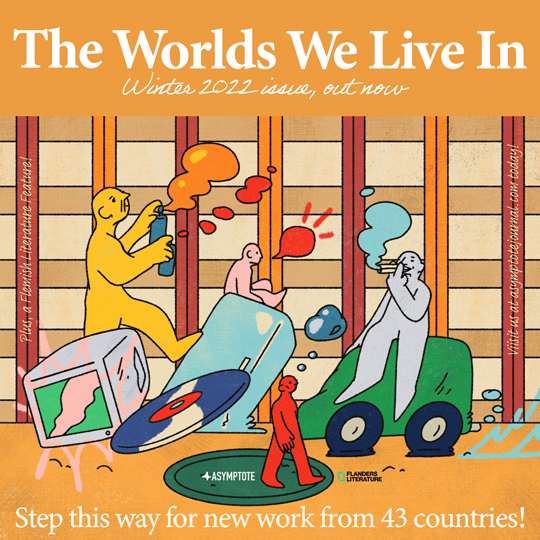
The tagline of this eleventh anniversary edition is “The Worlds We Live In”—pointedly not “The World We Live In”—meant to express the simultaneity of all our myriad existences, such as those inhabited by George Szirtes, who discusses his new collection of poems, the state of Hungarian literature, and translation in the age of Brexit. Also working from the liminal space of migration is Jamaican-born artist Cosmo Whyte, who explains why Barbados’s recent renouncement of the Queen is only the first of many necessary steps in healing (since, according to him, there is no “post” to colonialism). Neske Beks also performs a necessary act toward healing on behalf of Black women everywhere by centering the story of Ann Lowe, the Black designer responsible for Jackie Kennedy’s bridal gown in 1953, in her retelling of haute couture’s history. Pair her 2020 essay sparked by an exhibition with Charlotte Van den Broeck’s nonfiction excavating the curious real-life case of the Princess Caraboo of Javasu aka Mary Wilcocks—who might very well be the first yellowface captured in any artistic medium (an 1817 oil painting that shared a moment with Van den Broeck at the Bristol Museum & Art Gallery in her last gallery visit before the pandemic). All of this is illustrated in talented Singaporean guest artist Yeow Su Xian (Shu)’s irresistible palette and forms—I dare you to say hers isn’t the most fun cover we’ve had in a while!
For more Asymptote goodness, subscribe to our newsletter or Book Club, follow us on Facebook, Twitter, and our two Instagram accounts, and consider submitting work (Swedish-English translators take note: our recently announced call for submissions to a paid Swedish literature feature ends Mar 1). And of course, we’d be delighted if you’d like to come on board as a team member (apply by Feb 1) or, to honor our eleven full years in world literature perhaps, as one of our generous sustaining members! As always, thank you for your readership and support.
BECOME A SUSTAINING MEMBER TODAY
—Lee Yew Leong, Editor-in-Chief
Mapping the Vast Landscape of Romanian Theatre
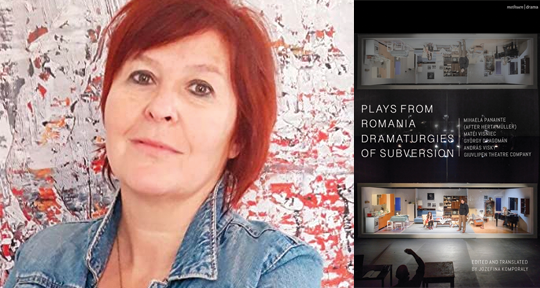
[T]he anthology’s aim—as stated by Komporaly—is mainly to feature the country’s formal literary and cultural diversity . . .
Plays from Romania: Dramaturgies of Subversion, edited and translated by Jozefina Komporaly, Bloomsbury Methuen Drama, 2021
In the pretentiously Francophone Bucharest of the late nineteenth century, Ion Luca Caragiale’s plays were met with harsh criticism for their alleged sexual innuendos and outrageous immorality—what one might nowadays call subversion. Caragiale, whose reputation has now grown into that of an unparalleled classic and a quintessential influence on a host of Romanian/international avant-garde luminaries, was in fact of mixed Balkan heritages. He spent his later years as an émigré in Berlin, thus proving himself an ambivalent maverick and avant-la-lettre transnational.
Almost 150 years on, Romanian drama boastfully continues this legacy of subversiveness, diversity, and transnationalism. In that respect, the best possible illustration of such variation is the recent anthology, Plays from Romania: Dramaturgies of Subversion, edited and translated by Jozefina Komporaly. From the very introduction, Komporaly pertinently places contemporary Romanian theatre at the crossroads of the culture’s emergence from communism thirty years ago, and situates its ever increasing representation of minorities—particularly Roma—in a global context. The very rich and nuanced landscape that Komporaly aptly charts is further complicated by the dualism of state-funded (more traditional) and independent (more avant-garde) theaters, as well as formal genre-related features—both text-based and experiment/performance-informed. The picture is then rendered even murkier by companies specializing in minority drama and/or being run by representatives of minorities striving to gain state-funded status.
While informed therefore by a knowledgeable historical and cultural perspective, the anthology’s aim—as stated by Komporaly—is mainly to feature the country’s formal literary and cultural diversity by illustrating the common grounds of “burning concerns rooted in Romanian realities” and the experiments “push[ing] the boundaries of the genre.” And indeed, unconventional approaches are featured from the very opening play: a stage adaptation by Mihaela Panainte of Noble Prize winner Herta Müller’s short story collection, Lowlands (thus forging a connection to the German minority in Romania). Panainte’s staging of Müller’s fiction rivetingly captures the latter’s poetic fragmentariness through what Komporaly rightly calls textual modularity—just as the translator herself lithely renders that same combination of poetry and alert colloquialism alongside a more ponderous social grayness and a haunting sense of death’s ubiquity. READ MORE…
Weekly Dispatches from the Front Lines of World Literature
The latest from Mexico, Bulgaria, Belgium, and Romania!
Though Asymptote is winding down with the year, literary events and going-ons continue to thrive around the globe. In Mexico, the Guadalajara International Book Fair presents its impressive line-up, and Polish female poets are celebrated in a new collection. In Bulgaria, the Christmas Book Fair returns to delight the locals. and in Romania, the Gaudeamus Book Fair features over one hundred exciting events. Read on to find out more!
Alan Mendoza Sosa, Editor-at-Large, reporting from Mexico
On December 10, Mexican editor, poet, and translator Isabel Zapata presented Dentro del bosque, an English-Spanish translation of the autobiographical essay Into the Woods by American author Emily Gould. The essay reflects on contemporary capitalist precarity through Gould’s personal experience as a young woman trying to make a living as a writer in New York City. Originally published in 2014, its translation into Spanish is part of the Editor’s Collection from Gris Tormenta, an independent publisher based in Querétaro, a rapidly growing state three hours north of Mexico City. Gris Tormenta has published several Asymptote contributors in the past, including Yuri Herrera, Tedi López Mills, and Thomas Bernhard.
On December 4, Mexican poet Rocío Cerón and Polish poet Marta Eloy Cichocka presented Luz que fue sombra, a Polish-Spanish bilingual collection of seventeen Polish female poets born between 1963 and 1981, translated by Abel Murcia and Gerardo Beltrán. The book was published in the Spanish independent press Vaso Roto, which has published Spanish translations of important authors such as Anne Carson, John Ashbery, and Ocean Vuong. It includes poems by Justyna Bargielska, Barbara Klicka, Krystyna Dąbrowska, and Urszula Zajączkowska. Julia Fiedorczuk, whose book Oxygen was reviewed for Asymptote by Elisa González, is one of the most renowned authors in the collection. The event took place in Talleres de Arte Contemporáneo (TACO), a cultural centre south of Mexico City dedicated to promoting and teaching contemporary art.
The 35th edition of the Guadalajara International Book Fair took place in Guadalajara, one of Mexico’s largest cities, between November 27 and December 5. It is considered one of the most important book festivals in Latin America. This year, the guest of honor was Peru, from where several important authors and artists travelled to Mexico to present their work, lead workshops, and host panels. Among them was Asymptote contributor Victoria Guerrero. Importantly, the events featuring Peru offered significant representation of literature written in indigenous languages, including books by Dina Ananco Ahuananchi, Gabriel Pacheco, Cha’ska Ninawaman, and Washington Córdova. The fair also featured both emerging and established authors from all over the world. Many of them have previously appeared in Asymptote, such as Ana Luísa Amaral, Georgi Gospodinov, Abdellah Taïa, Marieke Lucas Rijneveld, and Alejandro Zambra.
Andriana Hamas, Editor-at-Large, reporting from Bulgaria
Bulgaria has, for a long time now, been in the grips of mass paranoia, an all-encompassing misinformation campaign, and political turmoil. The health situation also not looking up; according to official statistics, the COVID-19 deaths are, sadly, approaching the chilling number of 30 000 since the beginning of the pandemic—a figure that definitely cannot be trivialised given the overall population. READ MORE…
Divine and Earthly Pleasures: On Ion Cristofor’s Somewhere a Blind Child
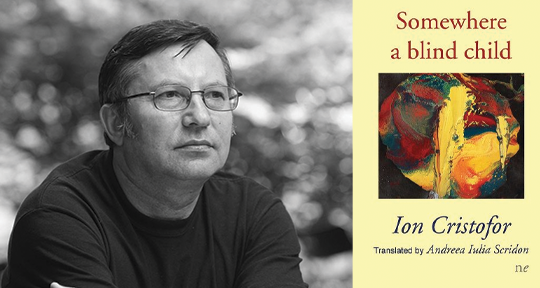
The poems follow a coherent design, with themes and characters growing organically, coalescing in a cohesive atmosphere and view of the world.
Somewhere a Blind Child by Ion Cristofor, translated from the Romanian by Andreea Iulia Scridon, Naked Eye Publishing, 2021
Oh, what a sinister story, what bothersome spectres
my bedstead is creaking.
We will have to move in the night
to other rooms to other countries to other life-stories.
Spirituality, references to the Scriptures, and direct calls from God—Romanian poet Ion Cristofor is known as a “modern Christian poet,” but Somewhere a Blind Child exemplifies his idiosyncratic approach to faith. Drawn from nearly forty years of work, these selected poems are translated into English for the first time by Andreea Iulia Scridon, a translator and poet herself. They are spiritual, but also ridden by spirits; they frequently allude to the scriptures with reverence, but also do not refrain from ridiculing them at leisure—God calls in, but he himself “gets no erotic phonecalls.” Cristofor’s numbingly clear awareness around the contradictions of the modern world—in realms of religion, history, science, and death—keeps the reader from being lulled into any false sense of comfort, whether by confidence in faith’s power or excessive hope in reason. When earthly pleasures do barge in, however, their offer to distract from pain and worry is accepted with abandonment and sensual relish, no matter how ephemeral their soothing effect.
When she undresses on the couch
the blossom-laden trees all move into my bedroom
their love-sick leaves becoming delirious.
It’s autumn, Lord, it’s so late in heaven
and love is a blue orange in your hand
In this unusual meeting place between the chilly high planes of the spirit and the dirty warm ground of the senses, visions flourish. It feels oddly logical; wracked with doubt, a mind can become overattentive to extemporary signs—the shape of a cloud or the temperature in a room, taking them for premonitions or glimpses of the truth that lies behind the real, as they appear and disappear in the surreal and overheated atmosphere. The senses, if capable of guiding reason, can also distort it, making room for the incredible, the strange, and the eerie.
a white phantom passes through the rooms
reminding you of an hour of love
that once passed over you like a galloping herd of horses,
like a reckless ocean wave.
And now flocks of starlings proclaim you governor of the
province
and towards evening the clouds send you dark ambassadors.
Constructing Unity From the Fragments of Living: Magda Cârneci and Sean Cotter on FEM
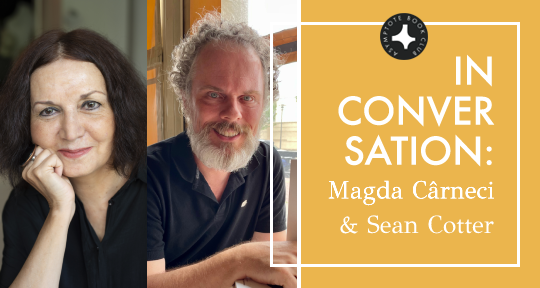
Poetry, as I use it, is a mystical way to attain certain states of mind and soul.
Magda Cârneci is a luminary. Writing in the vein of what Beauvoir called the artist’s need to “will freedom in [themselves] and universally,” her novel FEM is a feat of feminine imagination, at once within and beyond the body. Structured in a fluid prose but intricate with poetry’s capacities to manifest the numinous, the resulting text is an immensely powerful excursion within the mysteries of the mind as it meets the mysteries of the universe. We are proud to feature FEM as our Book Club selection for the month of June, and also to speak to Cârneci alongside translater Sean Cotter in a live interview held for members. The conversation, transcribed below, touches on the intricacies of contemporary Romanian literature, the legacy of French feminism, and the transcendental experiences of everyday life.
The Asymptote Book Club aspires to bring the best in translated fiction every month to readers around the world. You can sign up to receive next month’s selection on our website for as little as USD15 per book; once you’re a member, join our Facebook group for exclusive Book Club discussions and receive invitations to our members-only Zoom Q&As with the author or the translator of each title!
Andreea Iulia Scridon (AIS): Magda—you’re probably best known as a poet, but could you tell us about your history of writing fiction—or should I say prose? Did this represent a transition; were there anxieties about this process, or did it come naturally to you?
Magda Cârneci (MC): I used to write poetry, but at a certain moment, I realized that poetry is less read than prose, and the audience, unfortunately, is less numerous than it is for fiction. And as I had a message to transmit and some obsessions to confess, I felt the need to use fiction—the narrative as a tool, as a literary tool. It’s true that the prose form gives you possibilities which do not exist in poetry: describing and analysing feelings, or perceptions, or sensations in a minute way. So from this point of view, prose writing was a marvelous discovery for me. But I have to say that I mingle prose and poetry; I use poetry a lot in my writing, because I think it is a way of charging words with an intensity and with an aura of feelings. That does not exist in normal prose writing. So this is a kind of poetic prose or visionary prose, what I do in FEM.
AIS: Sean wrote a very interesting study called Literary Translation and the Idea of a Minor Romania, which I recommend to anybody interested in comparative literature, actually. So Sean, I was wondering if you could tell us what you think Romanian literature in particular is defined by, insomuch as it as possible to define a literature briefly, and what it brings to the corpus of world literature or global literature in particular.
Sean Cotter (SC): I don’t think that there’s an essence that would unite all Romanian literature in a useful way; what I would recommend is a difference in perspective when it comes to reading Romanian literature or understanding its history as a whole. This is something I addressed in the book—that in contrast to our usual ways of looking at national literatures (especially literature in the United States), I think we have to pay much more attention, when reading Romanian literature, to its interactions with other literatures. I think it’s much easier to misunderstand what is happening and why things changed, or why new things develop within Romanian literature, if we don’t attempt to document such interactions—and I think that FEM is a great example of this. READ MORE…
Announcing Our June Book Club Selection: FEM by Magda Cârneci
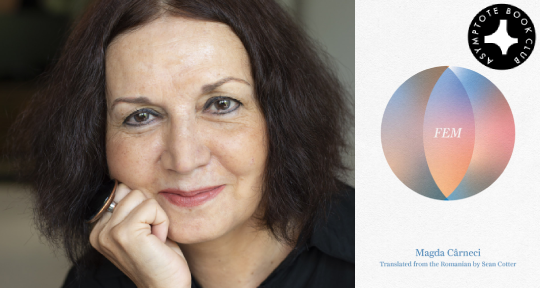
Cârneci's protagonist is a modern Scheherazade—or is she?
The persuasive potentials of storytelling don’t always hold the life-or-death thrill that they did for the mythical Scheherazade, who spun her narratives to stay alive, but as the profundities of Magda Cârneci’s FEM prove, there is always an enchantment in speaking one’s own experiences to another. Exalted with Cârneci’s celebrated poetics and visceral in its discernment of gendered bodies, our Book Club selection for June is a novel that speaks to our evolving understandings of physicality, sexuality, and selfhood as refracted in societal prisms of sex, femininity, and myth.
The Asymptote Book Club aspires to bring the best in translated fiction every month to readers around the world. You can sign up to receive next month’s selection on our website for as little as USD15 per book; once you’re a member, join our Facebook group for exclusive Book Club discussions and receive invitations to our members-only Zoom Q&As with the author or the translator of each title!
FEM by Magda Cârneci, translated from the Romanian by Sean Cotter, Deep Vellum, 2021
In the very first lines of FEM, the protagonist—a fictionalized version of author Magda Cârneci—compares herself to the mythical heroine Scheherazade, then immediately troubles the comparison: “A little, everyday Scheherazade in an ordinary neighborhood, in a provincial city; your personal Scheherazade, even if you won’t cut my head off in the morning, when I fail to keep you awake all night with extraordinary stories.”
How, then, is she like Scheherazade? She will indeed attempt to enchant her listener, a lover, with a string of stories—but are all women who tell stories like Scheherazade? It is not a simple affinity between the two women that gives meaning to the comparison, but, more fruitfully, the symmetry’s imprecision. Like the north ends of two magnets, the two storytellers’ refusal to meet tantalizes, inviting the reader into the no-man’s land, in which they may question—or even participate in this exchange of identities. Cârneci’s own active approach to living in a body, in fact, is exactly what she begs her listener/reader to adopt, and her appeal is so breathtaking, it’s a wonder anyone could refuse:
We are seeds sown into the brown-black loam of a terrestrial existence, and we must germinate and rise slowly from our fragile burgeoning, our green sprouting, through layers of clay and stone, through bacteria, worms, and insects that wish to devour us, we must pierce through sheets of underground water and enemy root systems, our germinations are deviated by contrary forces, deceived by gravitations and visions, by temptations and traps, but pulled upward by an atavistic, core instinct, along a fragile thread of light, pulled by an inverted, celestial gravity, we are tractable, attracted toward growth at any price . . .
Weekly Dispatches From the Front Lines of World Literature
Literary news from Europe, Argentina, and Sri Lanka!
As the world slowly reopens to possibilities made anew by the subsiding of pandemic restrictions, our editors are bringing you the latest from a summer of potentialities. In Argentina, bookstores are spotlit for their role in creating cultural spaces and dialogues, and virtual stages take full opportunity of their wide reach. In Europe, a Belgian festival dedicated to avant-garde poetry is proceeding at full speed, and new and noteworthy publications are hitting the shelves. In Sri Lanka, annual literary forum New Ink debates the definitions and reach of their national literature. Our editors are here with the full scoop!
Allison Braden, assistant blog editor, reporting from Argentina
The Feria de Editores is now accepting entries for its Bookstore of the Year award; the organization, which will host its annual festival of independent publishers on October 1-3, seeks to recognize the work of booksellers throughout Argentina, acknowledging that their cultural and curatorial role goes far beyond merely selling books. The prize, open to all bookstores that have been open at least one year, will honor a shop whose leaders and employees have worked tirelessly to promote intercultural exchange both inside and outside its physical space. “Bookstores,” says the invitation to enter, “are a focal point for fostering local culture and connection to international thought.”
Bookstores in Argentina and beyond will soon stock commemorative editions of Eduardo Galeano’s Open Veins of Latin America, a book of profound influence on international thought about the legacy of exploitation in the region. Galeano, a journalist and novelist who hailed from across the Río de la Plata in Montevideo, Uruguay, published the work in 1971, when authoritarian regimes on the continent still held sway. The book was banned by some, and even Galeano eventually came to think of it as poorly researched and written, but it nevertheless became a leftist classic with enduring appeal: It’s been translated into more than a dozen languages and shot to number six on Amazon’s best-sellers list after Venezuelan President Hugo Chávez gave a copy to U.S. President Barack Obama. In Argentina, the book’s fiftieth anniversary has provoked reflection on the relevance of Galeano’s thesis today.
Fundación Andreani, an organization that promotes cultural and educational programs to improve quality of life, and Universidad Nacional de las Artes joined forces this month to launch Paraísos Artificiales. Antología de poesía en la web (Artificial Paradises. Online poetry anthology). The series celebrates the web’s potential for creative freedom and brings attention to digital poetry and “technopoetics.” The first season, released this month and inaugurated with a virtual presentation, consists of three episodes, which focus on artists with various approaches to visual poetry: Rafaël Rozendaal, Ana María Uribe, and Belén Gache. The series is fuel for the Feria de Editores claim that cultural influence, especially in the age of Zoom, goes far beyond bookstore walls. READ MORE…
Ciuleandra Dances with Despair—and Earns Its Place in the Modernist Canon
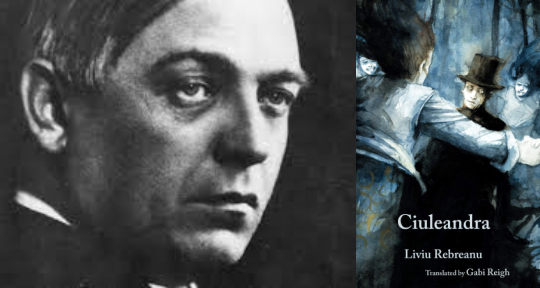
“Shut away on his own for two days a man can learn more about himself than he might in twenty years living his normal life, in the outside world.”
Ciuleandra by Liviu Rebreanu, translated from the Romanian by Gabi Reigh, Cadmus Press, 2021
Hailing from rural Transylvania, the sober and profound Romanian writer Liviu Rebreanu used the novel form to discover both society and the individual at a moment of rapid national and global evolution. One example of such a drama, depicted in Rebreanu’s deft style, is The Forest of the Hanged, which tells the tale of two brothers who fight for opposing sides in the First World War, though most of his novels are focused around agrarian life. Ciuleandra, however, tells a different story: that of Puiu Faranga, a high society dandy of 1920s Bucharest, who strangles his beautiful young wife, Mădălina, and descends into madness in a private sanatorium, under the—apparently—cold gaze of a certain Dr. Ursu. Though more classical than experimental (Rebreanu seems influenced by Balzac and Tolstoy and thus represents rather an anecdotal writer than one influenced by psychoanalysis), Ciuleandra has its seat, without a doubt, among the great novels that have emerged from Modernism.
The Indeterminacy of the Human: An Interview with Rainer Hanshe of Contra Mundum Press
. . . we say to read for difference, for dissonance; read not to identify, or to sympathize, but from a principle of fascination.
Contra Mundum is a New York-based independent publishing house expressly committed to Modernist work and principles. Its catalog includes the dramatic writings and theatre criticism of Robert Musil; Celan’s posthumous prose as translated by Pierre Joris; two “pre-heteronymic” works from Pessoa; the generously-illustrated Letters of Otto Dix; and a late film script from Marguerite Duras. Preference is given texts with limited circulation, the under-translated and outré in particular.
In 2012, for instance, Contra Mundum published Marginalia on Casanova, Tim Wilkinson’s rendering of Volume 1 in Miklós Szentkuthy’s cathedral-commentary-catalogus rerum, St. Orpheus Breviary. Contra Mundum is now five books into its tremendous project, bringing into English an immense cosmophagic-and-collapsing body of prose from a modernist still known as the “sacred monster” of Hungarian letters. In addition to works from the Breviary, Contra Mundum has so far contributed translations of Prae and Toward the One & Only Metaphor (also translated by Wilkinson, who died in October of 2020) and Chapter on Love (translated by Erika Mihálycsa, who will continue as translator for subsequent Szentkuthy works). That CMP should be the publisher to finally give Anglophone readers an adequate Szentkuthy is fitting: press and author share an understanding of zeitgeists alive—in art, in language—across history, unthreatened by chronology or multilingualism. Contra Mundum too experiences its periodic connection to modernism(s) without—or with different—temporal allegiances. In addition to Musil and Pessoa, CMP has published not only Baudelaire and Wordsworth and the Ghérasim Luca of Mary Ann Caws, but also Iceberg Slim, a new Gilgamesh (Stuart Kendall’s), Ahmad Shamlou, Maura Del Serra, and the collected prose of Robert Kelly. Many texts converge around performance, whether onstage, on screens, or in person(ae): CMP has published Elio Petri, Richard Foreman, Pier Paolo Pasolini, Jean-Luc Godard, Rédoine Faïd, and Carmelo Bene. Adjacent to this swirl of codexical text and idea is Hyperion, CMP’s in-house and aptly subtitled journal: On the Future of Aesthetics.
Rainer J. Hanshe is the founder, editor, and publisher of Contra Mundum Press, as well as the author of two CMP titles, Shattering the Muses and The Abdication, and the translator of its three works by Baudelaire. We spoke recently about the nature of (his) modernism and its role in contemporary literature. Deviation, ambition, and heteroglossia were our major subthemes.
Rachel Allen (RA): How does Contra Mundum understand “modernism”? How do you recognize modernist work when you encounter it? (Is modernism limited, temporally? Geographically? Relationally? Formally? To whom is it available to be modernist?)
Rainer Hanshe (RJH): Although Modernism does occur within a specific epochal moment, I don’t see it as bound to that cluster of time, nor do I see it in absolute or purist terms. There is no kind of totemic Modernism with a unified set of precepts that every modernist abides by. Any kind of doctrinaire, sectarian, or dogmatic form of something cannot be abided. We are advancing modernism more as a kind of mobile act or event, like a type of living roving machine (not in a mechanistic sense but as a generative force) or combustion furnace and monster of energy. It is a question of extracting from any period, any event, any moment, its active, productive elements, like taking an arrow shot by Nature, picking it up where it has fallen, and shooting it in new directions, as Deleuze said of Nietzsche.
In that way, art is no different from science in terms of advancements—once a certain insight or knowledge has been developed, there is no reason to abandon it, let alone restrict it to its original moment. Modernism (let’s avoid the term neo-Modernism) is to us protean and metamorphic, an open, indeterminate constellation. Beyond seeing it solely as a specific movement in time then, consider its principal elements as if they were discoveries: a conscious break with tradition (abandoning outmoded elements of classicism); a rejection of historicism and the grand narratives of Western metaphysics, not to speak of its morals and values; the displacement of reason as a ruling force (the curse of the Enlightenment) and fostering in its stead a chiasmic fusion of the rational and the irrational; an abandonment of bankrupt forms of art, such as naturalism and realism (and so representation), which different scientific developments essentially undermined, and Enlightenment-type encyclopaedic projects of totality; related to consciousness and new conceptions of the self and the indeterminacy of the human: interior monologues; stream of consciousness; perspectivalist viewpoints; fracturedness, fragmentation, heteroglossic language, en plus.
It is a literature of incommensurabilities, of a dynamism in signification, of a rejection of absolute truths, of an embracing of dissonance. A literature that is aware of language’s limits, of its fissures, of its cul-de-sacs and cracks, and it vigorously pursues such. Flaubert’s book about nothing; Mallarme’s Le Livre; Beckett’s search for a literature of the unword; et cetera. Modernism understands language as Bakhtin spoke of it: a dynamic entity consisting of an interplay between centripetal and centrifugal discursive forces. The combustive furnace. Heteroglossia. An amalgam of linguistic registers. The Tower of Babel is not a curse. READ MORE…