Place: Guatemala

Winter 2026: Highlights from the Team

Still not sure where to start with the new issue? Let our team members be your guide!

Reading Minna Canth’s Children of Misfortune (translated from the Finnish by Minna Jeffery) felt like a jolt of moral clarity. In a year when I stopped apologizing, the play reminded me why anger, when shared and articulated, can still feel invigorating. Canth refuses the lie that oppression is inevitable, insisting instead that the world we inhabit was made and can be remade. There is something bracing, almost ecstatic, about watching oppressed people unite in fury, turning their rage against the lifeless property their masters prize so dearly.

That same refusal of appeasement runs through Hélène Laurain’s On Fire (tr. Catherine Leung from the French), whose blunt, abrasive narrator feels almost instructive in a moment when calls for meek compromise echo as loudly as calls for violence. Laurain offers no heroes, no romanticism, only a clear-eyed account of what resistance actually costs: police brutality, surveillance, isolation, depression. And yet resistance remains necessary, as does art.

If Canth and Laurain speak to the anger of the present, Zekine Türkeri’s A Jihadist Dried Up a Sea (tr. Keko Menéndez Türkeri from the Turkish) does justice to its grief. Few endings have struck me as forcefully as Türkeri’s explanation of the title. Stripped of sentimentality, the piece insists that meaning is not born from grief but constructed against it, and that only by recognizing our shared pain can we find the strength to go on.

That recognition undergirds Anatoly Loginov’s The Narrow Neck of Being (translated from the Russian by the author himself), a staggering survey of attention in Russian literature. For all its scholarly precision, the essay is bound to the issue’s most politically outspoken works by its insistence that attention and suffering are inseparable. To be aware is to be fragile, mortal, and therefore attuned to the vulnerability of others. Loginov’s call to spend attention lavishly, even on another’s suffering, feels like an ethical compass for an age of ceaseless crises.

I ended my reading in a quieter register with Rokhl Korn’s Four Poems (tr. Pearl Abraham from the Yiddish). Their exactness captures the shared longing of romantic love, but what stayed with me most was Korn’s use of the future tense in “My Wait” and “My Dreams.” Desire, she seems to accept, will never be fulfilled. And still, she grants it beauty.

—Julia Maria, Digital Editor

Reading Zekine Türkeri’s A Jihadist Dried Up a Sea (tr. Keko Menéndez Türkeri from the Turkish) alongside Sidsel Ana Welden Gajardo’s As a Child of a Refugee, I Have Learned That War Lives on Across Generations (translated from the Danish by the author) was devastating. Even knowing, intellectually, that war and displacement scar across generations, both pieces force a confrontation with that truth. Türkeri reminds us that every person in a refugee camp carries a story worthy of more than a report, while Gajardo’s letter to her father wrestles with how trauma persists long after exile, living on in loneliness and the mind. If time heals, these pieces ask, what does healing even look like? Can war ever truly end?

I was struck, too, by A Poetic Psychology of Attention, the interview with Kristin Dykstra, particularly her observation that interruption itself can signify. In a world saturated with stimuli, dissonance becomes not a flaw but a necessity. Estranging ourselves from the familiar may be the only way to recognize what realities truly matter. READ MORE…
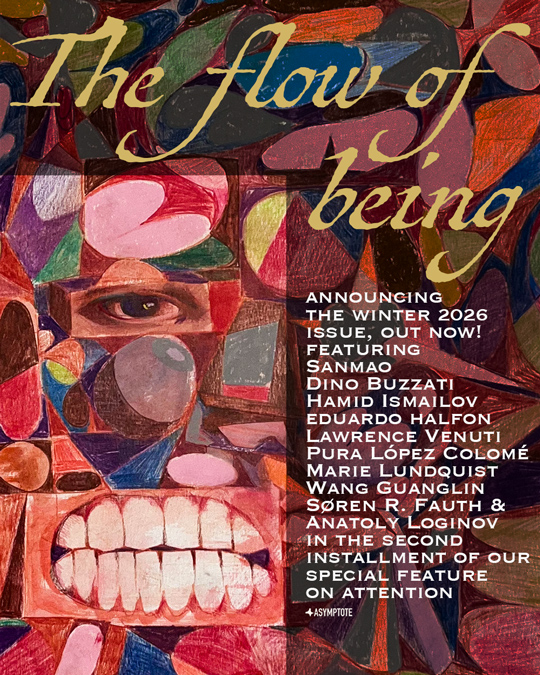
The Winter 2026 Issue Has Arrived!

World literature remains, at heart, a problem of attention: of who is seen, who is heard, and who is permitted to remain invisible.

As authoritarianism continues to take hold across the world, writers and translators are compelled to revisit an age-old question: What might art offer in response? Perhaps not answers, but something quieter and more resilient—a reminder of shared human frailty, and of the possibility that our “flow of being,” as Anatoly Loginov writes, might arrive at a “narrow neck” where attention itself becomes an existential force. Writing in our Winter 2026 Issue, which also marks Asymptote’s fifteenth(!) anniversary, Loginov turns to a literary and philosophical tradition that seeks “not mastery over an object, but communion with it, even if that communion burns.” For this second of our two issues devoted to attention, we bring together his tour de force survey of 200 years of Russian thought with a luminous travelogue by the beloved Taiwanese writer Sanmao, an excerpt from Guatemalan author Eduardo Halfon’s prizewinning Tarantula, an exclusive interview with Uzbek novelist Hamid Ismailov, a quietly devastating story by Italian master Dino Buzzati, and new translations of Milo De Angelis by Lawrence Venuti, alongside never-before-published work from 32 countries. All of it is illustrated by our talented Dublin-based guest artist Yosef Phelan.

Winter-2026_blog

If Loginov argues that attention, when cultivated deeply, can ground compassion toward others, Finnish playwright Minna Canth takes this ethical impulse further into the realm of collective action. In her barnburner drama, railway workers pushed beyond endurance channel their shared anger into defiant sabotage, making exploitation visible at last. Writing from a different frontline, Kurdish journalist Zekine Türkeri bears witness to life in the Mahmur refugee camp in the days preceding an ISIS attack, showing how attention to the living entails the inescapable labor of mourning the dead. Elsewhere, in Egyptian writer Mariam Abd Elaziz’s fiction, characters struggle to care for one another as they swim and sink in the deadly currents of maritime refugee smuggling. The issue’s arc closes with an interview in which China’s Wang Guanglin reflects on the difficulty of imagining a genuinely global literature at a moment marked by isolationism, xenophobia, and resurgent nationalism. World literature, he suggests, remains, at heart, a problem of attention: of who is seen, who is heard, and who is permitted to remain invisible.

For fifteen years, Asymptote has been organized around this problem. Founded on the conviction that literature across languages deserves sustained, serious attention, we have worked to widen the field of vision—introducing readers to voices beyond dominant centers, and treating translation not as a secondary act but as an ethical and imaginative practice in its own right. If this project has mattered to you—if you believe that attention, patiently given, can still resist the forces that would narrow our view—we ask you to help keep it alive by becoming a sustaining or masthead member. Your support ensures that the flow of being we trace here continues to move, freely and exuberantly, into the years ahead.

READ THE ISSUE

GET INVOLVED

Weekly Dispatches From the Frontlines of World Literature

The latest from Italy, Sweden, and Central America!

This week, our editors from around the world bring news of Palestinian solidarity and the necessity of individual action against genocide, debates surrounding culture and national identity, and the latest laureates of prestigious literary prizes. 

Veronica Gisondi, Editor-at-Large, reporting from Italy

Calls to end Italy’s complicity in Israel’s genocidal politics have intensified in recent weeks. While Italy’s economic and political ties to the Zionist regime are well known, citizens have been reclaiming public spaces with renewed unity and force. From statewide demonstrations on September 22—which drew more than half a million to the streets—to the general strike on October 3, many Italians have reached a breaking point underpinned by enduring forms of political grief. As the genocide in Gaza reaches its most advanced stages, the commitment of scholars such as Majed Abusalama reminds us why continued discussion is crucial: first, to anticipate how the neocolonial project will unfold—not only Israel’s, but that of its global allies—and second, to question our own role in it at “the harshest time of erasure,” both within and beyond cultural work.

Abusalama’s talk, titled “Il futuro di Gaza, la Palestina e noi” (The future of Gaza, Palestine and us), took place at CSA Vittoria, one of Milan’s squats—part of a network facing increasing threats (Leoncavallo’s eviction being a clear example) from municipal and state policies that accelerate urban privatization and erode the city’s relationship with its people. Abusalama, an award-winning journalist, human rights defender, founder of Palestine Speaks in Germany, and president of the Coalition of Lawyers for Palestine in Switzerland, described our present moment as the “last stage” of “a timeline of colonial violence” that has crushed past and future, scarring generations of Palestinians for nearly a century. By refusing to normalize their oppression, Palestinians have become experts in resistance and agency, effectively shaping models of struggle that had been later taken up by movements such as the Black Panthers and South Africa’s anti-apartheid groups. For Abusalama, to never know peace means to know one’s enemy well: for those who stand with Palestine, the enemy is imperialism, it is fascism; a fascism that “did not start on October 7,” but “has been there all the time, from the founding of Zionism until today.” READ MORE…

Weekly Dispatches From the Frontlines of World Literature

The latest from Egypt, Bulgaria, and Central America!

This week, our editors bring news of passed icons, emerging contemporary voices, and ongoing celebrations and commemorations of writers whose works continue to find relevance and vitality. Read on to find out more!

Ibrahim Fawzy, Editor-at-Large, reporting from Egypt

With the passing of the maverick Egyptian novelist Sonallah Ibrahim on August 13, Arabic literature has lost one of its fiercest voices and most uncompromising innovators. A novelist whose life and art were inseparable, Ibrahim transformed the experience of political imprisonment and disillusionment into a new literary form—a documentary style blurring the line between fiction and archive, testimony and imagination.

With his searing debut, That Smell—a slim novel once censored for its stark account of alienation and defeat—Ibrahim was widely regarded as a writer who heralded the arrival of the so-called “Generation of the Sixties.” From there, he would move into the biting satire of The Committee, the sprawling narratives of Sharaf and Warda, and the layered social chronicles of Zaat, documenting the disappointments and contradictions of modern Egypt with unparalleled clarity. His prose was stripped down, almost forensic, yet behind its austere surface pulsed the fury of a writer determined to expose what power sought to conceal. READ MORE…

Weekly Dispatches From the Frontlines of World Literature

The latest literary news from the Philippines, Canada, and Guatemala!

This week, our team members report on writers resisting governmental oppression, newly collected poems, one of the largest multilingual literary festivals in North America, and more!

Alton Melvar M Dapanas, Editor-at-Large, reporting from the Philippines

Writer, translator, and Amihan National Federation of Peasant Women organiser Amanda Socorro Lacaba Echanis, whose imprisonment PEN International has denounced as ‘a stark reminder of how governments silence female voices to suppress dissent’, has rolled out an unprecedented bid for the University of the Philippines (UP) Diliman student council while incarcerated under questionable charges.

The 36-year-old Bachelor of Arts (BA) in Malikhaing Pagsulat (Creative Writing in Filipino) student was arrested in 2020 for alleged illegal possession of firearms—an allegation she and several civil liberties organisations say is made-up. Amanda continues to write and translate behind bars, publishing her collection of poems, prose, and plays, Binhi ng Paglaya (Seeds of Liberation, Gantala Press) in 2023, and receiving fellowships from writing workshops like the Palihang Rogelio Sicat (which she attended virtually) in 2024. READ MORE…

Weekly Dispatches From the Frontlines of World Literature

The latest from Vietnam, Central America, and the ALTA conference!

This week, read about the annual conference of the American Literary Translators Association, the new pathways Vietnamese writers and translators are helping to pave in the Anglosphere, as well as the new accolades, conversations, and impact of Central American literatures.

Thuy DinhEditor-at-Large, reporting for Vietnam and the Vietnamese Diaspora

Han Kang’s recent Nobel win has spurred lively discussions among writers in Vietnam and the diasporic community on how to sustain and promote Vietnamese literature beyond its national borders. Thiên Kim, co-founder of UK-based Major Books, believes it’s not a quality issue but the scarcity of works being translated into English that has prevented Asian literature from being more widely appreciated.

To rectify the situation, Major Books has teamed up with talented translators Nguyễn Bình, Đinh Ngọc Mai, and Khải Nguyễn, among others, to present a “well-rounded portrait of Vietnam while preserv[ing] the integrity and … originality of each [translated] work.” Titles to be published in 2025-2026 range from a new translation of a beloved national epic (Nguyễn Du’s The Tale of Kiều), a broad satire on sexual mores during the French colonial era (Vũ Trọng Phụng’s Making a Whore), a gritty exploration of contemporary LGBQT culture (Vũ Đình Giang’s Parallel), to a biting social critique via the lens of folklore and existentialism (The Young Die Old by Nguyễn Bình Phương). READ MORE…

Weekly Dispatches From the Frontlines of World Literature

The latest in literary news from Central America, China, and North Macedonia!

This week, our editors-at-large take us around the world for updates on award-winning literature from Nicaragua and Guatemala; the blend of art and letters in recent events centering Chinese literature in translation; and a dedication to one of the most influential literary figures in Macedonia, the late Olivera Nikolova. 

José García Escobar, Editor-at-Large, Reporting for Central America

Last month, Mexico’s FIL (Guadalajara International Book Fair) announced that the Guatemalan editor Raúl Figueroa Sarti will receive the inaugural Federico García Lorca Prize. The Premio Federico García Lorca a la Libertad de Expresión y Publicación is awarded to people or organizations that have promoted and protected freedom of speech across Latin America and Spain. Raúl Figueroa Sarti is the founder and director of F&G Editores, one of Guatemala’s and Central America’s most renowned publishing houses, and in 2021, he also won APP’s Freedom to Publish Award.

READ MORE…

Weekly Dispatches From the Frontlines of World Literature

The latest literary news from Bulgaria and Central America!

This week, our editors-at-large fill us in on literary controversies, new releases, and returning festivals. From a conflict over a literary prize in Bulgaria to new short story collections from Asymptote alums, read on to find out more!

Andriana Hamas, Editor-at-Large, Reporting from Bulgaria

In July, I reported on the then unfolding conflict surrounding the proclaimed winner of the Novel of the Year award, given by the endowment fund 13 Centuries Bulgaria. It had turned out that Boris Minkov, the editor of the book (Вулкан or “Volcano” by Elena Alexieva), had also been a member of the jury, a fact that seemingly everyone had overlooked. The heated debates surrounding the legitimacy of the final choice led to Alexieva giving up her prize and the annulment of the decision.

In a recent development, Manol Peykov, managing partner at Janet 45, Вулкан’s publishing house, announced he would be withdrawing all nominated Janet 45 books from the competition as a way of making a statement against the way the above-mentioned crisis was resolved. The formal written withdrawal, which he shared on his personal Facebook profile, described the manner of dealing with the situation as “unacceptable, unprofessional, unethical and unfair.” The document questioned an existing legal ambiguity in the contest’s terminology: “No less worrying is the fact that neither [the organizers’] statements nor the published rules of the competition make it clear exactly what the definition of ‘conflict of interest’ is. Is it a conflict of interest for a member of the jury to have been or currently be published by one of the participating publishers? Or be close friends (or even bitter enemies) with any of the nominees? Or to have very recently received an unequivocal rejection from one of the other participating publishers?”

An official reply has yet to be issued. READ MORE…

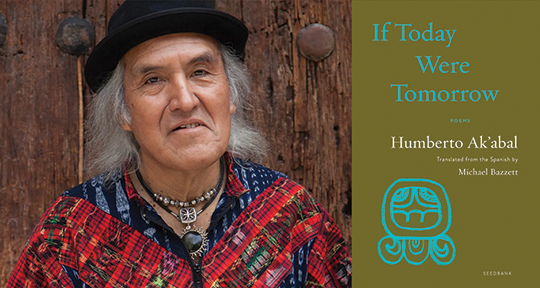
Ways of Seeing: On Humberto Ak’abal’s If Today Were Tomorrow

What do they think, those who we believe don’t think at all?

If Today Were Tomorrow by Humberto Ak’abal, translated from the K’iche’ and Spanish by Michael Bazzett, Milkweed Press, 2024

To read Humberto Ak’abal is to be transported: first to the Western Highlands of Guatemala, full of mountainous forests and ravines where corn grows amid the mist, and then through the natural world and toward everything it encompasses—the elements, their sounds, and even their language. In a world where the sun eats the mist, butterflies kiss the earth, and peach trees weep, the boundaries of the conscious world expand to envision a new, shared world. 

Humberto Ak’abal was a K’iche’ Maya poet from Guatemala. His book Guardián de la caída de agua (Guardian of the Waterfall) was named Book of the Year by the Association of Guatemalan Journalists, and he was awarded the Golden Quetzal award in 1993. A world-renowned Guatemalan poet, Ak’abal oscillated between writing in K’iche’—his mother tongue—and Spanish, the official language of Guatemala. This new collection, published by Milkweed Press in June, spans five sections, each delving into a different facet of the poet’s oeuvre, while always retaining his essence, humor, and care for the natural world. 

READ MORE…

Blog Editors’ Highlights: Summer 2024

A deeper look into our Summer 2024 issue!

With so many wonderful pieces in the Summer 2024 issue, where to start? Read the blog editors’ top picks.

We loved Eduardo Galeano when he spoke of “the infinite and invisible altars of our Latin America”, but perhaps we paid not enough attention when he called reality “. . . life that sings with multiple voices”. Despite the efforts of many historians and writers in establishing the distinctions and singular complexities of Latin American countries, outsiders tend to cohere the regions in a syncretic whole, held by the commonalities of language, Iberian colonialism, and modals of development. The term “Latin America” originated with the Chilean philosopher and politician Francisco Bilbao, who sought to contrast Europe and the Americas as past and future, instating a rhetoric in which the archaisms of the former could be overturned by the luminous visions of the latter: “. . . reason against religion, hope against tradition, union against isolation. . . the logic of sovereignty against oligarchic constitutions”. This summation of continents may have served him when the routes of imperialism carved the globe up into the Old World and the New World, but we’ve no use for such simplistic declarations today.

In “neozone”, the Chilean writer Juan Carreño is on the road. In a diaristic frenzy, this excerpt translated by Maya Feile Tomes moves from Mexico’s San Cristóbal to the city of Comitán, then past the Guatemala border with a stop at the capital, before urging its way towards the Nicaraguan capital of Managua (“crossing the whole of El Salvador and that little stretch of land where Honduras borders on the Pacific”). All the while the writer’s mind is running faster than the speed of any car or bus, threading in memories and markers across this immensely varied continent in the electric instantaneity of mobility, when every new encounter sends itself hurtling across the mind, awakening memories, desires, references, the middles of anecdotes, connecting itself to the great shifting web of a body amongst. Yet, even as the sights, the people, the landscape are playing their own pinball game within the ratting corridors of Carreño’s journals, the stark insider-outsider paradigm finds plenty of iterations in movements and border-crossings, illumed within the subtle details of social code—“I try to speak Spanish in a generic fashion”—that characterises the Chilean against the Guatemalan, the Mexican, the Nicaraguan. Regionalisms, habits, and assumptions abound, and the people who offer their company or a splinter of their story are as open as they are fleeting, honest in a way that is only possible without surnames. Holding to the shared language that occasionally sizzles with the separateness of nationalities, they share opinions, invitations, songs, insights. There’s something familiar, profound in this incidental intersection of the passing-through, when finding oneself in a different country and suddenly given the position of ambassador, as if a person is a miniaturised model of a nation. And when you tell them about where you came, you give the truth as only you could, and the country glows a little in response, in that stranger’s mind, and another house is built on the phantasmagorical, long accumulated, imagined atlas of the world—that which makes the maps seem paltry in comparison. READ MORE…

Weekly Dispatches From the Frontlines of World Literature

The latest from Guatemala, Taiwan, China, and France!

This week, our editors take us through Central America, France, and China to explore the reaches of literature, from a transcendent event honouring the poems of Robert Bolaño, to the new World Book Capital in France, and works featuring vital new voices from the Chinese language. Read on to find out more!

Rubén López, Editor-at-Large, reporting from Central America

When I entered the room, it looked like a coven: a group of people gathered around an edition of Roberto Bolaño’s Complete Poetry. Each member of the group would take turns to step into the centre, leaf through the text for a moment, and then recite one of the Chilean author’s poems at random, like a poetic Russian roulette. As I took my seat, one of the young men was reading the final verses of “The Romantic Dogs”. I had arrived at the event without much certainty about what it would be like; the poster from Perjura Proyecto, a cultural and artistic dissemination space, only said “The Poetry Came” and had a sketch of Bolaño’s silhouette. And, of course, it also mentioned the date and time—May 23, 17:00.

When it was my turn, I decided I wanted to read “Godzilla in Mexico”, my favorite poem by Bolaño. I clumsily flipped through the text while trying to make conversation with the rest of the participants, but I couldn’t find it. I apologised to the group because I would break the Russian roulette and put the bullet in the centre; I searched for it on my phone. As I recited “Yo leía en la habitación de al lado cuando supe que íbamos a morir”, I was overcome with a deep tenderness. I saw us, in the midst of a vertiginous and infamous city—a group of no more than ten people gathered to read Bolaño’s poems to each other. I thought about the infinite forms of cultural resistance in which we exist, all self-managed, all on the margins, all filled with beauty. READ MORE…

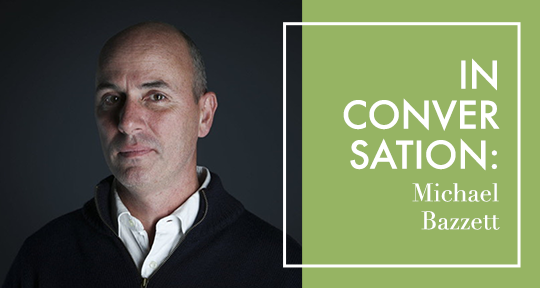
Translating Humberto Ak’abal: An Interview with Michael Bazzett

[Humberto Ak’abal’s] poetry lives in the silences around the work, in the emptiness of the page, like the hollow of a bell.

In January 2019, Maya K’iche’ poet Humberto Ak’abal passed away, thus transcending into the eternal silence—perhaps the same silence inhabited by his seismic poems. He was sixty-six.

In life, Humberto published more than thirty books, and his work has been translated into more than twenty languages—including English, French, German, Italian, Portuguese, and Arabic. He remains a towering figure for indigenous and Maya literature, as well as one of Latin America’s most beloved and inventive poets. Humberto wrote extensively about family, time, colonialism, men’s relationship with animals and nature, indigeneity, the plight of the indigenous people in Guatemala, and the Guatemalan genocide. He used onomatopoeia and cacophony to describe his surroundings, and his poems are imbued with devastating political commentary and subtle humor. Carlos Montemayor and Antonio Gamoneda admitted to being fans of Humberto’s poetry, and in 2006, he became a Guggenheim fellow.

One cannot overstate the importance, quality, originality, and poetic sensibility of Humberto Ak’abal. Though his work has been previously translated into English, a new translation shines a new light on Humberto’s devastating poems. This June, Milkweed Editions will publish If Today Were Tomorrow, a book of poems written by Humberto Ak’abal and translated by Michael Bazzett, the author of The Echo Chamber. If Today Were Tomorrow is a beautifully crafted, comprehensive, and faithful approximation and representation of Humberto’s work. I had the opportunity to interview Michael Bazzett on Humberto’s legacy, the experience working between K’iche’, Spanish, and English, and the translation of silence.

José García Escobar (JGE): In 2018, you famously put out your translation of the Maya’s creation myth, The Popol Vuh. Naturally, we find many references and similarities between The Popol Vuh and the poetry of Humberto Ak’abal. Can you describe how translating The Popol Vuh prepared you or helped you translate Humberto’s poetry? Or maybe it was the other way around. I know you’ve worked on If Today Were Tomorrow for many years.

Michael Bazzett (MB): In the opening of The Popol Vuh, when it came time for the gods to create the world, “it only took a word. / To make earth they said, ‘Earth’ / and there it was: sudden / as a cloud or mist unfolds / from the face of a mountain, / so earth was there.”

I’ve always sensed an entire theory of language swirling inside this moment—one that continues, of course, throughout the entirety of the myth—where words are energy, tethered intrinsically to what they call forth. As such, they are not imposed by humans upon the landscape, like labels or sticky notes, but instead uncovered through careful listening and observation of the world around us. If Humberto’s work is built on anything, it is careful listening and observation. One learns very quickly by reading his poems. For instance, in K’iche’, the call of a bird is synonymous with its name, including the little orange & brown plumed bird, “Ch’ik,” who hops “happily / among the fresh shoots”:

Ch’ik is her song,
Ch’ik is her name.

READ MORE…

Weekly Dispatches From the Front Lines of World Literature

News from India and Central America!

The future is in translation! Catch up on global literary news as our editors report on major international award winners, breakthrough publications, and exhibitions fusing poetry with visual art.

Areeb Ahmad, Editor-at-Large, reporting from India

On April 9, Madhu Sriwastav was announced as the winner of the 2023 Muse India’s GSP Rao Translation Award for her work on Post Box 203 Nala Sopara by Chitra Mudgal, translated from the Hindi. Three other translators on the shortlist also received the jury’s commendation: Priyamvada R for her translation of Jeyamohan’s Stories of the True from the Tamil; Sridhar M and Alladi Uma for their translation of Telugu: The Best Stories of Our Times, edited by Volga; as well as Ratan Kumar Chattopadhyay for his translation of Manik Bandyopadhyay’s The Puppet’s Tale from the Bengali.

In other book prize news, the jury of the 2024 JCB Prize for Indian Literature was recently announced. Chaired by writer and translator Jerry Pinto, the other members include art historian and curator Deepthi Sasidharan; filmmaker and writer Shaunak Sen; scholar and translator Tridip Suhrud; and the artist Aqui Thami. The prize is currently open for entries, with the shortlist, the longlist, and the winner announced in September, October, and November respectively. Since the prize began in 2018, five out of six winners have been books in translation, with three out of those five being originally written in Malayalam. READ MORE…

Weekly Dispatches From the Front Lines of World Literature

The latest of literary news from Guatemala, China, and Japan!

In this week of literary updates, we discuss the blend of technology and literature around the globe—from a virtual imagining of the Popul Vuh in Guatemala, to the use of ChatGPT by the winner of a prestigious literary award in Japan, to an interactive exhibition of Wisława Szymborska’s poetry in Shanghai.

Xiao Yue Shan, Blog Editor, reporting for China

Despite having famously said, in an interview with Edward Hirsch, that “it isn’t possible to save mankind”, Wisława Szymborska displayed no shortage of compassion towards humanity and its messes, surging always towards a more enriched penetration into people, the layered fabric of their histories, and the immense variegations of their natures. In China, funnily enough, most people likely became aware of the Polish poet through a celebrated graphic novel by the Taiwanese artist Jimmy Liao;《往左走,往右走》(published in English as A Chance of Sunshine) is a story about destiny and its aloneness—depicting two individuals who walk separate paths but are unified by the same experiences. In it, Liao borrows the following lines from Szymborska’s “Love at First Sight”:

They’re both convinced
that a sudden passion joined them.
Such certainty is beautiful,
but uncertainty is more beautiful still.

That same tension between unity and undeniable difference is consistently offered through Szymborska’s corpus, and is central to a new exhibit in Shanghai centred around her works, held at Qiantan L+Plaza from April 1 to May 15. Composed of interactive installations, performances, and graphic poetic representations,  “我偏爱“ (I prefer) is a valiant effort to iterate the complexity of the poet’s exquisite awareness, and aspires towards both a sense of communion and a defense of individuality. True to its vision of dialogic action, as well as honouring literature’s confessional and communicative capacities, there are surveys to fill out, votes to cast, letters to open, and a telephone to pick up. READ MORE…