Place: Ecuador

Winter 2026: Highlights from the Team

Still not sure where to start with the new issue? Let our team members be your guide!

Reading Minna Canth’s Children of Misfortune (translated from the Finnish by Minna Jeffery) felt like a jolt of moral clarity. In a year when I stopped apologizing, the play reminded me why anger, when shared and articulated, can still feel invigorating. Canth refuses the lie that oppression is inevitable, insisting instead that the world we inhabit was made and can be remade. There is something bracing, almost ecstatic, about watching oppressed people unite in fury, turning their rage against the lifeless property their masters prize so dearly.

That same refusal of appeasement runs through Hélène Laurain’s On Fire (tr. Catherine Leung from the French), whose blunt, abrasive narrator feels almost instructive in a moment when calls for meek compromise echo as loudly as calls for violence. Laurain offers no heroes, no romanticism, only a clear-eyed account of what resistance actually costs: police brutality, surveillance, isolation, depression. And yet resistance remains necessary, as does art.

If Canth and Laurain speak to the anger of the present, Zekine Türkeri’s A Jihadist Dried Up a Sea (tr. Keko Menéndez Türkeri from the Turkish) does justice to its grief. Few endings have struck me as forcefully as Türkeri’s explanation of the title. Stripped of sentimentality, the piece insists that meaning is not born from grief but constructed against it, and that only by recognizing our shared pain can we find the strength to go on.

That recognition undergirds Anatoly Loginov’s The Narrow Neck of Being (translated from the Russian by the author himself), a staggering survey of attention in Russian literature. For all its scholarly precision, the essay is bound to the issue’s most politically outspoken works by its insistence that attention and suffering are inseparable. To be aware is to be fragile, mortal, and therefore attuned to the vulnerability of others. Loginov’s call to spend attention lavishly, even on another’s suffering, feels like an ethical compass for an age of ceaseless crises.

I ended my reading in a quieter register with Rokhl Korn’s Four Poems (tr. Pearl Abraham from the Yiddish). Their exactness captures the shared longing of romantic love, but what stayed with me most was Korn’s use of the future tense in “My Wait” and “My Dreams.” Desire, she seems to accept, will never be fulfilled. And still, she grants it beauty.

—Julia Maria, Digital Editor

Reading Zekine Türkeri’s A Jihadist Dried Up a Sea (tr. Keko Menéndez Türkeri from the Turkish) alongside Sidsel Ana Welden Gajardo’s As a Child of a Refugee, I Have Learned That War Lives on Across Generations (translated from the Danish by the author) was devastating. Even knowing, intellectually, that war and displacement scar across generations, both pieces force a confrontation with that truth. Türkeri reminds us that every person in a refugee camp carries a story worthy of more than a report, while Gajardo’s letter to her father wrestles with how trauma persists long after exile, living on in loneliness and the mind. If time heals, these pieces ask, what does healing even look like? Can war ever truly end?

I was struck, too, by A Poetic Psychology of Attention, the interview with Kristin Dykstra, particularly her observation that interruption itself can signify. In a world saturated with stimuli, dissonance becomes not a flaw but a necessity. Estranging ourselves from the familiar may be the only way to recognize what realities truly matter. READ MORE…
The Winter 2026 Issue Has Arrived!

World literature remains, at heart, a problem of attention: of who is seen, who is heard, and who is permitted to remain invisible.

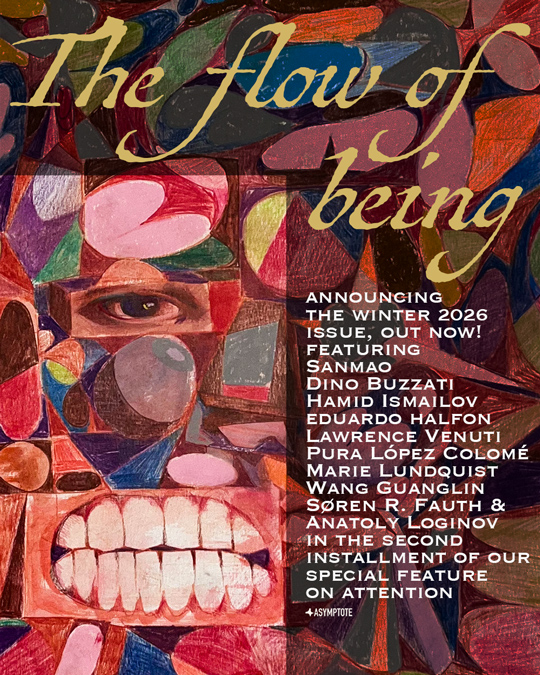
As authoritarianism continues to take hold across the world, writers and translators are compelled to revisit an age-old question: What might art offer in response? Perhaps not answers, but something quieter and more resilient—a reminder of shared human frailty, and of the possibility that our “flow of being,” as Anatoly Loginov writes, might arrive at a “narrow neck” where attention itself becomes an existential force. Writing in our Winter 2026 Issue, which also marks Asymptote’s fifteenth(!) anniversary, Loginov turns to a literary and philosophical tradition that seeks “not mastery over an object, but communion with it, even if that communion burns.” For this second of our two issues devoted to attention, we bring together his tour de force survey of 200 years of Russian thought with a luminous travelogue by the beloved Taiwanese writer Sanmao, an excerpt from Guatemalan author Eduardo Halfon’s prizewinning Tarantula, an exclusive interview with Uzbek novelist Hamid Ismailov, a quietly devastating story by Italian master Dino Buzzati, and new translations of Milo De Angelis by Lawrence Venuti, alongside never-before-published work from 32 countries. All of it is illustrated by our talented Dublin-based guest artist Yosef Phelan.

Winter-2026_blog

If Loginov argues that attention, when cultivated deeply, can ground compassion toward others, Finnish playwright Minna Canth takes this ethical impulse further into the realm of collective action. In her barnburner drama, railway workers pushed beyond endurance channel their shared anger into defiant sabotage, making exploitation visible at last. Writing from a different frontline, Kurdish journalist Zekine Türkeri bears witness to life in the Mahmur refugee camp in the days preceding an ISIS attack, showing how attention to the living entails the inescapable labor of mourning the dead. Elsewhere, in Egyptian writer Mariam Abd Elaziz’s fiction, characters struggle to care for one another as they swim and sink in the deadly currents of maritime refugee smuggling. The issue’s arc closes with an interview in which China’s Wang Guanglin reflects on the difficulty of imagining a genuinely global literature at a moment marked by isolationism, xenophobia, and resurgent nationalism. World literature, he suggests, remains, at heart, a problem of attention: of who is seen, who is heard, and who is permitted to remain invisible.

For fifteen years, Asymptote has been organized around this problem. Founded on the conviction that literature across languages deserves sustained, serious attention, we have worked to widen the field of vision—introducing readers to voices beyond dominant centers, and treating translation not as a secondary act but as an ethical and imaginative practice in its own right. If this project has mattered to you—if you believe that attention, patiently given, can still resist the forces that would narrow our view—we ask you to help keep it alive by becoming a sustaining or masthead member. Your support ensures that the flow of being we trace here continues to move, freely and exuberantly, into the years ahead.

READ THE ISSUE

GET INVOLVED

Our Fall 2025 Issue Is Here!

Featuring Nay Thit, Jen Calleja, Patrick Autréaux, and Johanna Drucker in our Special Feature on Attention

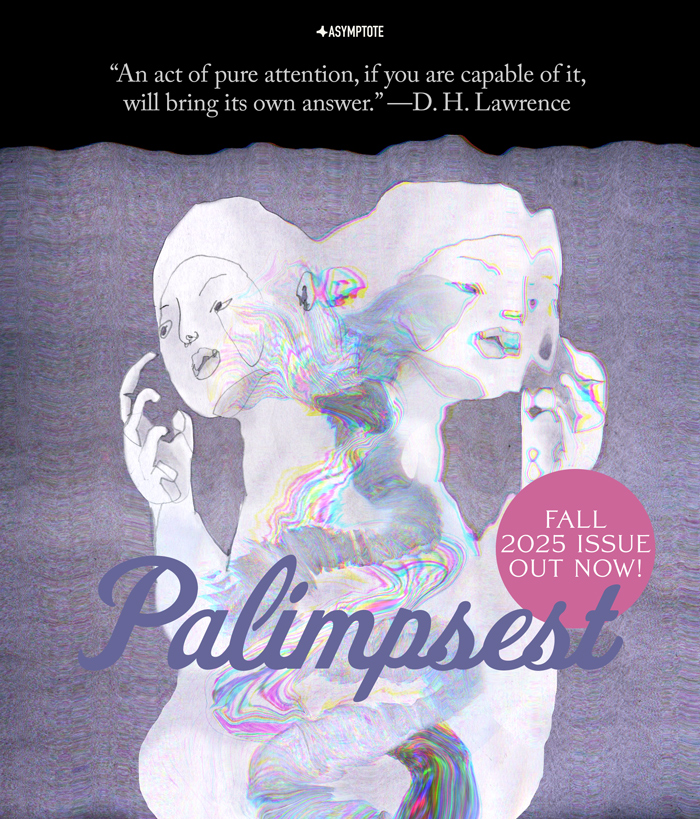
The world rewrites itself daily, unable to leave the past alone. As Trump’s relentless theatre once more monopolizes our gaze—proof, perhaps, of what Johanna Drucker, in her timely essay “Attention as Predation,” diagnoses as a civilization that is consumed even as it consumes—the question becomes what still endures beneath the smudged text of the present. Palimpsest, our Fall 2025 issue illustrated hauntingly by UK-based visual artist Jayoon Choi, turns to those deeper inscriptions: the faint, resistant traces that refuse to fade, the ghosts of meaning that survive the next rewrite.

In Amanda Michalopoulou’s “Desert,” Athens emerges as a manuscript of light and stone, its ruins glowing like marginalia of time. Carla Mühlhaus overlays the Black Dahlia murder and Andersen’s mermaid over Venice’s 2019 acqua alta, letting myth and crime shimmer beneath the rising waterline. Likewise, Barbara Köhler gives Homer’s Penelope her overdue monologue—both weaver and mermaid surfacing from the sediment of male authorship to reclaim their narratives. From Kazakhstan, Marat Uali laments the vanishing of minority tongues, an anxiety echoed in Tim Brookes’s interview on his Endangered Alphabets Project, where each carved script becomes an act of remembrance. In William Heath’s sparkling update, Herodas gives us drama composed on papyri—reminding us that even the most fragile art can defy oblivion.

blog-full
This issue’s wildcard Special Feature, “On Attention,” brings together thinkers and storytellers who resist the culture of erasure. Monika Vrečar asks whether poetry can still exist amid the static while Farah Ahamed, in an astute piece of film criticism on the Bollywood classic “Lagaan,” notes that the monsoon is also a season in the body. Elsewhere, Korean artists Koi and Hyungmee Shin—hailing from opposite sides of the 38th parallel—make masterful use of fabric to create radiant topographies of encounter, while Ecuadorian master Pablo Palacio’s “The Double and Singular Woman” (tr. Thomas Taylor) anatomizes the fractured identity of a pair of conjoined twins with a proto-modernist precision that feels radical in our own fragmented age. To read these works together is to experience literature’s own layered materiality.

If this issue has a thesis, it is that world literature does not replace; it accrues. Help us write the next layer: submit to the second installment of our “On Attention” Special Feature (as well as to our regular categories) and apply to join the team (deadline: November 1st)—we especially welcome applicants to the Assistant Editor (Fiction) role. A final note for the record: László Krasznahorkai, this year’s Nobel laureate in literature, appeared in our pages twice—long before Stockholm called. If this kind of early, global advocacy matters to you, please become a sustaining or masthead member today—the vital margin note that keeps this palimpsest legible, and gloriously alive.

READ THE ISSUE

HELP US BRING YOU MORE ISSUES IN 2026

A Sacred Collaboration with Nature: An Interview with Natalia García Freire and Victor Meadowcroft

I try to find answers in nature, in the mountains, the volcanoes, the animals—I wait for them to tell me something.

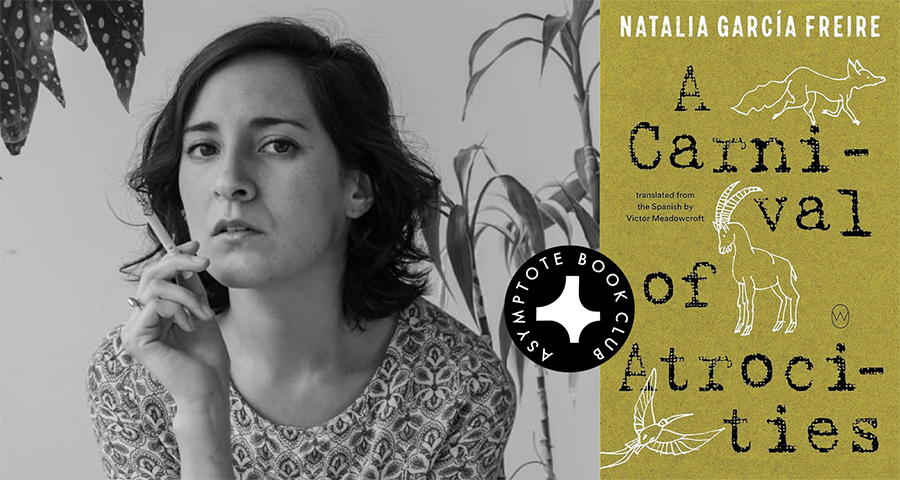
One finds a symphony of lyricism, naturalism, and generational phantasms in A Carnival of Atrocities, the latest novel from Ecuadorian writer Natalia García Freire and our Book Club selection for the month of May. Through a succession of perspectives that enmesh and build, a town and its chaotic history comes into view, and with it an illumination of postcolonial fractures, ecological conflicts, and tensions between the human and the divine. In this following interview, the author and her translator, Victor Meadowcroft, speak to us about the creation and the English rhythms of this complex narrative, as well as its place in the great, varied canon of Latin American writing.

The Asymptote Book Club aspires to bring the best in translated fiction every month to readers around the world. You can sign up to receive next month’s selection on our website for as little as USD20 per book; once you’re a member, join our Facebook group for exclusive book club discussions and receive invitations to our members-only Zoom interviews with the author or the translator of each title.   

René Esaú Sánchez (RES): I would like to start by asking both of you about the title of the novel, A Carnival of Atrocities. The original title in Spanish is Trajiste contigo el viento, which could be translated like You Brought The Wind With You, highlighting the mythical connection between Mildred—the character at the center of the novel—and nature.

Victor Meadowcroft (VM): That was actually a publisher’s decision. My original working title was the literal translation of You brought the wind with you. We also changed the title of Natalia’s debut novel, This World Does Not Belong To Us (originally, Nuestra piel muerta), so that could possibly be why they decided to do the same with the second one. Or maybe they thought that the title didn’t sound as nice as it does in Spanish, because they had asked me to look through the book to see if I could find some lines that might work well. I came up with a list of ten possible titles and the publisher loved A Carnival of Atrocities; at one point she said she wanted to call all her books A Carnival of Atrocities from then on. And Natalia was very happy to go with that title, so it was a publisher led decision, rather than a translator led one.

RES: What are your opinions on the title, Natalia?

READ MORE…

Announcing Our April Book Club Selection: A Carnival of Atrocities by Natalia García Freire

A dark chorus . . . unfurling a portrait of an unraveling community.

In Ecuadoran writer Natalia García Freire’s latest novel, A Carnival of Atrocities, rising from the landscape is a swirling, multivocal, and vivid portrait of a small town torn apart by prejudices and suspicion. There may be something rotten buried deep in the earth—but perhaps it is history itself. With an expert, distinguished lyricism translated melodiously by Victor Meadowcroft, García Freire aims her incisive sights on the violence and hatred that pervade amidst dissenting belief systems, gesturing towards the ways a limited, desperate existence can further inhibit our shortsighted perspectives.

The Asymptote Book Club aspires to bring the best in translated fiction every month to readers around the world. You can sign up to receive next month’s selection on our website for as little as USD20 per book; once you’re a member, join our Facebook group for exclusive book club discussions and receive invitations to our members-only Zoom interviews with the author or the translator of each title.   

A Carnival of Atrocities by Natalia García Freire, translated from the Spanish by Victor Meadowcroft, World Editions, 2025

There is something about a fictional town that allows their inventors to bend the rules of everyday life—to infuse these imagined destinations with magic, tragedy, and often fear. In novels like Gabriel García Márquez’s One Hundred Years of Solitude or Juan Rulfo’s Pedro Páramo, the respective towns of Macondo and Comala have become canonical spaces to reflect on death, family, faith, tradition, and the world itself. Natalia García Freire’s A Carnival of Atrocities is no exception: in the fictional town of Cocuán, myth, brutality, and poetic cruelty intertwine.

READ MORE…

Elementalia: Chapter II Water

The more I try to hold it, to shape it, the more it slips away from me, laughing at my hubris that tries to contain water.

Humans throughout history have been fascinated by the elements. Unfathomable forces of nature, they entered our myths and minds aeons ago. There’s no time when we’re not in their thrall. Drawing from the vast store of our collective imagination across mythology, philosophy, religion, literature, science, and art, I present Elementalia, a series of five element-bending lyric essays that explores their enchanting stories and their relationship with the word—making, translating, and transforming meaning and message. This is not an exhaustive (nor exhausting) effort that covers every instance of and interaction with each element, but rather an idiosyncratic, intertextual, meditative work—a patchwork quilt of conversations with other writers, works, and texts across space and time.

Water above and below.
Water outside and inside.
Water of the past and water of the future.
Water of the world and water of the word.
Water always finds a way.


READ MORE…

Yet So Alive: A Collection of Groundbreaking Latin American Horror Stories

The horror in all of these stories slithers in stealth . . .  it quietly intoxicates, revealing its true colors in a hypnotizing fashion.

Through the Night Like a Snake: Latin American Horror Stories, Two Lines Press, 2024

For some time now, Latin American literature has engrossed readers with magical realism, fantasy, surrealism, and most recently, horror. These aren’t necessarily the stories of the region’s most considered authors—Jorge Luis Borges, Gabriel García Márquez, Horacio Quiroga, Amparo Dávila, and other giants among them—but rather the work of bold, fearless, and independent writers who, in the last decade, have honored and twisted these genres in unprecedented ways. Their work represents a new generation of talents, who are redefining their region’s legacy in gothic literature.

Many call it horror. Others, like Carmen Alemany Bay, a literary scholar at the University of Alicante, call it “narrativa de lo inusual”—narrative of the unusual, or the strange, defining a subgenre “in which the reader is ultimately the one who decides what is possible and what is not.” Whatever one wants to call it, the certainty remains that these voices are as powerful as they are unflinching, grounded by a sincerity and authenticity faithful to their geographies; that is to say, these stories are as “unusual” as they are Latin American, which is in part what makes Through the Night Like a Snake all the more visceral.

READ MORE…

Weekly Dispatches From the Frontlines of World Literature

The latest from Central America, Spain, and China!

This week, our Editors-at-Large bring us around the world for the latest of literary news! From a brilliant cast of Central American authors at Madrid’s upcoming literary festival, to an inside glimpse into Spain’s translation residencies, to a thought-provoking workshop at China’s aBC Art Book Fair, read on to learn more!

José García Escobar, Editor-at-Large, reporting for Central America

Central America’s brightest stars are about to come together yet again!

On September 18, the latest edition of the region’s most celebrated literary festival, Centro América Cuenta, will kick off in Madrid, Spain!

This time, Centro América Cuenta will gather regional talents such as Arnoldo Gálvez Suárez (Guatemala), Cindy Regidor (Nicaragua), Horacio Castellanos Moya (El Salvador), Mónica Albizúrez (Guatemala), Rodrigo Rey Rosa (Guatemala), and Sergio Ramírez (Nicaragua), next to Latin American and Spanish writers such as Mónica Ojeda (Ecuador) and Patricio Pron (Argentina). One high point of the festival will occur on September 18, when former president of Costa Rica, Luis Guillermo Solís, and former Guatemalan jurist living in exile, Thelma Aldana, will gather to discuss the current state of democracy in Central America.

READ MORE…

Summer 2023: Highlights from the Team

Still looking for entry points into our brand-new Summer issue? Members of our multi-continental team offer you several!

From the Indonesian Feature in the Summer edition, I was intrigued by the poems of Nirwan Dewanto, in vivid translations by John H. McGlynn, including “The Way to the Museum,” which begins with “All eyeballs dipped in the vinegar of the bourgeoisie will become pickled eyeballs” and continues, in long lines, to contemplate class, blindness, and revolution. It resonated against the pathos and absurdity in excerpts from Ulrike Draesner’s Schwitters, translated by Sharon Howe, and Tatiana Niculescu’s play Brancusi v. United States, fresh portraits of European Modernist artists Kurt Schwitters and Constantin Brâncuși, respectively. In each case, as the exile of the artist comes to the fore, the language of their place of origin is woven into the text, along with glimmers of humor. I particularly appreciated the note from Niculescu’s translator Amanda L. Andrei, which describes the process of working, as a heritage speaker, with her father Codin Andrei: “The emotional challenge [of translating this work] lies in my own hang-ups of being a non-native speaker due to political and historical forces beyond my control. When we co-translate, my father and I converse about Romanian culture from a perspective free of Western stereotypes of communism, vampires, and oppression, and we are delighted.” Finally, I was swept up in the atmospheric excerpt from Habib Tengour’s Women of the Odyssey (tr. Teresa Villa-Ignacio) while listening to Tengour’s mellifluous reading of the subtle text in French, describing those who console themselves by “sticking ear in seashell” or the “Unfinished / Wave bringing you to the threshold.”

—Heather Green, Visual Editor

I adore the rush of the speaker’s voice in Enrico Remmert’s The War of the Murazzi (tr. Antonella Lettieri), and its syntactical verbality, meandering but never losing control, digressing into tightness, into an accumulation of narrative stress. I love as well the narrator’s contextualisations of the backdrop of Turin and its historico-social problems with violence, particularly in a refugee context: Turin feels masterfully integrated into the plotline, like a combattant in the Murazzi war itself, and the vivacity of its violence continues running, naturalistic, organic, as the “river never stops running.”

The textuality of Mateo Díaz Choza’s Precipitations (tr. Lowry Pressly) is staggering: the dual columns that inform multiple methods of reading the poem, as well as the materiality of the poem, almost transforming it into an object itself. The way the words waterfall down the screen mimic the “drop,” a kind of fall from heaven, in a mode that lends itself to the digital form undoubtedly better than it would a magazine or a standard-format book, in the “depths of the page” that ultimately do not supercede the infinite scroll of the screen. When the poem’s substance and words meet and meld into each other, the poem’s two columns also merge into one, into the “weather,” “snow-mute” but “beautiful” in the void of its meaning. Choza creates an aesthetics of decay, of death, of abandonment, but of regeneration as well. The drop recurs again and again; the speaker will continue to recognise his lover, again and again.

I love the adventure of Amyr Klink’s One Hundred Days Between Sky and Sea (tr. Rachel Morgenstern-Clarren), the sense of movement through space and time that underpins the narrator’s paradoxical stillness, immobility. It is remininescent of Jules Verne’s Voyages extraordinaires, venturing beneath the sea or into the heart of volcanoes, on a journey pushing against the boundaries of human capacity. Klink melds the joy and exuberance of a child discovering the world with a practical, didactical style of writing that underpins the veracity of his voyage. I find this piece particularly apt for Asymptote as a vessel in the sea of understanding, a buoy of translation in the archipelago of languages.

I appreciate Asymptote‘s continued dedication to featuring Ukrainian writing in each issue, particularly Ukrainian writing about the Russian invasion. In my view, this is one of the most essential tasks of literature in translation: to continually draw attention to the diversity of global experiences; to remind us that our lives are not insular, that we are not islands. To that end, I found Anton Filatov’s Finding Myself at War (tr. Patricia Dubrava) both heart-wrenching and vital. As his “eyes bleed” before the cruelty of false news stories, so do readers’ eyes before the horrors of Ukrainian soldiers’ war experiences. They are given voice not in those news stories, but in literature. Sharing their stories—and I love the detail of the abandoned cat, ironically (or not?) named Death, as well as the final section on cinema—is an act of taken care.

I find Nicole Wong’s discussion of translation theory in The Terroir of a Single Work: Redefining Scope in Approaches to Translation incredibly pertinent and eloquent, and I particularly enjoy the ‘close reading’ section where she dissects her own translation of Proust. It’s a priviledge to experience the clarity and sharpness of such a mind through this piece. Her style is reminescent of Kundera’s narrator in The Unbearable Lightness of Being: playful, heavy on metaphor without falling into abstraction, clear, enlightening (and bearably so!). Since reading this piece, I’ve found myself returning to it as I internalise and integrate her analysis into my own understanding of translation.

 —Michelle Chan Schmidt, Assistant Editor (Fiction)

READ MORE…

Blog Editors’ Highlights: Summer 2023

Taking a closer look at pieces on landscape’s multiplicity, unrequited love, and memory amidst grief.

Launched four days ago, our blockbuster Summer 2023 issue gathers never-before-published writing from a remarkable thirty countries—including a spotlight on Indonesia. Don’t know where to begin with this thrilling mélange of established and emerging voices? To help you dip your toe into this brand-new edition brimming with literary gems, our blog editors take you through their favorite pieces. Read on!

Within the tensions of unrequited love, the transformative faculties of ardor conduct their most astounding magic. Time is stretched to its utmost limits, unbound feelings hit a multiplicity of extremes, and the physical proof of reality collapse under the extraordinary pressures of belief. There’s not a lot of happiness that can be found amongst the shifting phantasms and polarities of this condition, but there is plenty of beauty, of poetry, of hope and awe, all of it stemming from nothing but the imagination in overdrive, sparked brilliantly alive by the beckoning figure of desire.

There are many examples of such love to be found in life and art, but one that seems particularly difficult to understand is the love of a fan. The indulgent culture of fandom gives free reign to displays of love-as-devotion, ranging from pedestrian claims of destiny to reckless acts of sacrifice—and because it often inflicts the young and the hyperbolic, its passions are seen as lacking any certifying element of truth. A one-sided, disingenuous, superficial love. But just try telling that to a fan.

In an excerpt from her novel, Phantom Limb Pain, Heejoo Lee does much to redeem this expressive, unrestrained love. Tracing the contours of a fan’s deep—even vicious—adulation for an idol, Lee’s forthright prose, translated with a sensitive colloquiality by Yoojung Chun, reaches a tender, natural honesty, describing an emotion that gives a rhythm to the days and months, a thrill to the pedestrian events of waiting and wanting, and a vividity to the fantasies making life more beautiful. Manok, the young woman who paves the way for our nameless protagonist into fandom, is “downright shameless,” keenly following her idol’s every move, openly displaying her possessive jealousy, and attributing her love to an act of God. Being a fan in South Korea’s multibillion-dollar idol industry is nothing less than laborious; fans religiously attend promotional events, spare no expense in purchasing goods and merchandise, and “pour their hearts out” at every opportunity. From the outside, one is made to wonder what any individual gets out of this all-consuming lifestyle, and here, Lee explains it to us through Manok, with the eloquence of absolute sincerity:

Their presence stayed mysterious over repeated encounters, and it refused to be locked into language. Their real presence rendered everything in high relief, so that everything—even their shadows or things that might be their shadows—became amazing to me.

READ MORE…

The Summer 2023 Issue Is Here!

Featuring Amyr Klink, Enrico Remmert, Diana Garzas Islas, and Rio Johan in our Indonesian Special Feature

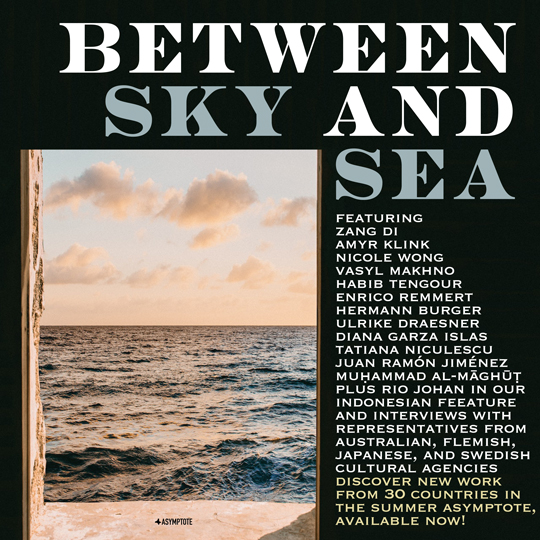
Wedged between sky and sea is the thin line we all know as the horizon, ever-present in Brazilian explorer Amyr Klink’s nail-biting account of survival in shark-infested waters—just one of many new works from this Rubik’s Cube-like Summer edition. Though this particular horizon is “defined” against a clear sky on the day of Klink’s wondrous salvation, the same line is also “dun-colored” in Ecuadorian author Solange Rodríguez Pappe’s profound fiction; “lacerated” in frequent contributor Habib Tengour’s Homer-inspired sequences; mottled with “dung heaps” in Nobel laureate Juan Ramón Jiménez’s poetry; or simply a vortex toward which the ocean ebbs in award-winning short story writer Nukila Amal’s description of the aftermath of the 2004 tsunami. Within the same Indonesian Feature, organized in partnership with the Lontar Foundation, Rio Johan’s brilliantly inventive “Fruit Maps”—about a drunk bioengineer!—finds a thoughtful echo in Nicole Wong’s Brave New World Literature entry invoking terroir and fruit to further problematize the mediating role of translation in world literature beyond mere tropes of “domestication” or “foreignization.” In Romanian playwright Tatiana Niculescu’s laugh-out-loud drama, on the other hand, it’s one particular foreigner with a very specific request who gives a museum guide grief; the museum is also the setting for Chapman Caddell’s thrilling review of Argentinian novelist César Aira’s latest “flight-forward” creation. All of this is illustrated by Singapore-based guest artist Eunice Oh, whose stunning photography graces our cover.

July-20_blog

Since the ongoing support of cultural institutions—or, in Asymptote’s case, lack thereof—makes a huge difference in what translator David Williams has wryly compared to the Olympics for being essentially a pay-for-play arena, we return to an interview series initiated two years ago and hear from four more fearless advocates who “work more backstage than onstage” to catalyze the transmission of their national literatures: Susanne Bergström Larsson from the Swedish Arts Council, Wenona Byrne from Creative Australia, Marieke Roels from Flanders Literature, and Shun Inoue from the Japan Foundation, the last sharing the same enthusiasm for manga as our Visual section’s Alexa Frank. “Because literature is such a powerful medium with which to explore the human condition and connect with one another,” Inoue says, “we must continue to look outward, not inward.” Hear, hear.

While we take some time off our issues to regroup and plan for a double milestone in January 2024 (the edition after this will mark both our 50th issue and 13th anniversary!), we hope you’ll join us in looking outward: apart from subscribing to our newsletter and international Book Club, following us in our daily blog, on Facebook, Twitter, our two Instagram feeds, and our newly launched Threads account, we invite you to come on board behind the scenes (apply by Aug 1st) or submit your own translations—who knows? you might share the same fate as contributor Anton Hur, double 2022 International Booker Prize longlistee and, as of eleven days ago, translator of BTS! Finally, if the work we do has similarly changed your life for the better, please consider advertising on our platforms, partnering with us on a Special Feature, or signing up as a sustaining or masthead member.

A toast to horizons in all their myriad forms—especially those that broaden perpetually!

READ THE ISSUE NOW

Celebrate International Women’s Day with Women’s Writing!

Join us as we highlight the vital contributions of women to literature and translation.

March 8th is International Women’s Day, and we wanted to take the opportunity to lift up the work of women in world literature. Below, find a selection of pieces published on the blog in the past year, across essays, reviews, translations, and interviews, curated to represent the breadth and brilliance of women working in writing.

Interviews

A Conversation on Kurdish Translation with Farangis Ghaderi
by Holly Mason Badra

But when you look deeper, when you look at archives, and look at early Kurdish periodicals, you find women. You discover these forgotten voices. An interesting example of that is Zeyneb Xan, who published under the pseudonym of Kiche Kurd (“Kurdish girl”). In 2018, when a publisher was reprinting Galawej (the first Kurdish literary journal published in 1939–1949), they decided to have sections on contributing writers. They came across this name, and one of the researchers working on the project uncovered that the identity of the writer was Zeyneb Xan (1900–1963), the eldest sister of Dildar—a very well-known figure of Kurdish literature who wrote the Kurdish anthem. Although her family was a literary family and at the center of literary attention, her manuscript remained unpublished until 2018. Her truly fascinating poetry collection covers a wide range of themes from patriotism to women’s education and liberation.

Wild Women: An Interview with Aoko Matsuda and Polly Barton
by Sophia Stewart

For me, films and television programs, as well as books and comics, have always been the places where I can meet outsider women, weirdo women, rebel women, sometimes scary women. When I was a child, I didn’t care if these women were human beings or ghosts or monsters, and I didn’t care if they were from Japan or other countries. I was just drawn to them, encouraged by their existence.

To Protect Oneself From Violence: An Interview with Mónica Ojeda
by Rose Bialer

Maybe if I was born in some other place, I would be writing about something else, but I do believe that Latin America is a very violent continent, especially for women, and in all of our traditions of women’s literature, there have always been women writing horror stories in Latin America. . .  I do believe that it’s because you can’t write about anything else. That’s how you live life. You are afraid for your life. You are scared of the violence in your family, the violence between your friends, the violence in the street. You can’t think about anything else except how to protect yourself from violence.


READ MORE…

Breaking Down the 2022 National Book Award Longlist

A selection to whet your appetite for translated literature!

Now in its fifth year, this rebooted annual award for translated literature deserves a serious look. How does its newly released longlist compare to the Booker International counterpart?

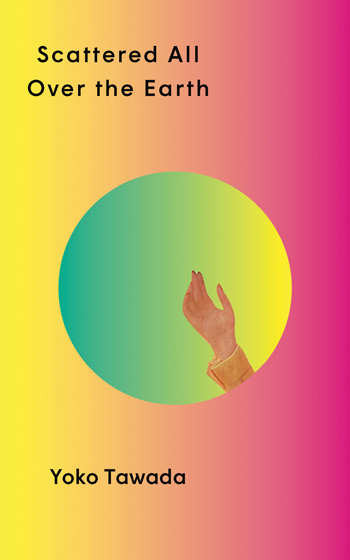
Unlike its Booker International counterpart, works from European languages dominated, continuing the trend from previous years. Previous winner (and frequent Asymptote contributor) Yoko Tawada’s Scattered All Over the Earth was one of the only two titles from Asia.

Order a copy of Yoko Tawada’s Scattered All Over the Earth, translated from the Japanese by Margaret Mitsutani.

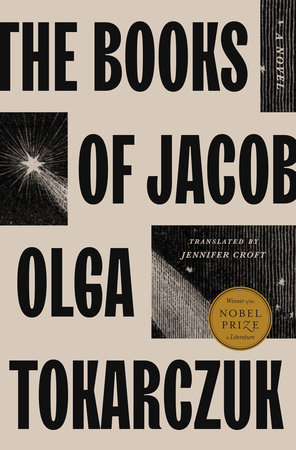
As with the 2020 selections, only one title appeared in both the Booker International and the National Book Award longlists, and it was an Olga Tokarczuk novel translated by Jennifer Croft. We hope it will be third-time lucky for this illustrious duo!

Order a copy of Olga Tokarczuk’s The Books of Jacob, translated from the Polish by Jennifer Croft.

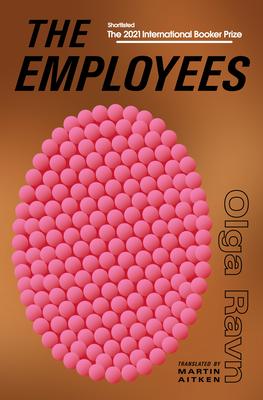
New Directions is the only publisher to have two titles on the longlist. Aside from Yoko Tawada’s Scattered All Over the Earth, Olga Ravn’s The Employees, which our Criticism Editor Barbara Halla chose as her clear winner from last year’s Booker International longlist, is also nominated.

Click here to order a copy of Olga Ravn’s The Employees, translated from the Danish by Martin Aitken.

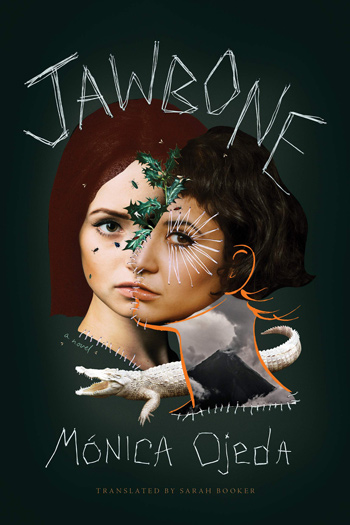
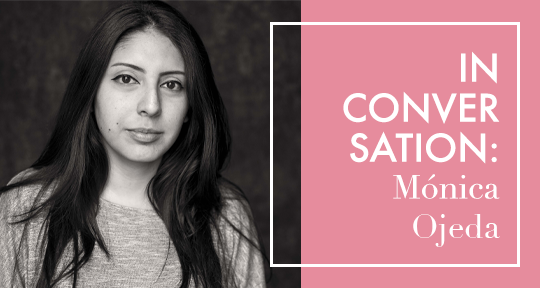
Incidentally, Aitken, who is the only longlisted translator to ever be nominated for his work on different authors, was interviewed in our pages last year. This year, we sat down with Mónica Ojeda, whom interviewer Rose Bialer calls “one of the most powerful and provocative voices in Latin American literature today.” Her Jawbone made the cut:


Order a copy of Mónica Ojeda’s Jawbone, translated from the Spanish by Sarah Booker.

We hope we’ve whetted your appetite with these selections. Take a look at the full longlist here! Oh, and by the way, we may receive a small commission for your purchase(s), which will go toward supporting our advocacy for a more inclusive world literature. Other ways to sustain our mission include signing up as a masthead member, or joining our Book Club!

To Protect Oneself From Violence: An Interview with Mónica Ojeda

I want to know what fear is. Why are we so afraid? What does fear make us do or not do? How does fear change our bodies?

Mónica Ojeda is one of the most powerful and provocative voices in Latin American literature today. With influences spanning from H.P. Lovecraft, to Stephen King’s Carrie, to anonymous internet horror legends called “creepypastas,” Ojeda’s novel Jawbone (Coffee House Press, 2021), translated expertly by Sarah Booker, explores the darkest aspects of relationships between women, amidst the suffocating atmosphere of an Opus Dei school for girls in Ecuador. 

In Jawbone, popular girls and best friends Annelise and Fernanda have created a religion of their own, outside of the classroom. The girls set up camp in an abandoned house, form a secret cult that worships “The White God”, and engage in a series of increasingly dangerous dares that threatens to tear their friendships apart. Meanwhile, their Spanish literature teacher, Ms. Clara, haunted by the ghost of her dead mother, begins to lose her grip on reality. Things take a sinister turn when Ms. Clara takes Fernanda hostage in a deserted cabin, intending to show her pupil the true meaning of fear. In her multivocal and lyrical prose, Ojeda demonstrates the pernicious ways that violence against women can be exercised, and reveals how victims can be transformed into perpetrators. I was lucky enough to be able to meet with Ojeda in person at a coffee shop in Madrid. Over orange juices, we discussed psychoanalysis in language, the implications of Latin American gothic literature, and her favorite horror films.

Rose Bialer (RB): The first book I read of yours was the poetry collection, Historia de la Leche, which investigates the strange violence of family relationships—specifically those between mothers and daughters. What drove you to return to this theme in Jawbone?

Mónica Ojeda (MO): I don’t remember if I first wrote Historia de la Leche or Jawbone. Well, I know that Jawbone was published first, but I don’t remember which book I wrote first. I could have been writing them at the same time. However, I do know that at the time, I was very interested in the violence within passionate relationships between women. I think the relationships between best friends, or sisters, or mothers and daughters are intense, and so of course there are a lot of possibilities for violence to get in. I’m kind of obsessed with how desire and love can be taken to the next level—the next level being sometimes absolute violence.

RB: I think your poetry comes through in your writing, especially in such highly imaginative phrases such as “mother-God-of-the-wandering-womb,” “umbilical-cord love” and “that sleeping-angel-of-history voice.” Tell me about the process of constructing these new terms.

MO: I think invention comes to me because I do see the act of writing as a way of putting language in some kind of crisis. In conflict. So sometimes, you have to develop some new forms to express certain things; that is something which pulls me back to poetry even when I am writing narrative. Because I think that poetry does that. Poetry reverts language, re-births language. Sometimes when words join together, developing new concepts and images, it can sound strange because you have no familiarity with something which has just been born. As such, it develops some kind of extrañamiento (estrangement), which also provides an atmosphere that I like, having to do with the strange and something that Freud called lo siniestro (the uncanny), which is when something unknown reveals itself in the middle of what is ordinary, during your daily routine. That is scary: when you are surrounded by the things that you know and then the strange comes in. I like to do that not only in the story of my narrative or my novels, but also in language. READ MORE…