In Review: Scales of Injustice by Loa Ho

Loa Ho is crucial to the development of modern Taiwanese literature

Scales of Injustice by Loa Ho, translated by Darryl Sterk, Honford Star, 2018

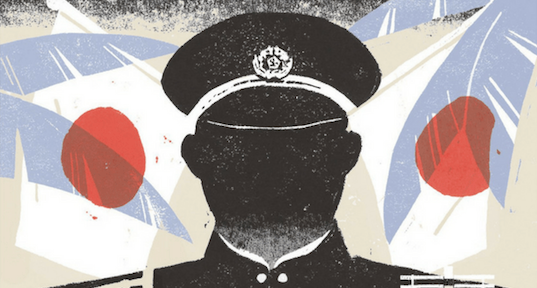
It is never easy to translate a founding figure in a literary field, let alone a pioneering writer who has been translated by influential translators before. Such is the tricky task assigned to Darryl Sterk of translating Loa Ho’s (賴和, “Lai He” in Mandarin Chinese pronunciation, 1894–1943) complete fiction collection, which includes twenty-one novellas composed by the “Father of New Taiwanese Literature.” Entitled Scales of Injustice and freshly published in May 2018 by the London-based publishing house, Honford Star, the book features Loa Ho’s fiction in Sterk’s brand new translations from vernacular Chinese, Japanese, and Taiwanese (the “Taiwanese varieties of ‘Southern Hokkien’,” as explained by the translator) into English. The mixed use of languages in Loa Ho’s writing reflects the historical background in which the Hakka author lived when Taiwan was under Japanese colonial rule. While Japanese was the official language, Taiwanese people with Minnan heritage still spoke Taiwanese at home, even as the Japanese government enforced an assimilation policy around 1937 and banned the use of Taiwanese island-wide. The use of vernacular Chinese in Loa Ho’s fiction, on the other hand, stemmed from the New Literature Movement in China. In addition to Japanese and Taiwanese, Austronesian languages were spoken by the aboriginal peoples.

READ MORE…

We’re Giving Away $3,000 to Six Top Emerging Translators!

Submit to our contest for emerging translators today!

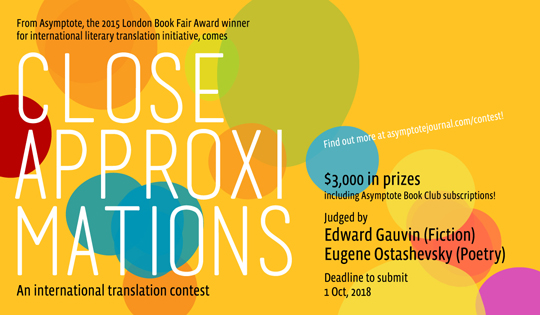
With just two months left to the deadline of Close Approximations, our annual international translation contest, there’s still time to polish up your translations (especially of female authors, since we’ve just entered Women in Translation Month) and submit to our contest!

Awarding a total of $3,000 in prizes to six winners this time are Edward Gauvin (Fiction) and Eugene Ostashevsky (Poetry). Entrants have until October 1 to submit their work for a chance of winning up to 1,000USD, in addition to publication in our Winter 2019 issue, joining a roster of translators we have published that includes J.M. Coetzee, Lydia Davis, Michael Hofmann, and Jennifer Croft. We are encouraging early submissions by taking 15% off the entry fee for contest submissions on or before September 1.

To further pique your interest about the contest, here’s more about our wonderful judges and what they think of translation.

READ MORE…

What’s New with the Crew? A Monthly Update

The Asymptote staff have been keeping busy!

Fresh from working on the fabulous Summer 2018 issue of Asymptote, our team members have been busy with their own creative endeavors. Read on to find out what we have been writing, doing, and learning!

Contributing Editor Aamer Hussein recently judged the McKitterick Prize. The prize, which honors the first novel by a writer over the age of forty, went to Nigerian writer Anietie Isong for his debut novel, Radio Sunrise.

Communications Manager Alexander Dickow has had quite a summer: other than publishing poetry in Place de La Sorbonne, he also recently wrote for Paragraph and Plume (which also ran his translations of Max Jacob’s poetry). His work also appeared in La Revue des Sciences Humaines, Littérature, and larevue*.

READ MORE…

Translation Tuesday: “Constantinople” by Flavia Teoc

More fragrant are the grapes slowly growing sour on a vendor stall in Yerebatan

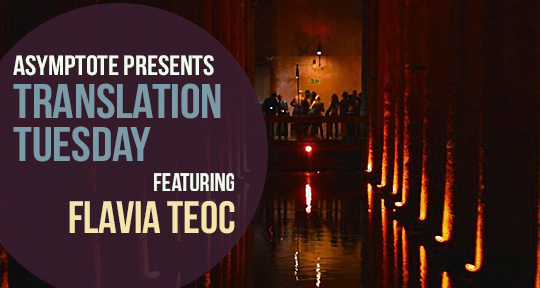
We are thrilled to feature Flavia Teoc’s poetry for the first time on Translation Tuesday. Teoc’s lines visit Yerebatan—the magical site in Istanbul where the Basilica Cistern hides a special sighting of Medusa. Under the dim lights of Yerebatan, Teoc’s fragrant lines shine brighter. 

Constantinople

More fragrant than the righteous ones perfect in all of their ways
Are the grapes slowly growing sour on a vendor stall in Yerebatan.
Under their cracked skin a sweet potion of sounds is distilled,
Memories from back when they were early sour berries or less,
An equal proportion mixture of screams from a woman flogged
Up against their vine, the bell of a leper who took shelter in the split leaves’
Shadow one late afternoon, and a stray dog’s quick nap nearby.
I’m telling you—
More fragrant are the grapes slowly growing sour on a vendor stall in Yerebatan,
For those perfect in all their ways will never touch them.

READ MORE…

Ricardo Lísias, the Brazilian Novelist on Trial for Unconventional Form

If an author designs his text to inspire a reader response in a specific social context, is translation even possible?

Featured in our Summer 2018 issue, Brazilian writer Ricardo Lísias’s “Anna O.” examines Latin American politics and memories of dictatorships in the region. In her translator’s note, Lara Norgaard discusses the way Lísias blends truth and fiction to create a unique reading experience: “Lísias’s many references are a key component of the unique relationship he builds between text and reader. The author’s goal is to cause confusion in his audience, to break the boundaries of the book as a discrete object, separate from the world. Nonfiction pours into his fiction and, conversely, the reader reacts to his stories in the real world. In ‘Anna O.,’ Lísias plays with the expectations and knowledge of his audience.” In the following essay, Norgaard further explores this exciting young author’s work.

Ricardo Lísias should be on everyone’s radar.

In Brazil, he already is, and in unconventional ways: two of the writer’s novels over the past four years have landed the writer in court trials. The first, a detective fiction eBook series; the other, a novel signed “pseudonym: Eduardo Cunha,” the name of a prominent right-wing senator currently in prison for corruption charges.

Lísias has the uncanny ability of ruffling feathers in a country where literature too often falls by the wayside. These trials—the former, a charge for the falsification of state documents; the latter, for the defamation of character—might indicate a lack of understanding or urge to control experimental art, both within the justice system and in the general public. But they might also imply that this specific author has managed to escape the bubble of traditional literary readership. His work is controversial, in a broad sense. And yet, despite his dramatic reputation in Brazil, and despite having been named one of Granta’s best young Brazilian novelists, only two of Lísias’ texts have appeared in English translation: the short stories “Evo Morales,” published in Granta and “Anna O.”, just released in Asymptote’s Summer 2018 issue.

READ MORE…

Weekly Dispatches from the Frontlines of World Literature

Our weekly roundup of literary news brings us to Central America, Albania, and Hong Kong.

We are a week out from the launch of our Summer 2018 issue of Asymptote and we could not be happier about the reading we have enjoyed and the positive response we have received from readers. As we get ready for the weekend, we bring you the latest news from around the world. José García Escobar reports from Central America, Barbara Halla from Albania, and Jacqueline Leung from Hong Kong. Happy reading!

José García Escobar, Editor-at-Large, reporting from Central America:

Guatemala has just closed its annual book fair, the Feria del Libro de Guatemala (Filgua), which hosted some of the most important publications and announcements of the year.

First, it was announced on Thursday, July 19 that the latest winner of the prestigious Premio Luis Cardoza y Aragón (Luis Cardoza and Aragón Prize) for Mesoamerican poetry was the Mexican writer, René Morales Hernández, with his book, Luz silenciosa descendiendo de las colinas de Chiapas. Born in Chiapas, René Morales joins the ranks of well-known and critically acclaimed writers such as David Cruz from Costa Rica, Maurice Echeverría from Guatemala, and the Garífuna poet, Wingston González, featured in Asymptote’s Summer 2018 Issue.

READ MORE…

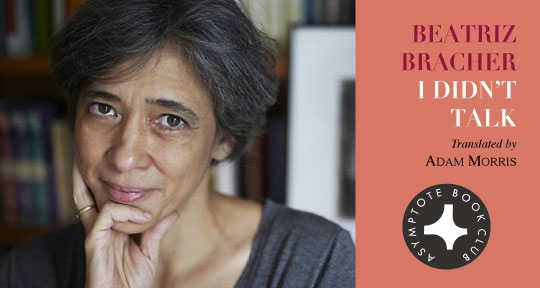
Announcing Our July Book Club Selection: I Didn’t Talk by Beatriz Bracher

With this translation, Adam Morris introduces a singularly powerful voice of Brazilian contemporary literature to English–language readers.

Under an authoritarian dictatorship, a single sentence can be the difference between life and death. In our July Asymptote Book Club selection, Beatriz Bracher’s I Didn’t Talk, retired professor Gustavo is preparing to leave São Paulo. First, though, he has a more demanding journey to make: a journey that will take him back to a darker time, when he and his brother-in-law were tortured by Brazil’s military regime. Did he talk?

Adam Morris’ English translation of I Didn’t Talk, published by New Directions, has been described as a “brilliant, enigmatic rumination of a novel.” We’re delighted to be sharing it with our Book Club subscribers across the USA, the UK, and Canada.

If you’re not yet a subscriber but want to sign up in time to receive next month’s selection, all the information you need is over on our official Book Club page. Meanwhile, subscribers are more than welcome to join the online discussion via our facebook group.

READ MORE…

Section Editors’ Highlights: Summer 2018

Our Section Editors pick their favorite pieces from the Summer 2018 issue!

The brand new Summer 2018 edition of Asymptote is almost one week old and we are still enjoying the diverse offerings from 31 countries gathered therein. Today, our section editors share highlights from their respective sections: 

2501 Migrants by Alejandro Santiago” is a powerful meditation on the US-Mexico border, compellingly written by Cristina Rivera Garza, and beautifully translated by Sarah Booker. Rivera Garza writes gracefully about sculptures made by Oaxacan artist Alejandro Santiago and his team. Each of these clay vessels contains the spirit of a migrant who, having tried their luck at crossing the border, now stands in mute testimony to the absences and deaths that striate both America and Mexico. In this essay, Rivera Garza explores the multi-faceted meanings of these sculptures and uses them to explore the intricacies of the border-condition—the nostalgia of those who leave Mexico, and the melancholy of those who remain. At this juncture in American history, I can think of no more valuable essay to read today than this one.

—Joshua Craze, Nonfiction Editor

The King of Insomnia, who first appeared as graffiti on the streets of Rio de Janeiro, has now become a central character in the fictional world of the Insomnia people, a creation of artist Tomaz Viana—known as Toz. Life-size three-dimensional Insomnia figures, with a history and traditions drawn from Brazilian and African sources, inhabited the Chácara do Cée Museum and its grounds in 2017. Lara Norgaard, Asymptote’s Editor-at-Large in Brazil, introduces the imaginary culture of Insomnia and interviews the artist who discusses his influences, including the Afro-Brazilian religion candomblé, and explains the evolution of these “fictional people with connections to the night, to the big city, but also to the jungle and the forest.”

—Eva Heisler, Visual Editor

READ MORE…

Translation Tuesday: “The Notes of a Writer” by Almaz Myrzakhmet

Don’t writers employ souls of innocent people?

Our Summer 2018 issue launched a few days ago and it is filled with gems from around the world. This Translation Tuesday we bring you another fabulous translation from a language and country never before featured on the blog! Translator Mirgul Kali introduces us to the piece:

Kazakh writer Almaz Myrzakhmet’s brilliant prose is often described as detached, but this is the detachment of a sharp and skillful writer confident in his ability to lure an unsuspecting reader into his story and play with their mind. “The Notes of a Writer,” which follows a young author who is anguished by the visions of his own unwritten story, is both a puzzle and a taste of the joys and struggles of the creative process.

The most delightful and challenging moments in translating this short story concern the old Kazakh expressions which refer to images that might not be easily invoked in an English-language reader’s mind. Yet they offer a rare and intimate glimpse into the culture and history of the nomadic people who had for centuries roamed the steppes of Central Asia. The language of the Kazakhs, who bred horses, maintains that misery can be “the size of a long trough,” evoking an image of an old wooden tub filled with putrid water; that the laughter of happy lovers sounds like a “jingle of coins,” perhaps at a lively, colorful market in a town along the Silk Route; and that fear feels like “a snake coiled in your bosom.” You are invited to discover these expressions, scattered like vintage jewels throughout Myrzakhmet’s striking post-modernist story.

The sound of her heels—like a tongue clicking—would begin at the bottom of a staircase, eventually reach the brown door of my rental apartment on the third floor, reverberate weakly and pause. At this point, she would become unusually still as if she was holding her breath and listening. A moment later she should tap the door timidly with the tips of her fingers.

I would open the door immediately. Acting as if she came to her own place, she barely looked at me and walked in, grazing me with her shoulder. The usual moves. Her, glancing over a picture of a bear playing with cubs, listlessly flipping through scribbled pieces of paper on my desk, walking over to a window and looking out—these actions were her daily routine. A bed would squeak as she sat on it. I would lock the door and take a cigarette from the desk.

READ MORE…

Blog Editors’ Highlights: Summer 2018

Our blog editors pick their favorite pieces from the Summer 2018 issue!

Here at the blog, we continue to be amazed by the breadth of the material featured every quarter at Asymptote. From our multilingual special feature to the urgent work of Lebanese artist Mounira Al Solh, who wanted to “recollect. . . Syria through the stories of the people,” and to “live its diversity,” our Summer 2018 issue again proves that incredibly groundbreaking material is being produced far from the centers of Anglo-American literary dominance. Gathering new work from thirty-one countries, this bountiful issue, also our milestone thirtieth, unfolds under the sign of the traveler “looking for [himself] in places [he doesn’t] recognize” (Antonin Artaud). Highlights include pioneer of modern Chinese poetry Duo Duo, Anita Raja on Christa Wolf, and rising Argentinian star Pablo Ottonello in a new translation by the great Jennifer Croft. Today, the blog editors share our favorite pieces from the new issue, highlighting the diversity of cultures, languages, and literary style represented. Happy reading! 

Perhaps because of my fascination with multilingual writing and the languages of mixed cultures, I was immediately drawn to the multilingual writing special feature in this issue of the journal. Shamma Al Bastaki’s “from House to House | بيت لبيت” in particular dazzles with its polyphonic quality.

Bastaki’s three poems (“House to House,” “Clay II,” and “Barjeel”) refuse singularity, whether in terms of form, language, or register. Different voices call out from the text of each poem and are brilliantly rendered alongside an audio clip of sounds from interviews conducted by Bastaki herself. (I would recommend listening to the clips before or during your reading of the piece!) The poems are inspired by and based on the oral narratives of the peoples of the Dubai Creek, but speak also to a modern global phenomenon of language mixing and syntax shifting that many around the world will relate to. I enjoyed what Bastaki terms “severe enjambments”—defamiliarizing what is otherwise standard English syntax, creating an instructive experience for native speakers.

Form and language aside, “from House to House” in particular reminded me of the communal nature of colloquial language—the speech that we are most familiar with in our daily lives, and that which we use with our families. To present them in poetry is an attempt to memorialize what is so near and dear to us. The context of Eid is especially well suited to this project, and to the issue’s timing as a whole, in celebration of Eid just past in June. “Barjeel” on the other hand, reminds me of poetry looking back on childhood (Thomas Hood’s “I Remember, I Remember” comes to mind) and on the things that seemed so big then. The Emirati influences and polyphony of “Barjeel” take that idea and renew it—demonstrating how reflection often is not a solipsistic affair, but very often one that takes place with family, parents telling children of their childhood pasts.

—Chloe Lim

READ MORE…

Announcing the Summer 2018 Issue of Asymptote

Introducing our thirtieth issue, which gathers never-before-published work from 31 countries!

We interrupt our regular programming to announce the launch of Asymptote’s Summer 2018 issue!

Step into our bountiful Summer edition to “look for [yourself] in places [you] don’t recognize” (Antonin Artaud). Hailing from thirty-one countries and speaking twenty-nine languages, this season’s rich pickings blend the familiar with the foreign: Sarah Manguso and Jennifer Croft (co-winner, with Olga Tokarczuk, of this year’s Man Booker International Prize) join us for our thirtieth issue alongside Anita Raja, Duo Duo, and Intizar Husain, and our first work from the Igbo in the return of our Multilingual Writing Feature.

READ MORE…

The Trouble with Prizes and Translation

Prizes may be good for publishing, but are they good for all authors and translators?

If you love reading fiction by writers from around the globe, you are used to hearing about the big prizes that put international literature in the spotlight: the Nobel Prize for Literature, the Neustadt International Prize for Literature, the Man Booker International, the Caine Prize, the Prix Goncourt, the German Book Prize, the Cervantes Prize, the Tanazaki Prize, and many others.

In fact, you might even have trouble keeping up with the variety of United States–based awards just for literature in translation, from the Best Translated Book Award (now eleven years old) to the National Book Award’s new Translated Literature category. It’s getting to be like following the Olympics, without all the fuss over new stadium construction. For one thing, winning books, like medal-bedecked Olympians, don’t get to the podium all by themselves. Winners need a team (and a coach and money) behind them. For another, we know that lots of great contenders don’t make it to the final round.

So what should we know about book prizes as we are reading the shortlisted candidates or hoping for a win for one of our favorite writers?

READ MORE…

Translation Tuesday: ‘So Long, Adolescence!’ by Réka Mán-Várhegyi

We’ll leave our mum and dad behind, we’ll leave their poverty and their slothfulness, their gestures and their misery all behind.

Full of dark humor and vibrant details, today’s Translation Tuesday, by Réka Mán-Várhegyi and translated by Owen Good, shows the inner workings of a Hungarian family. Dealing with obesity, sibling relationships, and emerging sexuality, this gripping story captures that uncomfortably liminal time known as adolescence.

‘It’ll be beach weather at the weekend,’ our mum squeaked. ‘Get your swimming costumes ready, we’re going to the lake. Dad, have you checked the batteries in the cooler bag? Does it still work? We’ll not miss it if we don’t buy a new one. No point in wasting money.’

Panni was staring at her hand. I was counting the strips in the rotting wainscot on the dining room wall. We didn’t put up any protest but we didn’t want to go to the lake and they knew it. We didn’t want to lie in the sun in swimsuits, we didn’t want to soak in the water, and, most of all, we didn’t want to gawp at jet-skis. Every summer, jet-skis tore up and down the puddle-sized lake with pornstar-esque girls and boys on them, our classmates, but at least in school they didn’t shriek all day long.

I was born into a fat, hemorrhoidal family as the younger member of fraternal twins. By our teenage years, Panni and I had turned into sluggish potato sacks, we’d become our own parents one size smaller. Later on it became clear that our features weren’t overly similar, but the differences between us were hidden by the fat, just like our parents. When I was seventeen the spare pounds didn’t hurt so much as the fact that I didn’t have any distinguishing features. After class Panni and I often went to the wood, we sat on our coats at the foot of a tree, smoked a cigarette each and scratched our faces with thorns. We both wanted a proper scar. But these were just pathetic thin scratches. They healed in half a day. Especially on my skin—which was positively brown compared to Panni’s milky white—when I wiped the blood off you couldn’t even see them.

READ MORE…