
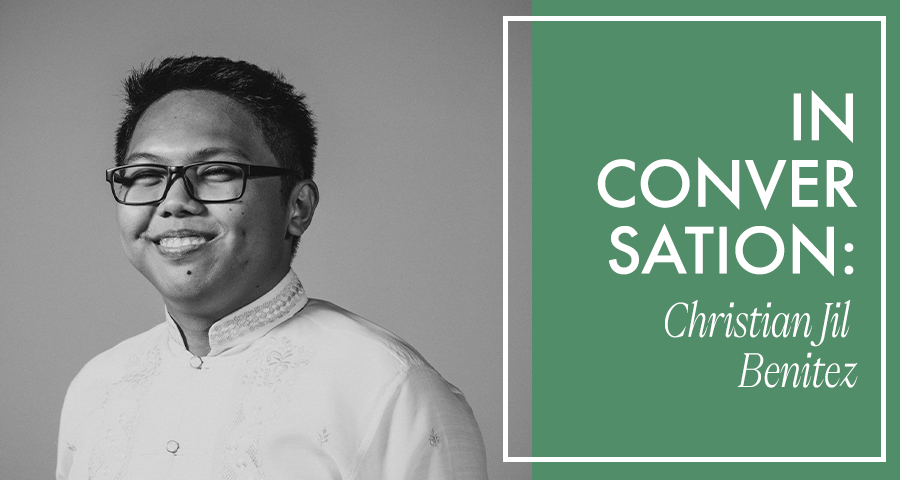
Named Poet of the Year in 2018 by the Komisyon sa Wikang Filipino (Commission on the Filipino Language), Christian Jil Benitez is a queer Filipino poet, scholar, and translator. His debut book, Isang Dalumat ng Panahon (A Theory of Time, 2022), was awarded the Best Book of Literary Criticism and Cultural Studies at the National Book Awards in the Philippines, substantiating his important work in codifying the cultural formation of ‘Filipino time’ via the material, the poetic, and the tropical, in addition to finding an equilibrium between Western critical theory and indigenous epistemologies.
Beyond his scholarship, from positioning the bugtong (or the Tagalog riddle) as ecopoetry to recasting vernacular oral traditions as matrices of queer world-making, Benitez’s translations maintain that their critical role is not merely linguistic, but also results in a creative rebirth, of ‘translation that acknowledges, and relishes even, the transfiguration of the material as it is carried over from one containing language to another’.
In this conversation, I spoke with Dr. Benitez, traversing Bangkok and Manila, about the pressures and prospects of translation in neocolonial, multilingual Philippines, as well as the ethics of barkadahan, especially when familiarity and friendship become central to the labour and logics of literary translation.
Alton Melvar M Dapanas (AMMD): Your debut, Isang Dalumat ng Panahon (A Theory of Time), excavates the construct of time through Philippine-language dictionaries, poetry, historico-colonial texts, metaphors, and indigenous orality, revealing it as ecological, discursive, and material. How does ‘Filipino time’, as you’ve theorised it, diverge from Western, capitalist temporality?
Christian Jil Benitez (CJB): We commonly use ‘Filipino time’ to refer to the tendency of Filipinos to be late: to start an event in ‘Filipino time’ means to actually start one hour after the initially agreed time. The term was supposedly coined by the Americans during their occupation in the country to shame Filipinos for this behavior, but this habit has also been observed in many Southeast Asian (as well as other non-Eurowestern) contexts, and can be understood as the persistence of polychronic sensibility in these cultures despite the imposition of Eurowestern, capitalist, and patriarchal monochronicity. READ MORE…

A Pointed Atemporality: Mui Poopoksakul on Translating Saneh Sangsuk’s Venom
He's very aware of the rhythm and musicality of this text . . . he said it should take something like an hour and thirty-seven minutes to read.
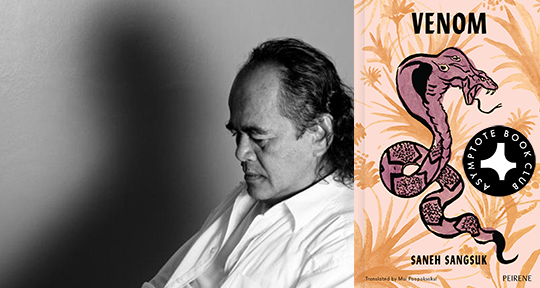
In our May Book Club selection, a young boy struggles with a snake in the fictional village of Praeknamdang, in a tense battle between beauty and cruelty. In poetic language that is nostalgic for the world it describes without romanticizing it, Saneh Sangsuk creates a complex and captivating world. In this fable-like story there are no simple morals, in keeping with Sangsuk’s resistance to efforts to depict a sanitized view of Thailand and to the idea that the purpose of literature is to create a path to social change. In this interview with translator Mui Poopoksakul, we discuss the role of nature in the text, translating meticulous prose, and the politics of literary criticism.
The Asymptote Book Club aspires to bring the best in translated fiction every month to readers around the world. You can sign up to receive next month’s selection on our website for as little as USD20 per book; once you’re a member, join our Facebook group for exclusive book club discussions and receive invitations to our members-only Zoom interviews with the author or the translator of each title.
Barbara Halla (BH): How did you get into translation, especially given your law background?
Mui Poopoksakul (MP): I actually studied comparative literature as an undergrad, and then in my early twenties, like a lot of people who study the humanities, I felt a little bit like, “Oh, I need to get a ‘real job.’” I went to law school, and I worked at a law firm for about five years, and I liked that job just fine, but it just wasn’t what I wanted to do for the rest of my life.
So, I started thinking, What should I be doing? What do I want to do with myself? I had always wanted to do something in the literary field but didn’t quite have the courage, and I realized that not a lot of Thai literature been translated. I thought, If I can just get one book out, that would be really amazing. So, I went back to grad school. I did an MA in Cultural Translation at the American University of Paris, and The Sad Part Was was my thesis from that program. Because I had done it as my thesis, I felt like I was translating it for something. I wasn’t just producing a sample that might go nowhere.
The whole field was all new to me, so I didn’t know how anything worked. I didn’t even know how many pages a translation sample should be. But then I ended up not having to worry about that because I did the book as my thesis.
BH: You mentioned even just one book, but did you have any authors in mind? Was Saneh Sangsuk one of those authors in your ideal roster?
MP: I wouldn’t say I had a roster, but I did have one author in mind and that was Prabda Yoon, and that really helped me get started, because I wasn’t getting into the field thinking, “I want to translate.” My thought was, “I want to translate this book.” I think that helped me a lot, having a more concrete goal.
READ MORE…
Contributor:- Barbara Halla
; Languages: - English
, - Thai
; Place: - Thailand
; Writers: - Mui Poopoksakul
, - Prabda Yoon
, - Saneh Sangsuk
; Tags: - Deep Vellum
, - environmentalism
, - literary criticism
, - nature
, - nature in storytelling
, - pacing
, - pacing in translation
, - Peirene
, - respect for nature
, - rhythm
, - rhythm in translation
, - social commentary
, - storytelling
, - Thai literature