Posts filed under 'short stories'

What’s New in Translation: December 2025

The latest from Japan, Peru, Germany, Austria, Czechia, South Korea, Brazil, and Hungary!

In our final round-up of the year, we present a thrilling novel capturing the margins of Germany as the nation begins to veer into fascism, a collection gathering the voices of powerful Hungarian women poets, a Brazilian novel testifying to the colonial erasure of indigenous language and being, a series of essays considering the act of reading as an oppositional force against capitalism, and more!

kappa

Kappa by Ryonosuke Akutagawa, translated from the Japanese by Geoffrey Bownas, Pushkin Press, 2025

Review by Kaelie Giffel

Even if one is unfamiliar with his work, English readers will recognize the name Ryonosuke Akutagawa from the prestigious Japanese literary prize, named after him posthumously by a friend. Kappa is a novella published in the final year of the author’s life. Pushkin Press’s reissue of Geoffrey Bownas’s 1970 translation comes on the heels of a 2023 retranslation by Lisa Hofmann-Kuroda and Allison Markin Powell, published by New Directions in 2023. Multiple, competing translations indicate the continued importance of Akutagawa’s work, which has a renewed urgency in our time.

Kappa is a philosophical meditation on whether difference can be encountered without violence and how we might meet others in the strange in-between spaces. Structured as a frame narrative, its inciting incident is the testimony of a patient in an unnamed mental institution. The patient speaks about meeting strange creatures with tummy pouches called Kappas. The Kappas have their own cultural, historical, and philosophical institutions and orientations to life, and the narrator lives among them for a while, alternately admiring, baffled, or repulsed as he learns more about their existence. They oppose birth control for silly reasons; sacrifice workers who have been laid off by literally eating them; prohibit artistic performance because they believe the general public to be hopelessly stupid; and are generally misogynist—female Kappas are cast as libidinous huntresses that oppress male Kappas. The narrator is bewildered by the similarities and differences between himself (Japanese) and the Kappanese. Hence, the mental institution.  READ MORE…
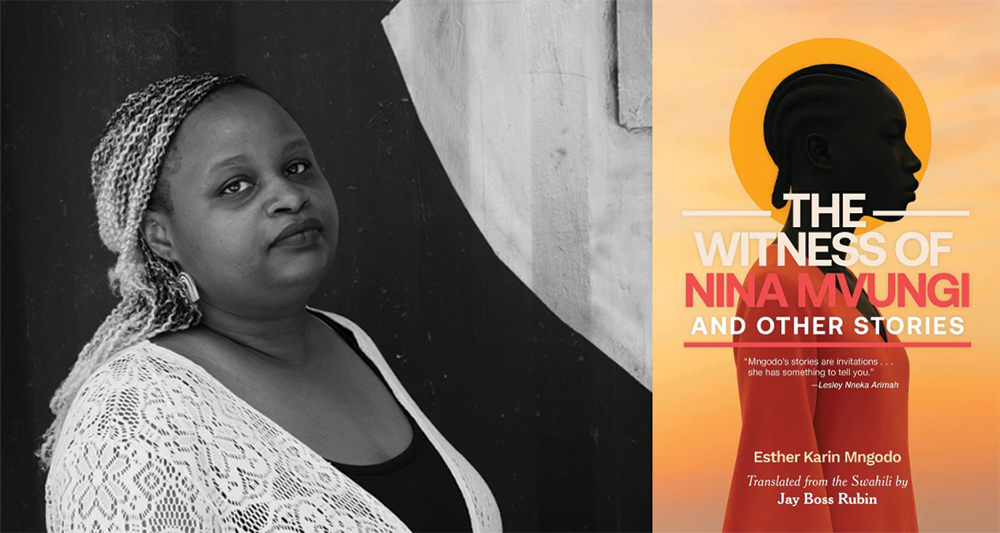
More Than a Witness: A Review of The Witness of Nina Mvungi and Other Stories by Esther Karin Mngodo and Jay Boss Rubin

Across the collection, these stories are unforgiving and gut-wrenching, a reminder that reality is often the same.

The Witness of Nina Mvungi and Other Stories by Esther Karin Mngodo, translated from the Swahili by Jay Boss Rubin, Hanging Loose Press, 2025

Each story in Esther Karin Mngodo‘s short story collection, The Witness of Nina Mvungi and Other Stories, work together to compose an intricate web, with ongoing threads of entrancement cocooning readers from beginning to end. Beautifully translated from Swahili by Jay Boss Rubin, the prose grips and refuses to let go, revealing the rawest truths of the human condition.

The collection is a mixture of realism, Afrofuturism, and speculative fiction. In one of the stories, a woman and man are on a date at the theater, and one quickly realizes, in a meta turn, that the play they are watching is actually an apocalyptic story from earlier in the collection. In the middle of the play, a scream emblematizes the center of the interconnected narrative and terrifies the protagonist in the story: “I nearly went into shock. My whole body snapped to attention. I wrapped my arms around myself so I wouldn’t have to run away or hide under my seat.” Contained in this bloodcurdling scream are all the themes explored in The Witness of Nina Mvungi and Other Stories: betrayal, jealousy, negligence, violence, powerlessness, loss—feelings that so many of us suffer through alone and in silence.

READ MORE…

Feminism & Imagination in Fifty-Two Stories: A Review of The Woman Dies by Aoko Matsuda

Matsuda's collection also continually surprises the reader with playfulness, randomness, and pleasure. . .

The Woman Dies by Aoko Matsuda, translated from the Japanese by Polly Barton, Europa Editions, 2025

Within the new wave of openly feminist Japanese literature, Aoko Matsuda is well-known for her fierce, sharply funny critique of sexism in contemporary Japan. Her work has previously appeared in English with publications like “The Girl Who Is Getting Married” (translated by Angus Turvill) and Where the Wild Ladies Are (translated by Polly Barton), and now, with the appearance of The Woman Dies—also translated by Barton—Matsuda continues her incisive vision with fifty-two short stories that jump from the mockery of gender roles to subtler reflections on girlhood, often interspliced with delightfully whimsical commentary on the everyday.

As sexism and anti-LGBTQ stances persist in Japan, the increasing number of talented Japanese writers translated into English nonetheless reveal literary discourses that dissect and challenge the limits of how gender and sexuality are established in mainstream society. Feminist discourses in Japan are also growingly transnational, with readers eagerly devouring feminist fiction translated from English, Korean, and other languages. Matsuda herself is not only an accomplished fiction writer and essayist, but also a translator of English, bringing out Japanese iterations of works by Karen Russell and Amelia Gray, among others. The Woman Dies is a unique addition to Japanese literature in English translation—which does not include much flash fiction—and certainly introduces fresh, lively feminist perspectives. At the same time, despite how the collection is advertised, it is too limiting to suggest that all of its stories can fall under “feminism,” as many of Matsuda’s pieces—sometimes only one or two pages in length—are charming snippets of everyday life, resisting any kind of categorization. READ MORE…

What’s New in Translation: October 2025

New titles from Haiti, Argentina, the Netherlands, Japan, Germany, Italy, Norway, Turkey, Mexico, Taiwan, Hungary, South Korea, and Latin America!

This month, we bring you thirteen reviews from thirteen countries: a poetry collection that reimagines friendships with long-gone revolutionaries, a tender and incisive rumination on disappearance, the latest novel on the inexplicability of love from a Nobel laureate, a story of Silicon Valley-fueled descent, a compilation of Latin American feminist thought, and much much more!

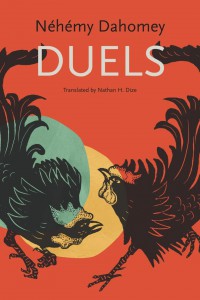
duels

Duels by Néhemy Dahomey, translated from the French by Nathan H. Dize, Seagull Books, 2025

Review by Timothy Berge

Néhémy Dahomey’s Duels is set in 1842, thirty-eight years after Haiti’s independence—a storied liberation that came through one of the largest slave uprisings in history. France withdrew, but issued an absurd debt of one hundred and fifty million francs. Paying off a debt while attempting to modernize a new country was a tough balancing act, so Haiti imposed high taxes on its citizens and forced them into unpaid labor.

Duels takes place in Böen, a small town in the Cul-de-Sac Plain that evaded a census for several years. As a result, no one in the town had fallen victim to the government’s schemes—until a local official decides that he needs laborers for a new project. From there on, in the context of freedom, economic entrapment, and postcolonial growing pains, the events of Duels unfold. Nathan H. Dize’s translation reads like a yarn spun out by an old relative with a deft deadpan humor, aptly navigating the tense shifts between past and present, and generating a sense of perpetuity for these characters and their stories. Here, the historical and the contemporary connect and blur. READ MORE…

Translation Tuesday: Two Short Stories from Sudan

“They’re not heart defects,” I desperately replied. “But my heart, always in exile, has taken the shape of my homeland.”

For this Translation Tuesday, we’re thrilled to present two very short stories by Sudanese writers Fatimah El Senussi and Wedd Alwakeel Maarouf. Both stories use a minimum of words to depict meaningful moments. In “Expatriate”, a routine doctor’s visit becomes a lens through which conventional ideas of pathology are questioned. The story deftly explores the struggles of immigrants navigating healthcare systems where their unique challenges are often misunderstood or ignored. In “A Machiavellian Mind”, a bartender’s long-nursed inner ambitions clash with the reality of his mundane job; with sharp wit, the story playfully subverts alarmist narratives about Islamic fundamentalism and its perceived threat to Western civilization. Translated from Arabic by Essam M. Al-Jassim, both pieces shine with a pithy, humorous, and deeply emotive voice.

Expatriate
by Fatimah El Senussi

In a distant land, the cardiologist closely scrutinized the X-ray of my heart. In a low, disturbed tone, he said, “You have congenital heart defects.”

“They’re not heart defects,” I desperately replied. “But my heart, always in exile, has taken the shape of my homeland.”

The doctor, initially stunned, sat down to diligently examine the map.

READ MORE…

What’s New in Translation: January 2025

Discover new work from Palestine, Sudan, Syria, Iraq, Greece, Italy, China, Sweden, Germany, Chile, and the Democratic Republic of the Congo!

In the first month of 2025, the offerings of world literature are as rich as ever. To help you on your year of reading, here are ten titles we’re most excited about—a new translation of a stargazing Greek classic; the latest from China’s most lauded avant-gardist; a rediscovered Chilean novel of queer love and revolution; a soaring, urgent compilation of Palestinian voices; surrealism and absurdism from an Italian short story master—and many more.

arabic between love and war

Arabic, Between Love and War, edited by Norah Alkharashi and Yasmine Haj, Trace Press, 2025

Review by Alex Tan

 Addressing itself to the subtle but immense interstice between the Arabic words for ‘love’ and ‘war’, which differ by only one letter, Trace Press’s community-centric poetry anthology is as much a testament to beauty and survival under the conditions of catastrophe as it is a refusal to perform or fetishize suffering for a white gaze. The bilingual collection is, further, an intergenerational gathering of voices: canonical luminaries like Fadwa Tuqan are assembled alongside contemporary lodestars like George Abraham.

Throughout the volume, language gives in to its fecundity, at times carried by a voice that “condenses history to the depths of silence”, at others seeded within a word that “alone was enough to wither a tree”. The whispered syllable, across utterance and inscription, temporarily suspends the cruelties of the real: “I love calling you habibi / because then I feel as though they haven’t destroyed our cities.” In shared intimacy, an interregnum emerges, fragile as the stroke of an ر.   

But how far can one measure the ruin and the specter of love in sentences? “I write rose and mean nothing,” the poet Qasim Saudi ventures, as if refuting the possibility of romanticism. The surveying ego can also be a trap—“my I wounding me”. Many of the writers here disclose a longing for dissolution, for blunting the edges of the self so that a liquid, collective consciousness might emerge in its stead. In Lena Khalaf Tuffaha’s idiom, “you never saw it coming, this cleansing, / how we have become this ocean”. Nour Balousha’s plangent question echoes, “Who told the wind that we were leaves?”  READ MORE…

Weekly Dispatches From the Frontlines of World Literature

Literary updates from Japan, Palestine, and airports in Ireland and France.

Only three days into 2025, the Asymptote team is hard at work reporting on literature across the globe. In the first roundup of the year, our staff introduces a thirty-one day reading challenge of Japanese short stories, the liminal thoughts of a busy poet in European airports, and a look back on the numerous achievements of Palestinian writers throughout 2024.

Bella Creel, Blog Editor, Reporting from Japan

It’s often said that short stories and collections thereof sell poorly in the publishing market—and what a shame! There’s something about the short story, its attention to detail, the palpable shift between acts, the transience of characters and settings, that has made up some of the most impressive pieces of literature. Particularly in Japan, the short story has historically been a dominant mode of writing, pioneered by the “father of the Japanese short story” Ryunosuke Akutagawa, and is still today one of the most common genres seen in bookstores around the country.

To our delight, much of this oeuvre has been translated into English, and Read Japanese Literature (RJL), an extensive online resource for Japanese literature, has created a list of thirty-one Japanese short stories in translation available to read for free online—one for every day of January—in celebration of #JanuaryinJapan. These stories range from the great Akutagawa’s “Dreams,” a chilling and meandering tale of a paranoid artist, to Kenji Miyazawa’s satirical “The Restaurant of Many Orders,” an Alice-in-Wonderland-esque commentary on posturing and westernization following the Meiji period. Many of these stories and authors are also discussed in detail in the RJL Podcast, including deep dives into authors such as Osamu Dazai and Izumi Suzuki, historical context, and more. 

If this is your first time hearing of this month’s reading challenge, don’t despair. We’re only three days into the month, and it won’t take you long to catch up—the stories are short, after all.

Carol Khoury, Editor-at-Large for Palestine and the Palestinians, reporting from Palestine

2024 has been a tragic year for the Palestinian; still, Palestinian authors made significant strides in the literary world, garnering prestigious awards and recognition on both regional and international stages.

In April, imprisoned novelist Basim Khandaqji won the International Prize for Arabic Fiction (the Booker Prize) for his novel A Mask, the Colour of the Sky. His brother Youssef and publisher Rana Idris accepted the award in Abu Dhabi. Nabil Suleiman, chair of the judging committee, confirmed that the decision was unanimous. Moroccan writer Yassin Adnan, who hosted the ceremony, emphasized that Khandaqji’s win highlights literature’s ability to transcend borders.

READ MORE…

Weekly Dispatches From the Frontlines of World Literature

The latest from Vietnam, Central America, and the ALTA conference!

This week, read about the annual conference of the American Literary Translators Association, the new pathways Vietnamese writers and translators are helping to pave in the Anglosphere, as well as the new accolades, conversations, and impact of Central American literatures.

Thuy DinhEditor-at-Large, reporting for Vietnam and the Vietnamese Diaspora

Han Kang’s recent Nobel win has spurred lively discussions among writers in Vietnam and the diasporic community on how to sustain and promote Vietnamese literature beyond its national borders. Thiên Kim, co-founder of UK-based Major Books, believes it’s not a quality issue but the scarcity of works being translated into English that has prevented Asian literature from being more widely appreciated.

To rectify the situation, Major Books has teamed up with talented translators Nguyễn Bình, Đinh Ngọc Mai, and Khải Nguyễn, among others, to present a “well-rounded portrait of Vietnam while preserv[ing] the integrity and … originality of each [translated] work.” Titles to be published in 2025-2026 range from a new translation of a beloved national epic (Nguyễn Du’s The Tale of Kiều), a broad satire on sexual mores during the French colonial era (Vũ Trọng Phụng’s Making a Whore), a gritty exploration of contemporary LGBQT culture (Vũ Đình Giang’s Parallel), to a biting social critique via the lens of folklore and existentialism (The Young Die Old by Nguyễn Bình Phương). READ MORE…

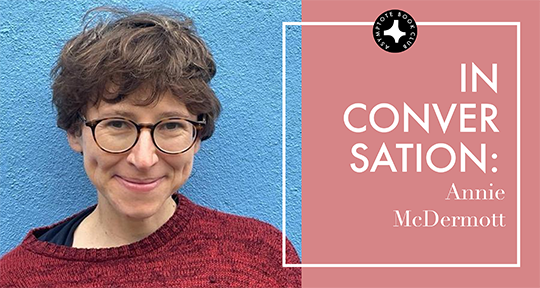
By Way of Dreams: Annie McDermott on Translating Mario Levrero

One of Levrero’s first publishers described him as a realist writer who lives on another planet.

The world is strange, and we make it stranger by living here. Uruguayan author Mario Levrero knew that better than most, and in his debut collection of short stories, The Thinking-About-Gladys Machine, one is guided by extraordinary vision and delightful humour along the writer’s gallery of fantasies and absurdities, impossible events and otherworldly journeys, all of which are made real and cemented into reality by thought and emotion. In this interview, translator Annie McDermott speaks about being drawn into Levrero’s singular voice, working with co-translator Kit Schluter, and distinguishing imagination from invention.

The Asymptote Book Club aspires to bring the best in translated fiction every month to readers around the world. You can sign up to receive next month’s selection on our website for as little as USD20 per book; once you’re a member, join our Facebook group for exclusive book club discussions and receive invitations to our members-only Zoom interviews with the author or the translator of each title.   

Georgina Fooks (GF): How did you first encounter Mario Levrero’s work, and what drew you to his writing?

Annie McDermott (AD): It was through a series of strange coincidences—which seems fitting. I was living in Brazil at the time, and I happened to go for lunch with a Mexican writer called Juan Pablo Villalobos, who was also living in Brazil at the time, and he is a great fan of Levrero. He wrote a great piece for Granta about how he became a fan before he’d even had the chance to get his hands on any of Levrero’s books—because they used to be so hard to get hold of—and he became a fan based on the titles alone.

He recommended him to me, and I happened to be going to Uruguay on the way home from Brazil, and I picked up a copy of one of Levrero’s novels. I remember that as soon as I started reading it, I realised that I’ve never read anything else like it. He has this amazing voice, this kind of strange, absurd, quite deadpan voice that is like nothing else. It’s also very warm, and also really engaging, and also very companionable and a really pleasant narrator to spend time with.

At the same time, Juan Pablo Villalobos had also been enthusiastically recommending Levrero to Stefan [Tobler] from And Other Stories, so it all happened in parallel in a very pleasing way, and that was how I came to end up doing some samples and eventually translating Levrero’s books. READ MORE…

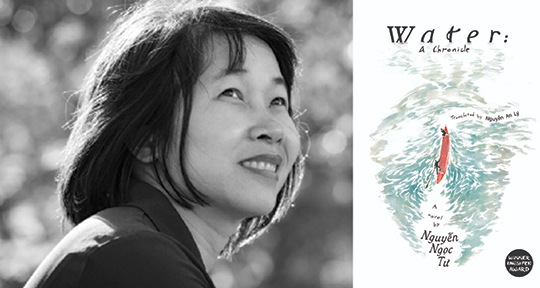
Life Without Breathing: On Water: A Chronicle by Nguyễn Ngọc Tư

In this swirling quasi-novel, saturated with insatiable quests of all varieties, everyone is engaged in endless seeking.

Water: A Chronicle by Nguyễn Ngọc Tư, translated from the Vietnamese by Nguyễn An Lý, Major Books, 2024

Water might have been the first floating signifier, if the image is anything to go by. Depending on its form, quantity, and culture of reception, it can be an agent of ritual purity, a destroyer of crops, a source of life, a symbol of illegible emotion. For the Vietnamese, water has been an operative metaphor and a lived reality since time immemorial; the word nước indexes both ‘water’ and ‘country,’ the two elements inseparably wedded in the linguistic psyche. A ruler of the Nguyễn dynasty once compared his precarious position on the throne to being in a boat, with the hoi polloi as the waters around him, threatening to overturn him at the slightest discontent. The scholar-translator Huỳnh Sanh Thông pointed out that Lạc, the first recorded name for the Vietnamese people, has a sonic affinity with numerous words denoting water: lạch (creek), lạt (to taste bland like water), lan (to spread like water).

The newly translated Water: A Chronicle, by the Vietnamese writer Nguyễn Ngọc Tư, embeds itself in this serpentine tradition. Better known as a litterateur of short stories than a novelist, Nguyễn Ngọc Tư’s popularity is virtually unmatched in her native country, even being named by Forbes as one of Vietnam’s most influential women in 2018. Many of her other works are similarly obsessed with the liquid element—as evidenced by their titles: Nước chảy mây trôi (Flowing Water, Drifting Cloud), Đảo (Island), Không ai qua sông (No One Crosses the River).

Though she mobilises a distinct dialect that is difficult to translate, spotlighting rural inhabitants swept up in the caprices of fate, her oeuvre is not unknown to the outside world. Her short story collection Cánh đồng bất tận (Endless Field) snagged Germany’s LiBeraturPreis in 2018, but the Anglophone sphere has thus far only received her work in dribs and drabs. This is now set to change with the groundbreaking labour of Major Books—a brand-new UK-based indie publisher dedicated to Vietnamese literature in translation, and with the poetic flair of translator Nguyễn An Lý, who deservedly won two PEN Translates awards this year. READ MORE…

Announcing Our October Book Club Selection: The Thinking-About-Gladys Machine by Mario Levrero

Life, as Levrero’s literature evidences, is richer and more beautiful when we follow our whims.

In The Thinking-About-Gladys Machine, the idiosyncratic wonderments of Mario Levrero are exhibited in a dazzling array. This first collection was, as the author tells it, ‘turned back into pulp’ in its first print run, but has since grown with tremendous repute, leading into a dedicated following in both its native Uruguay and neighbouring Argentina. It’s easy to see how these tales enthrall; each sees Levrero pushing the narrative form ever further into the enigmatic and the expansive, and any subject, object, and space is rendered as capable of endless transformations, creating portals at the seams of experience for the reader’s own marvelling journey. On live the bizarre, the mysteries, growing and multiplying at the non-existent borders of imagination.

The Asymptote Book Club aspires to bring the best in translated fiction every month to readers around the world. You can sign up to receive next month’s selection on our website for as little as USD20 per book; once you’re a member, join our Facebook group for exclusive book club discussions and receive invitations to our members-only Zoom interviews with the author or the translator of each title.   

The Thinking-About-Gladys Machine by Mario Levrero, translated from the Spanish by Annie McDermott and Kit Schluter, And Other Stories, 2024

What does reality look like? Might it in fact be more dreamlike than we assume? Does true madness lie in the acceptance of daily routine? All these questions ricochet throughout the stories of The Thinking-About-Gladys Machine, a dazzling array of imaginative exercises from the eclectic Uruguayan writer Mario Levrero. The simplest beginnings—the daily rounds of a bedtime ritual, the anxieties of being late for work—take unexpected turns, leading us to places we never could have imagined. Along the way, chance is revealed to be the dominant factor in reality, rather than routine. Levrero is a dizzying stylist and he is matched with aplomb by translators Annie McDermott and Kit Schluter, who evidently share the author’s passion for imaginative play.

The Thinking-About-Gladys Machine is both a product of the imagination and a book that mirrors it; just like the human psyche, the diverse stories of the collection record both our meanderings and our obsessions. Often, our narrator is a Levrero-like figure: a good-natured, comedic man (prone to yearning for women, as the title attests) who follows his flights of fancy to their utmost ends. He is a charming narrator, skilled with wry turns of phrase, and his inability to leave any stone unturned takes him down curious paths. Whether it’s the miniature world hidden within a lighter in ‘Beggar Street’, or the young boy who grows old searching for a key in ‘The Basement’, Levrero plays with absurd economies of scale by stretching out both space and time. Reality and matter are his playthings, but the ensuing absurdity leads to some profound truths. Life, as Levrero’s literature evidences, is richer and more beautiful when we follow our whims. READ MORE…

Weekly Dispatches From the Frontlines of World Literature

The latest literary news from Bulgaria and Central America!

This week, our editors-at-large fill us in on literary controversies, new releases, and returning festivals. From a conflict over a literary prize in Bulgaria to new short story collections from Asymptote alums, read on to find out more!

Andriana Hamas, Editor-at-Large, Reporting from Bulgaria

In July, I reported on the then unfolding conflict surrounding the proclaimed winner of the Novel of the Year award, given by the endowment fund 13 Centuries Bulgaria. It had turned out that Boris Minkov, the editor of the book (Вулкан or “Volcano” by Elena Alexieva), had also been a member of the jury, a fact that seemingly everyone had overlooked. The heated debates surrounding the legitimacy of the final choice led to Alexieva giving up her prize and the annulment of the decision.

In a recent development, Manol Peykov, managing partner at Janet 45, Вулкан’s publishing house, announced he would be withdrawing all nominated Janet 45 books from the competition as a way of making a statement against the way the above-mentioned crisis was resolved. The formal written withdrawal, which he shared on his personal Facebook profile, described the manner of dealing with the situation as “unacceptable, unprofessional, unethical and unfair.” The document questioned an existing legal ambiguity in the contest’s terminology: “No less worrying is the fact that neither [the organizers’] statements nor the published rules of the competition make it clear exactly what the definition of ‘conflict of interest’ is. Is it a conflict of interest for a member of the jury to have been or currently be published by one of the participating publishers? Or be close friends (or even bitter enemies) with any of the nominees? Or to have very recently received an unequivocal rejection from one of the other participating publishers?”

An official reply has yet to be issued. READ MORE…

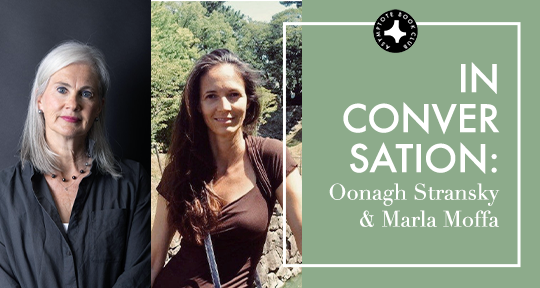
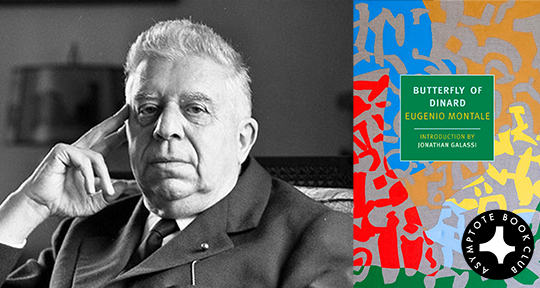
The Story as Experience: Oonagh Stransky and Marla Moffa on Eugenio Montale’s Butterfly of Dinard

[A]s ephemeral, beautiful, and delicate as these stories are, they are firmly grounded in history. . .

In Butterfly of Dinard, the great poet Eugenio Montale leads the reader up to numinous looking points along the towers of everyday experience, pointing us towards an innate sublimity and magic—how individual vision and experience can strike pedestrian sceneries with an extraordinary intensity of meaning. Originally published as columns in the Corriere della Sera, fifty of these stories have been translated with extraordinary care and finesse by Marla Moffa and Oonagh Stransky, and in this interview, they speak to us about the affinity between Montale’s prose and poetry, the revelations of translation, and how such stories travel from the page into personal realities, deepening and celebrating the spaces, people, and objects that—if looked at closely—“reveal a great truth.”

The Asymptote Book Club aspires to bring the best in translated fiction every month to readers around the world. You can sign up to receive next month’s selection on our website for as little as USD20 per book; once you’re a member, join our Facebook group for exclusive book club discussions and receive invitations to our members-only Zoom interviews with the author or the translator of each title. 

Xiao Yue Shan (XYS): I wanted to start with asking you both about the crossings between Montale’s poems and his prose works. What do both of you consider Butterfly of Dinard to be saying to us on its own? Is there an independent author to be found, or should we read his prose as dialogic with his poetry?

Marla Moffa (MM): I would say that there are various symbols in the poems that we can also find in the stories. Considering that he wrote Butterfly of Dinard when he was in his fifties—after the two main volumes of poetry, Cuttlefish Bones and The Occasions, and concurrently with The Storm and Other Things—it’s as if he’s regrouping in these stories everything that we find in the poems as well.

For example, as Jonathan Galassi points out in the introduction, Montale speaks about the eels in the story “The Best Is Yet to Come,” and just at the mention of the word eel on the menu for the protagonist, the narrator has this flashback, because the eels represented something special in his youth. There’s also the poem “L’anguilla / The Eel” in Montale’s poetry, which is one of his most important poems. It’s interesting to be able to read the two pieces in parallel, but at the same time, I feel like the stories are independent. If you don’t know his poetry, and you just read Butterfly of Dinard, you can still enter into Montale’s world. He even says himself that if one wants to know his story, that this is the book to read, because it is quite autobiographical.

Oonagh Stransky (OS): I agree with what Marla said, and the only thing I would add is that one of the things that appeals to me most about these stories is really the element of humour—the self-deprecating humour and irony. As in his poetry, there are moments of existential crisis, of gaps and sudden shocks, but there is also a delight in life, and a delightfulness that he attributes to so many different things. The nostalgia towards his past is one aspect of it, but I also like how he talks about himself—how he describes this figure, who may represent himself, as bumbling and Chaplin-esque, as Galassi calls it. It opens up new windows onto Montale the man, and who this very mysterious and obscure Nobel-winning poet was. Here we see him as a man in slippers, with a turban on his head, holding a rug up to scare away a bat—all those things are elements that allow the reader to feel more familiar with him. READ MORE…

Announcing Our May Book Club Selection: Butterfly of Dinard by Eugenio Montale

These stories are a spatial message; they tell of living amongst, and in this way, they belong to everyone.

In the fifty short stories that make up Butterfly of Dinard, the great lyric poet Eugenio Montale turns to prose to inscribe the world that moves the psyche to its most extraordinary heights. As one of the most inviting additions to a remarkable oeuvre, the collection moves from mystery to comedy, from reminiscence to fantasy, taking the reader on excursions and immersions, introducing an Italy grasped in historical and personal material alike. The Montale admirer will find motifs that correspond with his most famed poems, and anyone new to the writer will find an assured, perceptive voice, dedicated to documenting the most curious and complex intersections of our social reality. Reissued now by New York Review Books in an updated translation from Oonagh Stransky and Marla Moffa, and with an illuminating introduction by Jonathan Galassi, we are delighted to introduce Butterfly of Dinard as our Book Club selection for the month.

The Asymptote Book Club aspires to bring the best in translated fiction every month to readers around the world. You can sign up to receive next month’s selection on our website for as little as USD20 per book; once you’re a member, join our Facebook group for exclusive book club discussions and receive invitations to our members-only Zoom interviews with the author or the translator of each title. 

Butterfly of Dinard by Eugenio Montale, translated from the Italian by Oonagh Stransky and Marla Moffa, New York Review Books, 2024

After the walkman came into common use, a reporter in the Nouvel Observateur did a self-directed study on its effects, going around and asking its users if they considered themselves psychotic or schizophrenic. Clearly, the world of music had grown a new frontier. There would be communal listening, through the radio or some other form of public broadcasting, and solo listening; one could have a personal sonic timeline, running separately—though parallel—with the rest of the world’s sounds. Since then, we’ve only found new and improved ways to insulate ourselves from the social environment, so when a friend and I took a rental car around Los Angeles a month ago, I hadn’t heard the radio in probably a decade. When we turned it on, running through station after station, I catalogued the brief soundbites of the local airwaves—jockey banter, garbled trap, Christian rock, upbeat grupera. That frenetic soundscape accordioned over the brushed hills and highway traffic, and we synced to it, suddenly adopted into the city’s musical timestream as insiders. After a little while, we stopped at a light, and I looked to the car beside me. I couldn’t hear what the driver was listening to, but the taps of his fingers hit the exact same beats as those from our radio.

Music, and its innate potential for disrupting separation, was on my mind while reading Eugenio Montale’s Butterfly of Dinard, a collection of prose pieces first published in the daily Corriere della Sera. The newspaper, similar to the radio, is a halfway-abandoned arena of public consciousness—a gathering place where people can experience the same thing at relatively the same time, and be joined, if not in opinion, then in engagement. But the days in which radically dissonant lives and perspectives could be unified via song or text are largely gone; though the cultural artifacts themselves are more proliferate than ever, we meet them on terms that are ever more individualised, ever more catered to the psychic patterns that we build, alone. Passing through Montale’s slice-of-life writings, some tell stories of the past, some follow the mania of dreams, but running through all of them is a sense that they are being told in the textual version of the town square—meant for all to hear, no matter if you are sat in the audience or just passing through. These stories are a spatial message; they tell of living amongst, and in this way, they belong to everyone. READ MORE…