Language: Portuguese

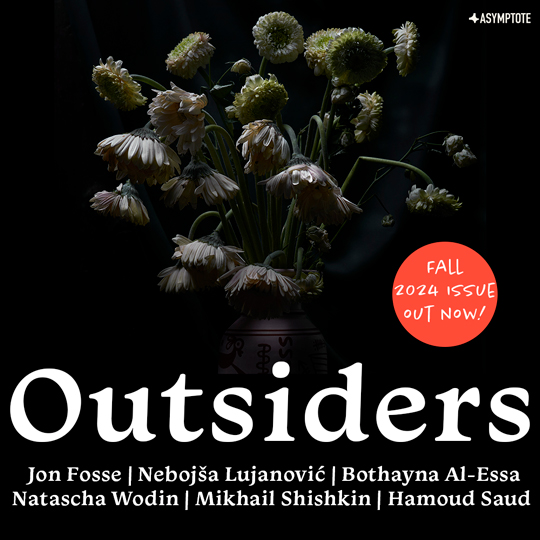
Our Fall 2024 Edition Is Here!

Feat. Jon Fosse, Mikhail Shishkin, Natascha Wodin, Bothayna Al-Essa, and Nebojša Lujanović in our Special Feature themed on outsiders

You and I, self and the other—it is the oldest, simplest difference we know. At a time of flooding across the world, from India to the US, the writers of our Fall 2024 issue call attention to physical and social separation, to the rushing waters that pull us apart, rendering us #Outsiders to one another. In exploration of this theme, we proudly bring you new work from 32 countries, including drama from Norwegian Nobel Laureate Jon Fosse, an interview with exiled Russian author Mikhail Shishkin, a review of French icon Simone de Beauvoir’s latest English publication, nonfiction by Omani writer Hamoud Saud, a spotlight on Brazilian artist André Griffo, and, for our final Brave New World Literature entry, a moving essay by the recently announced US National Book Award nominee the Kuwaiti author Bothayna Al-Essa. One year on from October 7th, Al-Essa confronts the limits of literary activism as she reflects on her video calls with a Gazan colleague: “Did I expect a person besieged in an open prison since 2006 to rejoice at the sight of a shelf of books?” In another highlight, German-Ukrainian writer Natascha Wodin’s narrator resuscitates her drowned mother, trying to fathom her across the gulf of time even as she pictures the Regnitz river washing her away. Meanwhile, Swiss poet Prisca Agustoni and Moroccan author Khalid Lyamlahy confront another kind of drowning—that of modern day migrants in search of a better life—in particular, the 269 lives lost to the sea around Lampedusa in a shipwreck, the news of which lights up Agustoni’s phone, and the death of a Gambian Lyamlahy never got to know: “I dream of a book that would contain all the words refused you, all the silences imposed on you. A book where the word ‘help’ is constantly repeated, in which the author would fade from each line, each fragment, to give you back the space denied you in life.”

blog2

Lyamlahy’s feat of empathetic imagination leads off this edition’s wildcard Special Feature, first announced on August 15th. By the time submissions closed one month later, anti-migrant rhetoric in the US had hit a new low with Trump repeating baseless claims of Haitians “eating cats and dogs” in his presidential debate. So, although we received more than one hundred manuscripts spotlighting every stripe of outsider, we decided to carve out space for the racial/national “other” so often denigrated in politics. From Cuban author Odette Casamayor-Cisnero drawing courage from her great-great-grandmother and taking a fiery stand against racism (“I’m done with running away”) to Croatian writer Nebojša Lujanović’s nuanced portrayal of a migrant who cannot bring himself to enunciate his full name for fear of outing himself to other members of his newly chosen community, the myriad voices showcased in this Feature are resounding proof of the struggle and humanity of those we as a society are so eager to condemn to the margins. All of this is illustrated by Spain-based guest artist Anastassia Tretiakova’s haunting photography.

As a magazine that does not receive ongoing institutional support because of our own outsider status—as elaborated in the Fall 2022 issue’s Editor’s NoteAsymptote counts on readers to sustain its mission more than most. If you think this “global literary miracle” (according to Dubravka Ugrešić) deserves to continue, please take a few minutes to sign up as a sustaining or masthead member today. (Interested in joining us behind the scenes instead? Our final recruitment drive of the year closes in four days!) Thank you for your readership and support. We can’t wait to see what 2025 brings!

READ THE ISSUE

SUPPORT OUR VITAL MISSION

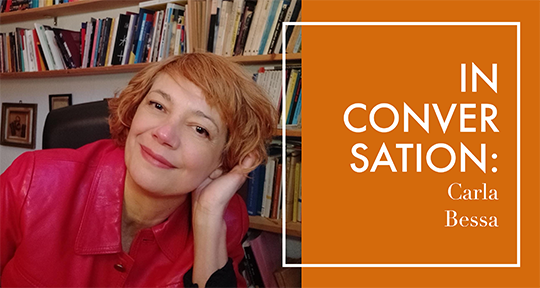
Guilty But Not Intentional: Carla Bessa on Traversing Germanophone and Lusophone Literary Worlds

We [translators] have to . . . make the text breathe (like an actor on stage) in the language, time, and culture of the target audience.

Carla Bessa wears many hats: theater actress, director, poet, short story writer, novelist, and translator. Born in Rio de Janeiro and now based in Berlin, she has translated Germanophone writers—Max Frisch (Switzerland), Ingeborg Bachmann (Austria), Thomas Macho (Austria), Christa Wolf (Germany), and more—into Brazilian Portuguese for São Paulo-based publishers WMF Martins Fontes and Editora Estação Liberdade, as well as Editora Trinta Zero Nove in Mozambique. As a translator, she works on fiction and nonfiction as well as young adult and children’s literature. As a writer, she writes what may be termed as “cross-genre” or “hybrid works,” questioning the boundaries demarcating limitless possibilities; this would eventually earn her Brazil’s most important literary award, the Prêmio Jabuti, given to her short story collection Urubus (The Vultures, Confraria do vento, 2019).

In this interview, I spoke with Carla on her award-winning works that cross the conventional genres of poetry, play, and prose; linguistic politics in the Lusophone world; and the intricacies of translating German-language writers into the Brazilian Portuguese.

Author photo by Hubert Börsig.

Alton Melvar M Dapanas (AMMD): Urubus and Todas uma, two of your short story collections, were translated by Lea Hübner into the German for Transit Verlag. Your 2017 book, Aí eu fiquei sem esse filho, on other hand, was rendered into the Greek by Nikos Pratsinis for Skarifima Editions. In the Anglosphere, you have been translated by Fábio Mariano and Elton Uliana. To anyone working on your works from their Brazilian Portuguese originals, what demands do you think these translators would face—in particular those translating you into German and English?

Carla Bessa (CB): The other day, I read an interview with my colleague Hinrich Schmidt-Henkel—the German translator of Nobel laureate Jon Fosse—in which he said: “Every literary text is an aesthetic project in its own terms. The translation is good if it realizes this aesthetic project in a style that is appropriate and consistent without breaks.”

I agree with that, despite the particularities of syntactic and verbal structures between Brazilian Portuguese and German. (As for English: I haven’t mastered this language in depth, but I dare say that the differences are minor.) I believe that the greatest difficulty in translating my texts is not of a textual or grammatical nature, but a cultural one. In my writing, I work very closely with spoken language, sometimes even using a kind of verbatim technique. So the translator of my work needs to have an in-depth knowledge not only of the environment where the stories take place—specifically the suburbs of Rio de Janeiro—but also, and above all, of the musicality of the Brazilian Portuguese spoken in these layers of society that I portray. I was very pleased that the translators who have translated me into English so far—Elton Uliana and Fabio Mariano—are Brazilian. Normally, we tend to think that a literary translator should have the target language as their mother tongue, but I don’t think that applies to all types of texts. In my case, the main challenge lies precisely in transferring this specific social environment with its many overlapping layers of cultural influences into the language and reality of German- and English-speaking countries, because this environment and its characters are the basis of my aesthetic project: to return here to the idea presented by Schmidt-Henkel.

READ MORE…

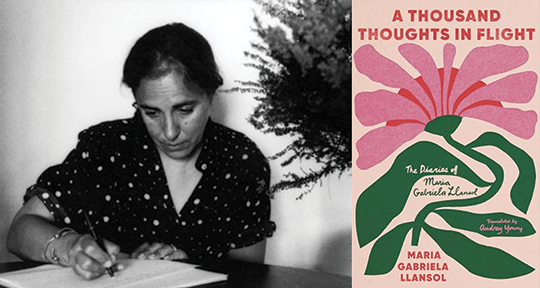
How the World Appears in States of Language: On A Thousand Thoughts in Flight by Maria Gabriela Llansol

Llansol is a generous and poetic writer, sensual in her descriptions and intensely attuned to the metaphysical and the otherworldly. . .

A Thousand Thoughts in Flight by Maria Gabriela Llansol, translated from the Portuguese by Audrey Young, Deep Vellum, 2024

A Thousand Thoughts in Flight, the diaries of Portuguese writer Maria Gabriela Llansol, is divided into three sections: “Finita”, “A Falcon in My Wrist”, and “Inquiry into the Four Confidences”. Comprised of three books from the seventies that Llansol left behind when she passed away in 2008, these volumes were the only ones to be published in Portuguese during the writer’s life, and are also the first of her non-fiction writings to appear in English, thanks to the work of translator Audrey Young. In his introduction, the critic João Barrento describes these private texts as “osmotic diaries: their genesis, their development, and their final form are inseparable from Llansol’s other books, which always accompany them and are interwoven with them”. This is true not only in the conceptual but also the literal sense; the first diary begins the day she finishes The Book of Communities—the first volume in her acclaimed trilogy Geography of Rebels—and ends the day she finishes The Remaining Life, the second volume, in 1977. The second diary picks up when she is finishing In the House of July and August, the final volume, and beginning to write her second trilogy, while also providing glimpses at the author brainstorming her duology, Lisbonleipzig.

Llansol is a generous and poetic writer, sensual in her descriptions and intensely attuned to the metaphysical and the otherworldly, coalescing history, philosophy, and physical experience; these qualities are boldly apparent in her fiction, but appear with an experimental and kinetic mode in these diaries. A common thread across the volumes is silence: everything that remains in the journal is a “draft”, consisting of left-out pieces and vacant spaces for contemplation, and this attention and appreciation reserved for emptiness becomes integral to the diaries’ form. Silence manifests in the common use of gaps in the text, indicated in certain places by a horizontal line (________), and more compellingly in other places as unannounced fragments of poetry. And in between these fragments is life. She moves all around Belgium, from Louvain to Jodoigne and finally to Herbais, where she and her husband Augusto Joaquim run an experimental school as part of a cooperative—which also makes and sells furniture and food. There, Llansol cultivates her own garden, which provides a bouquet of scenes and observations for her diaries, and immerses herself in music. Still, she never pauses in her pursuit of literature, of writing and reading about theology, philosophy, the lives of poets and mystics. It is only in the final diary that she moves back to Portugal’s Sintra, sometime in 1983, remaining there until her death. READ MORE…

Building a home for world literature in Lisbon

Lovers of brick-and-mortar bookshops, you’ll want to visit this new home for world literature next time you're in Lisbon!

Regular Asymptote readers will no doubt be familiar with the difficulties involved in sourcing the translated literature we all love. Thanks to small print runs, limited editions, and the vagaries of the publishing industry, it can be all but impossible to find certain books if you don’t live in their country of publication. Since moving to Portugal 6 years ago, I’ve really struggled to get my hands on books in English, and it’s a feeling shared by many who live here. 

Lisbon and Porto have some wonderful bookshops, including Bertrand, the oldest in Europe, and Lello, often called the most beautiful bookstore in the world. But the selection of literature available in English is very small, typically the same few mass-market paperbacks and classics; and after Brexit, it became very difficult to even order English books through the mail.

Over the past few years, Portugal has also become home to a cosmopolitan mix of tourists, expats, immigrants, and refugees, with English becoming a lingua franca. And so, as the need arose, we assembled a like-minded team and got to work.

We designed Good Company to be a true home for curious readers, and our dream bookshop. Every book is chosen by our team to create a selection that represents our interests, tastes, and reading experience. And we are always available to give personal recommendations, or special order anything you can’t find in our regular catalog.

Screenshot 2024-08-03 at 10.07.23 PM

With Good Company, we also wanted to bring the bookstore-as-a-third-space concept to Lisbon, creating a place for everyone to gather and meet, whether they are buying a book or not. Located in the elegant Avenidas Novas neighborhood, we’re building a community space full of beautiful books, comfy seating, great coffee, and event space that’s open for all to use. Every part of the bookstore was considered, and we have worked entirely with local artists and materials in its construction.

Even the design of the website was important. Having a beautiful and well-stocked online bookstore was always a priority for us, as we know how difficult it is to access independent literature and other English books in Europe, and how unpleasant most corporate sites can be.

We’ve tried to bring some of that bookstore magic to your screen. We hope you enjoy the little details, like how each book’s page is color-matched to better display the cover art, or our curated booklists, which range from our team’s personal favorites to recent prize winners, to highlighting the best Lusophone authors in translation. We’ve launched with over 3200 books in our catalog, and are adding more each week. 

Our online bookstore is live and currently shipping across Europe, and our physical store will be opening later this summer. Visit our website, browse our catalog, and if there’s any specific you’d like to order or you need a recommendation, just get in touch; we’d love to hear from you!

This is a sponsored post.

Summer 2024: Highlights from the Team

Find out what our very own editors have to say about our bountiful Summer issue!

Last week’s Paris 2024 Olympics Opening Ceremony featured numerous nods to literature, art, and music, calling to mind Georgi Gospodinov’s statement in his interview for our Summer 2024 issue: “Culture is a continuous conversation, a hum of different voices, and it’s actually wonderful music, a sort of polyphony. We are not only immersed in that conversation, we are also part of it.” Indeed, as our very own Mary Hillis points out, this brand-new Summer edition is a “veritable parade of nations with works from 35 countries.” Read on to discover some of the highlights, courtesy of our multicontinental crew!

My favorite in this issue is Honora Spicer’s Spitting Sutures, with its mesmerizing fluid interplay of drafting a translation, selling a house, and experiences of the body. Fluidity also defines Olivia Sears’s in-depth historical exploration of Italian Futurist Ardengo Soffici in a conversation with Eugene Ostashevsky. Krzysztof Umiński’s Three Translators (tr. Soren Gauger) is also a wonderfully detailed dip into translation history, this time Polish. Two other texts I really enjoyed were Farah Ahamed’s The Day You Ate our Deliveroo Delivery and the dramatic excerpt Trinity by Hamid Ismailov (tr. Shelley Fairweather-Vega), the first for its many-faceted examination of an ethical confrontation, the second for its gorgeously translated insults and imprecations.

 —Ellen Elias-Bursać, Contributing Editor

I love the compact, compressed nature of Adelheid Duvanel’s The Poet (tr. Tyler Schroeder). It’s got an amazing opening line that hooked me right away. The journey of the story that goes from childhood vignette to the awareness of the narrator as poet is really striking, showing how transformative and creative language can be, how altering a shift in perspective can be.

Micaela Brinsley’s Nothing to Be Owed is such a unique piece of writing, hybridic in its tone and structure, lyrical and poetic prose. The reflections on care in italics intersperse beautifully what’s going on in the almost journal-like entries. The line “I’m trapped by the transactional” will stick with me for a while.

Sarah Gear’s conversation with Georgi Gospodinov (tr. Angela Rodel) is a huge interview for Asymptote and it was a privilege to get such intimate access to the Booker International Prize-winning author’s mind.

—Hilary Ilkay, Assistant Managing Editor READ MORE…

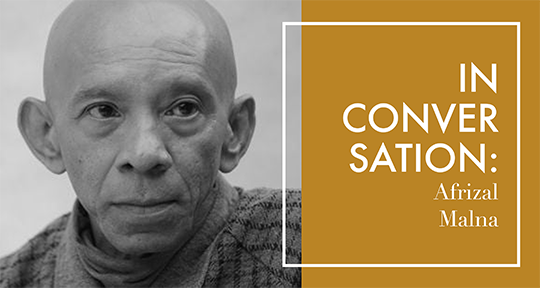
From the Tale of Crafting a God: Afrizal Malna on the Afrizalian in Indonesian Poetry and Drama

In writing poetry, I experience this body-that-writes as a mutant in language; I feel a different person is present in myself.

In contemporary Indonesian literature, the writer Afrizal Malna has earned his own movement. Coined by Universitas Gadjah Mada professor Faruk HT, the Afrizalian has come to mean “seemingly disjointed images and ideas wrapped inside deceivingly simple phrases,” according to University of Auckland’s Zita Reyninta Sari, who goes on to elaborate the ways that it puts “everyday objects, especially those which in a glance are the most mundane … in the spotlight.” In his foreword to Afrizal’s Anxiety Myths, translator Andy Fuller also contributes to the definition: “An Afrizalian aesthetic is an engagement with the physicality of the city. How the body collides and rubs up against the textures of the city; of the varying intense urban spaces of everyday life.”

A SEA Write award-winning writer and artist sketched as “one of Indonesia’s best contemporary poets,” Afrizal’s works have been translated from their original Indonesian into languages such as Dutch, Japanese, German, Portuguese, and English, and have received accolades from literary award-giving bodies in Indonesia and beyond. To name one, Daniel Owen’s translation of Afrizal’s poems was the winner of Asymptote’s 2019 Close Approximations Prize.

 In this interview, I spoke with Afrizal—currently in Sidoarjo in East Java—with the help of Owen’s translation. Our discussion covers the Afrizalian literary movement within contemporary Indonesian poetry and drama; the terrains of linguistic hierarchies and reader reception; and his latest poetry collection Document Shredding Museum, originally published as Museum Penghancur Dokumen in 2013.  

Alton Melvar M Dapanas (AMMD): Your latest collection, Document Shredding Museum, is now out from World Poetry Books. Could you tell us about the collection’s journey?

Afrizal Malna (AM): This edition of Document Shredding Museum is actually a revised, second edition of the book; the first edition was published by the Australia-based publisher Reading Sideways Press in 2019. In Indonesia, it was published a decade ago. The answer I’m giving you to this question now is probably quite different from how I would have responded back then.

This book was written between 2009 and 2013, over a decade after the fall of the Suharto regime and the 1998 Reformasi. This regime ruled from 1966 to 1998 as a result of the 1965 tragedy—the massacre of members of the Indonesia Communist Party (Partai Komunis Indonesia or PKI) and those accused of being Communists, alongside the overthrow of the prior president Soekarno—which is still full of question marks even now. 2009 to 2013 was a time when the Indonesian people began questioning: what resulted from the 1998 Reformasi? Has there really been a fundamental change? We wondered if the powerful in Indonesia will always be prone to nepotism and its corollary effects—such as legal, ethical, and human rights violations, as well as corruption.

It was also during this time that I lived in Yogyakarta, in a Javanese cultural environment, occupying the boundary between village and city as a blurred space in Nitiprayan, Bantul (still a part of Yogyakarta). This became the moment for me to start from zero, and to allow my activities to mimic the wind, moving to find empty spaces and lowlands. This blank slate could shift the past—which was filled with hope for political change, as well as hope for literature and art to respond the 1998 Reformasi.

Global society at that time was facing social upheaval and natural disasters. When the earthquake in Padang, West Sumatra happened, I was living in a house that I had rented from a family of farmers—an old, fragile Javanese house (rumah limasan) made of wood. The earthquake made the house convulse, and it was as if the house were dancing along to the earthquake’s rhythm in order to avoid collapse. When the earthquake stopped, not a single part was damaged, but many of the houses made of stone or cement had cracked or collapsed. It felt as if the wind had vanished. Leaves were stiff like in a painting, and the feeling of solitude, of quiet, was stifling.

That natural disaster, among many others, reflected the awareness that our bodies and our technology were paralyzed, powerless. Our ancestors, who had a long history of facing disasters, may have known how to read the portents of an upcoming disaster as an ancient form of mitigation, but this knowledge was not passed down to us. READ MORE…

Spring 2024: Highlights from the Team

More entrypoints into the glorious Spring Asymptote, courtesy of our generous team!

Aigerim Tazhi’s “Following the Breath of the Earth” is a refreshing reminder of another way of life through Kazakh spirituality—one that treasures the interconnectedness of nature and all of the species in it, where nature stands for truth in an undivided and nonhierarchical ecosystem. The ancestral belief in the gods of the sky (Tengri) and earth (Umai) echos the current calls for decolonial approaches to climate justice. And yet, the critique of the tourists who contaminate glacier lakes in Tibet, or the rise of yurts for camping trips North America, or the odd questions asked of the poet in Rotterdam, gently caution against the performative gestures that appropriate Indigenous beliefs. The story’s motif of nomadic travel and breath fits well in this conception of an interconnected world.

This theme of nature and the interconnected ecosystem for alternative worldbuilding is carried out in several other articles, including Jang Okgwan’s poems (tr. Susan K), with motifs of water and moonlight; and Leeladhar Jagoori’s poems (tr. Matt Reeck), of mountains and terrain.

I also appreciated the attention on language, the limits of the written word, and the rebelliousness of vernacular expression in this issue, especially in Sebastián Sánchez’s interview with Chilean author Diamela Eltit (tr. Fionn Petch) and in the poetry of German-Turkish Ozan Zakariya Keskinkılıç (tr. Özgecan Kesici). Each provides glimpses into the capacity of language play and hybrid rule-bending for community-building, political resistance, and memorialization.

 —Vuslat D. Katsanis, Assistant Editor (Poetry)

Chen Yuhong’s poem “Buddhist Pine” opened my eyes to different ways of being still/degrees of stillness. The way the poem successively transposes metaphors of animal, seasonal, granitic, and athletic stillness on the motionless pine made me understand that things can be still in different ways. That the pine might have a willed, disciplined stillness, or that it might be coiled, or frozen, or at rest, or somehow all at once.

 —Matthew Redman, Digital Editor READ MORE…

Winter 2024: Highlights from the Team

Get excited to dip into our Winter 2024 issue with these highlights from our team!

Ilya Kaminsky’s “Reading Dante in Ukraine” makes an impassioned case for the crucial role of art amid the horrors of war. What we need, as Dante’s journey shows us, is to defend ourselves with it: a tune to walk to, even in the underworld, as long as one still walks. In Miklós Vámos’s “Electric Train,”  translated by Ági Bori‚ the question-answer format gives the piece levity and rhythm, and the counterpoint of the humor interplaying with the troubled relationships brings it powerful depth. I found wisdom in the wry humor of Jaime Barrios Carrillo’s poems in David Unger’s translation. I love the image of angels spending the evening in their hotel rooms, ironing their enormous white wings.

—Ellen Elias-Bursac, Contributing Editor

The masterful language in Ági Bori’s translation, as though hand-holding the reader through a children’s story, and the simple act of gifting a present in the story belie the depth and complexity of emotional turmoil that wash over Miklós Vámos’s characters in “Electric Train,” a turmoil that seemingly hits out of nowhere like a wave yet in fact stems from a deep brewing well of built up memories and tensions. The contrast highlights all the more the challenges, and perhaps even limits, of recognizing and understanding another’s intentions, experiences, and feelings.

Rage, sorrow, resilience, helplessness, hope, a hunger for life and love and connection, grief, a numbing screaming despair: it is difficult to put into words the sensations that ran through me as I read Samer Abu Hawwash’s “My People” in Huda J. Fakhreddine’s translation. It cannot possibly compare to the feelings and thoughts of Samer Abu Hawwash and the Palestinian people, to the reality of having each day and moment narrow down to dried bread and tear tracks.

I was intrigued by Laura Garmeson’s discussion, in her review of Brazilian author Itamar Vieira Junior’s Crooked Plow, of the tongue as “both creator and destroyer. It has the power to make and unmake worlds.” It is a through line in Crooked Plow that reminds us of the power and possibilities of language and story to shape our lives. Garmeson’s review, in a way, is also a fire that kindles awareness of Itamar Vieira Junior’s work and the legacies, realities, and possible futures for Afro-Brazilian communities. The tongue as symbol also feels like a through line between these pieces in their rumination on what is gained and lost and pushed aside in the choices we make of what, how, and when we say (or write) things, or not.

—Julie Shi, Senior Executive Assistant

READ MORE…

A Year of Reading the World

Sometimes reality would seem unbearable if literature were not there to decipher it, to give it heart.

Every month, the Asymptote Book Club shares a newly published, translated title with readers and subscribers. From Nobel laureates to electrifying debuts, this selection features some of the most powerful voices writing in any language, opening up an entry into the immense archives of  wold literature. In this essay, we look back on the books of 2023 thus far. 

Sign up for the Asymptote Book Club here and have our curated titles sent to your door!

Whenever a major event transpires, anywhere in the world, the instinct of many is to reach into the annals of writing—for explanation, ruminations, solace, transcriptions of history, glimmers of what’s to come, stories of people and their ordinary or extraordinary lives. . . On January 1 of this year, Croatia officially joined the Schengen Area, making it the twenty-seventh member to benefit from the region’s removal of border controls—and the search for Croatian books and literature went up 30%. During the surprising and intermittently absurd “Chinese balloon incident” in early February, searches for books on Chinese espionage went up a full 100%. Interest for Ukrainian literature stayed at a high amidst the ongoing conflict, and peaked when the International Criminal Court issued an arrest warrant against Vladimir Putin for committing war crimes regarding the illegal deportation of children. As a devastating civil war broke out in Sudan in mid-April, the world immediately sought out writing from and about the region, and when Niger’s government was overthrown in a military coup on July 26, searches for Nigerien books and authors also saw a significant surge. And as writers from Palestine and Israel continued, over the decades, to release texts around nation, land, exile, occupation, humanity, and violence both physical and psychological, we all watched in horror as the devastation grew almost unimaginably—and we looked for those books.

Books and the world they’re written in, books and the worlds they give us—sometimes reality would seem unbearable if literature were not there to decipher it, to give it heart. As the poet Adonis said, “My homeland is this spark this lightning in the darkness of the time remaining. . .” (translated by S.M. Toorawa); with language, such texts lend us that brightness, and we are rendered able to discover the many narratives and landscapes of our long, shadowy era.

In this year’s Book Club, we’ve thus far featured eleven titles: eleven authors, eleven countries, eleven languages, and eleven translators. Each brought their own entrancing energy of storytelling, whether taking history or the human psyche as material, building on myth or fearlessly experimental. There were titles that sought to give us a vivid portrait of a certain neighbourhood, a certain period. Others dove into the intricate channels of thinking to paint a picture of the mind. READ MORE…

Weekly Dispatches from the Frontlines of World Literature

The latest literary news from North Macedonia, Latin America, and the Philippines!

This week, our Editors-at-Large take us to book fairs, awards ceremonies, and book launches. From celebrated poets and dearly departed essayists to up-and-coming novelists and prize-winning translators, read on to find out more!

Sofija Popovska, Editor-at-Large, reporting from North Macedonia

The recent publication of The Long Coming of the Fire, a collection of poems by Aco Šopov, translated from the Macedonian by Rawley Grau and Christina E. Kramer, was met with interest and celebration from Macedonian literary critics, journalists, and laymen alike. The book features a total of seventy-four poems, selected by Jasmina Šopova—daughter of the poet and established connoisseur of his work. A selection of Šopov’s poems in Kramer and Grau’s translation was featured in the Winter 2023 issue of Asymptote Journal.

Aco Šopov’s literary output is significant beyond its stylistic excellence and thematic range—it also marks the beginning of the modernist period in Macedonian culture. “His work,” writes N.M. for Nova Makedonija (New Macedonia), “is essential to a poetic movement that freed poetry from the grasp of both the folk oral tradition and the short-lived socialist-realist style, thus directing the [still] tenuous poetic tradition of authors writing in the newly minted Macedonian language towards the expansive spaces of modern European songmaking.” This swift evolution, propelled onwards by the “long strides” of Šopov’s visionary lyric, was the reason Macedonian literature managed to catch up with the still-relevant themes and styles of its European counterpart.

Now, 100 years after Šopov’s birth, the public at large can experience his unforgettable voice through The Long Coming of the Fire, a bilingual Macedonian-English edition published by Deep Vellum Press. In an unusual but successful move, the edition was translated via the synergy of three translators. In an interview organized by the Macedonian Academy of Sciences & Arts, Kramer explains that this translation resulted from the synergy of three unique approaches and skillsets: “Rawley [Grau], who translates poetry very well but doesn’t know Macedonian, me, who knows the Macedonian language very well but not how to translate poetry, and Jasmina, who weaved the threads together in a way that resulted in the creation of a team of translators.” Although, being a linguist, she would’ve “been more comfortable discussing Šopov’s use of nouns and verbs than his poetics”, Kramer notes that his images, recurrent within his poems, “subtly bind” the author’s inner workings to the outside world, creating poetry that is “simultaneously personal and universally human”. READ MORE…

Translating the Non-Existent

[W]hat if you wanted to translate a poem that can no longer be found in its original language?

Poems and stories have murky histories—the older, the more obscure. In the following essay, we follow a translation team from the College of Mexico as they work to unearth an ancient love poem by way of its later translations, delving into the question of what constitutes of an original.

It is accepted that our ancient texts do not come to us intact; from the poetry of Sappho to the second part of Aristotle’s Poetics, we can only know these works thanks to quotations or references by many other authors. As such, a question plaguing translators of history remains: what if you wanted to translate a poem that can no longer be found in its original language?

This is precisely the problem facing certain translators from the College of Mexico, who had decided to embark on the colossal journey of translating the first love poems of over fifty languages. Francisco Segovia, the leading editor of Primer Amor, the book that reunites these texts, stated that they actually “wanted to translate the first poems ever written, but it seemed like and unfathomable task, so we focused just on the love poems”. From there, Segovia, along with Adrián Muñoz and Juan Carlos Calvillo, gathered over forty translators, academics, and poets to ensure the texts were not only well translated, but also accompanied by a brief critical comment of the translation work and the poem itself. Included are poems written originally in Sanskrit, Latin, Náhuatl, Awadhi, Medieval French, Tamil, and more, include excerpts from the Bhagavad Gita, the Epic of Gilgamesh, and even Homer.

However, one text in particular was set apart from the others, and required a distinct approach. The “Song of the Serpent” is a poem originally written in Tupinambá, a native language from present-day Brazil. The community has been deeply described in André Thevet’s The New Found World, or Antarctike and in Jean de Léry’s History of a Voyage to the Land of Brazil, but the most prominent figure who has written about the Tupinambá was actually Michel de Montaigne; in his essay “Of Cannibals”, he delves into the otherness of the community in an attempt to understand the nations that “are still governed by natural laws and very little corrupted by our own”. As Carlo Ginzburg has pointed out, Montaigne’s unique perspective led him to see Brazilian natives not as animals or savage people, but as “belonging to a distinct and different civilization, although the word civilization did not exist as yet”. Not only that, but Montaigne refused to regard their poetry as barbarian, and defied the paradigms of natural anthropology that deemed American natives as inferior, stating: “I do not believe, from what I have been told about this people, that there is anything barbarous or savage about them, except that we call barbarous anything that is contrary to our own habits.” READ MORE…

Many Bridges To Cross: Sandra Tamele on Mozambican Portuguese and Unfolding a Publishing Scene

. . . translation plays a pivotal role in terms of making [Mozambican] borders more permeable to culture and knowledge and the circulation thereof.

Having envisioned a publishing infrastructure for Mozambicans and by Mozambicans after becoming the first published literary translator in her country, polyglot Sandra Tamele established a literary translation prize, attended the Breadloaf Translators’ Conference, obtained a diploma in translation from the Institute of Linguists Educational Trust in the United Kingdom, and eventually co-founded consortiums of literary translators and book publishers. She did all this while translating works from the English and Italian into the Mozambican Portuguese, from Premio Strega-winning Italian novelist Niccolò Ammaniti’s Eu não tenho medo (I Am Not Scared) to Jamaican poet Raymond Antrobus’s A Perseveranca (The Perseverance), and learning other languages—including the Mozambican Sign Language. 

Throughout all this, establishing The London Book Fair award-winning independent press Editora Trinta Nove Zero (30.09) and the As Sete por Quatro (7×4)—which champions works by marginalised Mozambican writers writing in Mozambican Portuguese, English, and other local languages such as Makhuwa, Sena, and Changana—seems to be her career’s crown jewel so far. In this work, she has engineered a landscape more consequential than any edifice and armature: the new age of Mozambican literature, translation, and publishing. “Literary translation is still underrated in Mozambique,” Tamele laments in her essay ‘Desassimilar: Decolonizing a Granddaughter of Assimilados,’ “But I have chosen a different path now, and this work is too important for me to give up.”

In this interview, I conversed with Tamele on the intricacies of translating from English and Italian into the Mozambican Portuguese language; finding readership in the Mozambique and the rest of the Lusophone world; and being one of the architects of Mozambique’s literary and publishing scene. 

Alton Melvar M Dapanas (AMMD): Did you have a road map to develop a publishing infrastructure with your many contributions to Mozambican literature? What went unmentioned behind the scenes?

Sandra Tamele (ST): I have to admit that I did not have a roadmap, but wish I had one when I decided to become a ‘PublisHer’ back in 2018; most of the shifts in my career, through this past decade, were a result of my restless, problem-solver spirit. In hindsight, I think that I never expected or even dreamed that today I could win any literary or publishing awards, nor act as a PublisHer advisory board member and president of the Mozambican Publishers and Booksellers Association, among others. 

Long story short, I left a career where I felt unwanted for one where I felt invisible—and with less prospects of succession because I had never heard a single child say they wanted to become a literary translator when they grew up. The solution: a literary translation competition to raise the profile of language professionals, while promoting reading and literary translation practice among young people in Mozambique. Three years later, we had this amazing collection of stories that no publishing house in Mozambique was willing to invest in, in spite being written by award-winning authors like Alain Mabanckou, Marguerite Abouet, and Imbolo Mbue, to mention a few. 

Establishing 30.09 was the solution. It went from strength to strength and now encompasses a creative writing initiative for women, workshops for illustrators, the transcription of children’s and YA books to build a Braille library, agenting for Mozambican writers, and the project of a groundbreaking bookshop and community library. I guess I am The Architect without a plan. Despite the steep learning curve and the many hats I have to wear, I believe that I’m gaining focus as I grow as a publisHer. 

In 2024, I plan to be more intentional in working with my peers to provide training for a cohort of female high school graduates in key publishing and related fields, to start building the book sector infrastructure in Mozambique. A roadmap for those who follow on my footsteps is also on the agenda, in addition to building a database and statistics for the sector. I’m now also in the position to advocate for book and literacy policies with key decision makers.

AMMD: You disclosed that most Mozambican writers do not share your views about the potentials of literary translation. In what ways has 30.09 been a solution to the many challenges you previously outbraved and myths you tried (and are still trying) to dispel as a translator and publisher? 

READ MORE…

Summer 2023: Highlights from the Team

Still looking for entry points into our brand-new Summer issue? Members of our multi-continental team offer you several!

From the Indonesian Feature in the Summer edition, I was intrigued by the poems of Nirwan Dewanto, in vivid translations by John H. McGlynn, including “The Way to the Museum,” which begins with “All eyeballs dipped in the vinegar of the bourgeoisie will become pickled eyeballs” and continues, in long lines, to contemplate class, blindness, and revolution. It resonated against the pathos and absurdity in excerpts from Ulrike Draesner’s Schwitters, translated by Sharon Howe, and Tatiana Niculescu’s play Brancusi v. United States, fresh portraits of European Modernist artists Kurt Schwitters and Constantin Brâncuși, respectively. In each case, as the exile of the artist comes to the fore, the language of their place of origin is woven into the text, along with glimmers of humor. I particularly appreciated the note from Niculescu’s translator Amanda L. Andrei, which describes the process of working, as a heritage speaker, with her father Codin Andrei: “The emotional challenge [of translating this work] lies in my own hang-ups of being a non-native speaker due to political and historical forces beyond my control. When we co-translate, my father and I converse about Romanian culture from a perspective free of Western stereotypes of communism, vampires, and oppression, and we are delighted.” Finally, I was swept up in the atmospheric excerpt from Habib Tengour’s Women of the Odyssey (tr. Teresa Villa-Ignacio) while listening to Tengour’s mellifluous reading of the subtle text in French, describing those who console themselves by “sticking ear in seashell” or the “Unfinished / Wave bringing you to the threshold.”

—Heather Green, Visual Editor

I adore the rush of the speaker’s voice in Enrico Remmert’s The War of the Murazzi (tr. Antonella Lettieri), and its syntactical verbality, meandering but never losing control, digressing into tightness, into an accumulation of narrative stress. I love as well the narrator’s contextualisations of the backdrop of Turin and its historico-social problems with violence, particularly in a refugee context: Turin feels masterfully integrated into the plotline, like a combattant in the Murazzi war itself, and the vivacity of its violence continues running, naturalistic, organic, as the “river never stops running.”

The textuality of Mateo Díaz Choza’s Precipitations (tr. Lowry Pressly) is staggering: the dual columns that inform multiple methods of reading the poem, as well as the materiality of the poem, almost transforming it into an object itself. The way the words waterfall down the screen mimic the “drop,” a kind of fall from heaven, in a mode that lends itself to the digital form undoubtedly better than it would a magazine or a standard-format book, in the “depths of the page” that ultimately do not supercede the infinite scroll of the screen. When the poem’s substance and words meet and meld into each other, the poem’s two columns also merge into one, into the “weather,” “snow-mute” but “beautiful” in the void of its meaning. Choza creates an aesthetics of decay, of death, of abandonment, but of regeneration as well. The drop recurs again and again; the speaker will continue to recognise his lover, again and again.

I love the adventure of Amyr Klink’s One Hundred Days Between Sky and Sea (tr. Rachel Morgenstern-Clarren), the sense of movement through space and time that underpins the narrator’s paradoxical stillness, immobility. It is remininescent of Jules Verne’s Voyages extraordinaires, venturing beneath the sea or into the heart of volcanoes, on a journey pushing against the boundaries of human capacity. Klink melds the joy and exuberance of a child discovering the world with a practical, didactical style of writing that underpins the veracity of his voyage. I find this piece particularly apt for Asymptote as a vessel in the sea of understanding, a buoy of translation in the archipelago of languages.

I appreciate Asymptote‘s continued dedication to featuring Ukrainian writing in each issue, particularly Ukrainian writing about the Russian invasion. In my view, this is one of the most essential tasks of literature in translation: to continually draw attention to the diversity of global experiences; to remind us that our lives are not insular, that we are not islands. To that end, I found Anton Filatov’s Finding Myself at War (tr. Patricia Dubrava) both heart-wrenching and vital. As his “eyes bleed” before the cruelty of false news stories, so do readers’ eyes before the horrors of Ukrainian soldiers’ war experiences. They are given voice not in those news stories, but in literature. Sharing their stories—and I love the detail of the abandoned cat, ironically (or not?) named Death, as well as the final section on cinema—is an act of taken care.

I find Nicole Wong’s discussion of translation theory in The Terroir of a Single Work: Redefining Scope in Approaches to Translation incredibly pertinent and eloquent, and I particularly enjoy the ‘close reading’ section where she dissects her own translation of Proust. It’s a priviledge to experience the clarity and sharpness of such a mind through this piece. Her style is reminescent of Kundera’s narrator in The Unbearable Lightness of Being: playful, heavy on metaphor without falling into abstraction, clear, enlightening (and bearably so!). Since reading this piece, I’ve found myself returning to it as I internalise and integrate her analysis into my own understanding of translation.

 —Michelle Chan Schmidt, Assistant Editor (Fiction)

READ MORE…

Weekly Dispatches From the Frontlines of World Literature

The latest from Spain and Central America!

In this week of literary news, we hear from our Editors-at-Large on Spanish-speaking countries around the world! From Spanish-Romanian literary intermingling in Spain, to recent award winners across Central America, to medium-bending poetry across sound and space in Mexico, read on to learn more!

MARGENTO, Editor-at-Large, reporting on Spain

As the summer season is kicking in and tourists are about to take over Spain—as is the usual for this time of the year—certain portions of the literary world are seeming to gain fresh momentum. That goes particularly for the transnational and translational endeavors. 

The latest issue of the Madrid-based literary journal Ágora – Papeles de Arte Gramático offers a rich overview of contemporary Spanish poetry while including a generous Catalan special feature. A substantive section on Romanian literature is also featured, with reviews of Encarnación García León’s recent anthology of Romanian fiction in Spanish translation and articles on Spanish translations of the legendary writer and internationally revered religion phenomenologist Mircea Eliade and the symbolist Ion Minulescu. 

Moreover, the issue opens with poems by past Asymptote contributor Felix Nicolau in Elisabeta Boțan’s Spanish translation and some of Fernando Pessoa’s celebrated poems in Dinu Flămând’s Romanian rendering. The journal has had a long-standing interest in Romanian-Spanish literary cross-pollinations, as a previous issue featured a sizeable section dedicated to the Romanian inter-war writer Max Blecher, who passed away at the age of 28 after spending a decade ill, confined to his bed, and writing literature that would later be widely translated. Blecher’s collected poems in Spanish translation, edited by Joaquín Garrigós, was a highlight of the issue. Ágora’s Editor-in-Chief Fulgencio Martínez warmly recommends to his readers the summer issue of another Madrid-based journal, Littera Nova, profuse with Romanian writing. 

READ MORE…