Language: Chinese

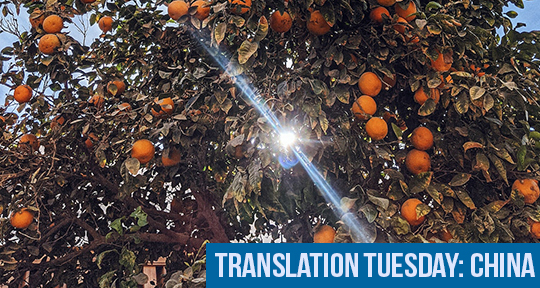
Translation Tuesday: “Colourful Fruit Trees” by Yao Yao

Those memories bathed in the bright sunlight reappear on quiet days from time to time.

Just in time for fall in the northern hemisphere, we have a special treat for nature lovers this Translation Tuesday: Yao Yao’s “Colourful Fruit Trees“ is in essence a paean to a wonder of nature and the conduit through which the warmth of the sun reaches into the sometime troubled lives of its myriad characters—some friends of the author in real life, others fictional. This is a living, breathing tapestry that is more than the sum of its parts. Thanks to translator Samuel Liangxing Luo, this marvel of a creative nonfiction that uses the list so well is now accessible to English readers. 

University teacher Frances Mayes, who had left San Francisco for a vacation in Tuscany, discovered a fascinating old house named “Yearning For The Sun.” There were hazel trees in front of the steps, fig trees by the well, and, on the surrounding hillside, 20 plum trees, 117 olive trees, along with countless other apricot, apple, and pear trees. These fruit trees were strikingly colourful and the scenery magnificent. Enchanted, she dug deep into her savings and put everything on the line to buy the house. Flooded with sunshine, her days there were brilliant and happy.

Cao Jie, who came to the city of Fuzhou to teach animation, connected frame-by-frame the images of the sky above the university city and the trees along the Minjiang River to create a Fuzhou version of Laputa: Castle in the Sky. The farm-style lychee and longan trees planted in the past were kept at the new campus. Every time she proctored for final examinations and looked out of the windows, she would see fresh lychee fruits shining in red on the branches, where two or three boys would be climbing and passing the fruits on to beautiful girls.

Cao Jie climbed all kinds of trees in her hometown of Chuandong. As a child, she fell from a red pomelo tree and pierced her eyelid on coal debris on the ground. There was a big yellow fig tree near the dormitory building at her middle school campus. Sometimes, she climbed up the tree and stayed alone quietly or had a nap there. Other times, she and three or four other classmates would sit and chat on branches more than ten metres high, just like the aliens living in the Hometree in Avatar. Cao Jie painted the best gouache for many trees. She was familiar with painting the details of the yellow fig tree, the winding branches, the tender yellow bud tips, and the little red fleshy fruits. There was also a big yellow fig tree at the university campus. Disguised by the fig tree, students turned over the wall, merged into the night, and played outside. READ MORE…

Weekly Dispatches From the Front Lines of World Literature

Literary dispatches from Croatia, Hong Kong, and India!

This week, our editors on the ground report on literary festivals, award winners, and exhibitions inspired by pivotal writings. From awardees of the Lu Xun Literature Prize to wide-ranging international programs, find out the latest news from the world of global letters below.

Katarina Gadze, Editor-at-Large, reporting from Croatia

The beginning of literary September in Croatia marked the tenth World Literature Festival, which ran from September 4 to 9 in Zagreb. The festival, a tradition for world literature aficionados throughout the region, has grown into an immersive experience for readers to see the best new works of world literature, meet novelists themselves, and listen to discussions regarding their works. This year, the festival brought forth a star-studded line-up of extraordinary international guests and talented authors—such as British writer Bernardine Evaristo, author of one of the most influential books of the decade, Girl, Woman, Other. 2020 Costa Book of the Year winner, Monique Roffey, also joined to share insight into their latest literary masterpiece, The Mermaid of Black Conch. On the local side of things, a talk on the heartbreaking novel/poem Djeca (Children) with its author, the Serbian writer Milena Marković, is also worth mentioning. Other foreign writers who took part in the festival’s fruitful discussions include Israeli writer Dror Mishani, Austrian novelist Karl-Markus Gauss, and German author Katharina Volckmer.

In Rijeka, the Croatian harbour city’s own literary festival, vRIsak, is also back for its fifteenth edition, in which both foreign and local literary voices flocked to the city’s new cultural center, the “Benčić” art district, to discuss contemporary writing and art. This year’s edition promised to be the most ambitious yet, with a lively program celebrating stories of emigrants, contemporary European poetry, and the city Mostar’s literary boom. On the topic of the latter, Mostar author Senka Marić, whose Kintsugi tijela (Body Kintsugi) will soon be published in English translation, spoke about the creative ambitions behind her latest novel Gravitacije (Gravitations). Another theme of this year’s festival was climate fiction, an ode to the healing potential of words in context to the rapid environmental changes of our time.

Last but not least, on September 22, Croatian Writers’ Association (Društvo hrvatskih književnika) organised a panel discussion on a hot topic in today’s literary scene, entitled “Literary Translation Today: Art or Transmission from Language to Language?” On the panel, numerous experts discussed what literary translators are up against in today’s competitive market, as well as the general lack of respect for such a demanding artistic process. READ MORE…

Weekly Dispatches from the Front Lines of World Literature

Literary news from India, Hong Kong, and Sweden!

In India, the country mourns the loss of Kerala’s groundbreaking tribal novelist. In Hong Kong, a genre-bending poet is being celebrated across the nation. And in Sweden, two talented writers have won the prestigious Klas de Vylder’s Grant Fund for Immigrant Writers. Read on to find out more!

Suhasini Patni, Editor-at-Large, reporting from India

On August 16, India’s first tribal novelist Narayan passed away in Kochi. Born in the Mala Araya tribe in Kerala, Narayan gained nationwide recognition for his book Kocharethi (1998), which won the Kerala Sahitya Akademi award. The book was a way to counter the misrepresentations of his community from outsiders, and Narayan struggled for ten years to find a publisher willing to release it; despite critical acclaim, many complained his work lacked literary merit. Translator Catherine Thankamma, who translated the text into English—winning the Crossword Book Award for it—wrote a tribute to him for Scroll.in. Her tribute honors the struggles and biases he faced in the literary world.

August has seen many new releases in translation. A significant one is Satya Vyas’s Banaras Talkies, translated from Hindi by Himadri Agarwal. A campus novel, the book is centered around three law students from Banaras Hindu University. The translation was facilitated by Ashoka Centre for Translation from Ashoka University, where Agarwal graduated from. According to Mohini Gupta’s review, “The Hindi novel seamlessly accesses Bhojpuri and English words and phrases and the translation captures these linguistic variations beautifully.”

Many translators in India are also turning to writing fiction. Aruna Chakravarti, winner of the Sahitya Akademi award for her translation of Sarat Chandra’s Srikanta, is known for her dedication to Bengali literature. Her first translation, Tagore: Songs Rendered into English, came out in 1984, and her critically acclaimed novels explore the lives of women in the household of Rabindranath Tagore. Her latest book, The Mendicant Prince, explores the Bhawal case—an extended court case from 1920-46 about a man claiming to be the prince of Bhawal. An excerpt of the book can be read here. READ MORE…

The World in Transformation, The Poem in Translation

A guide to translated poetry through our archives!

If you happen to be participating in The Sealey Challenge, wherein the literary community is encouraged to read a book of poetry everyday for the month of August, then the following is a guide to translated collections that might help you meet your mark, curated through Asymptote‘s annals of world literature. And if notconsider picking up one of these authors or text anyway, for within these works are brightnesses of spirit and sensuality, ranging journeys through landscapes and psychologies, and the courage of witness and words. These bold and wondrous works show that if you want to know a language, you should seek the knowledge of its poets.

We read widely to nurture our wonders—this much is true for all of literature, but is underlined especially when reading poetry. As the particular challenge of translating this tempestuous and evasive craft continues to unfold across the pages of poets and translators around the world, the growing numbers of collections that come to meet our shelves and hands are a testament to an endless dialectic of what Kenneth Rexroth called “imaginative identification”. The translation of a poem starts with wonder, with the identification of a gleam at the centre of the words, and a fierce urge to protect it. When this intensity then survives the removal of its own language and finds an exacting home in another, the result is just as wondrous. So much is left behind in translation, this much is true and shall always be true, but what remains constant is this sense—of awe, of the sense of something having opened up, of breathlessness in front of beauty, in front of truth. It arrives with a different music, in a different voice, but it was struck with the same spirit.

In the many poets and collections that we’ve covered at Asymptote, the work always identifies with the precise tenet of poetry to be close to its language. In German poet Kathrin Schimdt’s Twenty Poems, translated by Sue Vickerman, reviewer Andreea Scridon describes how “the two poets meet in their exigency and perspicacity, their quintessentially European writing towards a determined and defined idea.” Similarly, in Chinese poet Yi Lei’s collection, My Name Will Grow Wide Like A Tree, reviewer Marina Dora Martino notes translators Tracy K. Smith and Changtai Bi’s efforts to “open Yi Lei’s private world to the possibility of dialogue.”

Some translators work closely with their poets, in constant exchange and negotiation. Filip Noubel notes how in Taiwanese poet Amang’s Raised by Wolves, translator Steve Brandbury was careful to consult the author, ensuring that she “understands the various options I have for representing that in English.” Their collaboration defied limits, resulting in “a humorous approach to these seemingly insurmountable obstacles.” Other translators do not possess such luxuries. Alexander Dickow and Sean T. Reynolds, the translators of Swiss poet Gustave Roud’s Air of Solitude and Requiem, had to work without insight from the originating mind, the poet having passed in 1976. Nevertheless, reviewer Sarah Moore exalts the work as a “powerful, superb translation from one of Switzerland’s greatest poets of the twentieth century.”

So much of the importance in these texts lies in introducing the works of vital figures in movements that changed the world. In Alice Paalen Rahon’s Shapeshifter, translated by Mary Ann Caws, we see a collection that sheds light on a multi-faceted Surrealist, whose literary output had previously been overshadowed by her achievements in visual art. As reviewer Georgina Fooks states: “. . . with the arrival of Shapeshifter, we can gain valuable insight into this remarkable poet who was one of the best of the Surrealists, despite the lack of wider recognition.” Another Surrealist giant, Giorgio di Chirico, is revived in poetry by way of translator Stefania Heim; in his collection, Geometry of Shadows, reviewer Garrett Phelps identifies “a visual mind orienting itself toward the written word: a promiscuous use of strong imagery, and waves upon waves of metaphors at the expense of a more nimble and protean style.” Also defying any singular definition is Russian sculptor and founder of Russian Conceptualism, Dmitri Prigov, whose defiant and liberated poetics have reached the Anglophone by way of Simon Schuchat and Ainsley Morse in Soviet Texts. READ MORE…

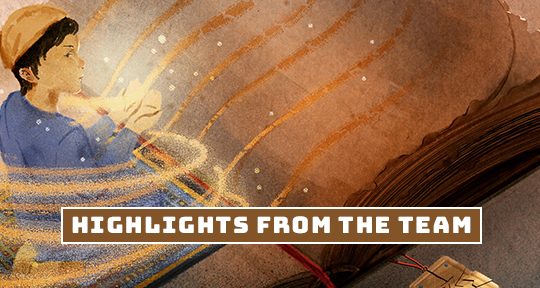
Summer 2022: Highlights from the Team

Don’t know where to begin with our latest issue? We’re here to help!

The most striking piece in this issue was Abdelfattah Kilito’s “Borges and the Blind” (tr. Ghazouane Arslane) for informing me of Borges’ deep affiliation with Arabic literature (something I wasn’t aware of before)—it opened my eyes to another dimension of Borges’ works as well as highlighted the blind spot of critics and readers of translation who might not be privy to the multifaceted aspects of the text behind the text. Cao Kou’s “The Wall Builder” (tr. Chen Zeping and Karen Gernant) is a truly wonderful and chilling fable on the idea of border, i.e., a porous wall between insider and outsider, individual and the collective in a repressive society. Anna Felder’s “Unstill Life with Cat” (tr. Brian Robert Moore) is a lovely, fully immersive tale from a cat’s point-of-view. The translation is magical, wondrously immediate. I love Rose Bialer’s perceptive questions and the resulting interview with Maureen Freely for revealing how Turkey’s political situation might affect the relationship between an author and his translator, and how there are so many layers of “the other” in Turkish society.

—Thuy Dinh, Editor-at-Large for the Vietnamese Diaspora

Kelsi Vanada’s translation is itself a reflection of Andrea Chapela’s long meditation on the meaning and mechanics of mirrors, with all the inevitable subtle distortions and complex reconfigurations that Chapela elaborates on. This extended reflection employs myriad angles of vision‚ philosophy, science, toys, personal narrative, literature, and history, from which to view the significance of mirrors, the act of looking at oneself, and the act of constructing a self-image, with and without the fragmented and inevitably distorted images that mirrors provide. Juan Calzadilla’s poems from Dictated by the Pack (tr. Katherine Hedeen and Olivia Lott) are virtuosic translations—the complexity of the diction and rhythms as well as the subtlety of how the language accretes are very challenging to carry over into English without disrupting the balance between sense-making and surprises in the language. The lines shift across the page, like waves lapping onto the shore, as if the rhythms of thought have been recorded faithfully in their syncopated arrivals, gaps, and runnings-over. Almog Behar’s long poem “First We’ll Speak Many Words About God” (tr. Shoshana Olidort) is a meditation on religion and god, but also an interrogation of our conception of god, an interrogation of the faithful as well as the faithless. It’s subversive and yet hopeful. Sa’eed Tavana’ee Marvi’s ”The Open Tome” (tr. Khashayar Kess Mohammadi) is set in a post-apocalyptic, interplanetary, post-Earth world. The voice of the poem shifts‚ from an unnamed speaker, to a television set, to an ”Oceandweller,” to an unnamed speaker again. The experimental formatting of the poem allows the reader to shift between these different lens ratios. As such, the reader experiences a telescoping which perhaps informs the experience alluded to in the poem‚ by a visionary which either documents the future, or foretells the otherworldliness of the present moment. I really enjoyed Rose Bialer’s interview with Maureen Freely, which touches on the craft of translation, the challenges and the advantages of translating through the prism of race, gender, sexuality, etc., and what it’s like to navigate a translator-author relationship that spans two very different cultures, especially when the author in question is famous, and at certain points even infamous.

—M. L. Martin, Assistant Editor (Poetry)

I have a distinct affinity for Mitteleuropa miserablism, and this edition contains two quintessential instances of this literary tendency: Elfriede Jelinek (tr. Aaron Sayne) and Thomas Bernhard (tr. Charlie N. Zaharoff). It does not get much more central European than Austria, and the Austrians seem to have an affinity for misanthropy, self-loathing, destruction, perversity, and psychosis, but all expressed in the most perfect prose, poetry, painting, and music. Part of my love for these two writers in particular, however, is their pushing, bending, and breaking of the formal rules of language. Perhaps this formalism is my own perversity, since, as a copy-editor, I should be forcing such language back into its grammatical and syntactical straightjacket; but as much as I know and can enforce such rules in a professional manner, I thrive and find a thrill in breaking them. READ MORE…

Weekly Dispatches from the Front Lines of World Literature

The latest literary news from Puerto Rico, Hong Kong, and Sweden!

This week, our editors from around the world report on book-crafting as political resistance and new poetry anthologies in Puerto Rico, a controversial book fair in Hong Kong, and the recovery after decades of a lost manuscript by a major literary figure in Sweden. Read on to find out more!

Cristina Pérez Díaz, Editor-at-Large, reporting from Puerto Rico

The poets Nicole Delgado and Xavier Valcárcel founded Atarraya Cartonera in 2009. Making books out of discarded cardboard boxes was their response to the economic crisis just beginning to hit Puerto Rico—the result of more than a decade of neoliberal policies and obscene corruption. In the 1990s, neoliberalism had left its mark on the book market with the arrival of the gigantic US chain Borders, whose monopoly forced many small independent bookstores out of business. Borders sold books mostly in English, which clashed with the reality that Puerto Rico’s first language is Spanish and most of the population is not bilingual. In their stores, Puerto Rican literature was showcased in a small shelf under the headline, “Of local interest.” Nicole and Xavier paid frequent visits to Borders but through the back door. They took the stores’ discarded cardboard boxes to handcraft Atarraya’s own “of local interest” books. Thus, they turned book-crafting into a political gesture by looking at the neoliberal crisis, as Nicole puts it, “not as an obstacle but rather as a material to work with.” The press participated in a larger web of cardboard presses in Latin America, each in its own way a response to a national and global crisis. Atarraya was hence an effort to connect with literary movements in other parts of Latin America, something that has always been hard in Puerto Rico because of the trade limitations imposed by the US. Active until 2016, Atarraya published a total of twenty-four poetry titles, all of which are now available for free as pdfs on its archival blog.

Nicole and Xavier have continued collaborating––and dream of reviving Atarraya one day. Last month, they co-hosted a virtual editing workshop at La Impresora, a publishing press and Risograph shop founded in 2016 by Nicole with fellow poet and editor Amanda Hernández. La Impresora recently received a grant from Proyecto Inversión Cultural, which has facilitated, among other things, the offering of free workshops. The first, addressed to emerging writers without a published book, tackled the ropes of the editorial process. Together with the ten participants who were all in their early twenties, Nicole and Xavier rehearsed what goes into bookmaking, including content, conceptualization, and production. The result is a collaborative, forthcoming anthology including poems from each of the attendants. The title, Ese lugar violento que llamamos normalidad (That violent place we call normality), reveals how things have and have not changed in the ten years since Xavier and Nicole edited a first poetry anthology, back with Atarraya Cartonera. The latter’s title was Plomos (Lead Sinking Weights), a loaded word that simultaneously alludes to the small weights used for sinking the fishing net, to water contamination by lead, and to gun violence––part of Puerto Rico’s “normality.” As Nicole and Xavier write in the blog, “any relationship between that word and the violent circumstances of the country or with the contamination caused by certain heavy metals, is absolutely intentional.” Back in 2012, there was room for metaphoric language. In 2022, an emerging generation of writers names violence with even more earnest precision.

READ MORE…

Weekly Dispatches from the Front Lines of World Literature

Literary festivals and publications from Bulgaria and Hong Kong!

This week, our editors from around the world report on literary celebrations in Bulgaria and historical archives of Chinese literature in Hong Kong. Read on to find out more!

Andriana Hamas, Editor-at-Large, reporting from Bulgaria

Plovdiv, one of Bulgaria’s oldest cities and the European Capital of Culture for 2019, recently hosted the twentieth anniversary edition of its renowned literary festival: Пловдив чете (“Plovdiv Reads”). For twenty years, the month of June has seen both established and up-and-coming authors sit side by side, trying to unravel the mysteries of the written word. Among the most notable participants this year were Zdravka Evtimova, winner of the Chudomir National Award; the writer and translator Chavdar Tsvenov; the literary historian Cleo Protohristova; the critic Boris Minkov, known for his masterful editorial skills; the publisher Svetlozar Zhelev, who takes pleasure in mediating literary friendships; and the experimental writer Rene Karabash.

Over the course of approximately two weeks, the various hosts and their audiences reviewed some of the best that contemporary Bulgarian fiction has to offer. However, the festivities weren’t restricted to the local literary stars, but also included prominent international guests such as the Ukrainian novelist Haska Shyyan—who commented on her new book in light of the dreadful developments in Ukraine that have shaken the world over the past few months. Another event of note was the special talk devoted to the twentieth-century Bulgarian poet and translator Atanas Dalchev, and the relatively unfamiliar circumstances surrounding his life in Thessaloniki and Istanbul.

READ MORE…

Weekly Dispatches from the Front Lines of World Literature

New books, events, and publishing houses from the Philippines, Hong Kong, and Sweden!

This week, our editors from around the world report on new acclaimed translations from the Philippines, Hong Kong writers discussing art-marking during political restrictions on their freedom of expression, and a new publishing house in Sweden focused on investigative journalism and books translated from Swedish. Read on to find out more!

Alton Melvar M Dapanas, Editor-at-Large, reporting from the Philippines

Literary translation in the Philippines is more alive than ever. Asymptote contributor Bernard Capinpin won the 2022 PEN America’s Heim Grant for his translation of the late Edel Garcellano’s sci-fi novel Maikling Imbestigasyon ng Isang Mahabang Pangungulila (Kalikasan Press, 1990) [A Brief Investigation to a Long Melancholia]. Also, obstetrician and travel writer Alice Sun Cua’s landmark project with Sto. Niño de Cebu Publishing House “ferried” post-Spanish Civil War novelist Carmen Laforet’s Nada into Hiligaynon language.

Aimed at enhancing the Filipino “diasporic cultural footprint around the world,” the country’s National Book Development Board offers translation grants to authors and publishers of children’s literature, classical and contemporary prose, graphic literature, as well as historico-cultural works written in Philippine languages (Ilocano, Cebuano, Waray, Hiligaynon, Meranaw, Tausug, and Kinaray-a) and foreign languages (German, Spanish, French, Arabic, Japanese, and Chinese). This year, the National Commission for Culture and the Arts also conferred the Rolando S. Tinio Translator’s Prize to SEAWrite awardee Roberto T. Añonuevo for his translation of the late National Artist for Literature Cirilo F. Bautista’s phenomenological study Words and Battlefields: A Theoria on the Poem (De La Salle University Publishing House, 1998) [Mga Salita at Larangan: Isang Pagninilay sa Tula] from English.

READ MORE…

One for Another: A Conversation on Translation from the Chinese

It seems to me that the world is a better place to live in simply because we translators are eternally making contributions to the Tower of Babel.

In Antena’s “Manifesto for Ultratranslation,” it is stated: “The politics of translation make us ultraskeptical and ultracommitted.” As such, the discourse and dialectics surrounding this artform are in an ever-evolving state of being challenged, argued, and explained. In the following conversation, Blog Editor Xiao Yue Shan discusses her work in editing Chinese language translations with fellow translator Zuo Fei, touching on their separate values, priorities, and approaches.

Xiao Yue Shan: Translation is an intensely personal experience—perhaps the most transparent reflection of what occurs when idea is transmuted through the individual mind’s various channels. This is why we, as translators, are continually struck by our work’s mutating forms, its evolving methods, and continue to conversate with such intensity about our own logic; when one speaks of translation, one speaks of a way of seeing the world. When we were editing translations together, you wrote me a letter in response to some edits I sent on a final draft of some poems; in it, you stated that you believe in literal translation, in seeming opposition to my approach of preserving the ineffable by creating anew.

It’s interesting because we are both poets, and I’ve always assumed—presumptuously—that poets are all apart of the same passionate investigation, in which consciousness touches something and brings it to life, shaped in a precise and resolved concentration of words. In translation, there is no transposition of this consciousness, which is a singular encounter between the poet, their knowledge, and all that it reaches and contacts. So, the translator must take the place of the poet, and—with intelligence but without egoism—give the original poem something it can live with.

Essentially, there is a distinction between a poem’s components and its poetics. It seems to be a corrupt exchange should a text be translated word-for-word, when one acknowledges the multiple roles that words play in literature; they do not simply transmit meaning, but also voice, history, and music. Could you tell me why you work from a more literal approach?

Zuo Fei: I prefer literal translation to free translation simply because, in the time of science and technology, people believe translators should strictly follow the original text. By literal translation, I don’t mean word-for-word, which does not work for poetry in many cases; my intention is that we should adhere to the original work as much as we can, and put it into a target language according to our desires. That is to say, if translation is an impossible job, we try to increase the odds of it being possible. READ MORE…

What’s New in Translation: June 2022

New work from China, Tibet, and Slovenia!

In this month of highlights from the world of translated literature, we’re spotlighting three singular, wide-ranging, and immersive texts. From the Chinese, Shawn Hoo discusses the philosophical and journeying collection from celebrated poet Xi Chuan. From the Tibetan, Suhasini Patni reviews a dark, compassionate novel of womanhood and urbanity from Tsering Yangkyi. And from the Slovenian master Drago Jančar, Eva Wissting gives a look into his latest novel, on how personhood and identity survive the ravages of war.

Screen Shot 2022-06-13 at 5.38.43 AM

Bloom and Other Poems by Xi Chuan, translated from the Chinese by Lucas Klein, New Directions, 2022

Review by Shawn Hoo, Assistant Editor

In the title and opening poem of Xi Chuan’s (西川) Bloom and Other Poems, a simple verb like “bloom” begins lyrically and unsuspectingly enough—

if you’re going to bloom then bloom to my rhythm
close your eyes for one second breathe for two be silent for three then bloom

—but in the course of its exuberant and exacting repetitions across six pages, the action soon blossoms into a sophisticated geometry. At times, the verb seems to indicate an instructive concern for those new to the world (“bloom a pear blossom in case the nape of your neck is cold”). Other times, we hear the speaker issuing something of an injunction or a dare: “bloom / unleash a deep underground spring with your rhizome.” In a poem structured around insistence (to borrow Gertrude Stein’s understanding of how repetition works), Lucas Klein—who also curated and translated Xi Chuan’s Notes on the Mosquito—constructs a resonant architecture, allowing the echoes to bounce off the pages’ acoustics, often to rhapsodic effect: “bloom barbaric blossoms bloom unbearable blossoms / bloom the deviant the unreasonable the illogical” and later: “bloom three thousand boundless universes / and string up and beat any beast that refuses to bloom.”

In English, though not in Mandarin, bloom sits uncomfortably close to blood; in this titular poem, this simple word—across both languages—operates with an undertone of violence, belying its vivacious exhortations until the end, ending up as a verb that has swelled beyond its initial premise. The poems that come after “Bloom” all seem to share this restless inflation of the poetic image and line, each taking the verse to its various geometric limits, upon where it strains to meet other worlds. READ MORE…

Weekly Dispatches from the Front Lines of World Literature

Book fairs, award shows, and passings from Hong Kong, Spain, and Iraq.

This week, our editors from around the globe report on recent literary awards in Hong Kong, examine the links between the literary scenes in Spain and Romania, and reflect on the passing of a revolutionary Iraqi poet. Read on to find out more!

Charlie Ng, editor-at-large, reporting from Hong Kong

The awards ceremony of the 16th Hong Kong Arts Development Awards was conducted online on 22 May. Renowned Hong Kong writer Xi Xi (the pen name of Cheng Yin) was honored with the Life Achievement Award for her tremendous contribution to Hong Kong literature. Moreover, essayist Tung Chiao won the Award for Outstanding Contribution in Arts, and fiction writer Dorothy Tse Hiu-hung was awarded Artist of the Year for the literary arts category. While two works by Tse, Snow and Shadow and The Door, are available in the English language, Tung Chiao’s works have yet to be translated, despite the fact that he is already a highly acclaimed author in Chinese literary circles.

READ MORE…

Weekly Dispatches from the Front Lines of World Literature

Bringing news from Argentina, Hong Kong, Bulgaria, and Sweden!

Book fairs, festivals, competitions, new publicationsthe literary world this week is filled with a flurry of events and announcements. From the ongoing debate between culture and commerce in Bueno Aires, to new releases from Hong Kong icons Dung Kai-Cheung and Xi Xi, to a celebration of poetry debuts in Haskovo, to a renewal of a beloved book festival in Karlskrona, the world of letters has no shortage of things to offer.

Josefina Massot, Editor-at-Large, reporting from Buenos Aires

In his opening speech at the 46th Buenos Aires International Book Fair, author Guillermo Saccomanno issued a complaint: “When we talk about a fair,” he declared, “we’re talking about commerce. This is a trade fair rather than a cultural one, even if it claims to be the latter. At any rate, it represents an understanding of culture as commerce.” What’s more, he added, the country’s dire economic situation does not bode well for the Spanish-speaking world’s largest industry event.

Saccomanno was both right and wrong: right that the Fair’s pursuits are largely commercial, wrong that they’d be somewhat of a bust this time around. Perhaps to make up for two years of pandemic torpor, over 1.3 million visitors crowded La Rural’s sprawling halls in just under three weeks, from April 28 to May 16—a 30% increase relative to pre-pandemic figures. Sales, too, went up by about 10-20%.

In addition to bestselling genre sensations (American John Katsenbach among them), the Fair featured critically acclaimed writers from over forty countries. Stand-outs included Peruvian Nobel Prize winner Mario Vargas Llosa, Chileans Diamela Eltit and Paulina Flores, Spaniard Jorge Carrión, and locals Mariana Enriquez, Selva Almada, and Guillermo Martínez. There were over 1,500 book stands on display, helmed by everything from multimedia conglomerates to artisanal press co-ops, as well as over 1,000 programmed events that spanned readings, conferences, panels, book signings, and courses for every taste and age group.

It would be impossible, given this near embarrassment of riches, to mention just one or two based on quality alone. I’ll appeal to our journal’s métier, then, and focus on a few events related to the art (and, yes, the commerce) of translation. READ MORE…

Weekly Dispatches from the Front Lines of World Literature

Prizes, poetry contests, and new works from India, Thailand, and China!

This week, our editors from around the globe report on publishing trends in India, the memorialization of the author Wat Wanlayangkoon in Thailand, and an exciting new development in Chinese to English interpretive translation, led by the Accent Society. Read on to find out more!

Suhasini Patni, Editor-at-Large, reporting from India

Temperatures are soaring and the country is experiencing grueling heatwaves. Indians have taken to social media to critique the Modi government’s negligent response to the climate crisis. Many are also sharing their memories of the devastating and nightmarish second wave of the coronavirus that led to numerous deaths in the country this time last year.

The pro-Hindutva, right-wing Bhartiya Janta Party is known to instigate violence, especially against Muslims, in the name of the Hindu religion. In the latest reform to eradicate voices of dissent, verses by Urdu poet Faiz Ahmed Faiz have been dropped from the CBSE (Central Board of Secondary Education) class 10 textbook. Faiz, one of the most celebrated Urdu poets and a nominee for the Nobel Prize in Literature, addressed the issues of military dictatorships and tyranny in Pakistan. According to Scroll.in, “the verses were part of the ‘Religion, Communalism and Politics—Communalism, Secular State’ segment of the National Council of Educational Research and Training’s textbook called “Democratic Politics II.” The two poems are “Let Us Walk in the Market in Shackles” and “Upon Returning from Dhaka.”

In 2021, the New India Foundation (NIF) announced its inaugural grant for writing books relating to India’s history. The three winners of the NIF Translation Fellowship were chosen from ten Indian languages and each awarded a stipend of INR 6 lakhs for a period of six months with mentorship opportunities as well as publishing and editorial support. The three winners are Venkateswar Ramaswamy (literary translator) and Amlan Biswas (statistician) who will translate Nirmal Bose’s Diaries 1946-47 from Bangla; NS Gundur (academician and literary historian) who will translate DR Nagaraj’s Allamaprabhu Mattu Shaiva Pratibhe from Kannada; and Rahul Sarwate (academician and historian) who will translate Sharad Patil’s Marxvad: Phule-Ambedkarvaad from Marathi. More can be read about the winners here.

READ MORE…

Spring News: A new educational guide, two paid Special Features, and a final call to join our team!

Whether you are an educator, a translator, or a potential volunteer, check out the following opportunities to be a part of our mission!

unnamed-1

Calling all teachers: the Spring 2022 Educator’s Guide is now available for download here! Whether your purview is high school or university students, we invite you to visit the Asymptote for Educators web page to discover new ways to bring translation into your classroom. With writing prompts and reading suggestions galore, this free resource based on articles from the Spring 2022 issue will be sure to spice up any literary discussion. Share the wealth with all your educator friends and be sure to fill out this survey to give us feedback. In this age of division, we can all play a part, however small, to foster empathy across cultures. Grab a copy of the new Educator’s Guide now.

unnamed-2

Considering a career in world literature? Then you should know that Asymptote provides the perfect training ground! (Former team members have gone on to take up positions at Penguin BooksDalkey Archive, and Words Without Borders.) And now is the perfect time to apply! We’ve just entered Phase II of our mid-year recruitment drive—concentrating on editorial and marketing roles this time. Among the newly available openings are Visual Editor, Nonfiction Editor, Social Media Manager, and Assistant Director of Outreach. If you’d like to join us behind the scenes, check out the newly available positions and apply today. READ MORE…