
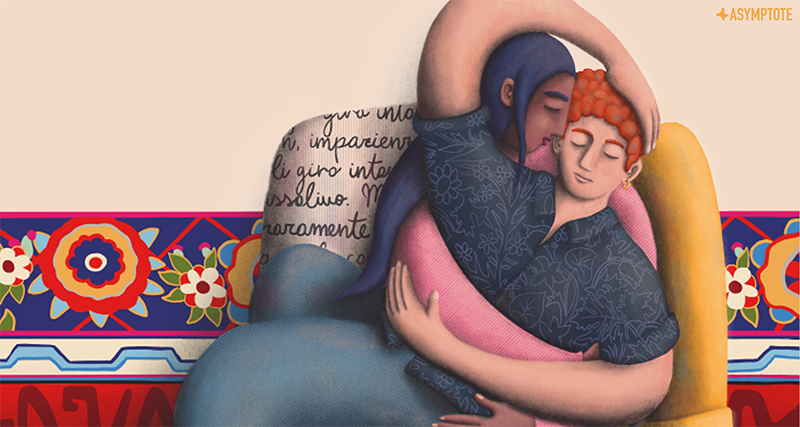
Now in its thirty-seventh edition, the Salone Internazionale del Libro di Torino, or the Turin International Book Fair, continues to be a vital occasion for the literary community, gathering a diverse and lauded array of writers from around the globe to speak about their craft and its reflection of the world. This year, the theme “Le parole tra noi leggere/ Words fall lightly between us” gestured towards the need for literature to create connections and compassions; in the following dispatch, Veronica Gisondi reports on the illuminations to be found in this “between,” capturing the intersections and collisions that marked this year’s Fair.
This year, the Turin International Book Fair gathered a constellation of voices that, like a compass, revealed multiple paths to traverse the conflicts of the present and the complexities that await us, prefiguring a future expectant with the consequences of increasing inequality, oppression, and unbridled political violence. In these crossings, the fair also bridged a distance—the one that separates Europe from the rest of the Mediterranean, its ancient cradle—which has, for too long, appeared bigger than it actually is.
Some of the speakers that enlivened the fair’s thirty-seventh edition—held on May 15 to 19 in Lingotto, a former Fiat car factory—dissected the impact of being subjected to settler-colonial violence and the potential of literature in resistance. A dialogue between the Palestinian short-story writer Ziad Khaddash and Palestinian-Syrian writer and journalist Raed Wahesh took place on the anniversary of the Nakba (a day that signals the start of a long process of occupation and expropriation); in observance, Grazia Dell’Oro, Wahesh’s Italian publisher, remarked that “for us Westerners, anniversaries are often a way to clean our conscience. But we believe that the lively literary life of the Palestinian world needs to be remembered and promoted here at the fair,” and further stressed the risks of “the victimization that comes with an Orientalist gaze.” READ MORE…

Blog Editors’ Highlights: Winter 2025
Reviewing the manifold interpretations and curiosities in our Winter 2025 issue.
In a new issue spanning thirty-two countries and twenty languages, the array of literary offers include textual experiments, ever-novel takes on the craft of translation, and profound works that relate to the present moment in both necessary and unexpected ways. Here, our blog editors point to the works that most moved them.
Introducing his translation of Franz Kafka’s The Trial in 2012, Breon Mitchell remarked that with every generation, there seems to be a need for a new translation of so-called classic works of literature. His iteration was radically adherent to the original manuscript of The Trial, which was diligently kept under lock and key until the mid-fifties; by then, it was discovered exactly to what extent Max Brod had rewritten and restructured the original looseleaf pages of Kafka’s original draft. It is clear from Mitchell’s note that he considers this edit, if not an offense to Kafka, an offense to the reader who has lost the opportunity to enact their own radical interpretation of the work: an interpretation that touched Mitchell so deeply, he then endeavored to recreate it for others.
In Asymptote’s Winter 2025 Issue, the (digital) pages are an array of surprising turns of phrase and intriguing structures—of literature that challenges what we believe to be literature, translations that challenge what we believe to be originality, and essays that challenge what we believe to be logic. I am always drawn to the latter: to criticism, and writing about writers. As such, this issue has been a treat.
With the hundredth anniversary of Kafka’s death just in the rearview and the hundredth anniversary of the publication of The Trial looming ever closer, the writer-turned-adjective has not escaped the interest of Asymptote contributors. Italian writer Giorgio Fontana, in Howard Curtis’s tight translation, holds a love for Kafka much like Breon Mitchell. In an excerpt from his book Kafka: A World of Truth, Fontana discusses how we, as readers, repossess the works of Kafka, molding them into something more simplistic or abstract than they are. In a convincing argument, he writes: “The defining characteristic of genius is . . . the possession of a secret that the poet has no ability to express.” READ MORE…
Contributors:- Bella Creel
, - Meghan Racklin
, - Xiao Yue Shan
; Languages: - French
, - German
, - Italian
, - Macedonian
, - Spanish
; Places: - Chile
, - France
, - Italy
, - Macedonia
, - Switzerland
, - Taiwan
, - Turkey
; Writers: - Agustín Fernández Mallo
, - Damion Searls
, - Elsa Gribinski
, - Giorgio Fontana
, - Lidija Dimkovska
, - Sedef Ecer
; Tags: - dystopian thinking
, - identity
, - interpretation
, - nationality
, - painting
, - political commentary
, - revolution
, - the Cypriot Question
, - the Macedonian Question
, - translation
, - visual art
, - Winter 2025 issue
, - world literature