Posts filed under 'grief'

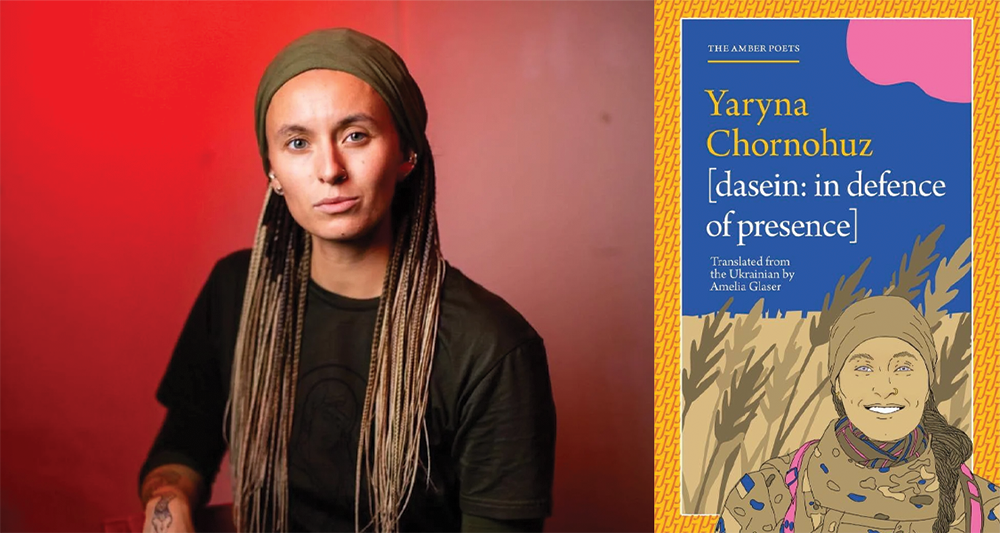
‘if you were alive I’d embrace you’: A Review of [dasein: defence of presence] by Yaryna Chornohuz

Chornohuz’s exhortation in defence of Ukraine’s presence is at once melancholy yet resolute.

[dasein: defence of presence] by Yaryna Chornohuz, translated from the Ukrainian by Amelia Glaser, Jantar Publishing, 2025

In 1922, the Spanish philosopher, essayist, and poet George Santayana wrote: ‘Only the dead have seen the end of war.’ Though initially penned when reflecting on the impact of World War I, his words would remain just as pertinent a century later. With this sombre message ringing strong as horrors continue to unfold in Africa, Eastern Europe, and the Middle East, Jantar Publishing brought us a transfixing collection in late 2025: [dasein: defence of presence], written by widely lauded poet and member of the Ukrainian Armed Forces, Yaryna Chornohuz, and translated by Amelia Glaser. Originally published in Ukrainian in 2023 and drawing on Heidegger’s principle of Dasein (‘being-there’ / ‘being-in-the-world’), Chornohuz writes of her experiences and reflections from the frontlines with harrowing lyricism, exploring themes of existence, mortality, and grief.

In Being and Time, Heidegger defines Dasein as ‘this entity which each of us is himself and which includes inquiring as one of the possibilities of its Being’—in other words, this philosophical principle is distinct from a mere essence or detached existence, but rather stresses the importance of active engagement with one’s environment and circumstances. This significance of inter-personal and inter-situational interaction challenges humanist interpretations, in which people are viewed through the lens of a static Cartesian subject. Further still, this involvement, being so consciously instigated, thereby inherently necessitates a confrontation with one’s own mortality as much as their personhood. READ MORE…

Niels Fredrik Dahl and “Reality Literature”: Writing to Become Visible to Yourself

. . . truth in literature is less about precision than about resonance.

What does it mean to write truth into literature? In recent decades, books that are largely autobiographical but also explicitly include fictional elements have become a very popular genre in Scandinavia. It’s a conversation that crosses borders and has many names, from “reality literature” in Norway and Sweden (or sometimes “witness literature”) to “autofiction” in Denmark. More and more authors from Scandinavian countries are working in this genre, taking inspiration from authors like Tove Ditlevsen and her The Copenhagen Trilogy and penning highly lauded literary work based on their lived experiences. Recent examples include Andrev Walden’s Bloody Awful in Different Ways, Vigdis Hjorth’s Is Mother Dead and Karl Ove Knausgård’s My Struggle. Though these titles differ in many ways, they also share much in common. If “reality literature” has one unifying claim, it is that writing should bring us closer to truth. But truth in literature is never simple and in autofiction two approaches matter: one based on fact, and one based on feeling. One insists that truth is found in lived experience backed up by historical records and documents; the other suggests that creative reconstructions can produce a truth of their own.

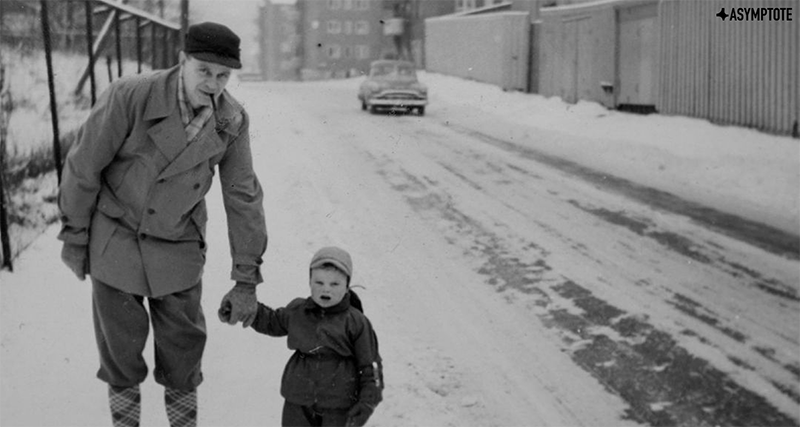
Norwegian poet, playwright, and novelist Niels Fredrik Dahl—sadly not yet translated into English—enters this conversation with a diptych of sorts, consisting of Mor om natten (2017) and Fars rygg (2023), the latter of which was awarded the Nordic Council’s Literature Prize in 2024. In these two autofictional works, he returns to the silences, absences, and fractures in his family history—first, in a portrait of a mother who battles depression, and later in a reconstruction of his father’s childhood before, during, and after World War II. Of course, as with most good family portraits, these books are also a portrait of the author himself, as a child growing up with his mother’s sadness and a father he never quite knew, and as an adult, dealing with a profound sense of loneliness. By shifting between autofiction’s two modes across his two works, Dahl demonstrates that truth in literature is never a stable concept, but always a matter of perspective and curation.

READ MORE…

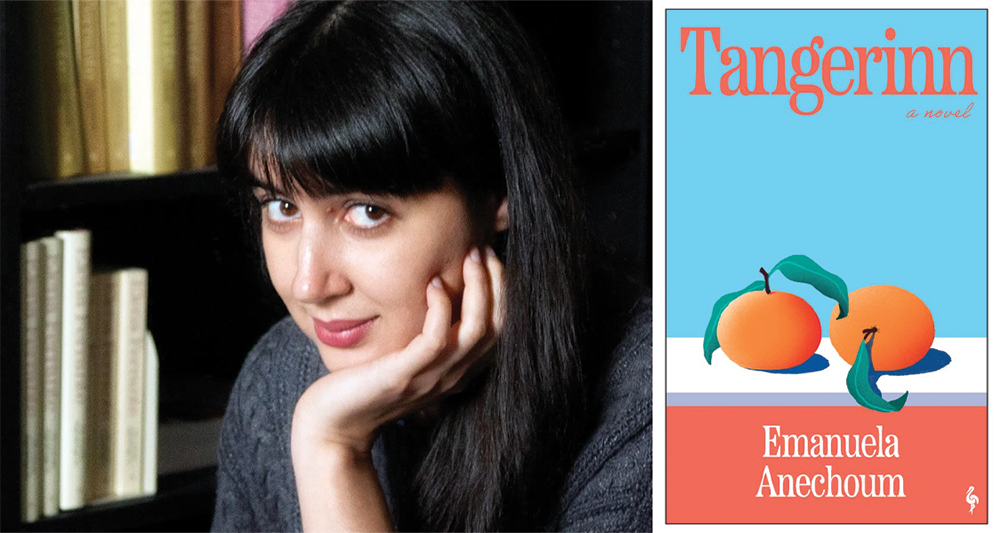
How to Find Your Home: A Review of Tangerinn by Emanuela Anechoum

Tangerinn is . . . a story of blooming beyond the social images and pressures that can get confused with a meaningful life.

Tangerinn by Emanuela Anechoum, translated from the Italian by Lucy Rand, Europa Editions, 2026

When Mina, the first-person narrator of Emanuela Anechoum’s debut novel Tangerinn, returns to her childhood home in southern Italy after the death of her father, she is argumentative and defensive. She fights with her sister Aisha who picks her up at the airport—about hair removal, head scarves, who knew their father best. Though some of this prickliness could be due to grief, her pre-loss self has already been established as someone quick to judge, who has shored up a levee of self-defense. Mina readily admits to herself that she is a knot of “inadequacy and fear” and is most on edge trying to answer the question of who she really is. Though this query is always loaded, it is particularly so in this novel that takes on the weighty contemporary topics of cross-generational immigration and the social digital landscape.

The beginning of Tangerinn takes place in London and shares resonances with Vicenzo Latronico’s Perfection, published in English earlier this year. Like Mina, Latronico’s couple have moved from Italy to northern Europe and define themselves by their curations—what brands, plants, colors, furniture, and neighborhood they live in. But while the insecurities of Perfection remain mostly placid below this veneer, Mina dislikes her acquiescence to this powerful, social dictate, which is represented by her roommate/mentor/idol Liz. Before Mina receives the call about her dad’s death, she and Liz are having a conversation about envy, at which Mina thinks: “I envy everyone, all the time. I constantly envy people who are beautiful, rich, happy, sure of themselves. I’m full of venom for other people’s privilege, and I also envy their merits. I hope Liz loses everything she has.” Yet Mina must have Liz as her friend, because only Liz—the influencer who has everything—can be the reassurance that she is getting her life in London right.   READ MORE…

What’s New in Translation: January 2026

New titles from China, France, Peru, Italy, Romania, Brazil, South Korea, Mexico, Sweden, and Japan!

Looks like 2026 isn’t coming in slow. Despite the chaos, we’re looking forward to another year of illuminating the best of what world literature has to share—and we’re starting off with plenty to go around, with thirteen titles from ten countries. Find in the mix a new translation of one of the Peruvian canon’s most dazzling and convulsive works; a novel depicting the delicate indigenous customs of a region between Siberia and northeast China; a shocking, propulsive novella from a Japanese cult writer; a story of transformative grief from an enthralling Romanian voice, and so much more.

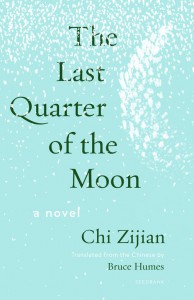
The Last Quarter of the Moon by Chi Zijian, translated from the Chinese by Bruce Humes, Milkweed Editions, 2026

Review by Mandy-Suzanne Wong

The opening lines of Chi Zijian’s wondrous novel, The Last Quarter of the Moon, set a carefully measured tone for this enchanted story of Evenki nomads: “A long-time confidante of the rain and snow, I am ninety years old. The rain and snow have weathered me, and I too have weathered them.” this rich and essential passage gently, and with deference, opens a window into a world where humans confide in rain. Chi and translator Bruce Humes indulge the word weather in at least three of its meanings, conveying the narrator’s resilience and hinting at her costly intimacy with other-than-human energies.

A word exchanging its meaning for other meanings—as if adopting different bodies to slide between existential contexts—invokes the dynamism of the shamanic Evenki cosmos, wherein earth and sky, humans and nonhumans, the embodied and the disembodied, dance together in precarious balance and tender reciprocity. Everything is alive in the Evenki’s animist multiverse, every entity ensouled, each Earthling an embodiment of the Spirits, and every human owes a debt to the Spirits for the lives of nonhumans killed for food. In turn, when a human child goes missing, in danger of freezing to death, a reindeer child must go “to the dark realm on [the human’s] behalf,” in a mimetic exchange.

READ MORE…

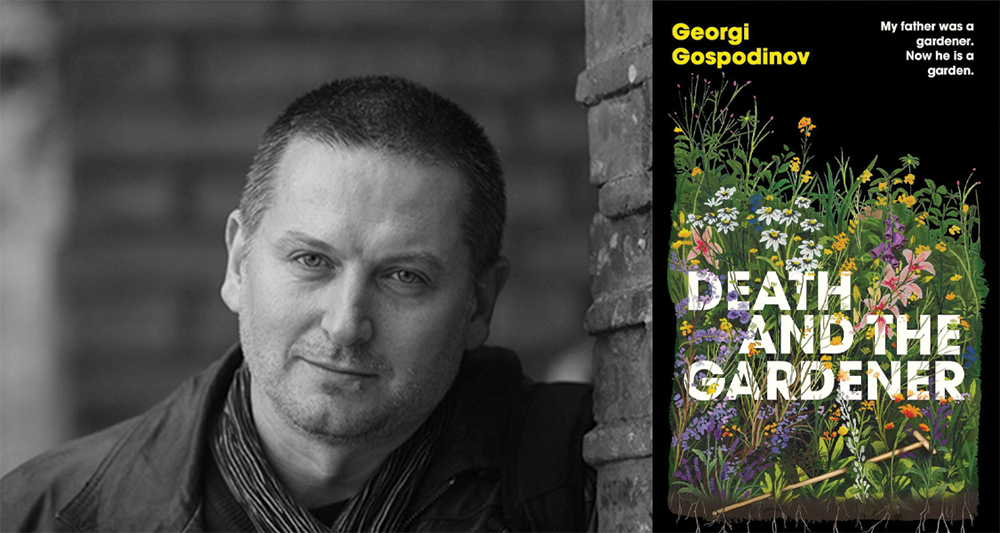
Growing, Growing, Gone: A Review of Death and the Gardener by Georgi Gospodinov

[T]he fiction of Death and the Gardener is suggesting that the only way to get through both death—and life—is by transforming experiences.

Death and the Gardener by Georgi Gospodinov, translated from the Bulgarian by Angela Rodel, Liveright, 2025

“What happens to the garden . . . when the gardener is gone?” asks the narrator of Georgi Gospodinov’s new novel, Death and the Gardner. After winning the International Booker Prize in 2023 for Time Shelter, the Bulgarian writer returns with a novel featuring a similarly famous Bulgarian writerwith the additional autobiographical detail of a father who has died from cancer, leaving his garden behind. Within this autofiction, the reader will not have to wait long for an answer to that primary, haunting question: “The garden will continue to flourish, even without its gardener, what he has planted will still grow, bear fruit, but wildness will also start to make inroads, after some time weeds and grasses will overtake everything.” The seasons will cycle the plants through life and death—and life again. In a garden, even without its gardener, there is still promise of spring; perhaps it’s this promise of revival that makes gardening an ideal outlet for grief.

I began my first garden three years ago as my dad lay dying of cancer in the living room. His friends—now my friends—had shown me how to hoe a straight line between two markers and brush in the seeds, then how to cover them with soil, going back down the lines. What they couldn’t do was prepare me for when the tilled dirt filled with weeds, for when my dad died and I inherited his house and its garden. That first summer, I ripped up endless roots, but the weeds kept on growing.

The narrator of Death and the Gardener does not work at his father’s garden after he dies, but he does use it as the central grounding image for the book that he writes. Though Death and the Gardener calls itself a novel on the cover, it reads with the intimacy of a memoir in Angela Rodel’s expert translation. Acknowledging this slippery approach to genre, the narrator admits, “This book has no obvious genre; it needs to create one for itself.” He too wonders “whether the kindling of those words cools [grief], or just inflame it all the more.” Writing, then, is taken to be like gardening after a death: a way to bargain for just a little more time with that person. This cathartic use of writing (and gardening) in grief is nothing new, but Gospodinov’s approach draws particular attention to the push and pull of the writing itself, and how this kind of detailed remembering both brings back his father and reproduces the trauma of witnessing him suffer and die. READ MORE…

What’s New in Translation: June 2025

New publications from Iran, Argentina, Spain, Peru, Mexico, Japan, France, Finland, Sweden, China, and Italy!

This month, we’re delighted to be bringing twelve brilliant titles from eleven different countries. Find here the novelization of a famous chess match that reveals the greater geopolitical game playing us all; a summery fiction that melds the structures of nature and human architecture; a poetry collection rendering tender portraits of working-class women; a lyrical rewriting of a remarkable nun-turned-conquistador’s New World adventures; and so much more.

oblivion

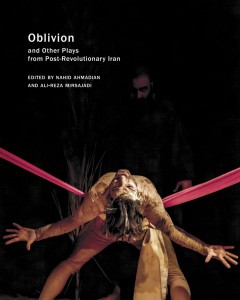
Oblivion: and Other Plays from Post-revolutionary Iran, edited by Nahid Ahmadian and Ali-Reza Mirsajadi, translated from the Persian by Nahid Ahmadian, Ali-Reza Mirsajadi, and Hesam Sharifian, Seagull Books, 2025

Review by Henry Gifford

In order, the five plays included in Oblivion: and Other Plays from Post-revolutionary Iran are set in Arabia in the fifth century AD (The Sacrifice of Senemar by Bahram Beyzaie); China in the second century BC (Oblivion by Hamid Amjad); Spain in the twentieth century (Dance of Mares by Mohammad Charmshir); somewhere (per stage directions and blank spaces left in the dialogue) in the city you’re in, on the day you’re reading it (The Child by Naghmeh Samini); and a laundromat in Los Angeles at three in the morning (Bird of Dawn by Sepideh Khosrowjah). Their narratives are of a hubristic yet indecisive king and his palace; imperial bloodshed and familial betrayal; sex and mariticide; an infant born on a migrant raft, protected at the border by three women who all deny being his mother; and three generations of Iranian immigrants, each with romantic trouble and divided identities. Some are epic, and others are everyday. None of them are set in ancient Persia or modern Iran, and only the first and last are explicitly about Persians or Iranians.

Yet these are, in fact, plays from the same country over the same quarter-century, from 1995 to 2019. The diversity of their settings and scale is a wise editorial decision intended to highlight the diversity of theater in Iran, but it also reflects a practical need of addressing contemporary, local problems obliquely under a censorship regime. What is more interesting is the collection’s consistency, and in particular the nonchronological approach taken within almost all of the plays. Oblivion, for example, begins with two siblings going to meet their adoptive brother after years apart; the encounter then extends over the course of the play as a frame to the story of their lives and their parents’, acted out in shadows on a scrim behind them. The formal blending extends this sense of collapsed time; as the editors’ introduction explains in great detail, shadow puppetry (khayāl-bāzi) is an old Persian form, here embedded within a more modern, European-inflected mode. The other plays are similarly mixed—traditional aspects and motifs cohering with contemporary themes and styles.

Every nation has history, but I wonder, reading the plays of Oblivion, if there is something about Iran—a young nation of an ancient culture—that has made its past more palpable, fraught, and vividly present. READ MORE…

Seeing and Unseen: Lowest Common Denominator by Pirkko Saisio

Getting a child narrator right is no easy task, and Saisio executes it perfectly.

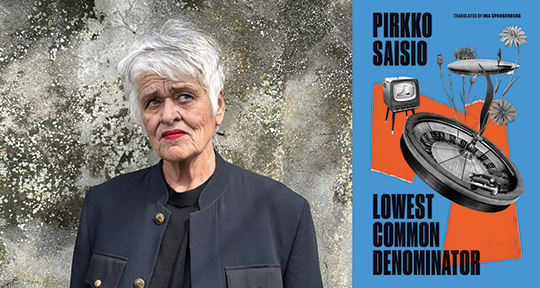
Lowest Common Denominator by Pirkko Saisio, translated from the Finnish by Mia Spangenberg, Two Lines Press, 2024

When Pirkko Saisio’s father passed away near the end of the millennium, she decided to write a book that explored her history; what resulted was an autofiction that follows the only daughter of communist parents as she comes of age in 1950s Finland. First published as Pienin yhteinen jaettava in 1998, it is now out in a superb English translation by Mia Spangenberg as Lowest Common Denominator. The first of three thinly veiled autobiographical novels, it is preceded in the Anglosphere by The Red Book of Farewells, and the third, Backlight, will soon follow. It is hard to believe that someone who is so critically acclaimed in her native language—with a writing career spanning five decades—is being translated into English only recently. The hope is that this is just the beginning.

With the death of Saisio’s father at its root, Lowest Common Denominator focuses on our narrator’s childhood and is essentially plotless, with vignette-like chapters arranged in achronological order. The majority of the chapters take place in the past, while the few sections set in the present follow the narrator in the days leading up to her father’s demise, as well as the aftermath. Most of the former are on the shorter side, focusing on a particular incident, event, or person, while the longer chapters explore a certain aspect or individual over an extended period of time. These usually take the form of character studies or personal histories of extended and far-flung family members. Throughout, Saisio’s prose remains straightforward though formally fluid, capably mirroring the narrative’s varied directions. READ MORE…

A Polyphonic Portrait of Omani Women: A Reading of Silken Gazelles

Through interconnected stories, Alharthi masterfully weaves a network of characters in a narrative inhabited by lively, magnificent women.

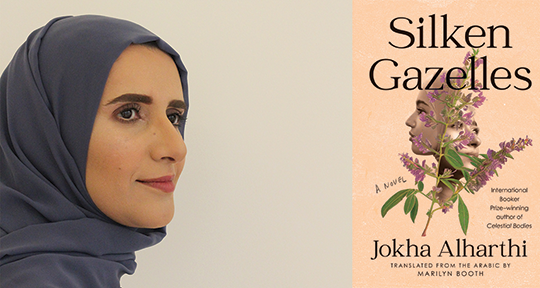
Silken Gazelles by Jokha Alharthi, translated from the Arabic by Marilyn Booth, Catapult, 2024

The acclaimed Omani writer and academic Jokha Alharthi has emerged as an increasingly significant voice on the international literary landscape since her novel, Celestial Bodies (translated by Marilyn Booth), was awarded the International Booker Prize in 2019. Now, once again, Catapult Press has opened the floodgates to another tentacle of the Omani society in the form of Alharthi’s fragmented worlds. In her latest novel Silken Gazelles, also gracefully translated by Booth, a wide net reins in the past to the present, the village to the city, sisterhood to motherhood, and love to loss. The dreamy and nonlinear narrative moves forward and backward in time, treating generations as flexible containers and relying on polyphony to create a poetic geometry of voices.

Tellingly, the intertwined threads of the narrative are captivating from the very beginning; extremely concise hints are made in the early chapters towards the throughline, but the hints are almost complete in themselves. At the end of the first chapter, for instance, Ghazaala’s life is wrapped up in a few sentences. “Within five years [she] had given birth to twins,” writes Alharthi, “finished her secondary education, and entered the university. In her final year of study in the College of Economics, the Violin Player ran away from the house of marriage.” In a similar vein, in the second chapter, when talking about Ghazaala’s foster mother, Saada, Alharthi writes:

It would have seemed so ordinary, so natural, for Saada to live to be a hundred years old. For Saada to always be there, preparing maghbara for the cow and coconut sweets for the children, drawing milk and cream, feeding Ghazaala and Asiya and Mahbuba and the goats, undoing her hair and baking as she sang, exuding a fragrance of incense and fresh dough, laughing her ringing laugh, and forever gathering the plants that could treat poisons and fevers from the high slopes surrounding Sharaat Bat. . . But Saada never made it, not even to thirty.

READ MORE…

Translation Tuesday: “She-wolf” by Dieuwke van Turenhout

Only later, outside the city, when the meadows are staring at her, does she say, ‘Manouk is probably not going to make it.’

This Translation Tuesday, the spotlight is on an unflinching portrayal of bereavement from Dutch author Dieuwke van Turenhout, brought into the English by the award-winning translator Michele Hutchison.

Nicole’s young daughter is in hospital, hooked to machines that keep her alive. The prognosis is that she will soon die. Nicole is overwhelmed with a vicious grief, but a hospital is no place to voice the waves of anguish, panic and rage that churn and tear inside her. The blank pretence and sterile platitudes she must adopt serve only to heighten her desolation. But at her very lowest, a moment of connection with a fellow parent shows the beginning of a path forward. By cutting through suffocating politesse, she is able, finally, to confront the impending death of her child.

She passes the smokers, her fists clenched. Every afternoon, she makes her way through their fumes, dizzy from the hospital air and her faltering breath. Beyond the smokers, she sniffs disdainfully in disgust and then fills her lungs. She doesn’t give a damn that sometimes, walking with her eyes closed, she almost knocks over one of them. She doesn’t want to see them either, this good-natured puffing herd, choosing to smoke themselves to death, to wilfully destroy their organs.

Today had been a good day, as in ‘not so bad’—the nurse’s voice had sounded cheerful. And even though it could have just been the nurse’s mood, she dialled Hugo’s number right away in the stairwell.

As she says hello to Hugo, she looks up. She finds herself amid a group of people waiting around. The boy in the wheelchair is on his own. His blanket has slipped from his torso, he moves a hand slowly over the folded edge. She scans the smokers, no sign of the man with the drooping shoulders, the one she presumes is his father. Although she doesn’t want to, she makes eye contact with the boy. Now she knows he has no eyelashes or brows. Blue worms run across the boy’s hands, pointing to his skinny fingers.

READ MORE…

What’s New in Translation: May 2024

New titles from Italy and Colombia!

In a fecund month of new translations, our editors select two phenomenal titles: a collection of the later poems by the acclaimed Eugenio Montale, and an intimate epistolary fiction leading readers to a seldom-seen region of Colombia. 

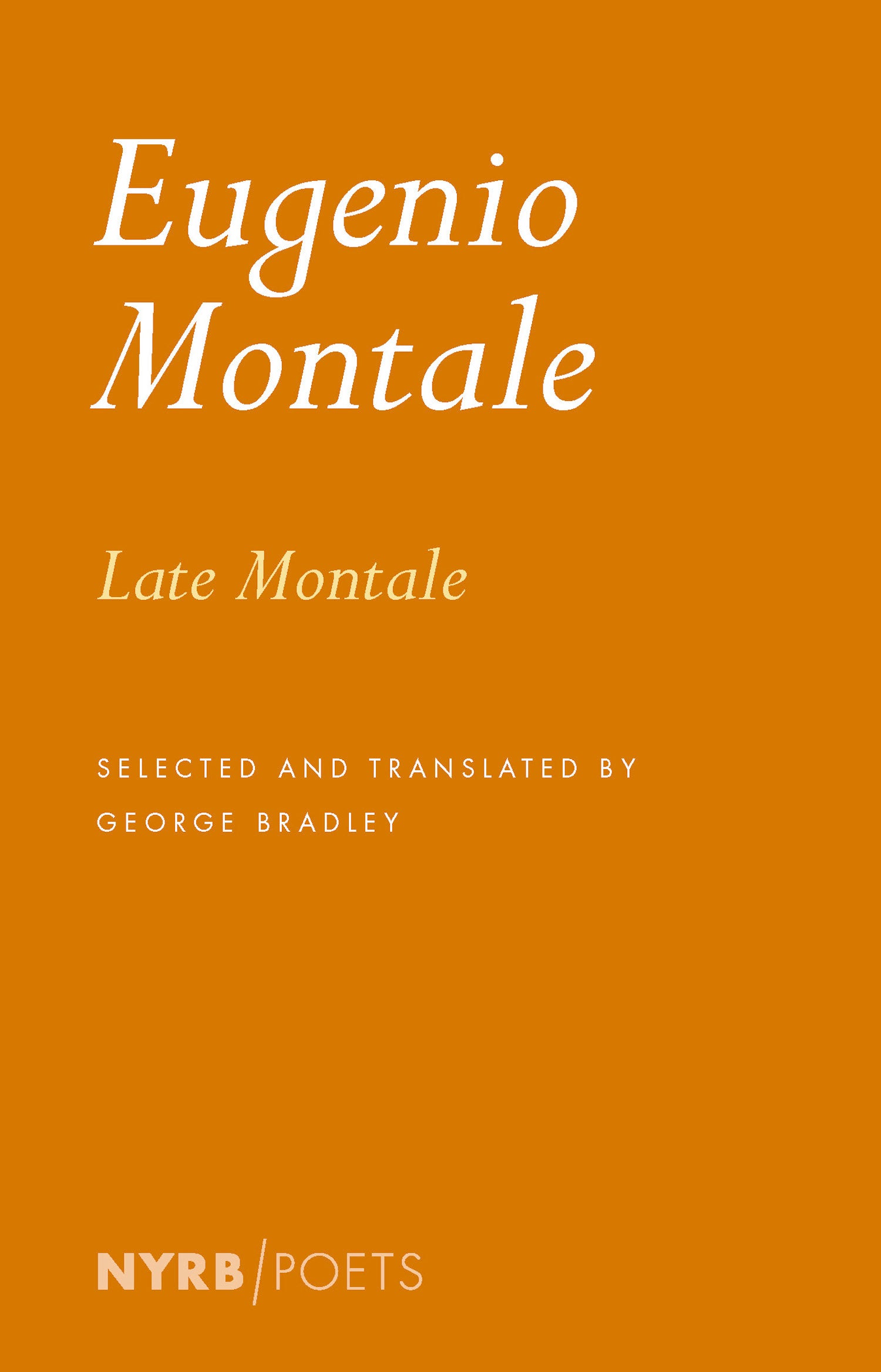
Late Montale – New York Review Books

Late Montale by Eugenio Montale, translated from the Italian by George Bradley, New York Review Books, 2024

Review by Danielle Pieratti, Poetry Editor

“The world exists,” declared Eugenio Montale in the poem “Wind and Flags” from his first book, Cuttlefish Bones, published in 1925 (translated by Jonathan Galassi). Given the frank, existential agnosticism that governs the poet’s later work, it feels a little like whiplash to return to this otherwise characteristically subtle poem after reading Late Montale. Translated from the Italian by George Bradley, this collection comprises Montale’s published and unpublished poems from the second half of his life, offering glimpses of the poet first in the period of his Nobel win and later, as an increasingly reflective and skeptical widower. Yet ultimately, Montale seems to arrive where he began. “Unarguably / something must exist,” he writes in an unpublished poem at the end of his life,

But with [regard to] this,
science, philosophy, theology (red or black)
have all misfired.

If this isn’t faith,
O men of the altar or the microscope,
then go f. yourselves.

Given that these works range from the 1960s to his death in 1981, the fact that Montale circles back to this revelation bears noting. While his underlying ironies and symbolism persist, there’s a definitive “shift from formality to intimacy and self-revelation,” Bradley writes in his introduction, which “parallels the course of twentieth century poetry as a whole”. In poems taken from Satura, first published eight years after the 1963 death of his wife Drusilla Tanzi, Montale retains his characteristic imagery and density, but his focus has drifted from the tangible nature symbolism of his earlier works to more abstract questions of grief befitting an older poet experiencing loss. Many of the poems speak to memory and to individuals from Montale’s past, including several from two long sequences addressed to Tanzi. Others allude frequently to Montale’s former life as an opera singer. Indeed, the tension between then and now pervades Late Montale, and the poet’s apparent scorn for the passing of time lends a hint of tragedy to poems increasingly pensive and raw. “We were two lives too young to be old but too old to feel we were young,” he writes to Tanzi in “Lake Sorapis, 40 Years Ago”, which ends:

That’s when we learned what aging is.
Nothing to do with time, it’s something that tells us,
that makes us tell ourselves: “Here we are,
it’s a miracle and won’t come again.” By comparison
youth is the most contemptible of illusions.

READ MORE…

What’s New in Translation: March 2024

New works from Alexander Kluge, Marjane Satrapi, and Jón Kalman Stefánsson!

The latest text from one of German New Wave’s founding members and all around heavy-hitter; a wide-ranging compilation of art and testimony championing the Iranian feminist movement from Marjane Satrapi; and a moving, braided narrative of grief and recovery from a lauded Icelandic author. Our editors review some of the most exciting works in translation coming to the Anglophone this month. 

kluge

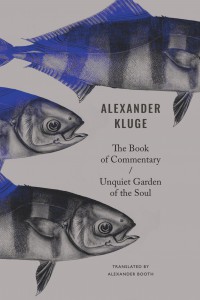
The Book of Commentary / Unquiet Garden of the Soul by Alexander Kluge, translated from the German by Alexander Booth, Seagull Books, 2024

Review by Bella Creel, Blog Editor

Filmmaker, author, and philosopher Alexander Kluge’s most recent oeuvre, The Book of Commentary / Unquiet Garden of the Soul, is an act of rethinking. Born in Germany in 1932, Kluge blurs the edges of the many years of his life in this ambitious work, expanding beyond the first-hand, beyond generations, drawing connections between now and before, all in order to fully describe the experience of a single life. Alexander Booth offers a wonderfully dense and witty translation from the German, with no aversion to a confusing syntax that demands rereading and rethinking.

Kluge is trying to find the right words throughout this collection, which, in the process of its creation, must have been turned over and inside out, stretched to snapping and magnified to the molecular; reading it, in turn, requires a certain liquifying of the brain. This giving-in allows one to absorb the words, which only then can be reformed into some sort of meaning. Kluge himself seems to follow a similar process:

Where does all my ‘fluent speech’, my rabid desire to write, come from? I listen to others. And carefully! A word that flies towards me, an observation that charms me into conversation, a quotation that I read: all of this gets stored inside me for the long-term.

I usually tear books to shreds, marking any places that captivate me in colour pencil before ripping the page out. These I attach to other findings of mine with a paper clip. They’re often annotated. My flat is full of these piles of paper. My personal bastion against the ‘ignorance that shakes the world’.

READ MORE…

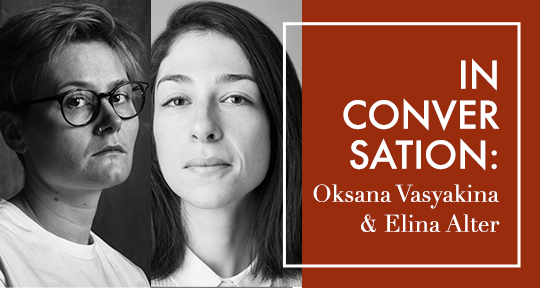
The Richness of the Fragment: An Interview with Oksana Vasyakina and Elina Alter

I don’t believe in wholeness and I don’t believe in Chekhov’s gun. Language . . . isn't enough to reflect the fullness of the world.

What does it mean to hold grief—to physically carry your mother’s death with you in daily life? 

Oksana Vasyakina’s Wound documents the journey of a queer poet as she delivers her mother’s ashes from Moscow to Siberia. Translated from Russian by Elina Alter, the novel is an auto-fictional exploration of processing grief through language, and also a meditation on the Russian lesbian lyric—a polyphonic conversation with feminist thinkers across time and space. While making her way across Russia, the narrator weaves together a cycle of poetry, composed of recollections of her past sexual experiences and fragmented essays. Wound then began as a few pages typed alone in the dark, when Vasyakina was writing during the pandemic, and this sense—of both intimacy and intensity—persists throughout the book. Vasyakina writes, as Alter puts it, with a brutality and directness that feels “exceptionally clear-sighted.”

Wound is Vasyakina’s first novel and the winner of the 2021 NOS Prize. Since then, she has published Steppe and Rose, books that also center on family figures. In addition, her works include two collections of poetry: Женская проза (Women’s Prose) and a cycle of poetic texts titled Ветер ярости (The Wind of Fury). 

Alter is the editor-in-chief of Circumference, a journal of international culture and poetry, and has also translated It’s the End of the World, My Love by Alla Gorbunova. Her translation of Wound has been listed as one of Nylon’s Must-Reads of the Month and LGBTQ Read’s Most Anticipated Titles of the Year. 

This interview, conducted with Oksana and Elina separately, has been edited for clarity.

Jaeyeon Yoo (JY): How did Wound begin? 

Oksana Vasyakina (OV): As I rode a bus through Volgograd while carrying the urn [containing my mother’s ashes], it occurred to me that I would never be able to describe this experience. It wasn’t because the situation was tragic; I just saw how complicated it was, and I felt that I wasn’t equal to the material. This was in early 2019. 

A bit later, in the summer, I wrote a cycle of poems—which are included in the book—called “Ode to Death.” I had the desire to write, but I understood that poetry wasn’t sufficient for the challenge I saw before me. And then the pandemic began. I was shut up in my apartment, all events were canceled, all work went on Zoom. One night, I opened up my laptop and wrote the first few pages of Wound. I was writing in the dark, because it wasn’t clear to me how to write long prose, and before this I’d only written short poems, I didn’t know how to put together a novel. A week later I pulled up my draft, reread it, and understood that this was what I wanted to do, that I had to continue. 

I’m superstitious, so when I start writing a text, I name the file with a random combination of letters, just in case I never finish. But as I continued writing, I thought that the novel needed a simple name. The simplest word. The first word a child utters when it learns to speak is mama, and that was the original title of the manuscript. But some time later, I thought that mama rhymes with the word rana [“wound” in Russian]. It’s just as simple, and contains many meanings. After I wrote the scene in which the mother is lying in her coffin, I renamed the file. Since then, the book has been called Rana: Wound

READ MORE…

Translating Multiple Dimensions: Sarah Timmer Harvey on Jente Posthuma’s What I’d Rather Not Think About

Life isn’t one-dimensional; it’s a blend of emotions, absurdity, and different tones. . .

Jente Posthuma’s striking, moving novel, What I’d Rather Not Think About, delves into the aftermath of an unthinkable loss: the death of a twin. In tracing the patchworked life of a narrator who has long thought of herself as one-half, Posthuma explores the complexities of our most intimate relationships with evocative reflection and unexpected humor. This distinct work and our July Book Club selection has been translated beautifully by Sarah Timmer Harvey, resulting in razor-sharp prose that navigates the most intricate aspects of our selfhoods—how we are with one another. In this following interview, Harvey speaks about her discovery of this novel and her translation process, as well as the intricate journey of following this book’s many thought-paths and references. 

The Asymptote Book Club aspires to bring the best in translated fiction every month to readers around the world. You can sign up to receive next month’s selection on our website for as little as USD20 per book; once you’re a member, join our Facebook group for exclusive book club discussions and receive invitations to our members-only Zoom interviews with the author or the translator of each title. 

Daljinder Johal (DJ): I’m curious about your background and your journey into translation. I read that you’re Australian-born but ended up living in the Netherlands, where you began reading and occasionally translating Dutch fiction and poetry. Was there a particular work that played a significant role in sparking this interest?

Sarah Timmer Harvey (STH): Of course. Back then, while learning Dutch, I relocated to the Netherlands at nineteen with the intention of staying for a year. That single year evolved into a fourteen-year stay. During this time, I was working at a university, which eventually led me to translation as a second career. It happened somewhat unexpectedly. I strove to read while learning Dutch, focusing on more accessible books such as Hermann Koch’s The Dinner and even Harry Mulisch’s The Discovery of Heaven—which, while not mainstream, deeply resonated with me.

READ MORE…

Announcing Our July Book Club Selection: What I’d Rather Not Think About by Jente Posthuma

Posthuma develops an affecting novel about grief by embracing its full complexity.

Jente Posthuma’s What I’d Rather Not Think About delves into the closeness of a relationship that many find difficult to understand: the inextricable link between twin siblings. Through a delicately woven tale of memory, shared selfhood, and grief, the author takes us into the mind that struggles to understand a world shattered by loss, when one sibling dies and another is left to reconstitute the fragments. Poetic and surprising, Posthuma shows how even in the most intimate of connections, in another person lies the great unknown.

The Asymptote Book Club aspires to bring the best in translated fiction every month to readers around the world. You can sign up to receive next month’s selection on our website for as little as USD20 per book; once you’re a member, join our Facebook group for exclusive book club discussions and receive invitations to our members-only Zoom interviews with the author or the translator of each title. 

What I’d Rather Not Think About by Jente Posthuma. Translated from the Dutch by Sarah Timmer Harvey, Scribe, 2023

In short, poignant vignettes, What I’d Rather Not Think About is Jente Posthuma’s story of twin siblings: a brother who commits suicide, and a sister who is left behind. True to its title, the novel grapples with the narrator’s dark, complicated feelings of loss following the death of her brother, as she ruminates on the intensity of their relationship. In reflections of the siblings’ childhood and youthful dreams, tracing how these dreams changed or were lost on the way to maturity, Posthuma develops an affecting novel about grief by embracing its full complexity.

From its opening passage, Posthuma hints to the darker turn the twins’ story will take; the first memory shared is of the two experimenting with waterboarding as children, after seeing a film about Guantanamo Bay. To this, their mother sighs, accurately guessing that: “this has to be one of your brother’s ideas”. The untraditional game cleverly introduces their relationship, with the brother being more in control of their makeshift experiment, leaving the narrator coughing and spluttering from the experience. She asks her brother: “Why didn’t you help me?”, and only receives a single “sorry” in return. This pattern of behavior continues as adults, such as when the narrator joins her brother in a diving lesson, since “my brother expected me to follow him because that’s what I always did. If I wanted to go in a different direction, he would ignore me and keep walking.” READ MORE…