
In our final round-up of the year, we present a thrilling novel capturing the margins of Germany as the nation begins to veer into fascism, a collection gathering the voices of powerful Hungarian women poets, a Brazilian novel testifying to the colonial erasure of indigenous language and being, a series of essays considering the act of reading as an oppositional force against capitalism, and more!
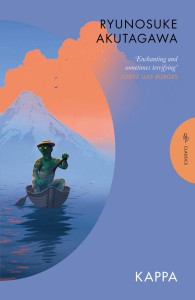
Kappa by Ryonosuke Akutagawa, translated from the Japanese by Geoffrey Bownas, Pushkin Press, 2025
Review by Kaelie Giffel
Even if one is unfamiliar with his work, English readers will recognize the name Ryonosuke Akutagawa from the prestigious Japanese literary prize, named after him posthumously by a friend. Kappa is a novella published in the final year of the author’s life. Pushkin Press’s reissue of Geoffrey Bownas’s 1970 translation comes on the heels of a 2023 retranslation by Lisa Hofmann-Kuroda and Allison Markin Powell, published by New Directions in 2023. Multiple, competing translations indicate the continued importance of Akutagawa’s work, which has a renewed urgency in our time.
Kappa is a philosophical meditation on whether difference can be encountered without violence and how we might meet others in the strange in-between spaces. Structured as a frame narrative, its inciting incident is the testimony of a patient in an unnamed mental institution. The patient speaks about meeting strange creatures with tummy pouches called Kappas. The Kappas have their own cultural, historical, and philosophical institutions and orientations to life, and the narrator lives among them for a while, alternately admiring, baffled, or repulsed as he learns more about their existence. They oppose birth control for silly reasons; sacrifice workers who have been laid off by literally eating them; prohibit artistic performance because they believe the general public to be hopelessly stupid; and are generally misogynist—female Kappas are cast as libidinous huntresses that oppress male Kappas. The narrator is bewildered by the similarities and differences between himself (Japanese) and the Kappanese. Hence, the mental institution. READ MORE…

Radical Reading: Sara Salem Interviewed by MK Harb
I’ve increasingly thought more about what generous, kind, and vulnerable reading might look like instead.
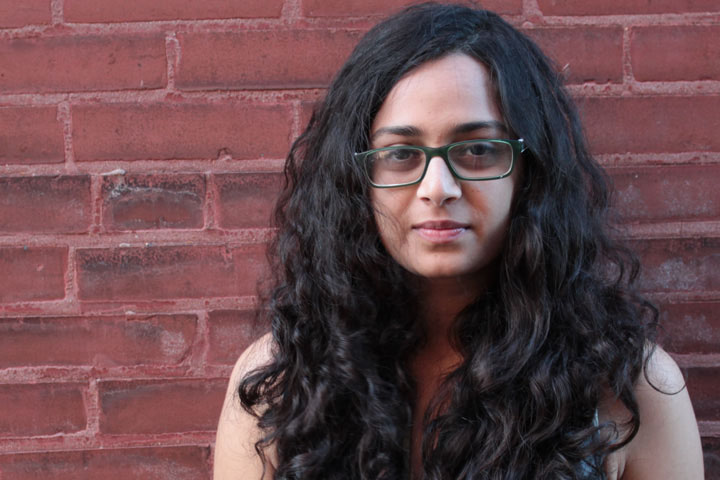
At the height of the pandemic, I—like so many of us—looked for new sources of intrigue and intellectual pleasure. This manifested in finding Sara Salem’s research and reading practice, Radical Reading, which was a discovery of sheer joy; Salem views books and authors as companions, each with their own offerings of certain wisdom or radical thought. When she shares these authors, she carries a genuine enthusiasm that they might come with some revelation.
I interviewed Salem as she sat in her cozy apartment in London wrapping up a semester of teaching at the London School of Economics. We discussed our lockdown anxieties and our experiences with gloomy weather until we arrived at the perennial topic: the art of reading. The interview continued through a series of emails and transformed into a beautiful constellation of authors, novelists, and activists. In what follows, Salem walks us through the many acts of reading—from discussing Angela Davis in Egypt to radicalizing publications in her own work, in addition to recommending her own selections of radical literature from the Arab world.
MK Harb (MKH): Reading is political, pleasurable, and daring. Inevitably, reading is engaged in meaning-making. How did you arrive at Radical Reading as a practice?
Sara Salem (SS): Some of my most vivid childhood memories are of spending long afternoons at home reading novels, and when I think back to those novels, I find it striking that so many of them were English literature classics. I especially remember spending so much time reading about the English countryside—to the extent that today, when I am there, or passing it on a train, I get the uncanny feeling that it’s a place I know intimately. Later, when I read Edward Said’s writing on Jane Austen and English literature more broadly—its elision, erasure, and at times open support of empire—it struck me that we can often read in ways that are completely disconnected from the lives we live. This tension was what first opened up entire new areas of reading that completely changed my life, among which was the history of empire across Africa; at the time I was living in Zambia, where I grew up, and often visited Egypt. Critical history books were probably my first introduction to what you call the practice of radical reading, of unsettling everything you know and have been taught in ways that begin to build an entirely different world.
I like that you say reading is engaged in meaning-making, because it has always been the primary way in which I try to make sense of something. Even more recently, as I’ve struggled with anxiety, reading above all became my way of grappling with what I was experiencing: what was the history of anxiety, how have different people understood it, and how have people lived with it? I realise, of course, that not everything can be learned from a book, but so far, I’ve found that what reading does provide is a window into the lives of people who might be experiencing something you are, making you feel less alone.
MKH: How do you reconcile reading for pleasure versus reading for academic and political insights? Do they intersect? Being idle has its own spatial practice of radicality at times, and I’m curious on how you navigate those constellations.
SS: This question really made me think! In my own life, I have always made the distinction of fiction as pleasure and non-fiction as academic/work-related. So, if I need to relax, or want to take some time off, I will instinctively reach for fiction, and if I want to start a new project, I think of which academic texts would be helpful. However, this began to change about five or six years ago, when I began to think more carefully about how fiction speaks to academic writing and research, as well as how non-fiction—unrelated to my own work—can be a great source of pleasure and relaxation. This has meant that they have begun to intersect much more, and it has enriched both my academic work and my leisure time. READ MORE…
Contributor:- MK Harb
; Language: - Arabic
; Places: - Egypt
, - Zambia
; Writers: - Ahdaf Soueif
, - Arwa Salih
, - Huda Tayob
, - Mahmoud Darwish
, - Sonallah Ibrahim
, - Thandi Loewenson
, - Waguih Ghali
; Tags: - intersectional feminism
, - migration
, - Race
, - radicalism
, - Reading
, - sexuality
, - social commentary