Posts filed under 'history'

What’s New in Translation: December 2020

The latest in literature from Spain, Romania, and France!

Our final selections in excellent translations for the year of 2020 are fittingly full of thought. Throughout these texts, one finds the endless potential roadmaps that chart out from the individual mind’s interrogation and contemplation of their surroundings, and one’s own place within them. From a wandering mind, everything is a pool for endless reflection; a Catalan collection draws from the sea, a Romanian notebook is filled with musings and defiances of authorship, and a French diary novel tells the lives of many through the life of one. 

salt water

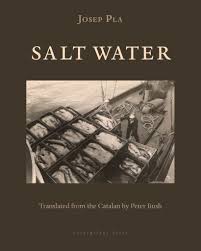
Salt Water by Josep Pla, translated from the Catalan by Peter Bush, Archipelago Books, 2020

Review by Allison Braden, Editor-at-Large for Argentina

On a recent virtual happy hour, my friend described a weekend camping trip on a secluded barrier island off the coast of Georgia, in the southern US. My envy verged on rage as I listened from my living room, which doesn’t get enough natural light. He said that after he and his wife kayaked over and set up their tent (annoying a resident heron in the process), they had done absolutely nothing—not even read. They sat on the shore and watched the sea. It’s easy to believe how that could have been enough.

Josep Pla would understand. In Salt Water, translated from the Catalan by Peter Bush and released by Archipelago Books this month, Pla writes that “the mere presence of the sea is enough to sink into the deliquescent bliss of the contemplative life.” His curiosity courses through the book, a series of ten sketches that revolves around the coast of Pla’s native Catalonia: he describes shipwrecks, submarines, and harebrained sailing schemes. He relates stories from a salty, one-handed raconteur and imbues the rambling tales with strikingly lifelike texture. Though his plots unfold on or near the sea, human culture is ever present. Pla revels in detail, describing at length the joy of nearly black coffee on a marginally small boat: “That beverage makes an almost immediate impact: your mind projects itself onto the outside world, you are fascinated by everything around and a gleam comes to your eyes.” This book is a product of that fascinated, caffeinated gaze.

In the preface, Pla describes the stories as writings from his adolescence. In the translator’s note at the end of the book, however, Bush clarifies that they were written in the 1940s and hypothesizes that the preface was a canny attempt to evade censorship. He points out that Pla’s “articles containing veiled critiques of the dictatorship made him the most censored journalist in Spain.” Indeed, his biography offers helpful context for the conflicting claims that bookend the collection.

As a university student a century ago, Pla developed a clear, intelligible writing style and deployed it throughout his career as a journalist. He traveled widely across Europe as a foreign correspondent and served briefly as a member of Parliament for the Commonwealth of Catalonia, a short-lived assembly notable for its symbolic value. Over its eleven years in existence, the Commonwealth promoted Catalonia’s unity and identity, and evinced strong support for the Catalan language—Pla’s language. He became a chronicler of Spain’s tumultuous early twentieth-century history and spent multiple stints in exile. In the 1940s, he took to exploring his native coast and writing dispatches for Destino, a Burgos-based magazine at the forefront of the reemergence of Catalan-language culture. Throughout his peripatetic career, Pla never stopped writing: his complete works, compiled shortly before his death in 1981, stretch over thirty-eight volumes. READ MORE…

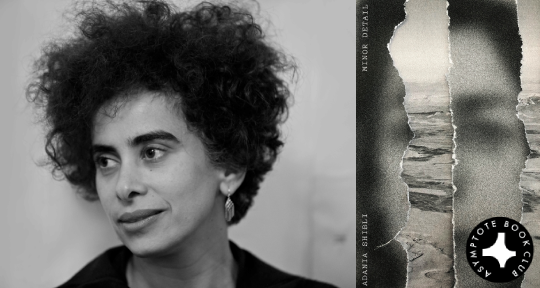
Announcing our May Book Club Selection: Minor Detail by Adania Shibli

This is one of Shibli’s greatest strengths as a storyteller: she trusts her readers to fill in the gaps.

One of the most powerful responsibilities of literature is to ascribe human voices to the momentous, overarching events of our world. This month, Asymptote has selected Adania Shibli’s unflinchingly powerful Minor Detail, a novelistic reflection on the violent and painful consequences of the Israeli-Palestinian conflicts, from the War of 1948 to present day. With an astutely visual language and an unwaveringly intelligent morality, Shibli’s work is an impeccably crafted totem of resistance and justice. 

The Asymptote Book Club aspires to bring the best in translated fiction every month to readers around the world. You can sign up to receive next month’s selection on our website for as little as USD15 per book; once you’re a member, you can join the online discussion on our Facebook page

Minor Detail by Adania Shibli, translated from the Arabic by Elisabeth Jaquette, New Directions (US), Fitzcarraldo (UK), Text Publishing (Australia), 2020

The smell of gasoline, the sound of a dog howling, the taste (or distraction) of a simple stick of chewing gum—these are only a few of the motifs surrounding trauma and pain in Minor Detail, by Adania Shibli, translated from the Arabic by Elisabeth Jaquette. It is August, 1949, and a group of Israeli soldiers have set up camp in the Negev desert. As they patrol the nearby areas, they encounter and ambush a group of Bedouins, returning with a single survivor: a young Arab woman. Shortly after, she is hosed down and raped by the officer in charge. Over half a century later, a woman living in the West Bank crosses the border into Israel, looking to uncover the details of the case. Her journey reflects a changed Middle East.

As a literary project, a historical record, and a translation, Minor Detail is, simply put, brilliant. My knowledge of the Arabic language is limited, and so my goal here isn’t to compare the translation to the original text. Instead, I want to focus on narrative structure and style—two elements clearly on the minds of both Shibli and Jaquette, whose collaboration proves a success on all fronts.

READ MORE…

In This Together: Writers From Around the World Respond to the COVID-19 Outbreak

I remember that when everything starts to crumble, there are always people you can rely on, people who heal...who make everyday life more bearable.

For this week’s edition of In This Together, we present a text from the French writer, journalist, and musician Tania de Montaigne. Sarah Moore, translator and Assistant Blog Editor at Asymptote, introduces the piece:

This week, France ended its national lockdown that had been in place for almost two months. Yet, of course, life has not returned to normal and people have been adapting to the déconfinement, along with the many changes it has brought. During the lockdown, French daily newspaper Libération (popularly known as Libé) continued to publish its weekly column “Écritures” in its weekend edition, written alternately by four French writers including Tania de Montaigne. This particular article, “Pour mémoire” (“For the record”) looks back on everyday life before the COVID-19 pandemic, recalling past normality. Saying something ‘for the record’ is to let a voice ring out, to publicly declare that these words have value and should be remembered. The text’s power lies in its simplicity and honesty—evoking nostalgia for a pleasurable but naïve innocence that has been lost. 

De Montaigne alludes to the many small cultural references that can stir and unite a collective memory—song lyrics, TV shows, books, exhibitions—as well as our old habits and the importance of touch, which we perhaps took for granted. She also draws a link with the AIDS crisis and our various responses to something that is frightening, new, and unknown—that will inevitably be used politically. Most importantly, referencing other times of hardship, including the terrorist attacks in Paris and Nelson Mandela’s apartheid resistance, de Montaigne upholds the continual value of powerful words, voice, and support during times of crisis. 

For the record

by Tania de Montaigne

I remember the day when the word ‘AIDS’ entered our lives.
I remember Barbara’s song, “Maladie d’amour / Où l’on meurt d’aimer / Seul et sans amour, / Sid’abandonné”. (“Love sickness / Where you die from loving / Alone and loveless, / Aidsabandoned”.)
I remember fear.
I remember people who had first-hand info through “my mother’s aunt’s cousin who works at the hospital” or “my brother-in-law’s cousin’s best friend who works for the government”.
I remember the National Front saying: “People with AIDS are like lepers, they should be locked up in an Aidsatorium.” And how they also said: “It’s a lie, condoms don’t protect you from the disease.”
I remember how some people claimed that there were miracle cures.
I remember Hervé Guibert’s book, To the Friend Who Did Not Save My Life.
I remember a philosophy exam and this quote from Aristotle: “The ignorant man affirms, the learned man doubts, the wise man reflects.”
I remember when Corona was a Mexican beer that you drank with a slice of lemon.
I remember the quiz you always found at the end of summer magazine editions: “What about you, what would you take with you to a desert island?” I went crazy trying to decide.
I remember how we used to go to the theatre, to concerts, how everyone was packed tight, focused, emotional, vibrating in unison and how that’s what was beautiful. READ MORE…

What’s New in Translation: April 2020

New literature from Algeria, Guadeloupe, Italy, and Japan!

In the newly ruptured world, the questions that arise all seem perplexingly novel. It is somewhat of a tonic, then, that one turns to literature to find that the queries that confound us now are more specific reiterations of questions that have plagued humanity for a long, long time. What is freedom? How do we persist through the turmoil of our nations? What does the past mean for the present? And, perhaps most pertinently, what survives? In this month’s selections in translated literature, four astounding works from around the world encounter and contend with these problems in their singular styles. Below, discover a passionate novel about a real-life Algerian bookseller, a Guadeloupe-set fiction that intermingles personal and national revolution, the latest English-language volume in Roberto Calasso’s grand series on human civilization, and a Japanese literary sensation which contends with feminine pain and perseverance.

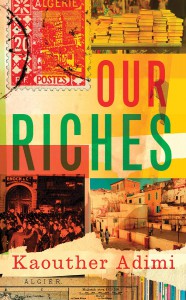
our riches

Our Riches by Kaouther Adimi, translated from the French by Chris Andrews, New Directions, 2020

Review by Clémence Lucchini, Educational Arm Assistant

Though one cannot truly stress all the qualities of Our Riches, Kaouther Adimi’s first translated novel into English by Chris Andrews, within the limits of a book review, Adimi has certainly proved that she is able to convey Edmond Charlot’s life long passion for books in less than two hundred pages. In this historical fiction, recognized with two French literary awards, Adimi finds a new way to portray her native Algeria: through Edmond Charlot’s many literary endeavors.

For those who do not know Edmond Charlot (I was among that group before reading this book), he left a great gift to the publishing world by being Camus’ first publisher, by publishing under-represented authors, and last but not least, by pioneering the design of book covers as we know it today in Western Europe, referred to as “the talk of the publishing world” in Adimi’s work. READ MORE…

What We Owe to Our Ancestors: On Nino Haratischwili’s The Eighth Life

I kept wondering if part of the reason we are so invested in the stories of our female ancestors is not to save them, but to save ourselves?

The Eighth Life, by Nino Haratischwili, translated from the German by Charlotte Collins and Ruth Martin, Scribe, 2019

Sometimes I wonder how many people harbor a secret desire to write a book about their family’s entire history. I have certainly met enough women in my life who have expressed this explicitly, especially the stories shared by their mothers and grandmothers—the implication being that we don’t get enough of these stories in literature or biographies. It is perhaps for this reason that reading Nino Haratischwili’s The Eighth Life, translated by Charlotte Collins and Ruth Martin, feels so familiar, almost like a wish fulfilled. Because with all its exciting intricacies and the moving depth, The Eighth Life is not just the story of the trials and tribulations of one Georgian family over the red century; it is first and foremost a tribute that Niza, the book’s narrator, pays to her matriarchal line and to her family’s youngest member, her niece Brilka.

The Eighth Life has deservedly been compared to Tolstoy’s War & Peace, most recently translated by Richard Pevear and Larissa Volokhonsky. Just like its epic predecessor, The Eighth Life features a dizzying amount of main and secondary characters whose lives are explored in depth and trailed over several decades, from the early 1900s to our present. The story starts with Niza’s great-grandmother, Stasia, the daughter of a famed Georgian chocolate-maker, who almost impetuously betroths Simon Jashi, a military man. Throughout the book, we follow Stasia, her sister Christina, and their granddaughters as they shape and are shaped by one hundred years of Georgian and USSR history. Like Tolstoy, Haratischwili is not afraid to go into the details of the major historical events that signpost the twentieth century, providing a guideline even for those that are not well versed in Soviet history. And just like Tolstoy, through the voice of her perceptive narrator, she is ready to remind us of the hypocrisy and absurd repetitions that history often entails. READ MORE…

Blog Editors’ Highlights: Fall 2019

Our blog editors pick their favorite pieces from the Fall 2019 issue!

Another issue, another record broken: Asymptote’s Fall 2019 issue features work from an unprecedented thirty-six countries. Looking for a point of entry? Consider our blog editors your guides. Their selections here, which range from Korean poetry to Russian drama, will set you off on the right foot. 

“Why do I think October is beautiful? / It is not, is not beautiful.” So goes a poem by the late Bill Berkson. It is not—as we know when the grey settles and looks to stay—a particularly delightful month, but if all the poems featuring October attests to something, it is that this time, its late and sedate arrival, is one that enamors poets. So it is that a vein of poetics runs through our Fall 2019 issue, and the poetry section itself is one of tremendous artistry and vitality. From the stoic and enduring lines of Osip Mandelstam to a brilliant translation of Sun Tzu-Ping’s strikingly visual language, Asymptote has once again gathered the great poets from far reaches. 

READ MORE…

The Multiple Worlds of the Writer: In Conversation with Margo Rejmer

I feel that I live longer than I do in reality, because I have three parallel lives . . .

Margo Rejmer’s spare, exacting prose and illustrious methods have earned her widespread praise for both her meticulous reportage and her discerningly detailed narratives. From recollections garnered from the survivors of Communist Albania, to the stories collected from the varied and elaborate landscape of Bucharest, to the grappling of relationships in certain toxic fictional characters in Warsaw, the worlds depicted are all at once worn with secrecy, curious with hope, and bold with the human instinct for survival. In this following interview, Asymptote’s Filip Noubel speaks to Rejmer on subjects of writerly process, choice under totalitarianism, and individual freedoms.

Filip Noubel (FN): You have written two books on the experience and the consequences of dictatorial Communism in Ceauşescu’s Romania and Hoxha’s Albania. What drew you to those countries that, even within the context of then Communist Central Europe, have been generally perceived as economically underdeveloped, politically very conservative, and unattractive as destinations?

Margo Rejmer (MR): Both of the books, Bukareszt. Kurz i krew (Bucharest. Dust and Blood, 2013) and Błoto Słodsze Niż Miód. Głosy Komunistycznej Albanii (Mud Sweeter than Honey: Voices of Communist Albania, 2018) deal with problems of power, strategies of survival in the authoritarian system, and searching for spaces of freedom. Although, when I started working on them, I didn’t know where they would lead me, as it turns out, everyone has their own inner path that leads to the same point. My book about Albania was supposed to simply be a guide to the Albanian mentality for the Polish reader. In the end though, it turned out to be a story about an isolated Orwellian-Kafkaesque space where people are controlled and punished, yet try to look for happiness and for a substitute for freedom, at least internally.

READ MORE…

Translation Tuesday: “Coming of the Rivers” by Pablo Neruda, exclusive translation by Waldeen

You were fashioned out of streams / and lakes shimmered on your forehead.

Poet-translator Jonathan Cohen has recovered these stunning translations of Pablo Neruda’s poetry, made in 1950 by the extraordinary Waldeen. Who? Learn about her and the secret of her translations in Cohen’s essay, “Waldeen’s Neruda,” appearing on our blog tomorrow. Here, published for the first time in this week’s Translation Tuesday, is her rendering of the complete “Coming of the Rivers” sequence. Comprising five poems, the sequence comes from the opening section of Neruda’s epic Canto General titled “La lámpara en la tierra” (“Lamp in the Earth”) in which he celebrates the creation of South America.


Coming of the Rivers

Beloved of rivers, assailed by

blue water and transparent drops,

apparition like a tree of veins,

a dark goddess biting into apples:

then, when you awoke naked,

you were tattooed by rivers,

and on the wet summits your head

filled the world with new-found dew.

Water trembled about your waist.

You were fashioned out of streams

and lakes shimmered on your forehead.

From your dense mists, Mother, you

gathered water as if it were vital tears,

and dragged sources to the sands

across the planetary night,

traversing sharp massive rocks,

crushing in your pathway

all the salt of geology,

felling compact walls of forest,

splitting the muscles of quartz.

READ MORE…

My 2018: Andrea Blatz

August was “Women in Translation” month, so, naturally, I took advantage of this as a reason to buy some more books.

Blog Copy Editor Andrea Blatz’s 2018 reading list was packed with nineteenth-century science fiction and women in translation. In today’s post, she discusses the common themes that unite many of these books, among them the experience of trauma and the role of space and place in our lives, before looking ahead to her reading list for the new year!

Like most book lovers, I buy more books than I have time to read, so my “To Read” list is usually longer than my “Already Read” list. Having so many books to choose from for my next read means I usually pick something completely different than the book I’ve just read. However, this year, it seems as though spaces have been a prominent theme in much of what I’ve read.

I started the year with The Other City by Michal Ajvaz, translated by Gerald Turner. After finding a book written in a mysterious script in a bookshop, the narrator begins noticing strange things around him in his home city, Prague. The result is a strange, new reality composed of spaces that are ignored in the daytime. Fish talk to you, tiny elk live on the Charles Bridge, and ghosts appear as the mysterious narrator crosses a boundary into this “other city.”

READ MORE…

My 2018: Jonathan Egid

I relished the opportunity to read texts with somewhat more invigorating prose than typically displayed in analytic philosophy journals.

Israeli writer Amos Oz and Cretan memoirist George Psychoundakis are two of the highlights of Assistant Blog Editor Jonathan Egid’s 2018 reading list. Addressing topics ranging from Israeli politics and the death of Jesus (Oz) to Renaissance poetry and home-brewed alcohol (Psychoundakis), the two writers nevertheless share a sense of humour and a talent for producing powerful and thought-provoking texts.

Having spent most of the first half of the year reading texts about, rather than in translation, as part of my research for a thesis on the philosophy of cultural and conceptual difference, I relished the opportunity to read texts with somewhat more invigorating prose than typically displayed in analytic philosophy journals, and my summer reading list was full of translated fiction.

High on this list was the Israeli writer Amos Oz’s first new novel in over a decade, Judas. An old-fashioned novel of ideas in the tradition of Tolstoy and Thomas Mann, Judas begins with an end; the protagonist Shmuel Ash is left suddenly by his girlfriend, and then learns of his father’s bankruptcy, which forces him to abandon his promising studies. He takes up work caring for an elderly cripple in an ancient house on the outskirts of Jerusalem, and the narrative follows Shmuel as he is drawn into the troubled history of this crumbling house and its mysterious and enticing inhabitants.

The narrative is interspersed with Shmuel’s reflections on his now-abandoned thesis, giving the story—which takes place almost entirely in the old house and the neighbouring streets, cafes, and alleyways—a dazzling historical and intellectual scope, as Oz spans continents and centuries from medieval Al-Andalus to Galician shtetls and kibbutzim on the Sharon plain, tracing the fraught history of Jesus and the Jews. The focus of these reflections is neither Jesus nor the Jews, but on the eponymous Judas, or rather on the figure of Judas, the figure of a most reviled and hated traitor.

READ MORE…

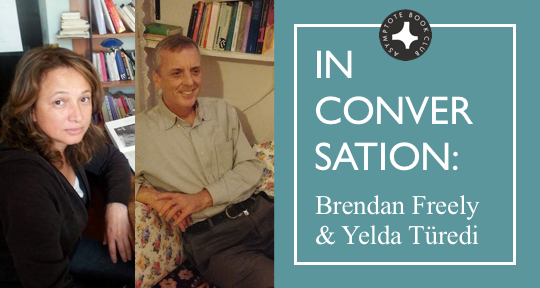
Translating the Ottoman Quartet: An Interview with Brendan Freely and Yelda Türedi

In practical terms, communication with the author is difficult: we can only communicate through his lawyers.

Ahmet Altan’s writing is sprawling, ambitious, radical—so radical that the author is currently serving a life sentence on charges of inciting the plotters behind Turkey’s 2016 failed coup. In the latest instalment of the Asymptote Book Club interview series, Altan’s co-translators, Brendan Freely and Yelda Türedi, reveal that their only contact with the author is through his lawyers. No written materials can be carried into or out of the prison where Altan is serving his sentence, but work continues on the final volume of the monumental Ottoman Quartet.

In conversation with Asymptote’s Garrett Phelps, Freely and Türedi give us an insight into how they came to translate Altan’s work, and why a novel sequence of novels dealing with the events of the early twentieth century has never felt fresher or more contemporary.

Garrett Phelps (GP): Like a Sword Wound is set during a momentous period in Turkish history and details the cycle of chaos which ultimately results in the Ottoman Empire’s collapse. As translators, did you feel the setting added to your burden of responsibilities?

Brendan Freely and Yelda Türedi (BF/YT): Both of us are quite familiar with this period, so the setting as such did not present any particular problem. However, we were aware of the echoes of the current political situation in Turkey, and of how little the main political currents seem to have changed in over a hundred years. In practical terms, although Like a Sword Wound was written in modern Turkish rather than Ottoman Turkish, Ahmet Altan made an effort to reflect the language of the period, often choosing outdated words and phrases. In our initial meeting to discuss the translation, he was concerned about how we would approach this. We agreed to take the same approach he did—that is, to prefer older words and phrasing to evoke the mindset of the period while still keeping the language current enough to avoid alienating contemporary readers.

READ MORE…

Weekly Dispatches from the Frontlines of World Literature

Literary awards, festivals, and commemorative exhibitions reign in this edition of weekly dispatches.

It’s been a busy October in world literature! Join us to find out more about literary happenings from around the world, in Taiwan, China, the United Kingdom, and Albania.

Vivian Chih, Editor-at-Large, reporting from Taiwan:

The “Double Tenth Day” on the 10th of October has been commemorated as the “birthday” of the Republic of China, the official name of Taiwan. On this day in 2018, the Li Mei-shu Memorial Gallery in Sanxia District, New Taipei City, held an opening ceremony for a series of exhibitions featuring the works by two important Taiwanese cultural figures,  Li Mei-shu (李梅樹, 1902-1983) and Zhong Lihe (鍾理和, 1915-1960), respectively a painter and a novelist. Both were influential to the development of Taiwan’s art and literary scenes, and having lived through the martial law period, Li and Zhong grounded their paintings and novels in depicting the homelands that had nourished them. Both are considered to be among a group of Taiwanese nativist artists, who composed works to express their concerns and affections about the local people and places in Taiwan. The exhibition is open to the public until the 18th of November, featuring many precious manuscripts by Zhong, paintings by Li, as well as artworks of the other two younger Taiwanese artists.

READ MORE…

In Conversation: Mui Poopoksakul

Thailand has become politically divided...so many young Thai writers are now turning back toward the themes of politics and history.

September’s Asymptote Book Club selection, Moving Parts, is a dazzlingly original collection of short stories by Prabda Yoon, “the writer who popularized postmodern narrative techniques in contemporary Thai literature.”

Translating from Thai to English can be daunting, to the extent that it sometimes feels as though “you can never do the right thing.” Continuing our monthly series of Book Club interviews, Mui Poopoksakul tells Lindsay Semel about the challenges of translating a language with “a multitude of pronouns that are extremely nuanced,” as well as an affinity for elaborate rhyme and alliteration.

Lindsay Semel (LS): I was immediately struck by the aurality of Moving Parts. It’s full of rhyming prose and onomatopoeia. When you interviewed Prabda Yoon for The Quarterly Conversation, you said, “I feel like the alliteration can be recreated sometimes, but rhyming is more of a problem because the Thai ear is far more used to it. Translating Thai, you face the problem of translating poetry. You can never do the right thing. Someone will always say you did the wrong thing because you kept the sound or you kept it straight. It’s a real problem.” His answer didn’t offer much of a solution. Can you talk about some of the more challenging or intriguing examples in Moving Parts of translating what in English might be considered poetic language in prose?  

Mui Poopoksakul (MP): In Thai, people like to say two or three or four synonyms in a row if they rhyme or if they’re alliterative. The sound play isn’t intended to create extra meaning. The Thai ear is used to that sing-song quality, so it doesn’t feel like someone is suddenly breaking into a nursery rhyme. Rhyme was more of an issue in this collection, whereas in The Sad Part Was, the first Prabda Yoon collection I translated, alliteration was more present. In Moving Parts, there were a couple of big moments where Prabda really played up the rhyming—in “Evil Tongue” and in “Eye Spy”—I think as a nod to that element of the Thai language, so I felt that I needed to carry those mini poems over to represent the sound. So there are sentences in those stories where every clause rhymes. With him, these moments aren’t always intended to be particularly lyrical—some are just playful. “Eye Spy” includes a rhyme about theater seats. There are also smaller instances of rhyming: in “Mock Tail,” for example, there’s “flip or slip.” I try to pepper them in, but I also have to watch out that there is not too much of a sing-song quality in the translation.

READ MORE…

Fall 2017: The Last Space For Resistance

Asymptote’s most precious gift to readers: each issue guarantees a rich dastarkhan that fully embraces and celebrates diversity.

Asymptote is more than a journal—it’s a one-stop portal for world literature news. September 2017 marks a milestone for two essential columns: the second anniversary of our monthly What’s New in Translation? reports, compiling in-depth staff reviews of the latest world literature publications; and the first anniversary of our weekly Around the World with Asymptote roundups, gathering literary dispatches from every corner of the globe (not aggregates of news hyperlinks culled from elsewhere, mind you, but actual reporting by staff on the ground). Though we do reviews better than most, I’m especially proud of the latter column, which has provided first-hand literary coverage from more than 75 countries by now thanks to Assistant Managing Editor Janani Ganesan, Senior Executive Assistant Daljinder Johal, and of course our valiant blog editors who upload, edit, and proofread every single dispatch. Inconveniently (because I have been invited to speak at five panels in four cities in the last quarter of 2017, and also because the then-erratic social media team will soon need to be replaced entirely), the lump in my neck turns out to be thyroid cancer, my doctor summons me back to his office to tell me in August 2017. A few days before the first of my three hospitalizations that quarter, I share the news with my team. Just as I’m about to be wheeled into surgery, one concerned colleague emails me to say that the same influential person who demanded I pay translators two years ago is making new noise about Asymptote on social media; some PR intervention might be called for. Well, if the work my team and I’ve done doesn’t speak for itself by now, I think to myself sadly, if no one comes to Asymptote’s defence, then let it be. Though my life expectancy—one year on—remains the same as before the diagnosis, the mortality scare from that time has made me confront what to do with Asymptote—as it stands right now, we are still a long way from sustainability; no one would willingly step into my role. Will readers rally to keep us alive, if push comes to shove? Here to introduce the Fall 2017 issue and the French New Voices Feature that I edited is French Social Media Manager Filip Noubel.

I joined Asymptote in the fall of 2017. This old dream finally came true as I was sitting in Tashkent, struggling with flaky Uzbek Internet and reflecting on how my nomadic life across cultures and languages was mirrored in the history of that city where identity has always been both plural and multilingual, and where literature has often turned into the last space for resistance.

As I looked at the Fall 2017 issue of Asymptote, I felt as if I had just been invited to a literary dastarkhan. In Central Asia, when guests arrive and are invited into the interior of a traditional house to sit on the floor, a large tablecloth is thrown on the ground and rapidly filled with a mix of delicacies and treats from various parts of the region. Fruits (fresh and dry), cooked meats, drinks (hot and cold), vegetables, sweets, bread and rice are all displayed to please the eye. Despite being very different, they all contribute to the same feast. Just like any issue of Asymptote in fact: a collection of diverse texts from various corners of the world all united by an underlying theme, and carefully curated to satisfy the most curious minds. As I read this issue, I sensed it had been especially designed to please my literary taste buds.

Marina Tsvetaeva opened the gates of translation for me when I was studying translation theory in Prague, and in one of her Four Poems I could once again hear the rebellious voice that had seduced me back then: READ MORE…