
This month, we bring you thirteen reviews from thirteen countries: a poetry collection that reimagines friendships with long-gone revolutionaries, a tender and incisive rumination on disappearance, the latest novel on the inexplicability of love from a Nobel laureate, a story of Silicon Valley-fueled descent, a compilation of Latin American feminist thought, and much much more!
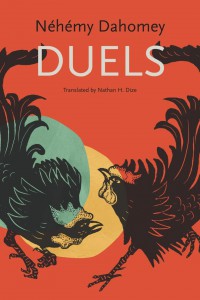
Duels by Néhemy Dahomey, translated from the French by Nathan H. Dize, Seagull Books, 2025
Review by Timothy Berge
Néhémy Dahomey’s Duels is set in 1842, thirty-eight years after Haiti’s independence—a storied liberation that came through one of the largest slave uprisings in history. France withdrew, but issued an absurd debt of one hundred and fifty million francs. Paying off a debt while attempting to modernize a new country was a tough balancing act, so Haiti imposed high taxes on its citizens and forced them into unpaid labor.
Duels takes place in Böen, a small town in the Cul-de-Sac Plain that evaded a census for several years. As a result, no one in the town had fallen victim to the government’s schemes—until a local official decides that he needs laborers for a new project. From there on, in the context of freedom, economic entrapment, and postcolonial growing pains, the events of Duels unfold. Nathan H. Dize’s translation reads like a yarn spun out by an old relative with a deft deadpan humor, aptly navigating the tense shifts between past and present, and generating a sense of perpetuity for these characters and their stories. Here, the historical and the contemporary connect and blur. READ MORE…
 This spirit of formal ambition is by no means limited to our Special Feature. After all, “as the reality of each time changes,” says
Blog Editors’ Highlights: Winter 2025
Reviewing the manifold interpretations and curiosities in our Winter 2025 issue.
In a new issue spanning thirty-two countries and twenty languages, the array of literary offers include textual experiments, ever-novel takes on the craft of translation, and profound works that relate to the present moment in both necessary and unexpected ways. Here, our blog editors point to the works that most moved them.
Introducing his translation of Franz Kafka’s The Trial in 2012, Breon Mitchell remarked that with every generation, there seems to be a need for a new translation of so-called classic works of literature. His iteration was radically adherent to the original manuscript of The Trial, which was diligently kept under lock and key until the mid-fifties; by then, it was discovered exactly to what extent Max Brod had rewritten and restructured the original looseleaf pages of Kafka’s original draft. It is clear from Mitchell’s note that he considers this edit, if not an offense to Kafka, an offense to the reader who has lost the opportunity to enact their own radical interpretation of the work: an interpretation that touched Mitchell so deeply, he then endeavored to recreate it for others.
In Asymptote’s Winter 2025 Issue, the (digital) pages are an array of surprising turns of phrase and intriguing structures—of literature that challenges what we believe to be literature, translations that challenge what we believe to be originality, and essays that challenge what we believe to be logic. I am always drawn to the latter: to criticism, and writing about writers. As such, this issue has been a treat.
With the hundredth anniversary of Kafka’s death just in the rearview and the hundredth anniversary of the publication of The Trial looming ever closer, the writer-turned-adjective has not escaped the interest of Asymptote contributors. Italian writer Giorgio Fontana, in Howard Curtis’s tight translation, holds a love for Kafka much like Breon Mitchell. In an excerpt from his book Kafka: A World of Truth, Fontana discusses how we, as readers, repossess the works of Kafka, molding them into something more simplistic or abstract than they are. In a convincing argument, he writes: “The defining characteristic of genius is . . . the possession of a secret that the poet has no ability to express.” READ MORE…
Contributors:- Bella Creel
, - Meghan Racklin
, - Xiao Yue Shan
; Languages: - French
, - German
, - Italian
, - Macedonian
, - Spanish
; Places: - Chile
, - France
, - Italy
, - Macedonia
, - Switzerland
, - Taiwan
, - Turkey
; Writers: - Agustín Fernández Mallo
, - Damion Searls
, - Elsa Gribinski
, - Giorgio Fontana
, - Lidija Dimkovska
, - Sedef Ecer
; Tags: - dystopian thinking
, - identity
, - interpretation
, - nationality
, - painting
, - political commentary
, - revolution
, - the Cypriot Question
, - the Macedonian Question
, - translation
, - visual art
, - Winter 2025 issue
, - world literature