Posts filed under 'resistance'

Sounds Like Fiction: Traversing Minor Detail Again, in the Time of Genocide

Amidst the ruins, I want to read Shibli's writing ... as a pedagogy of hope, of waiting, and of revolutionary becoming.

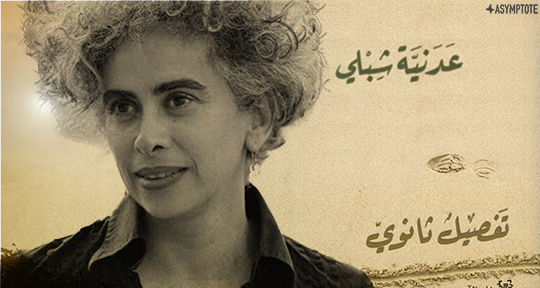
After the shameful decision to cancel Palestinian writer Adania Shibli’s LiBeraturpreis award ceremony at the 2023 Frankfurt Book Fair, everyone in the Global North flocked to read Minor Detail (translated into English by Elisabeth Jaquette), as thousands of writers, intellectuals, editors, and others in the literary ecosystem rightly condemned the cancellation. It was a symptom not only of Europe’s routine silencing of Palestinian voices but, more perniciously, of Germany’s particular brand of virulent anti-antisemitism, its Holocaust memory culture metastasised into a total interdiction on critiques of Israel.

Adania Shibli cites Samira Azzam—a writer whose seemingly unthreatening short stories describing everyday life in Palestine managed to pass the censorship bureau’s checks—as a formative influence. Azzam “contributed to shaping my consciousness regarding Palestine as no other text I have ever read has done”, Shibli writes, for it cultivated in her “a deep yearning for all that had been, including the normal, the banal, and the tragic”. For many of us, grappling with what solidarity and hope can mean in the light of Israel’s ongoing genocidal violence against Gaza, Minor Detail might be such an essential touchstone. How might we (re)read Shibli’s work today, not only as a prescient source of information about Palestine but also as a text that theorises and maps its own aesthetic possibility? With what voice does it continue to address us, reverberating through silence and the distortions of language?

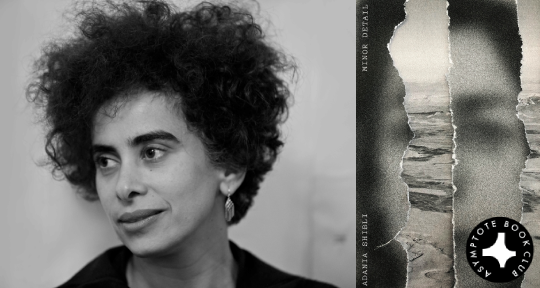
One day, a splotch of black ink bloomed on my well-thumbed copy of Adania Shibli’s Minor Detail. I didn’t know where it came from. The blemish, to my consternation, appeared in the light-grey region of the cover, which depicts an undulating terrain. Misted waves, perhaps, or the volatile sands of a desert. Obsessed with keeping my books as pristine as possible, I took an alcohol swab and wiped the black dot right off.

The smudge was dispatched as swiftly as it had arrived. Days later, I noticed the alcohol had also dissolved the matte surface of the cover where I had rubbed it. A tiny glossy archipelago emerged, its lustre and its jagged edges visible only at an angle, under the light.

Now the sheen reproaches me for thinking I could make something disappear with no trace.

*

Desert / الصحراء

 I want to juxtapose without asserting equivalence; the unnamed Israeli military commander in Minor Detail, too, believes in the seamlessness of disappearance. In the novel’s first half, he helms a Zionist platoon in a mission to conquer the Negev desert. This ruthless assertion of sovereignty takes place in 1949, a year after the traumatic Nakba dispossessed most Palestinians of their homeland. It is also a rearguard response to Egypt’s invasion of an Israeli kibbutz a year prior.

Charged with purging the land of “infiltrators”, the Zionist soldiers massacre a band of Arabs. They capture a Bedouin girl, humiliating, gang-raping, and murdering her. The horror of these bloodthirsty actions is continually evaded: “Then came the sound of heavy gunfire.” The narrative camera, as it were, turns its back on the moment of life’s desecration. Landscape itself seems to consent to these crimes. The desert, an aggressive mouth, collaborates in the erasure of evidence, each occasion with a different attitude: “languidly”, “greedily”, “steadily”, the sand sucks blood, moisture, substance into its depths. READ MORE…
From Palestine to Greece: A Translated Struggle 

. . . utopias are not solely objects of fantasy but are objectives to be built and lived . . . at the intersection of art and revolution.

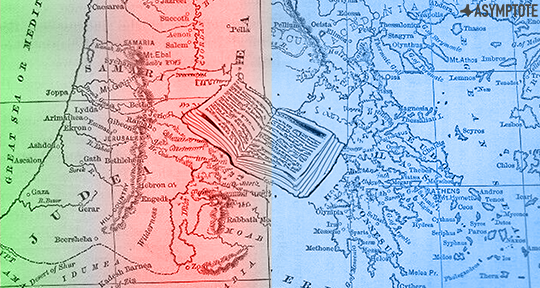
Palestine and Greece have long enjoyed a strong relationship of solidarity and friendship, fortified by mutual assistance during political tumults, expressions of recognition, and profound demonstrations towards peace and independence. In this essay, Christina Chatzitheodorou takes us through the literature that has continually followed along the history of this connection, and how translations from Arabic to Greek has advocated and enlivened the Palestinian cause in the Hellenic Republic.

Following the Israeli invasion of Lebanon and the siege of Beirut in 1982, the Palestinian Liberation Organisation (PLO) was forced to leave the city. Its leader, Yasser Arafat, then fled Beirut for Tunisia, and, in fear of being captured or assassinated by Israel, he asked his Greek friend Andreas Papandreou for cover. The two had previously joined forces during the dictatorial regime in Greece known as Junta or the Regime of the Colonels, in which Arafat supported the Panhellenic Liberation Movement (Panellinio Apeleutherotiko Kinima/PAK) founded by Papandreou, and had also offered training in Middle Eastern camps to the movement’s young resistance fighters. 

Arafat arrived then from war-torn Beirut to Faliron, in the south of Athens. He received a warm dockside reception by the then-Prime Minister Papandreou and other top government officials, as well as a small crowd consisting mostly of Greek Socialist Party (PASOK) members and Greece-based Palestinians, who stood by chanting slogans in support of the Palestinian cause. Papandreou called Arafat’s arrival in Athens a “historic moment” and assured him of Greece’s full support in the Palestinians’ struggle; after all, while Arafat was coming to Athens, accompanied by Greek ships, pro-Palestinian protests were taking place around the country almost every other day. 

Although our support and solidarity with the Palestinian cause neither began nor stopped there, that day remains a powerful reminder of the traditional ties and friendship between Greek and Palestinian people. But more importantly, it comes in total contrast with the position of the current Greek government. Now, despite the short memories of politicians, it is the literature and translations of Palestinian works which continue to remind us of Greece’s historical solidarity to Palestine, particularly from left-wing and libertarian circles. 

READ MORE…

Weekly Dispatches From the Frontlines of World Literature

The latest literary news from Palestine, the United States, and the Philippines

This week, one of our editors-at-large reports from Palestine, amidst the outbreak of war. Our editors also report on new publications from the Philippines and literary festivals in New York. 

Carol Khoury, Editor-at-Large, reporting from Palestine

In a normal world, you would expect me to write my dispatch this week about the latest version of Palestine International Book Fair, or about Raja Shehadeh making the 2023 National Book Awards finalists list, or the just-concluded Palestine Writes Festival. But this week, Palestine is far from normal, although what we are living now is also déjà vu.

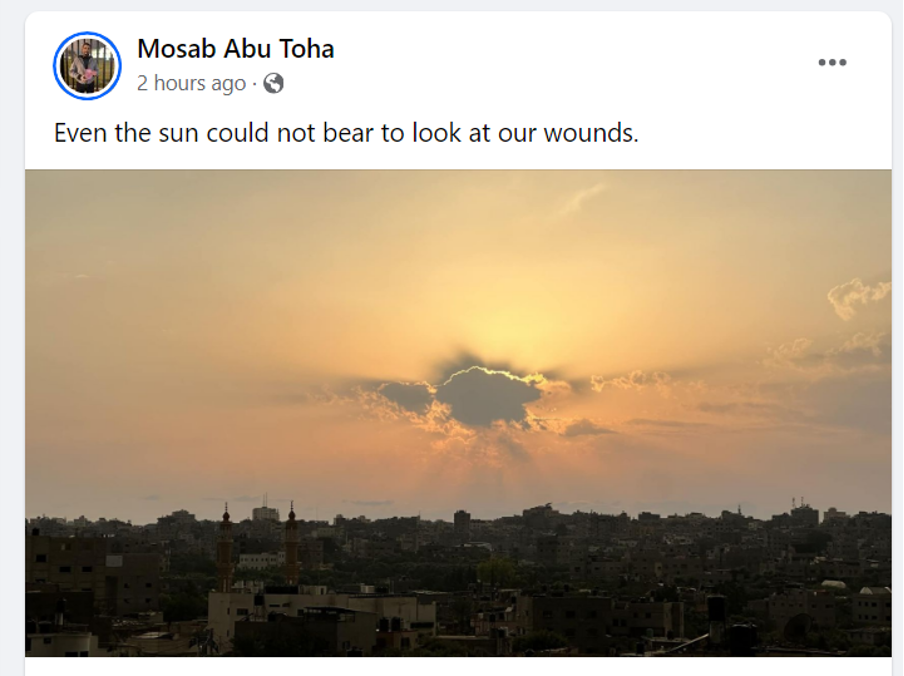
My last dispatch was about Gaza, but it was pleasant news. Little did I know what the following month would hold when I wrote “Each morning, as the sun timidly broke through the horizon, Mosab Abu Toha’s words flowed like a river, weaving tales of resilience and hope from the depths of despair.”

I will give the floor to Mosab this dispatch too:

Picture1 READ MORE…

Weekly Dispatches from the Front Lines of World Literature

News this week from Vietnam, Japan, and Southeast Asia!

This week, our editors from around the world present reimaginings of Sophocles in Hanoi, memorials and debuts from Japan, and witness writing from Southeast Asia. Read on to find out more!

Thuy Dinh, Editor-at-Large, reporting from the Vietnamese Diaspora

Since November 2021, The Goethe Institute in Hanoi has been in collaboration with the Youth Theatre of Vietnam (Nhà Hát Tuổi Trẻ) to produce six interpretations of Sophocles’s Antigone, exploring a variety of salient themes—fate versus freewill, the family versus the state, moral integrity and political order, feminism versus patriarchy, reason and emotion, loyalty and disobedience. While most of the productions were performed live in Hanoi after the gradual easing of COVID-19 restrictions, “Portrait” (“Bức Chân Dung”)—Antigone’s fifth iteration—is shown online from February 19 through February 26, 2022.

Directed by Lê An of Ho Chi Minh City’s Saigon Theatreland, “Portrait” shifts the first act of Antigone into 1970s wartime South Vietnam, where An (Huỳnh Ly)—whose name means peace and contentment—must forge her identity out of her family’s traumatic past. Creon, Antigone’s uncle in Sophocles’s play, is transposed into her emotionally repressed father, Đắc (Công Danh), a high-ranking officer in the South Vietnamese Army. Đắc forbids An to bring home Kỳ’s dead body—his son and An’s brother—an enemy soldier who fought and died for the Communist cause. Despite the obvious ideological landmines evoked by this premise, director Lê An, in a pre-performance podcast, sidestepped politics by discussing her heroine’s psychological quest “to find herself”— possibly to detract from the production’s more provocative implications.

While ideological heresy still cannot be addressed explicitly in modern adaptations of Antigone within Vietnam (despite the heroine’s Greek name which can mean “one who resists/is of the opposite bend”), this theme plays a central role in Vũ Thư Hiên’s oeuvre—including his newest story collection, Confessions at Midnight (Lời Xưng Tội Lúc Nửa Đêm) (California: Văn Học Press, 2022). A well-known dissident writer and translator, Vũ Thư Hiên has become Vietnam’s persona non grata since the 1997 publication of Night at Midday (“Đêm Giữa Ban Ngày)—a memoir, inspired by Arthur Koestler’s 1940 novel Darkness at Noon, which recounts the nine years (1967-1976) he spent in various North Vietnamese prisons after being charged with “anti-Party, anti-State, spying and revisionist conduct.” READ MORE…

What’s Going On in Myanmar?

In their attempts to control this narrative, the illegal regime has made use of tactics old and new.

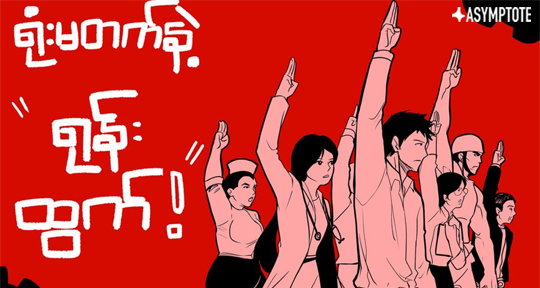
On February 1, 2021, the military forces of Myanmar deposed the democratically elected members of the National League for Democracy, which had won 83% of the country’s parliamentary seats in the previous election. Protests erupted across the country in response to the coup, and what started out as peaceful resistance quickly turned violent as the junta worked to suppress the demonstrations. In this following essay and dispatch, Asymptote correspondent Lucas Stewart provides a delineation of what has happened in the year since, and examines the place of literature during such times of suppression. In conversations with Yu Ya, whose prolific writing career follows that of her father’s and uncle’s (both of whom were writers imprisoned under the former regime), this following piece puts a finger to human pulse of political unrest. Yu Ya’s quotations were co-translated by Stewart and Eaindra Ko Ko.

My balcony in Yangon had overlooked Sule Pagoda, an ancient stupa that once lay beyond the limits of the old city of Dagon, but now lights up the heart of Myanmar’s largest metropolis. From there, on the sixth day of the coup—a Saturday afternoon—we saw some of the first public outpourings of anger. Security forces, which had secured the City Hall opposite us and other strategic buildings in the early days of conflict, tumbled out; grey-uniformed, some with riot shields, those without a step behind them, they fanned from one side of the road to the other. An officer spoke into a radio, pointed one way north and then south and then back north again, before eventually settling on the east side of the pagoda, closest to the City Hall’s main entrance. There was a stand-off but no carnage that day, nor for the first two weeks. In that time, what had been a hundred protestors grew to hundreds of thousands, many coming from elsewhere, but always heading towards Sule Pagoda, the symbolic crux of protest. Some describe it like a carnival—which was true, I guess, at first. Music blasted out from overloaded speakers strapped to trucks. Sellers sold whatever, food, drink, National League for Democracy (NLD) merchandise. Volunteers picked up the debris left behind as the crowd moved on. Cars bashed their horns as they passed City Hall, knowing the soldiers within could hear their disgust. A neighbour, who remembered the midnight of 1988 when perhaps 300 or more protestors were shot at Sule Pagoda, told me this time if felt different. But that was in the early days.

Among the millions of people who woke up alongside me on February 1 to a blacked out and disconnected country was Yu Ya: prominent young short story writer, and friend of several years since we worked together on Hidden Words, Hidden Worlds, an anthology bringing short stories from Myanmar’s censored ethnic nationality languages to light for the first time. She later worked for BBC Media Action as a scriptwriter, contributing to inclusive, working-class voices radio programmes such as The Teacup Diaries.

Like many in Myanmar, she is no stranger to military coups, nor to the violence and oppression that follows the ascent to illegal power. Min Lu, Yu Ya’s father as well as a leading poet and author, was jailed in the aftermath of the 1988 revolution for penning ‘What’s Going On?’—a satirical, sarcastic poem attacking the then-illegal regime’s murders and maladministration. The poem witnessed a revival in the weeks following the 2021 coup. So now, what is going on in Myanmar? READ MORE…

Weekly Dispatches from the Front Lines of World Literature

New translations and upheavals in publishing from India, Central America, and Palestine!

Around the globe, February has seen upheavals in Indian publishing, the release of new translations of Central American literature, and the loss of a giant in Palestinian letters. Read on to find out more! 

Suhasini Patni, Editor-at-Large, reporting from India

The Indian publishing industry was taken by storm on February 1, when Amazon India announced that it was shutting down Westland Books, home to some of the fiercest writing from the country. The details of how it will affect the backlog of books, whether they will remain available or be taken out of circulation, are still unclear. Westland is one of the largest English-language trade publishers in India, with an imprint called Context that publishes literary fiction and another called Eka that publishes translations. They have consistently released daring titles, such as The Price of the Modi Years by Aaker Patel and Modi’s India by Christophe Jaffrelot.

The Mint Lounge, one of the first publications to break the news, wrote: “The editors of Westland were informed about the impending closure only earlier today, a member of the staff at the publishing house said, requesting anonymity.” After hearing the devastating news, many have posted on social media to appeal to readers to buy books before they run out. The Bookshop, an independent bookstore in New Delhi, wrote: “For a company to acquire an independent, local publisher of books that will in future certainly prove to be foundational texts of Indian literature, and then to arbitrarily shut it with no forewarning is a highly reprehensible act that the entire community of booksellers condemns.”

Westland recently published best-selling Malayalam author KR Meera’s latest novel Qabar, translated by Nisha Susan. A short novella of magical realism, the book is a riff on the Babri Masjid case. It explores increased communalism in India and ultimately magnifies the tensions that lead to lynching, mob-making, and dehumanization.

READ MORE…

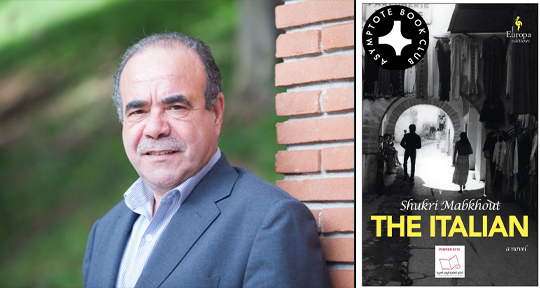
Announcing Our October Book Club Selection: The Italian by Shukri Mabkhout

The novel lends itself to debates on more universal themes such as power, corruption, the idealism of youth, gender equality, and abuse.

In his seminal work on colonialism and subjugation, The Wretched of the Earth, Frantz Fanon asks: “how do we get from the atmosphere of violence to setting violence in motion?” Shukri Mabkhout liberates this idea into story gracefully in his debut novel, The Italian. Delineating the fermenting revolutions in late twentieth century Tunisia through the scope of one young man, Mabkhout paints a vivid reproduction of the oppressive conflicts between nationalism and religion, love and lust, ideology and action. We are proud to present this vivid text, and its detailed contours of individual life in the wider contexts of country, as our Book Club selection for the month of October.

The Asymptote Book Club aspires to bring the best in translated fiction every month to readers around the world. You can sign up to receive next month’s selection on our website for as little as USD15 per book; once you’re a member, join our Facebook group for exclusive book club discussions and receive invitations to our members-only Zoom interviews with the author or the translator of each title. 

The Italian by Shukri Mabkhout, translated from the Arabic by Miled Faiza and Karen McNeil, Europa Editions, 2021

Shukri Mabkhout’s The Italian, winner of the 2015 International Prize for Arabic Fiction, was first published in the aftermath of the Arab Spring. Perhaps with some suggestion of history repeating itself, it is set during another period of political upheaval in Tunisia—the 1980s and 1990s, which saw a ‘bloodless coup’ led by Ben Ali, the leader who was to be deposed in 2011. Intricate and detailed, heavy with politics, philosophy, food, and sex, the novel is an insight into Tunisian history and society, human relationships, and the often politically motivated and self-interested inner workings of institutional power.

The novel opens with its own violent outbreak and fallen patriarch. At his father’s funeral, the protagonist, Abdel Nasser—nicknamed el-Talyani (the titular Italian) for his Mediterranean good looks—attacks the local imam. The family and wider community are shocked and shamed, but also perplexed; as the narrator, one of el-Talyani’s childhood friends, tells the reader, grief over his father’s death “didn’t fully explain it.” Abdel Nasser’s family members offer various explanations—the “corrupt books” he read as a child, his university classmates, the personal circumstances of his divorce, or the “deep-rooted corruption” of his morals. While the broader community simply consider him the black sheep of the family, none of these explanations seems to satisfy the narrator. Jumping back in time, the novel thus sets out to unpack what might have motivated Abdel Nasser’s outburst, and, along the way, also details much of the political history of Tunisia during these tumultuous decades.

Abdel Nasser has a complex and somewhat distant relationship with his family, and in particular with his brother, Salah Eddine. Salah Eddine left Tunisia as a young man, and is now an “esteemed academic and international finance expert” living in Switzerland—in other words, he is the epitome of cosmopolitanism and institutional economic liberalism. When Salah Eddine leaves Tunisia, Abdel Nasser assumes the throne as the de-facto eldest son—which Mabkhout explains endows a special status and freedom within the Tunisian family. He also takes up residence in his elder brother’s room, which provides him with an intellectual awakening through books and records, and in which he also experiences a sexual awakening: he is groomed by the family’s significantly older neighbour, who—by no means coincidentally—is his brother’s ex-lover. The room eventually also becomes a political hotbed where Abdel Nasser discusses philosophy, politics, and Marxist economics with select classmates, for he is set apart from others not only by his good looks, but also his astute mind and leadership skills. He goes on to study law at university, where he acts as a leader and recruiter in an activist student organization. READ MORE…

Here France Drowns Algerians: Literary and Cultural Afterlives of October 17, 1961’s Occulted Pogrom

How will France reconfigure its fragile self-image to accommodate the historical excesses that it has consistently balked at confronting?

This essay is written in memory of all those—predominantly Algerian—killed, deported, or otherwise injured by the violences of French colonialism, and in solidarity with the continuing efforts to resist the forgetting of October 17, 1961 and demand accountability from the French state.

For most of the English-speaking world, October 17 will not register as a date of any consequence. Yet, several days ago in the boulevards of Paris, scores of demonstrators marched from the Rex Cinema to the Pont Saint-Michel; they were tracing, in a defiant act of memory, the cartography of a heinous massacre of Algerian protestors by the French police force that took place, sixty years prior on the very same cobblestones. Their ancestors—most of whom did not survive that deadly evening—had walked those roads in peaceful opposition to the racism and surveillance they had suffered at the hands of the French, as well as the discriminatory night-time curfew that had just been imposed exclusively on Algerian workers.

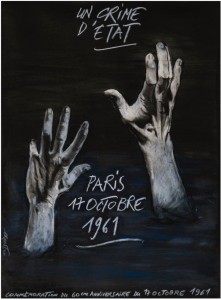
The publicity posters of this year’s commemorative efforts feature the title “Un Crime d’État” (a crime of the state), handwritten in a ghostly chalk-like texture above two shadowed hands reaching out of murky, watery depths. To the survivors, descendants, relatives, historians, activists, and those who otherwise refuse to forget the bloody police brutality of October 17, 1961, that tableau of desperation will be familiar. On that night, besides beating and injuring countless men, French police officers handcuffed and threw an undocumented number of Algerian demonstrators into the river Seine, leaving them to drown. Historians estimate that around two hundred deaths occurred that night. In an eyewitness account cited in House and MacMaster’s monumental Paris 1961: Algerians, State Terror, and Memory, officers throttled the arms of a man clinging to the parapet “until he dropped like a stone into the river.” Subsequently, nearly six thousand Algerians who did not perish were rounded up, tortured, and deported back to detention camps in Algeria.

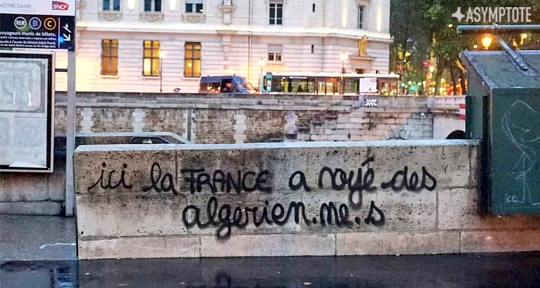
Of the scant images that have circulated of 1961, the most iconic is arguably a shot of graffiti spray-painted along the riverbanks, reading “Ici on noie les Algériens” (here we drown Algerians). What’s remarkable is its persistent afterlife in the infinitely reproducible medium of photography, elevated to a sort of metonym for Algerians’ collective trauma—despite the actual graffiti having been literally whitewashed out of existence not long after its writing. Street art continues to spring up here and there: a telling instance is “Ici la France a noyé des Algérien(nes)” (here France drowned Algerians), shifting the temporal frame of reference and naming the locus of guilt. Or, more recently: “Nous sommes les descendants des algériens que vous n’avez pas noyé . . .” (we are the descendants of the Algerians that you did not drown).

oct 17 poster

The state’s erasure of the incriminating graffiti emblematises an essential hypocrisy upon which France’s modernity is built, and perhaps no colony has borne the brunt more painfully than Algeria. It was there, during its struggle for independence from 1954 to 1962, that the French government engaged in one of its most violent and cruel wars while native peoples agitated for decolonisation. Yet the metropolitan French press, largely indifferent to what was transpiring across the Mediterranean, referred to the widespread killings, bombardments, and torture euphemistically as “the events.” Only in 1999—a full thirty-seven years after Algeria gained independence—did France officially bring itself to acknowledge that a “war” had occurred. READ MORE…

Translation Tuesday: Two Poems by Jacques Viau Renaud

opening a furrow/to pour our blood/and maybe,/who knows, our lives.

This week’s Translation Tuesday brings you two poems by Haitian-Dominican poet and revolutionary fighter Jacques Viau Renaud. In “Man Awakens,” our speaker pledges his lifeblood to resurrecting hope (an “assassinated seed”), urging his compatriots to appreciate the majesty of their homeland in the face of socioeconomic injustice. In “We Take Refuge,” the seed metaphor becomes even more corporeal, as the roots of love embed themselves in peoples’ hearts despite their “mutilated lives”—the speaker now pledges not only his blood, but his voice. Written during the rise of another U.S.-backed dictatorship (the Dominican Republic was still recovering from the terror of the Trujillo Era), Viau Renaud’s verse channels the natural beauty of his country to inspire resistance. Ariel Francisco’s superb translations sublimates the visceral and sometimes violent imagery of these poems into an enduring love in the speaker’s voice, a testament to Viau Renaud’s gifts as a poet who celebrated his homeland’s fragile democracy and honored those who defended it.


MAN AWAKENS

Man awakens sewing the assassinated seed
hope curdling in a cry.
Light escapes his hands.
The washer’s stream throws its loud laughter
rinsing in the trees
tightening the earth
possessing it
leaving the internal seed in the roots;
injecting his spirited youth
unearthing the buried love
all the tightened silences in the streets of my homeland
razed by hunger
assaulted by thieves
led towards the banks in fragments
where pieces of shit in disguise
monopolize the lilies and bread.

READ MORE…

Announcing our May Book Club Selection: Minor Detail by Adania Shibli

This is one of Shibli’s greatest strengths as a storyteller: she trusts her readers to fill in the gaps.

One of the most powerful responsibilities of literature is to ascribe human voices to the momentous, overarching events of our world. This month, Asymptote has selected Adania Shibli’s unflinchingly powerful Minor Detail, a novelistic reflection on the violent and painful consequences of the Israeli-Palestinian conflicts, from the War of 1948 to present day. With an astutely visual language and an unwaveringly intelligent morality, Shibli’s work is an impeccably crafted totem of resistance and justice. 

The Asymptote Book Club aspires to bring the best in translated fiction every month to readers around the world. You can sign up to receive next month’s selection on our website for as little as USD15 per book; once you’re a member, you can join the online discussion on our Facebook page

Minor Detail by Adania Shibli, translated from the Arabic by Elisabeth Jaquette, New Directions (US), Fitzcarraldo (UK), Text Publishing (Australia), 2020

The smell of gasoline, the sound of a dog howling, the taste (or distraction) of a simple stick of chewing gum—these are only a few of the motifs surrounding trauma and pain in Minor Detail, by Adania Shibli, translated from the Arabic by Elisabeth Jaquette. It is August, 1949, and a group of Israeli soldiers have set up camp in the Negev desert. As they patrol the nearby areas, they encounter and ambush a group of Bedouins, returning with a single survivor: a young Arab woman. Shortly after, she is hosed down and raped by the officer in charge. Over half a century later, a woman living in the West Bank crosses the border into Israel, looking to uncover the details of the case. Her journey reflects a changed Middle East.

As a literary project, a historical record, and a translation, Minor Detail is, simply put, brilliant. My knowledge of the Arabic language is limited, and so my goal here isn’t to compare the translation to the original text. Instead, I want to focus on narrative structure and style—two elements clearly on the minds of both Shibli and Jaquette, whose collaboration proves a success on all fronts.

READ MORE…

Translation Tuesday: “9th June” by Jacky Yuen

Each generation must have its roads and its flags

This week’s Translation Tuesday features the work of Jacky Yuen. Titled “9th June,” after the date of the sizable 2019 demonstrations in Hong Kong, this poem paints the energy and direction of the protestors in a way that is both cosmic but not disengaged. Within the symbolism of the poem, the oppression of mass and obscurity are combatted by singular points. The poet expresses a spirit that is constant rejuvenating and resurfacing, which is aptly captured by the translator: clauses tumble over one another like a structure kept in motion by magnets. Inspiration moves through the people as stardust and rainbows, ethereal and material at the same time. The poem presents the material and metaphysical aspects of collective movement, expressed in individual activation, thereby expressing the frustration and hope of the current political climate.

9th June

No one wants to drown twice in the same ocean.
The fins that sank
will resurface.

The comet fights to resurface.
It trails long shards of ice
like a fisherman’s net. When we lowered it they were stones—
When the times released it they were stars in sideburns.
READ MORE…

Olga Tokarczuk and Polish Literature’s Home Army

Poland has been using art to revitalize—or reform—its postwar image.

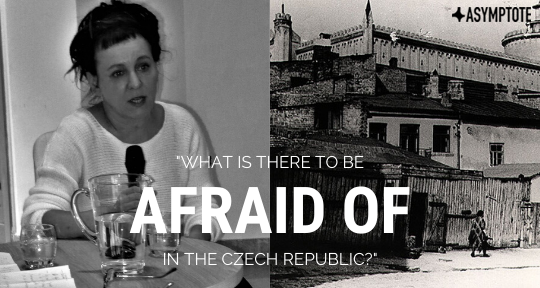
“I and motherland are one. My name is Million, because for millions do I love and suffer agonies.” Adam Mickiewicz’s words from his dramatic cycle Dziady (Forefathers’ Eve) are indicative of Poland’s long tradition of voicing resistance and examining its national identity through literature. Last month, acclaimed Polish writer and past Asymptote contributor Olga Tokarczuk won the 2018 Nobel Prize in Literature, and yet has also outraged many conservatives in her own country. In this essay, Cynthia Gralla takes us through the history of resistance in Polish literature in the twentieth century, before examining Tokarczuk’s own challenge, defiance, and her place in such a history.

The past hundred years in Polish literature have been, by one reading, a history of resistance through weaponized words.

Poland has made resistance an art. Born into a Polish-American family, I have heard tales of my relatives’ wartime resistance work since childhood. Between 2012 and 2014, I lived in Lublin, Poland, conducting research into their activities during Nazi occupation with the help of a Fulbright grant. My relatives served as ski couriers in what eventually became known, in 1942, as the Armia Krajowa—literally “the Home Army.” Before that, it was called Związek Walki Zbrojnej, or “the Union of Armed Struggle”, and the Służba Zwycięstwu Polski, or “Polish Victory Service”. The name mattered little; all were incarnations of the Polish Resistance, the heart of a national body so conditioned by the vicissitudes of history and occupation that it began beating again as soon as Germany invaded. It also beat steadily throughout the nineteenth-century partitioning of Poland by Russia, Prussia, and Austria, in the classrooms of that century’s “flying university” (which educated luminaries like Marie Salomea Skłodowska, also known as Marie Curie, when teaching youth in Polish was forbidden,) and during the parched years of Communism. READ MORE…

“Guatemala has always produced great writers”: An Interview with Guatemalan Poet and Feminist Ana María Rodas

One day, poetry simply came out of me. One day, I was filled with poetry.

Wearing a thin sweater, a colorful scarf, and a dazzling smile, Ana María welcomed us to her house in Zone 15, Guatemala City. Outside it was pouring, much like when she presented her famed Poemas de la izquierda erótica (Poems from the Erotic Left), forty-six years ago. She offered us tea—“To fight back the cold,” she said, still smiling—and told us we had to do the interview in the living room, not upstairs, because, “There are books scattered everywhere; imagine, a lifetime spent collecting books.” And, yes, one can only imagine.

Ana María Rodas, born in 1937, is a veteran Guatemalan poet, journalist, and teacher. Her career spans more than sixty years. She has released close to twenty books, and her work has been translated into English, German, and Italian. In 1990, she simultaneously won the poetry and short story categories of the Juegos Florales de México, Centroamérica y el Caribe. In 2000, she won the prestigious Miguel Ángel Asturias National Prize in Literature for her life’s work. She is also one of the leading figures of Guatemalan and Central American feminism. She has lived her whole life in Guatemala. And one cannot say this lightly. She grew up during the Jorge Ubico dictatorship (1931–1944), admired how the Guatemalan Revolution toppled Ubico in 1944, thrived during the so-called Ten Years of Spring, lamented the 1954 CIA-backed coup that removed the democratically elected, progressive president Jacobo Árbenz, and witnessed the atrocities of the Civil War (1960–1996). Many of her friends and colleagues were killed during that time. Alaíde Foppa, Irma Flaquer, and her dear friend, Luis de Lión, author of El tiempo principia en Xibalbá—considered one of the cornerstones of contemporary Central American literature. Even if she never picked up a rifle or joined the militarized resistance, her feminist struggle and intellectual defiance have influenced many generations.   

She’s not a cynic, though. Or bitter. She’s hopeful. “Even though we have a brute for president,” she says, “I believe in resisting.” And resisting, Ana María has done.

But as much as Ana María is grandmotherly and warm, as much as she’s a jokester and amicable, she is also analytical, astute, and disarmingly agile. She’s a force of nature, a rising tide, and an unmovable object. Her poetry is sensitive, electric, and subversive.

READ MORE…

Poetic Solidarity Across the Himalayan Divide in Burning the Sun’s Braids

The Chinese state . . . is unable to extinguish the fire of protest among Tibetans in exile and Tibet.

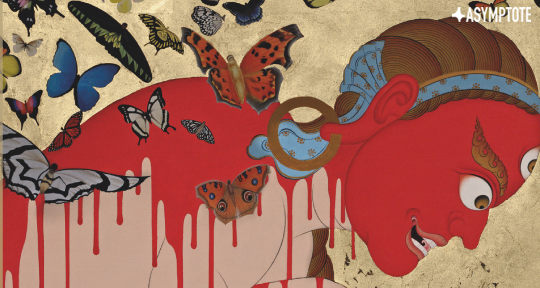
For the poets who bear witness, language has been both weapon and shield, but perhaps most importantly, it has always a chance to reach both inward and outward, so that the defiant strength against cruelty may arrive from any direction. The Tibetan poems collected by Bhuchung Dumra Sonam in Burning the Sun’s Braids is a testament to this endless realm of perseverance. In the following essay, Asymptote’s Editor-at-Large for Tibet, Shelly Bhoil, writes about the urgent and moving works in this formidable collection of resistance and courage.

Bhuchung, which means “a little boy” in Tibetan, was ten or eleven years old when he was smuggled out of Tibet for a better life as a refugee in India. During his escape with a group of familiar strangers in the winter of 1983, this little boy, for no particular reason, held on to the visions of black boots from his fantasies, but had no idea that he would never get to see his parents again. Years later, in a moment of existential rage, he tore apart a notebook of poems he had penned during his college years. Lines from one of the earliest poems he recalls having written are telling:

Like a stray dog I cling
to the dry worldly bone . . .
In a blossoming garden of hatred
this little boy
drowns in tears of sorrow . . .

From the torn pages of this notebook were to emerge Bhuchung Dumra Sonam as a prolific poet, essayist, publisher, and translator.

READ MORE…