A Thousand Lives: Staff Reads from Around the World

A selection of staff reads from Asymptote’s Fortnightly Airmail

We hope you’re staying dry. If you’re looking for a book to curl up with, check out these staff reads—hailing from Colombia, Germany, and India. Sign up for our newsletter to get these recommendations delivered right to your inbox.

unnamed-13

Like an archaeology museum, Judith Schalansky’s An Inventory of Losses (New Directions, 2020), translated from the German by Jackie Smith and longlisted for the 2021 International Booker Prize, catalogues objects, places, artwork, people, and animals lost to history across centuries of time and continents through twelve genre-bending and essayistic pieces, one of which was previously featured in Asymptote. Schalansky is a German writer and editor, whose previous novels grappled with the transience of things, isolation, and the disappearance of islands and species. Schalansky adopts a wide range of styles to enter the world of her material and reanimate the objects under consideration, while Jackie Smith captures the idiosyncratic form of each piece. Schalansky’s pieces are indeterminate, meandering collages of history, biography, memoir, and criticism. They are linked through their concerns with the ravages of time, the processes of decay, and memorialization. In the style of W.G. Sebald and Sir Thomas Browne, these pieces represent memento mori, in that they meditate on the disintegration of things, while also asking us to consider how the past is interpreted from writings, artifacts, and a discontinuous archive. These retellings of history are acts of preservation—they give voice to the silenced, reorient the reader toward an era, a place, or a person, while also probing the political and philosophical dimensions of memory and forgetting.

Darren Huang, Editor-at-Large for Taiwan

unnamed-12

David, an aging painter losing his vision to macular degeneration, reflects on the most difficult night of his life: his son’s euthanasia twenty years ago. Such is the plot of Tomás González’s elegiac novel Difficult Light, translated from the Spanish by Andrea Rosenberg, and released by Archipelago Books. As David writes, he keeps returning to the night in New York City when his family waited to hear if his son, paralyzed and suffering, had followed through with his decision to die. Will the doctor show for the illegal assisted suicide in Portland? Will his son change his mind? Death permeates the novel. His son’s. His wife’s. His own, impending. But so does beauty, love, humor, and though it’s difficult, light.

—Kent Kosack, Director, Educational Arm READ MORE…

The Art of Anguish

The poignant novel is imbued with anguish rather than heated rage—both emotionally charged and deeply analytical.

Tatjana Gromača’s contemporary novel Divine Child centers on the narrator’s relationship with her mother, whose bipolar disorder diagnosis coincides with a startling descent into Croatian nationalism. The book earned the Croatian Ministry of Culture’s 2012 Vladimir Nazor Prize of the for t­­­­­­­­­­­­­­­­­­he best work of prose and Jutarnji list’s Novel of the Year prize in 2013. Yugoslav émigré writer Bora Ćosić called Divine Child “a small masterpiece” and stated that the author stands out for her “precious crudity”—a reference to its often stark, earthy descriptions despite the prevailing poetic and philosophical vein. Divine Child will be released in North America by Sandorf Passage in October 2021. Here, translator Will Firth describes challenges he encountered along the way.

In 2020, I was commissioned by Zagreb publisher Sandorf to translate three books of contemporary fiction by Croatian writers with funding from the EU’s Creative Europe program. One of them was the short novel Divine Child (Božanska dječica) by Tatjana Gromača. I had not read anything substantial of hers before.

I immediately related to Divine Child. It’s a diarylike biography of the author’s mother, which focuses on her slide into bipolar disorder, when she is cold-shouldered and denigrated by society. It makes an important link between socioeconomic crises—the collapse of former Yugoslavia, accompanied by virulent nationalisms—and the individual. The mother’s Croatian-ethnic neighbors label her an undesirable minority, in this case an ethnic Serb, although she has spent all her life in Croatia and shows few, if any, signs of otherness. But this was a time when having the “wrong” name could cause you problems throughout the region, and arguably still can. The exclusion triggers the mother’s illness.

The poignant novel is imbued with anguish rather than heated rage—both emotionally charged and deeply analytical. As a review in Publishers Weekly noted, it “takes on the hatred that was manufactured, mythologized, and manipulated to feed, justify, and rationalize violence.”

The title—Divine Child—is a dual reference: to the mother’s turn to religion in later life, and to the formative influence of her disciplinarian father, a military man, whose expectations she always strove to fulfill, even after his death, thus making her something of an “eternal child.” Typical of literature from the region, character development is sparse, even with the central character of the mother, and we have to piece together her appearance, occupation, and family history from a range of allusions and asides. Setting her in a historical and social context is more important for the author and omniscient narrator, and the reader is free to decide whether this sparseness is an exquisite literary pleasure or unnecessarily tantalizing suspense.

The editor of the English edition, Buzz Poole, was not convinced by the looseness of the narration in combination with its poetic style and philosophical ambit, so he made a major structural intervention: the novel in translation begins with an event central to the story—a visit to Mother at the hospital. This directs the flow and helps transport the author’s delicate voice. As translator, I was a go-between in negotiating this significant change.

Inconsistencies in the original also put me in the role of editor, and I collaborated with Gromača to tighten the language in translation. I like to correspond with authors to check my understanding of the text, even when I’m pretty sure how I’m going to render a particular term or phrase. With Divine Child, Gromača and I exchanged quite a few emails. We got on well and were on the verge of meeting up in the fall of 2020, when I was at a residency in Zagreb, but the worsening pandemic foiled our plans. In any case, our good working relationship was important for facing the challenge of translating this novel.

The main difficulties in translating Divine Child were to do with its startling imagery and metaphors. Here are several examples:

Frigid Sphinxes

Gromača describes packs of stray dogs in her hometown that “roamed the streets (…) and floated in abandoned fishing boats like frigid sphinxes with piercing, hypnotic eyes.” The original conveys this image as “poput pomodrjelih sfingi,” i.e., like sphinxes that have turned blue. I wasn’t sure in what sense the author meant “blue”—I thought it could refer to the bluish light by the river and the silhouettes of dogs in the twilight. In fact, she meant that the dogs have literally turned blue from the damp cold on the riverbanks and also from their lowly thoughts and those of the surrounding human society. “Frigid” conveys that physical and spiritual cold. READ MORE…

Translation Tuesday: “The Speed of Gardens” by Eloy Tizón

There are loves that crush those who receive them.

This week’s Translation Tuesday features the titular short story from Eloy Tizón’s Velocidad de los jardines (The Speed of Gardens), which was chosen by El País as one of the hundred best books published in Spanish in the past twenty-five years. A tale of adolescence, the dramatic expansion of life’s possibilities, and its accompanying disappointments—Tizón’s narrator recalls an entire class and their fascination with the luminous Olivia Reyes. All this is told through Tizón’s finely wrought sentences which itself is a kind of spellbinding music. Hear from the translators about the peculiarities and pleasures of Tizón’s baroque style. 

“Eloy Tizón is one of the most important baroque writers working in the Spanish language today. In his language, where the baroque tradition reigns supreme, mastering the baroque style is tantamount to mastering the style of the Spanish language tout court. There have been no shortage of competitors for this title on both sides of the Spanish-speaking Atlantic, and in the Iberian Peninsula, we find such luminaries of the baroque register: Gómez de la Serna and Francisco Umbra, followed by Cristina Fallarás and Juan Manuel de Prada. In these writers, who are equally as prominent fiction writers as they are columnists, we find in them an affected antiquarian prose, a contrarian bravado at the level of ideas, a curated brand of O.K.-Boomerism, with sudden tinges of chauvinism, misogyny, or anti-Trumpism—depending on the day.

Tizón is a stranger to this school. He is worthy of winning the baroque pennant—not that he would care—but he might not be playing the Spanish league. Though a stylist of excess, and a habitual contributor to newspapers, he has shaken off all remnants of regional scruff. His sentences abolish the habitual linguistic ostentation of his contemporaries; there is no old fogey gesturing in his work; he is not known to indulge in that strange form of Iberian competition that consists in piling up subordinate clauses and stringing consonantic polysyllables. This has to do with Tizón’s readings of Clarice Lispector and (I venture) Virginia Woolf. Like them, his style is elastic, image-heavy, allusive rather than exact in a pseudo-philologist kind of way. Like them, he knows when to surrender style to character. Like them, he knows the purpose of curlicues and filigrees: to entertain the reader and not the author’s vanity.

Praised by many of his contemporaries, perhaps the aptest compliment comes from Alberto Olmos, who once described his style as “pouring MDMA on the dictionary.” What dictionary, he didn’t say. Certainly not The Royal Spanish Academy’s.”

Natalia Baizán de Aldecoa and Manuel Antonio Castro Córdoba

Many said the fun ended when we passed into eleventh grade. We turned sixteen, seventeen; everything gained an unsettling speed. Sciences or humanities was the first customs house, the first border crossed, separating friends like travelers commuting from one train to another, their luggage left somewhere between the snow and the porters. Classrooms disbanded. Javier Luendo Martínez broke up with Ana María Cuesta and Richi Hurtado stopped talking to the Estévez twins and María Paz Morago dumped her boyfriend and scholarship—in that order—and Christian Cruz was expelled from school after hurling a flask containing a fetus at the biology teacher. 

Oh, yes; from class to class we towed Plato and something called hylomorphism that belonged to some forgettable school of thought. The Russian Revolution spread itself wide across our notebooks, and on page seventy-something the Tsar was executed between crossed-out scrawls. The economic causes of the war turned out to be complex, not what they look like by a long stretch, even if impressionism brought a fresh palette and a new idea of nature to painting. Mercedes Cifuentes was very fat and didn’t get along with anyone,  but that year she came back crushingly thin and still didn’t get along with anyone.

It was a kind of hecatomb. Half the class fell in love with Olivia Reyes, at the same time or in turns. Every morning she came into the classroom, showered, barely powdered, it was a creaking and vulnerable vision that could hurt you if you dared think about it around midnight. Olivia always arrived forty-five minutes late, and until she made her appearance the syllabus was something dead, a waste, the teacher rambled on about Bismarck, as if painstakingly brushing his tailcoated corpse, the chalk repulsed. Her arrival resuscitated our desks. You couldn’t believe it, Olivia Reyes, something so sponge-like and scented, stepping into the classroom, laughing, providing us with her fabled profile, her light at the prow, you wouldn’t believe it, it hurt so much.

The first days of spring have an amazing air about them, unimaginable, you can’t tell where it comes from. This effect is heightened by the first sightings of summer clothes (the coats strangled in the closet until next year), of bare-armed students carrying decapitations and whole kingdoms inside their folders. We would walk into school through a great red-brick patio with the basketball courts outlined in white, a scrawny tree blessed us; we would jog up the double staircase, hurried on by the dean—who comprised a blonde moustache with a wholehearted dedication to cursingand then the bell would ring, firing the starting signal to our daily race for wisdom and science. READ MORE…

Announcing Our August Book Club Selection: After the Sun by Jonas Eika

Eika has convinced the cacophony and sensory exhilaration of dreams into the accounts of narration.

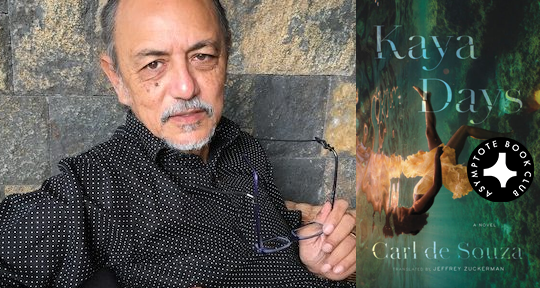
In the last act of summer, the Asymptote Book Club is proud to present an award-winning collection of short stories by Danish writer Jonas Eika. In five deeply immersive studies of sensation and cognition, After the Sun is an introduction to a stunning new voice in descriptive prose, establishing a new narrative tradition with non-linear dreamscapes and astounding evocations of the physical body as a site of storytelling. As our own world continues to evolve ever more into the intangible, Eika is a writer that makes corporeal the unreal realities of our times. 

The Asymptote Book Club aspires to bring the best in translated fiction every month to readers around the world. You can sign up to receive next month’s selection on our website for as little as USD15 per book; once you’re a member, join our Facebook group for exclusive book club discussions and receive invitations to our members-only Zoom interviews with the author or the translator of each title.

After the Sun by Jonas Eika, translated from the Danish by Sherilyn Nicolette Hellberg, Lolli Editions, 2021

To throw things into relief, I’ll play an old trick and say there are two kinds of people—those who seek to understand their dreams, and those who prefer that they remain in the inscrutable realm from where they came. The deciding quality—which also contributes to one’s ability to endure an intensive retelling of another’s dreams—is perhaps having to do with one’s own understandings of a life’s compartments; if within the rationale of time’s chronology, strangeness and encryption can occasionally take on the roles of logic and comprehension. Whether one sees a life’s events as a series of why-questions seeking the compatibility of answers, or if what we perceive as happenings are innocent to their order, oblivious of our insistence on purpose, and the phenomenon of them all fitting into the elapse of a life is simply an incredible feat of human storytelling.

It is incredible: that what baffles us about our own lives—mysteries, coincidences, appearances, and disappearances—is given such distinct clarity when organised into the perpetuity of sentences and pages. They move the world, they provide instruction, they are understood. A gun never appears to not go off. Fiction gives dreams a language that we also speak, ascribing to their impossible nature the subtle conviction of a greater design. In the reassuring procession of language’s patterns, we read life, with all the pieces fit somehow in place.

The stories in Jonas Eika’s collection, After the Sun, move firmly against this reassurance of knowledge; instead they insist forward with all the strangenesses of reality. Time is liquid, settings shift like cards in a deck, the present arrives as if already in memory. The logic of dreams dominate the prose in a determination that thwarts simple comprehension, and as such, Eika has convinced the cacophony and sensory exhilaration of dreams into the accounts of narration. In these five stories, the interruptions of the world—antithetical to our egocentric perceptions of individual purpose—is what drives the reading forward. We are led not by the simple fact of our choices and pathways, but by the world as it happens in experience. Before the discerning objectives of order intervene, we are allowed to luxuriate awhile in the immediate poetry of sensation—consciousness amidst the inexpressible moments of a new encounter.

Eika is especially interested in those dreaming moments where one is estranged from our lives and our bodies. “Alvin,” the story that begins the collection, establishes its opening shot in the aftermath of an “extremely fictional flight.” Then, nothing goes quite according to plan. The bank he’s meant to work at has burned to the ground, his savings and accommodations along with it. Eventually, he falls into the company (and the apartment) of a man he meets on the street. In confrontation with the dissonance between world and interiority, language serves to confirms the singularity of experience; in the wide landscape of world-events, we speak of what is happening to us as a confirmation of being. But where this iteration of feeling and knowing is so often a seeking of solidarity and mutual recognition, these stories instead maintain the volatility of selfhood: life as easily mutated by us as we are by it. The domino-effect of Eika’s narratives then signal a thrilling ceaselessness of possibility, speaking to the world as we know it now, boundless in abstraction. The speed by which we travel, the phantasmagoric architecture of financial markets, the way temporality collapses between reality and virtuality, After the Sun molds these accustomed surrealisms of our everyday into established reality. READ MORE…

Weekly Dispatches from the Front Lines of World Literature

Catch up on literary news from our editors on the ground!

This week, our editors report on literary gatherings, from a Chinese organization that seeks to bridge the cultural divide between the mainland and Taiwan, and Central America’s biggest book fair, FILGUA. Read on to find out more!

Xiao Yue Shan, Blog Editor, reporting for China

The Taiwan Strait measures only 130 km at its narrowest point, but it is the other distance—the unphysical distance, imposed by human prescriptions—that defines it. Recently, with the US’s withdrawal from Afghanistan, Taiwan’s own future was placed into question, with many remarking that the island was due to become “the next Afghanistan,” and criticizing American foreign policy as a hasty manifestation of 始乱终弃—to play with and abandon as if with a toy. Whether or not the US will continue its disengagement of military intervention, the geopolitical tension has deepened the chasm between the island and the mainland—in history if not in nature—with the continual wear of weariness, suspicion, and speculation.

Yet in Pingtan, Fujian, from where Taiwan is vivid and impossibly near on the other side of the waters, there persists certain attempts of breaching the cultural distance, most recently by the Pingtan Cross-Strait Sinology Center, established in 2018. Regularly hosting forums and lectures on Chinese and Taiwanese scholarship and texts, the Center, on August 18, held a talk on Taiwanese women writers, and how they write about love.

As Taiwanese writer 余光中 Yu Guangzhong once remarked, it is the work of women writers that have contributed most significantly to the nation’s exceptional range of contemporary essays. The traditional memoirist 林海音 Lin Haiyin, the nomadic and impassioned diarist Sanmao 三毛, the erudite humanist 琦君 Chi Chun—the works of such women essayists both expanded and challenged the imagination and logics of Taiwanese letters, intervening in the traditional discourse with intelligent intimations of selfhood, voyage, and being. While delivering the lecture, professor Yuan Yonglin remarked on how writers such as 张晓风 Zhang Xiaofeng and 简媜 Jian Zheng impressed deeply in their works by giving personal insight as to how they defined their relationships with the men in their lives—the former with the letters written to her husband, and the latter with writings on her father. In the depiction of men as subjects of love, these texts identified passions, affections, and aestheticizations specific to the female experience, addressing their complexity and bringing them into public language. READ MORE…

On the Verge: Keila Vall de la Ville and Robin Myers Discuss The Animal Days

What gives the book its identity is this relationship with fear and with the extreme.

Keila Vall de la Ville’s debut novel The Animal Days is a thriller—but not in the traditional sense. Protagonist Julia, a climber, chases mountain highs as she tightropes between life and death, joy and grief, adolescence and adulthood. She also chases a boy bent on destruction. Julia narrates this time in her life—the animal days—in a powerful, fluid vernacular that plunges readers into her precipitous milieu. We’re proud to feature this cliffhanging novel as our Book Club pick for July and to share this conversation between Vall de la Ville and translator Robin Myers, which was held live for members. The collaborators discuss the delicacies of portraying gender violence, the climbers’ patois, and the way contemporary Latin American literature plays with time and tense.

The Asymptote Book Club aspires to bring the best in translated fiction every month to readers around the world. You can sign up to receive next month’s selection on our website for as little as USD15 per book; once you’re a member, join our Facebook group for exclusive Book Club discussions and receive invitations to our members-only interviews with the author or the translator of each title!

Allison Braden (AB): There’s so much going on in this book, even though it takes place over a relatively short time span. Keila, how do you describe what the book is about?

Keila Vall de la Ville (KV): I think of the book as the story of the process of becoming, in which travel, spatial movement, has to do with the inner journey as well. That might seem a little general in the sense that many talk about displacement and movement, geographical movement, as a way to travel inwards.

What makes the book different and what gives the book its identity is this relationship with fear and with the extreme—not only because the characters are climbers but also because of their own particular intimate relationship. Julia’s actually transitioning from one state and one moment to the next. So, it’s all about extremes.

Gender violence pervades the whole story, and it’s very important to me. It took me a while to figure out how to talk about it. We all know how terrible it is, but at the same time, it has so many nuances, and so many colors, and so many ways of manifesting. I believe it’s important to show that it’s not only about physical violence or even psychological violence. There are many, many ways to feel violent, especially in an environment that is mostly masculine.

AB: Robin, how did you encounter this book? What attracted you to the story?

Robin Myers (RM): I came into contact with this wonderful book after coming into contact with Keila herself. We’ve actually been working together for so long that I can’t even remember which came first, Poetics on Beauty or this novel, but we’ve been in touch for a number of years about different projects of Keila’s. Shortly before we started writing to each other, this book had won the Latino Book Award, so Keila was interested in having it translated into English.

I read it and was instantly fascinated. I was riveted by the story and by the force of the narrator’s presence—she has a very subtle narrative voice. But in terms of the language itself, which is always what does it for me or doesn’t as a translator and reader, I was so interested in the intensity and the directness of the narrative voice, which is very beautiful but also very blunt. It has this almost spoken quality, which I was really interested in. READ MORE…

Strangely Familiar: A Menagerie of Contemporary Thai and Indonesian Writing

A comparative imagination is best guided by a “rebel consciousness” which works towards mutual emancipation from all systems of domination.

Although the Thai and Indonesian languages have no linkages and belong to quite different linguistic ancestries, both have long had a fatalistic image of a frog who lives all its life under half a coconut shell.

—Benedict Anderson, A Life Beyond Boundaries

What can two nations mired in their own peculiar chauvinisms learn from each other? How does a country take a long, hard look at itself without losing the exercise of hard-fought internationalism? Earlier this month, the conference “Thai and Indonesian Writing in an Era of Conservative Redux” yielded certain insights to these questions via literary means. Featuring twenty-one speakers and conducted entirely bilingually in Thai and Indonesian, the conference is a colossal collaboration between the School of Political Science and Laws, Walailak University, Thailand, and the Faculty of Letters, State University of Malang, Indonesia.

Exemplifying the critical spirit of this “South-South” comparison, Indonesia’s keynote speaker Linda Christanty shared a personal anecdote: on a visit to Thailand, she went to a cinema and was prompted to stand up for the royal anthem. The Indonesian writer and journalist had then felt proud that Indonesians, in contrast, did not need to stand up to pay respects to some royalty from Java. However, this pride was nullified when, in 2019, the Indonesian Minister of Youth and Sports Affairs—enamored with the Thai monarchy—came up with a proposal: requiring moviegoers to stand up before the images of Yogyakarta Sultan Hamengkubuwono X and to sing along to the national anthem. Even though the proposal didn’t become policy, this anecdote is an important reminder that one cannot afford national smugness when authoritarianism spreads internationally, as it increasingly does.

Neither does the conference dwell on the opposite of smugness—i.e. the grass is greener syndrome—otherwise prevalent in international comparisons from the standpoint of a terrible national situation, especially vis-à-vis the West. Even if the grass on the other side is really greener, the vital point of comparison remains first and foremost to find out exactly how it has become so not-green where one is.

Thai scholar and critic Chusak Pattarakulvanit concurs with Linda Christanty that the so-called “conservative redux” may be more accurately described as a re-strengthening of something that never went away. In his diagnosis of the phenomenon where formerly leftist or pro-democracy writers enjoy a “free right turn,” Chusak identifies three structural contributors: recuperation of subversive works, institutionalization via patronage, and fetishization. The last entails the reduction of literary work—with its inherent capacity to go against convention—to a single prescribed reading, as well as the fixation on a certain “resistant” aesthetics that mutates it into a sacred thing (khong), divorced from actually existing social conditions. READ MORE…

Translation Tuesday: An Excerpt from The Letters of Hiragy al-Qot by Abdel Rahman El-Abnudi

If this letter were a boat, / I would sail down the Nile to reach you.

When Nasser commissioned the construction of the Aswan High Dam—a project pivotal to his legacy of modernising Egypt—most of the migrant builders who came from Upper Egypt were farmers who were unfamiliar with industrial machinery and faced hazardous work conditions. This week’s Translation Tuesday features a set of epistolary poems that relate the story of this historic project through the correspondences of a migrant worker Hiragy and his wife Fatma. These poems, drawn from the start of Abdel Rahman El-Abnudi’s The Letters of Hiragy al-Qot, were written when the poet lived amongst the labourers in Aswan who came from his village of Abnoud. One of the Arab world’s most respected vernacular writers—a true poet of the people—El-Abnudi’s works are social documents that chronicle the history of Egypt. In Mariam Moustafa’s translation, the emerging language of technological modernity is conjured with sensitivity, and the various registers of labour and longing are given emotional resonance. We are thrilled also to feature an audio clip of El-Abnudi himself reading the first two letters in Arabic—for our readers to appreciate why he too is known as “the sound of Egypt.”

“Abdel Rahman El-Abnudi always emphasized that his poems were meant to be listened to, not just read, and recorded most of his poems. I grew up listening to El-Abnudi reciting The Letters of Hiragy al-Qot, and was unsure how to convey the profound emotions that I hear in his voice to an English-speaking audience. A translator can communicate the meaning of sentences, expressions, and even untranslatable words to their target audience, but how can the emotions heard through the heart and soul be translated? In translating and revising this piece, I wanted English readers to feel and hear his voice, and asked constantly: “If El-Abnudi wrote these poems in English, what would they sound like?” This translation is my way of expressing gratitude to the poet, whose voice attracted me as a kid, enlightened me as a teenager, and kept me connected to my roots as a young woman.” 

— Mariam Moustafa

Letter 1

The addressee, the most precious diamond,
The marvelous pearl,
My wife, Fatma Ahmed Abdel Ghafar.
The address, our village of Gabalyat El Far.

This is my first letter to you, my love,
Sent from Aswan where I now work.
If I’d surrendered to the shame of being late,
I wouldn’t have written this letter.
Forgive me, Fatma, for the long wait.
I am sorry, I am ashamed, I am abashed.

It has been two months since you shed your tears.
I still remember how they burned my calming hand.
I promised you then, “Before my train reaches Aswan,
My letter will be in your hands.”
You didn’t believe me, you said:
“You’re such a liar. I know you’ll forget.”

I wish that moment could have lasted longer,
But my friends pulled me inside the train.
Their pull troubled my heart.
A fire raged in my soul as I left you, and our kids, Aziza and Eid.
The train began to move,
My heart plummeted.
I ran to the window and screamed,
“Fatma, take care of Aziza and Eid.”
The train screamed too,
Screeching off as if escaping a fire.
I heard your voice next to me, far away.
“My heart and soul follow you to Aswan, habiby.”
I threw myself inside the train, into the crowd,
And I cried aloud.
Our large village, where we could walk around for a whole day,
Was gone in the blink of an eye.

Forgive me, my love, for being late.
If this letter were a boat,
I would sail down the Nile to reach you.

Finally,
I send to you, to my village, and to my children,
A thousand greetings and salams.

Your husband,
Hiragy.

READ MORE…

Writer and Translator E.J. Koh Explores the Bridged and Braided Histories of Language

If my mother’s letters could sleep, my translations would be their dreams.

E.J. Koh’s memoir, The Magical Language of Others, was published in January 2020, but I read it in lockdown a few months later. Since March, I have read or listened to this book at least four times, each time encountering something else that makes me come back to it. Koh’s memoir is a coming-of-age story framed by translations of the letters her mother sent her from Korea, where she and Koh’s dad relocated for work. It tells the heartfelt story of a young Korean-American woman who comes to poetry and translation, to Japanese, and to a deeper understanding of her own languages, English and Korean. And she weaves into this story, with palpable sincerity and magnanimity, the stories of generations of women before her who survived the Japanese occupation, the Jeju massacre, and one abandonment after another. In this interview, she talks about avoiding seamlessness and translating war, wounding, and the seemingly impossible.

Ruwa Alhayek (RA): Has translation allowed you to inhabit your mother’s letters in a different way? 

E.J. Koh (EJK): Translating my mother’s letters for me is inseparable from experiencing the vast distance between us in my youth—from the US to South Korea, between English and Korean—and the violence of when that distance suddenly collided to a close. I am living my way back toward the pain of being separated and reunited again. I am holding two strings at the same time. One is the mother who delivered her child. The other is the child who can deliver her mother. That is why I say if my mother’s letters could sleep, my translations would be their dreams.

RA: If you were to issue a new translation of these letters, how do you think they might change? 

EJK: I am in love with and feel deeply grateful for the work of translators. I’d be honored to see her letters translated again, by different translators. What occurs to me is how I leaned away from seamlessness, translation as if written in the historically dominant English, and hoped to let Korean remain—against erasure—choosing instead words with sound, syntax, and rhythm to keep pace with my mother’s voice running circles inside me. But I feel there is no one way, and the assumption of one is the failure to see what can be different and what can be changed.

RA: I was really inspired by the scene of your morning ritual in Japan where you sit in the coffee shop with the hanging vines from dawn until your classes start, memorizing ten pages from your pocket dictionary every day—is there something about that type of immersion that resembles the process of translation for you?

EJK: When I lived in Japan, I starved myself. I wouldn’t eat a proper meal until I could order in Japanese without error. My eating disorder entered my language, and discipline became a place where I could intellectualize my self-harm. I learned the language quickly but with shame and guilt—not opposites to but the very sources of pride. I used language to isolate myself. I say, Languages, as they open you up, can also allow you to close. Where before I depended on separation, now I move in the world by way of connection and humanity. READ MORE…

Weekly Dispatches from the Front Lines of World Literature

This week, our editors report from Thailand, Sweden, and the USA.

Around the world, the way we read is changing: Eva Wissting digs into book sales data in Sweden and finds a spike in digital subscription services amid the pandemic, Peera Songkünnatham reports that Thai poets are reinventing a classic form, and Allison Braden rounds up a slew of Women in Translation Month events. The annual celebration, dedicated to shaking up the canon, makes for a perfect moment to envision the heady, vivid future of literature.

Eva Wissting, Editor-at-Large, reporting from Sweden

A literary project called Bokbastionen (“The Book Bastion”) is finally about to launch in Sweden. The Swedish Arts Council has granted Svenska Bokhandlareföreningen, an association of Swedish booksellers, 400,000 SEK to support in-store events with authors. Although it was the challenges posed by the pandemic that led to the idea of supporting booksellers, coronavirus restrictions have delayed its start because gatherings have not been possible until now. Finally, the first event supported by the project will be held this coming week at a poetry festival in picturesque Söderköping. The initial plan for Bokbastionen included twenty author events this year, but about half of these will spill over into next year instead. The interest to host events has been particularly large among smaller, independent bookstores, which now are looking for ways to create interest among readers and book lovers.

Even though the pandemic has had severe consequences for much of the cultural sector, book sales have had a positive development in Sweden, according to a new report from the Swedish Publishers’ Association. In the first half of 2021, overall book sales have increased by over 10 percent, but there is an ongoing shift between sales channels. The largest growth is in digital subscriptions with almost 20 percent, followed by an almost 15 percent increase in online bookstores. Physical bookstores, on the other hand, have had an 8 percent decrease in sales during the first half of this year. Both digital and printed books increased in sales, by 14 percent and 7 percent respectively, indicating that ebooks are not replacing physical books. Out of all book sales in Sweden, almost 80 percent take place online—50 percent through online bookstores and 28 percent through digital subscriptions. The report concludes that book sales have been greatly influenced by the pandemic. More customers have turned to online options, including digital subscription services. Though there are more bookstores closing down permanently than there are starting up, readers seem to be returning to physical bookstores as vaccination rates increase. READ MORE…

Lana Bastašić Still Believes in Beauty

The Yugoslav-born author talks happy endings, self-translation, and her award-winning novel, Catch the Rabbit.

Lana Bastašić’s novel Catch the Rabbit, published this year by Picador (UK) and Restless Books (US), has launched the author and her work into the orbit of contemporary world fiction. Translated into English by the author herself, the book delivers an unprecedented and riveting tale of female friendship, which spans the recent history of the Balkans. Best friends Lejla and Sara, a Bosnian Muslim and a Serb, whose strong yet strained bond suffers a twelve-year discontinuation, reunite on a quest for the missing pieces in the puzzle of their personal lives in post-war Bosnia. Here, Bastašić discusses her writing process and translating the book into English, as well as the possibility of catharsis in contemporary Balkan fiction—at a moment when ongoing political and social processes provide none in real life.

Jovanka Kalaba (JK): Catch the Rabbit, which came after two collections of short stories, a collection of poetry, and a book of stories for children, won the 2020 EU Prize for Literature for Bosnia and Herzegovina and was shortlisted for the NIN Award. Moreover, it has been widely read in the countries of former Yugoslavia. How do you understand the success and impact of the book?

Lana Bastašić (LB): In the past three years I have found myself in a very peculiar situation of having to explain or justify the success of my book. It was usually male journalists in the Balkans who would ask, “How do you explain this?”—the underlying assumption being that there is something surprising or unnatural about a young woman writing an internationally successful book. It simply doesn’t happen that often in the Balkans because we are faced with a thick firewall of institutionalized patriarchy. I didn’t make it through the firewall; instead I took another path, translated my own book, and found an agent in another country. But the most difficult part was not about getting published elsewhere. It had to do with battling impostor syndrome, becoming assertive, and believing that my work deserved to be read.

This is the battle all of us women writers in the Balkans have to fight within ourselves—to silence the centuries-old voice inside telling us we can’t write. Once I killed that phantom, I could do anything. And I did. The problem I am witnessing now is not about being successful or unsuccessful but about the language used to describe my success. My male colleagues in Serbia are usually “the biggest new talent” or “the most authentic new voice” and, if older, “genius,” etc. My female colleagues and I are simply “literary stars”—a category that says nothing of the quality of our work but simply states that we are popular. However, I can’t spend too much time dwelling on this, otherwise the phantom reappears and paralyzes me.

READ MORE…

Because Reading (Subtitles) Is What? Fundamental!

RuPaul’s Drag Race demands translation sensitive to global and local queer cultures.

In the twelve years since RuPaul’s Drag Race first premiered on the relatively unknown LGBTQIA+ cable channel Logo TV, the Emmy award-winning series has gained an immense global following and become one of the defining shows of our age. The reality TV show, which boasts thirteen seasons (along with six All Stars series), follows drag queens competing in a range of performance-based challenges to be crowned “America’s Next Drag Superstar.” More recently, the race has expanded overseas, with Spain becoming the latest in a series of international spinoffs, joining Thailand, the UK, Canada, Holland, and Australia/New Zealand. In its evolution from a niche talent show for US drag performers to a global cultural phenomenon, Drag Race has propelled a queer subculture from the margins to the mainstream and put drag performance in the international spotlight. In the journey to globalize the show, translation has played a key role in giving drag and LGBTQIA+ culture visibility around the world.

It is of course thanks to the subtitling and dubbing of Drag Race into multiple languages that the US original achieved global success and found audiences worldwide. For translators, capturing the nuances of the show is no small feat. Much of its entertainment relies on verbal and cultural humour, each episode packed with English-based puns, double-entendres, and innuendos that can be hard to translate. Similarly, the dialogue showcases slang terms, neologisms, and catchphrases that are deeply rooted in the drag and LGBTQIA+ culture of the US. Take “mothertuckin’,” for example. In drag culture, tucking, used here to rhyme with a certain English swearword, refers to a taping practice used by drag queens to make their genital anatomy appear more feminine. Recreating this kind of wordplay poses a challenge for translators working in a context with a less developed drag culture and associated vocabulary.

READ MORE…

Translation Tuesday: “The Salted Fish Shop (A Sonnet)” by Yam Gong

Hear from Hong Kong poet Yam Gong, winner of the Workers’ Literature Award.

This Translation Tuesday, we bring to you a sonnet from the award-winning Hong Kong poet Yam Gong, translated by Dorothy Tse and James Shea. Rows of dried salted fish dangle in Hong Kong’s streets but, here, Yam Gong’s woefully romantic working-class speaker singles out one as an object of his adoration. First appearing in his 1997 collection, And So You Look at Festival Lights along the Street, this poem shows Yam Gong—himself a former mechanical technician—as a shrewd voice of labour and the everyday.

The Salted Fish Shop (A Sonnet)

It hung there for a long time, that salted fish
On the first day of work I used a pole
to hang it up and I started thinking
this salted fish is so handsome
surely someone is going to pick it
but day after day it hung there upright
and not a single grain of salt fell
Today someone should pick it
Looking at it every morning I think every day
this same thing every day I look at it
and slowly it became my hope each day
until my boss came to me today and said
You look as dumb as a salted fish
Don’t bother coming back tomorrow READ MORE…

What’s New in Translation: August 2021

New work this month from Lebanon and India!

The speed by which text travels is both a great fortune and a conundrum of our present days. As information and knowledge are transmitted in unthinkable immediacy, our capacity for receiving and comprehending worldly events is continuously challenged and reconstituted. It is, then, a great privilege to be able to sit down with a book that coherently and absorbingly sorts through the things that have happened. This month, we bring you two works that deal with the events of history with both clarity and intimacy. One a compelling, diaristic account of the devastating Beirut explosion of last year, and one a sensitive, sensual novel that delves into a woman’s life as she carries the trauma of Indian Partition. Read on to find out more.

beirut

Beirut 2020: Diary of the Collapse by Charif Majdalani, translated from French by Ruth Diver, Other Press, 2021

Review by Alex Tan, Assistant Editor

There’s a peculiar whiplash that comes from seeing the words “social distancing” in a newly published book, even if—as in the case of Charif Majdalani’s Beirut 2020: Diary of the Collapse—the reader is primed from the outset to anticipate an account of the pandemic’s devastations. For anyone to claim the discernment of hindsight feels all too premature—wrong, even, when there isn’t yet an aftermath to speak from.

But Majdalani’s testimony of disintegration, a compelling mélange of memoir and historical reckoning in Ruth Diver’s clear-eyed English translation, contains no such pretension. In the collective memory of 2020 as experienced by those in Beirut, Lebanon, the COVID-19 pandemic serves merely as stage lighting. It casts its eerie glow on the far deeper fractures within a country riven by “untrammelled liberalism” and “the endemic corruption of the ruling classes.”

Majdalani is great at conjuring an atmosphere of unease, the sense that something is about to give. And something, indeed, does; on August 4, 2020, a massive explosion of ammonium nitrate at the Port of Beirut shattered the lives of hundreds of thousands of people. A whole city collapsed, Majdalani repeatedly emphasises, in all of five seconds.

That cataclysmic event structures the diary’s chronology. Regardless of how much one knows of Lebanon’s troubled past, the succession of dates gathers an ominous velocity, hurtling toward its doomed end. Yet the text’s desultory form, delivering in poignant fragments day by elastic day, hour by ordinary hour, preserves an essential uncertainty—perhaps even a hope that the future might yet be otherwise.

Like the diary-writer, we intimate that the centre cannot hold, but cannot pinpoint exactly where or how. It is customary, in Lebanon, for things to be falling apart. Majdalani directs paranoia at opaque machinations first designated as mechanisms of “chance,” and later diagnosed as the “excessive factionalism” of a “caste of oligarchs in power.” Elsewhere, he christens them “warlords.” The two are practically synonymous in the book’s moral universe. Indeed, Beirut 2020’s lexicon frequently relies, for figures of powerlessness and governmental conspiracy, on a pantheon of supernatural beings. Soothsayers, Homeric gods, djinn, and ghosts make cameos in its metaphorical phantasmagoria. In the face of the indifferent quasi-divine, Lebanon’s lesser inhabitants can only speculate endlessly about the “shameless lies and pantomimes” produced with impunity. READ MORE…