Language: French

In Conversation: Abnousse Shalmani on the Politics of the Female Body

To cover the female body with a veil, a burqa, a hijab, a burkini, is to accept that said body is a site of desire and only that.

The first time I heard Abnousse Shalmani speak was her TEDxParis talk, which opened with: Oh, putain de bordel de merde [oh, motherfucking shit]. The auditorium echoed with scattered titters of discomfort and appreciation. “It’s ugly, all these curse words in a woman’s mouth, at least that is what parents tell their daughters,” Shalmani continued, “but I think the opposite: that all these swear words—words of the mouths of men—in the mouths of women, are indispensable.” In the remainder of the talk Shalmani exhibited through personal anecdotes and precise historical and literary analysis how sexism and misogyny, through the constraints on women’s bodies, permeate the Republic celebrated for equality and liberty.

To Shalmani, freedom begins with the liberation of the body and the assurance of one’s ability to fulfill corporal desire without limits or restriction. In her first book, Khomeini, Sade, et Moi [Khomeini, Sade, and Me, tr. Charlotte Coombe, World Editions]—which toes the line between memoir, manifesto, and novel—Shalmani expands and elaborates upon these foundations. In September 2016, I had the opportunity to interview the author about her book, feminism, and the conundrums facing contemporary France

Nina Sparling (NS): In Khomeini, Sade and Me, you make the case for a renewed humanist project, a way past all forms of extremist thought. But you get there via an unusual intellectual trajectory: through the libertine literature of authors like the Marquis de Sade or Pierre de Louÿs, both of whom are often associated with the search for extreme—even cruel—sensations and thoughts. Is it possible to reconcile humanism and libertine literature?

Abnousse Shalmani (AS): Above all, I plead for the liberation of the female body. And that liberation is impossible without the erasure of prejudice. The intellectual paths I’ve taken might seem unusual, but under closer scrutiny, their trajectory fits perfectly within the tradition of Enlightenment thought.

I first ‘encountered’ Pierre Louÿs, the prolific erotic writer. What struck me most about this lover of Beauty (“Beauty is made from Greek perfection crowned with Oriental grace,” he wrote) in his erotic poems and pornographic novels was his playful vision of flesh, of sex. Born in Teheran under the Islamic Revolution, all I knew of the body was the drama it provoked, the gravity with which my world covered up the female body, the danger it represented. To read a poet—at fourteen—who laughed about the body, about sex, who took pleasure in both, this took the drama out of the body. I began to see my body as something besides a forbidden place. It began as a literary step; the politics followed.
READ MORE…

Translation Tuesday: An excerpt from Prosopopoeia by Farid Tali

That autumn I believed in God for three months while the metro trains screeched along, especially where there were bends.

Farid Tali’s Prosopopoeia is a hybrid novella—a work of postmodern elegy that narrates the death of a young man from AIDS. We are told this story by the deceased man’s brother, who is at times tormented and mournful, at times disengaged from his French-Moroccan family’s forms of grieving. With “cold curiosity” he even describes the decomposition of his brother’s corpse in dense, poetic language. In the excerpt included here, the narrator reveals his conflicted feelings about religion even as the power and beauty of the Quranic verses sustain him, give him—in the midst of this death song—life.

Forty days would have passed between the first ceremony and the last: there was a time, a dead time that followed the death of the body, which was calm, having been abandoned by pain and now engulfed by two long songs which got mixed up. It was neither a period nor a duration, just a time, sensed too early and known too late. It’s to keep company with the deceased, someone said, so that he knows where he’s going, that he won’t be alone there. His room had been emptied of all furniture; it was also the room in which I slept. I was crouched in a corner: old, Arab men with receptive palms were sitting in an almost perfect circle in which each one in his place rhymed with another. And those soft, rhyming words, whose meaning I could not understand, seemed to be coming out of their palms. I knew they were from the Quran, that it was music, I recognized its rhythm. I breathed in the syllables, they cure tuberculosis. I hung on to each successive rhyme, each time it was the same. I puffed out my chest at the beginning of every verse, it was like nectar for my lungs. The words came loose as though liquid and, flowing in a single gush, came to rest on my lips as at the source of a garden as old as several years of drought. The words came but in written form only, dressed in strength and glory, borne in those sacred characters that symbolized for me the essence of the divine. They had neither body nor flesh but were men. They came from the bottom of the throat—from the base of the larynx, to be more precise. From the voices of those one seldom hears, beyond the commonness of the everyday, composed of a balance between breath and sculpted air. They possessed nothing more than the appeal of written things and they were no less beautiful for it. I thought this as I listened, and I listened. It might have been God or madness or love, but so what. Certainly I was wrong to think that to love this singing as I did meant I believed in God, that there could be no beauty in a moment such as this without it having been dictated by him. I didn’t think I could be this deluded, that I could be so unhappy as to confuse pleasure with faith. I saw truth where there was none, as is the case often.

That autumn I believed in God for three months while the metro trains screeched along, especially where there were bends. I believed because I was reading the Quran (and I was haunted by the idea that my hands were too dirty to touch it, that for every page I turned I needed water—or sand, as I’d heard it said of those primitives, Muslims of the desert, who in the absence of water were permitted, by way of ablution, to rub their bodies and hands with a stone or with sand) and because it made me fear God.

READ MORE…

In Review: The Tongue of Adam by Abdelfattah Kilito

All languages had the same value . . . The plurality of tongues was synonymous with cohesion—diversity with unity.

In the afterword to the book, Abdelfattah Kilito, a Moroccan writer who writes in both French and Arabic, speaks about his obsession with “the fact of language”. And this obsession is exactly what we get a great introduction to in his intriguing new book of essays, The Tongue of Adam (New Directions, 2016, tr. Robyn Creswell).

The book is divided into several chapters: “Babblings,” “Babels,” “A Babelian Eden,” “The Oldest Poem in the World,” “Poet or Prophet?” “The Oblivion of Adam,” “Poetic Destiny,” and the afterword entitled “That’s . . . nice.” In these chapters, he takes us on an exploration into our origins of language, multilingualism, poetry, history, religion, myth, translation, and much more, consulting ancient Arabic sources throughout.

In “Babblings”, Kilito writes, “No one bothers to ask about the tongue of Adam anymore. It’s a naïve question, vaguely embarrassing and irksome, like questions posed by children, which can only be answered rather stupidly. But for the ancients this question was serious and consequential. To answer it meant to take a stand”.  So that is where he begins: he asks about the tongue (the language and the organ) and discusses what the ancients thought about the original human language, approaching these questions with an attitude that is serious and playful at the same time.

The inquiry into humanity’s original language, Kilito informs us, can arise only “when multiple languages are found in a state of competition or rivalry. Every inquiry into the tongue of Adam hopes to uncover a beginning”—to identify the one and only language of origin—but such inquiries also point toward the one who asks the question: Why does my language differ from that of others? How can we explain the plurality of languages?” These are post-Babelian inquiries, implying a rupture between communities.

READ MORE…

A Dispatch from European Literature Days 2016: On Colonialism and Literature

Two writers and a publisher from three different places around the world shared the same story: each, at age sixteen, felt their life was changed.

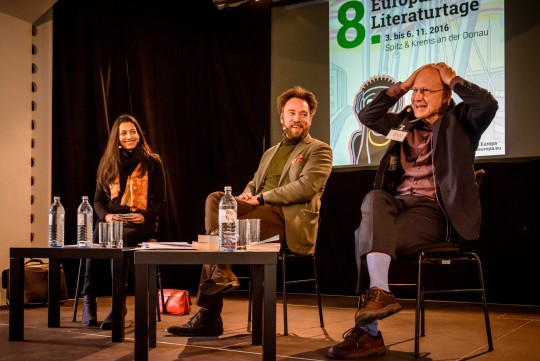
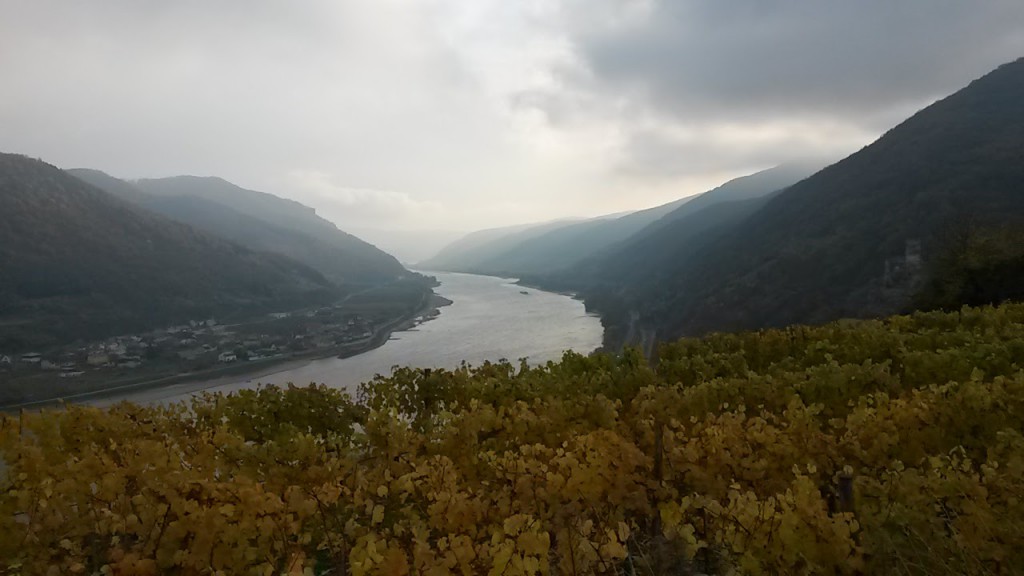
In early November, the picturesque, if rather overcast hills and vineyards along the Danube in Spitz, Austria provided a luscious backdrop to literary discussions ranging from Haiti to Hungary, Brazil to Burkina Faso, Slovenia to South Africa and Brazil to Zimbabwe. Headlined “The Colonists”, the European Literature Days 2016 brought together writers, translators and literary critics to debate cultural appropriation and colonialism in literature in both the literal and metaphorical senses, with literary readings and wine tastings to boot.

danube

© Julia Sherwood

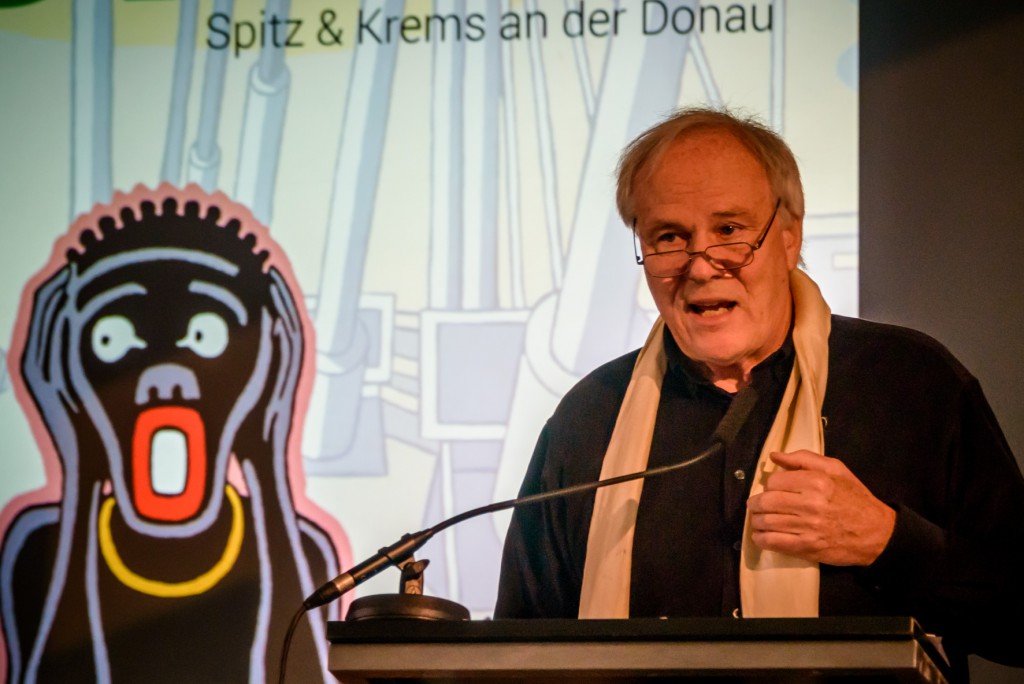
“Every country in the world is a hostage of its history from which there is no escape,” German reportage writer Hans Christoph Buch declared in his keynote speech (reproduced in full in the daily Die Presse). Since first visiting Haiti—the country of his father’s birth—in 1968, Buch has traversed the world, concluding that, although he might have written about the Caribbean and Africa, experience is not transferable across continents.  But isn’t a white author writing about Haiti stealing the country’s stories? Do writers have the right to write about countries that are not their own or does it turn them into colonists? Media and cultural scholar Karin Harrasser posed these questions to Zimbabwean lawyer and novelist Petina Gappah and Cuban author and cultural journalist Yania Suárez.

hans-christoph-buch-2-osaka-1

Hans Cristoph Buch © Sascha Osaka

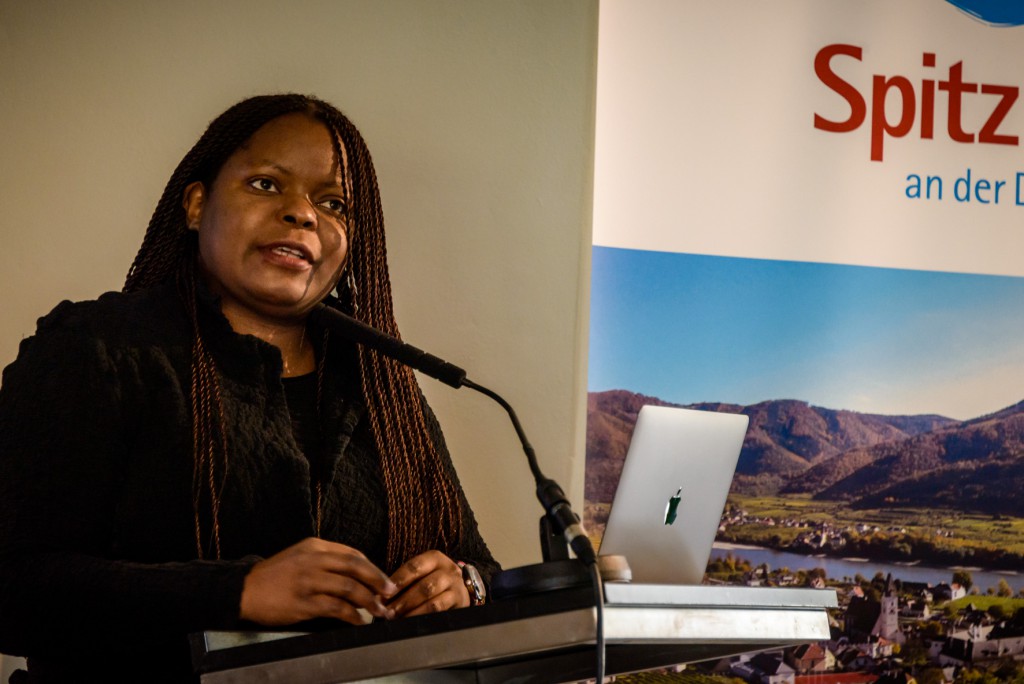
They certainly do, according to Gappah. But with the privilege to tell stories, especially those that are not yours, comes responsibility to tell the truth, she added. She deemed Hans Christoph Buch to have passed this test with flying colours.  She stressed the value of the external gaze but warned about striving for authenticity, which is the death of fiction: “If you go down the rabbit hole of authenticity you end up with memoirs.”  Suárez agreed that people have the right to write about other countries but only if they’ve spent enough time there to get to know their surroundings properly. Those who haven’t immersed themselves in the culture often misrepresent and fetishize Cuba, for example, creating fantasy narratives and appropriating its recent history to support their own romantic ideas (ideas echoed only a few weeks later by the accolades heaped upon the late Fidel Castro).

petina-gappa-osakah-1

Petina Gappah © Sascha Osaka

READ MORE…

Weekly Dispatches from the Frontlines of World Literature

The latest literary news from Tibet, North America, and South Africa.

Friday, as you well know, is world literature news day here at Asymptote. This week, we delve into news from three continents. In Asia, Social Media Manager Sohini Basak has been following the Tibetan literary discussion, while in North America, Blog Editor Nina Sparling is keeping a close eye on post-election developments. Finally, we go to South Africa where Editor-at-Large Alice Inggs has plenty of awards news. 

Social Media Manager Sohini Basak sends us this fascinating report on the Tibetan literary scene:

Some very interesting work on Tibetan literature is in the pipelines, as we found out from writer and researcher Shelly Bhoil Sood. Sood is co-editing two anthologies of academic essays (forthcoming from Lexington Books in 2018) on Tibetan narratives in exile with Enrique Galvan Alvarez. These books will offer a comprehensive study of different cultural and socio-political narratives crafted by the Tibetan diaspora since the 1950s, and will cover the literary works of writers such as Jamyang Norbu, Tsewang Pemba, Tsering Wangmo Dhompa, Tenzin Tsundue as well as look at the cinematographic image of Tibet in the West and the music and dance of exile Tibet.

Speaking to Asymptote, Shelly expressed concern for indigenous Tibetan languages: ‘It is unfortunate that the condition of exile for Tibetans, while enabling secular education in English and Hindi, has been detrimental to the Tibetan language literacy among them.’ She also pointed towards important work being done by young translators of Tibetans like Tenzin Dickie and Riga Shakya and UK-based Dechen Pemba, who is dedicated to making available in English several resistance and banned writings from Tibet, including the blog posts of the Sinophone Tibetan writer Tsering Woeser (who is prohibited from travelling outside Tibet), on highpeakspureearth.com.

At Himal magazine, which Asymptote reported in an earlier column will suspend operations from November due to “non-cooperation of regulatory state agencies in Nepal”, writer and scholar Bhuchung D Sonam has pointed to another facet of Tibetan literature, in what could be one of the last issues of the magazine. In his essay, Sonam looks at the trend in Tibetan fiction to often use religion and religious metaphors as somewhat formulaic devices which ‘leaves little space for exploration and intellectual manoeuvring’. He sees this trend being adopted by several writers as a challenge to locate themselves ‘between the need to earn his bread and desire to write without fear, and between the need to tell a story and an urge to be vocal about political issues and faithful to religious beliefs.’ READ MORE…

Meet the Publisher: Coach House Books

It’s just coming across things that look really interesting and that I feel need a home in the English language.

Coach House Books publishes and prints innovative Canadian fiction, non-fiction, poetry, and drama. The press was founded by Stan Bevington in 1965 and takes its name from the old coach house where he began putting out early works by many Canadian authors, including bpNichol and Michael Ondaatje. Since 1975, translations of Québécois literature have been an important part of the press’ catalogue. Poet, translator, and science writer Sarah Moses met with Alana Wilcox, Coach House’s editorial director since 2002, to discuss printing presses, bookish books, and translating French-Canadian authors.

Sarah Moses (SM): Could you begin by talking about the history of Coach House?

Alana Wilcox (AW): Coach House has been around since 1965, so we celebrated our fiftieth anniversary last year—not me personally, but the larger undertaking. It’s always been a press that focuses on innovative work, poetry, more difficult fiction, that kind of thing. It’s a long and convoluted story, like that of many presses: more difficult years, less difficult years, but we’re still at it, still publishing translation.

SM: What do you mean by more difficult fiction?

AW: I would include translation in that. By difficult I don’t necessarily mean fiction that’s hard to read, but that’s hard for people to think that they want to read—even though they might love it when they get into it.

SM: Could you tell me a little about the printing side of Coach House?

AW: We print our books here: we have an old Heidelberg printing press and binding equipment. Printing on location has always been the thing with Coach House. It’s interesting when the means of production is available to the writers and the editors—it just makes publishing a more tangible, real process. We always make the authors come in and glue the first copy of their book, if they can. There’s just something so beautiful about that. READ MORE…

Translation Tuesday: An Excerpt from “Brothers” by David Clerson

In his dream, he was walking on the ocean as one might walk across a desert, an ocean covered in bodies, a dry sea, not fit for life.

David Clerson’s Brothers is an original, phantasmagoric piece of fiction that is steeped in myth and fable. In a world of “gruesome, gargantuan creatures, two-headed fish, turtles with shells as big as islands, whales with mouths so large they could consume entire cities,” two brothers set out to find their dog of a father. The elder brother is missing an arm, while his younger brother has been fashioned by his mother from that arm. Excess and adventure abound as fresh, original writing draws us in to “surreal, hostile worlds.” We meet the leech-boys, a wooden puppet the brothers drag from the sea to become a member of the family, six pig-children, and more, all conveyed in a tone that lies somewhere between delirium and a disturbing dream.

The sailboat was small and light, made of wood, and it glided on the ocean, attended by graceful seagulls and a few cormorants. This craft was much easier to handle than the brothers’ rowboat. This time, the older brother headed straight out to the open sea, pushed by fair, warm summer winds.

He had secured Puppet’s head to the bow, leaving his figurehead clad in the grey pelt. Often, the wind would fill the pelt, moving the body and limbs. It seemed to dance at the bow, and it made the older brother smile, a fleeting happiness.

There had been a barrel of fresh water in the boat when he set sail, along with a few dry biscuits and some smoked herring. The older brother ate parsimoniously, nearly fasting, and he almost never slept, his eyes wide open over dark circles carved out by a scalpel.

READ MORE…

In Review: Two New Books Mark a French Author’s English Debut

A network of veins, ponds, ferns, a system of gray stills saturated with a reddish glow in which, like a rainbow...suddenly appeared the Angel.

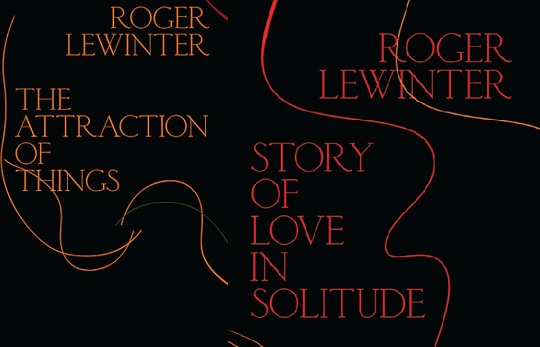
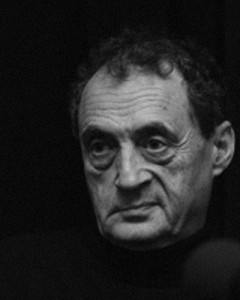
Asymptote reviews two new publications—a collection of short stories and a novel—by Roger Lewinter, born in 1941 in Montauban, France. The author currently lives in Switzerland and has worked as a writer, editor, and translator. These are two of his three works of fiction to date, and their publication with New Directions is Lewinter’s first appearance in English, in translations by Rachel Careau. 

lewinter-headshot

Story of Love in Solitude by Roger Lewinter, tr. Rachel Careau, New Directions

Review: Thea Hawlin, Social Media Manager

New Directions certainly lives up to their name with this exciting new foray into the work of a long neglected French author. Story of Love in Solitude marks the first translation of Roger Lewinter into English. Lorenzo Valentin has compared Lewinter’s writing to “a Kashmir shawl in its infinite interlacing, woven in one piece and from a single thread” and the description is apt. The continual lacing of Lewinter’s prose is a beguiling process; it may confuse and frustrate, but in its complexity it also points to beauty.

This short but sweet collection combines three of Lewinter’s tales, ‘Story of Love in Solitude’, of the title, ‘Passion’, and ‘Nameless’. Intriguingly, rather than a facing-page translation, the publishers have decided to starkly separate the translation and its original counterpart in the book. This makes cross-referencing a lot more of a challenge, but equally forces the reader to take time with the translations and appreciate them as independent from their origin.

The first, and most lyrically titled of the three, begins with an all-too familiar scenario—spotting a spider before heading to bed. Except this occurrence becomes a sinister loop. The next night, another appears and the pattern continues. The scenario is episodic, a simple commentary in which the brevity of the encounters is such that they hardly have room to develop before being suddenly cut off.

READ MORE…

Weekly Dispatches from the Frontlines of World Literature

Your arts and culture update from Mexico, Ecuador, and Romania

It’s been a big week in literature around the world, with major awards, book fairs, and new publications vying for media attention in a particularly crowded news cycle. But the book world keeps turning even when it seems like everything else has come to a standstill. Blog Editor Madeline Jones reports from south of the border in Mexico, Editor-at Large MARGENTO gives us the update on Romania, and Contributor George Kirkum checks in from Ecuador.

Madeline Jones, Blog Editor, brings the literary update from Mexico:

Hundreds of Mexican artists have been mocking the President Elect of the United States, Donald Trump, by way of political cartoons. Now that he’s clinched the elections, the value of the peso has plummeted and Mexicans on both sides of the border are speaking out about their disapproval of Trump’s platform as well as their own fears for the future. Poet, novelist, and activist Javier Sicilia told El Universal, “This man unified fragments of fascism that were scattered throughout North America. And he’s creating proposals for destruction…it doesn’t matter if Trump wins, the theme is systemic.”* Well-known Mexican author and historian Enrique Krauze’s op-ed in The New York Times also captures the sentiments of many, in Hank Heifetz’s translation from the Spanish.

Eduardo Lizalde, who is recognized as one of the most important living poets in the Spanish-speaking world, was awarded the Premio Internacional Carlos Fuentes a la Creación Literaria en el Idioma Español this week. The judges said that his collection El tigre en la casa [The Tiger in the House] is “one of the most influential and poignant books in several generations.”*

2017 marks the 40th anniversary of the reopening of diplomatic relations between Mexico and Spain after the Franco regime ended. Last week, the organization la Cátedra México-España, which was founded with the purpose of studying and fomenting the historical, cultural, and linguistic links between the two nations, celebrated its tenth year. Attendants at the anniversary conference noted that the international relationship is still in its “honey moon” phase and the first ten years of the organization’s work have seen significant academic collaboration across the Atlantic.

READ MORE…

What’s New in Translation? November 2016

Asymptote reviews some of the best new books from French, Swedish, and German.

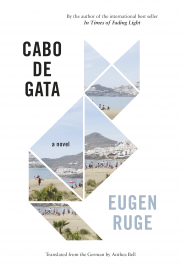
cabo-de-gata

Cabo de Gata, by Eugen Ruge, tr. Anthea Bell, Graywolf Press

Review: Sam Carter, Assistant Managing Editor, US

First published in German in 2013—when his In Times of Fading Light appeared in EnglishEugen Ruge’s Cabo de Gata, out this month from Graywolf Press, might strike a familiar note for readers who have witnessed a surge in autobiographically-inflected works that frequently take the production of fiction as a subject worthy of novelistic exploration. Hailing from both the Anglophone world and beyond, such novels record the process of their creation or the struggles to even begin them, and Ruge quickly aligns himself with this approach in his tale of a writer’s attempt to get away from it all in the hope of figuring something out. “I made up this story so that I could tell it the way it was,” declares the dedication to this slender volume, and a more precise formulation arrives soon after as the narrator recalls a period in which “I was testing everything that I did or that happened to me at the same moment, or the next moment, or the moment after that, for its suitability as a subject … as I was living my life, I was beginning to describe it for the sake of experiment.”

While in Cabo de Gata, a small town on the Andalusian coast, the narrator quickly settles into routines designed to simultaneously distract him from blank pages and provide him with some inspiration to fill them. The local fishermen, whom the narrator visits on his daily stroll, can empathize with such difficulties: ¡Mucho trabajo, poco pescado! A lot of work for only a little fish—it’s a piscatory philosophy that applies just as well to the writing life. Ruge, however, proves to be an exceptionally gifted angler as he reels in catch after catch in what would seem to be difficult waters, namely a single man’s short trip to this seaside village.

Serving as a metronome marking out the rhythm of memories that constitute the novel, a refrain of “I remember” begins many of the paragraphs that have been expertly rendered by translator Anthea Bell. Far from repetitive or reductive, such a strategy instead seems somehow expansive, particularly when we are reminded that, “fundamentally memory reinvents all memories.” Both the vagaries and the vagueness of memories—“I remember all that only vaguely, however, like a film without a soundtrack,” remarks the narrator in a line that will be hard to forget—serve as the subjects of reflection that find their counterpart in the rhythms of the sea and the surrounding Spanish countryside.

READ MORE…

Asymptote’s Pushcart Prize Nominations

It's that time of year, and we're proud to recognize six wonderful pieces of literature!

We are thrilled to nominate the following six articles published during the past year for the Pushcart Prize. Please join us in giving a round of applause to both the authors and translators behind these incredible pieces.

At 997 words, Pedro Novoa’s devastating short story, “The Dive”, won Peru’s “Story of 1,000 Words” contest. Translating this nautical thriller cum family saga into English, George Henson made it an Oulipian exercise by keeping the English text under 1,000 words as well. Shimmering with poignancy, the multi-layered story delivers a powerful allegory about the blood ties that bind even when broken—the concatenation of islands we will nevertheless always be.

“To translate means, therefore, not only to exercise extreme vigilance over the movements of the original text, but above all to scrutinize the limits of one’s own language, as it creeps up to the original.” Via co-translators Rebecca Falkoff and Stiliana Milkova, Anita Raja’s magnificent essay frames “Translation as a Practice of Acceptance ” and argues that the translator’s greatest resource must be her own inventiveness.

READ MORE…

Translation Tuesday: Two Poems by Philippe Beck

Space creates grammar. (And in itself creates is said in space.)

Complex, haunting, and profoundly literary, Didactic Poetries is French poet Philippe Beck’s response to Schiller’s statement: “We are still waiting for a didactic poem where thought itself would be and would remain poetic.” In recognition of his entire oeuvre, Beck was awarded the French Academy’s Grand Prix de Poésie [Grand Poetry Prize] in 2015. We present two poems from his debut publication in English, released by Univocal Publishing today.


Liminal Poem

If an I does not begin,
it is because of the sum
of strong concerns
that make and unmake
someone’s history
in the history of some ones
in the history of many
and not in everyone’s.
For a someone differs
in the sum of possible exchanges
with everyone
(the big I is also
theoretically absent, and
the ordinary you and I
strive to become a You
before the imagined arrival
of the big I
that does not exist);
discussions begin
because of discussions.
What must be said
is not already spoken
in the individual’s brain,
nor in the Collective,
but it is said
because of the conversation
which creates necessity
all around brains
and hearts.
And the world is not everyone’s
negative rough draft.

READ MORE…

Indigenous Languages, Migration, and Multilingualism in Fall 2016 Canadian Poetry Special Feature

A country that takes pride in a mosaic model of multiculturalism becomes home to an abundance of languages

In “Verisimilitude,” the Fall 2016 issue of Asymptote, Assistant Editor K.T. Billey edited a stellar special feature on Canadian Poetry. Reaching far beyond the exchange between French and English, this section presents a diverse group of authors and translators that reflects a multitude of cultural and historical intersections and conflicts. Now, Billey situates and introduces the poets and translators. Delve into the special feature here.

Global readers likely are aware of Canada’s official French/English bilingualism. What the literary world may not know about—and what Asymptote is delighted to spotlight in our Fall 2016 issue—is the range of Aboriginal and First Nations voices that are fundamental to Canada’s evolving identity. The Special Feature on Canadian Poetry introduces readers to three of the approximately sixty distinct Indigenous languages spoken in Canada.

Multilingual poems by acclaimed poet Duncan Mercredi are a crystalline example of the verisimilarity that unites the Fall issue. Duncan’s brother Joe translated the English portions of Duncan’s poems into their native Cree, a language whose dialects nearly span the entire North American continent. Joe’s line-by-line translations became, and are recognized as, part of the poems rather than separate works. The poems are unified though their dual-linguistic nature, exacerbating and expressing the ambivalence of a First Nations poet writing in English.

READ MORE…

Weekly Dispatches from the Frontlines of World Literature

The latest in literary news from Africa and North America

As the week comes to a close, we’ve been busy reading and re-reading the Fall 2016 issue of Asymptote, while trying to escape the fact that November is nearly upon us. This week, we hear from Alice Inggs, Editor-at-Large based in South Africa, who shares the details of the literary awards season from across the continent. We visit Editor-at-Large Marc Charron in Canada next, before heading south to catch up with Blog Editor Nina Sparling in New York City. 

Alice Inggs, Editor-at-Large in South Africa, sets us afloat with a whirlwind literary tour of the continent:

After peaking in the polls but missing out on the Nobel Prize for Literature, Kenyan writer Ngũgĩ wa Thiong’o, author of Decolonising the Mind: The Politics of Language in African Literature and In the House of the Interpreter: A Memoir, was subsequently awarded the prestigious Pak Kyong-ni Literature Award by the South Korean Toji Cultural Foundation. Thiong’o, a champion of African literature(s), has produced novels, plays, short stories, and essays, publishing primarily in the Gikuyu language.

In West Africa, Abubakar Adam Ibrahim won the Nigeria Prize for Literature for Season of Crimson Blossoms, which explores sexuality, loss, and community through an affair between a twenty-five-year-old street gang leader and a devout widow and grandmother. Shortlisted candidates included Elnathan John (Born on a Tuesday) and Asymptote-featured writer Chika Unigwe (Night Dancer).

READ MORE…