Posts filed under 'marginalization'

What’s New in Translation: January 2026

New titles from China, France, Peru, Italy, Romania, Brazil, South Korea, Mexico, Sweden, and Japan!

Looks like 2026 isn’t coming in slow. Despite the chaos, we’re looking forward to another year of illuminating the best of what world literature has to share—and we’re starting off with plenty to go around, with thirteen titles from ten countries. Find in the mix a new translation of one of the Peruvian canon’s most dazzling and convulsive works; a novel depicting the delicate indigenous customs of a region between Siberia and northeast China; a shocking, propulsive novella from a Japanese cult writer; a story of transformative grief from an enthralling Romanian voice, and so much more.

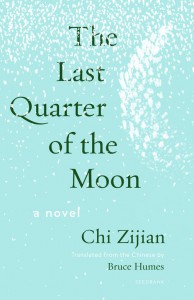
The Last Quarter of the Moon by Chi Zijian, translated from the Chinese by Bruce Humes, Milkweed Editions, 2026

Review by Mandy-Suzanne Wong

The opening lines of Chi Zijian’s wondrous novel, The Last Quarter of the Moon, set a carefully measured tone for this enchanted story of Evenki nomads: “A long-time confidante of the rain and snow, I am ninety years old. The rain and snow have weathered me, and I too have weathered them.” t6his rich and essential passage gently, and with deference, opens a window into a world where humans confide in rain. Chi and translator Bruce Humes indulge the word weather in at least three of its meanings, conveying the narrator’s resilience and hinting at her costly intimacy with other-than-human energies.

A word exchanging its meaning for other meanings—as if adopting different bodies to slide between existential contexts—invokes the dynamism of the shamanic Evenki cosmos, wherein earth and sky, humans and nonhumans, the embodied and the disembodied, dance together in precarious balance and tender reciprocity. Everything is alive in the Evenki’s animist multiverse, every entity ensouled, each Earthling an embodiment of the Spirits, and every human owes a debt to the Spirits for the lives of nonhumans killed for food. In turn, when a human child goes missing, in danger of freezing to death, a reindeer child must go “to the dark realm on [the human’s] behalf,” in a mimetic exchange.

READ MORE…

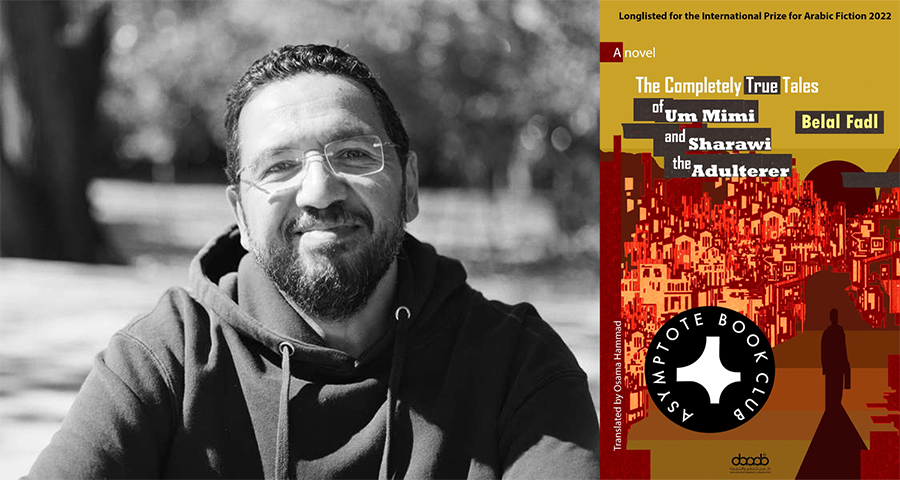
Announcing Our December Book Club Selection: The Completely True Tales of Um Mimi and Sharawi the Adulterer by Belal Fadl

Here, language tells the truth without mitigation, even when that truth is ugly.

Upon the premiere of Youssef Chahine’s Cairo at Cannes, the Egyptian critics in attendance resented its unflinching portrayal of the city’s poverty and density, claiming it as a derogatory and inciting the film’s eventual ban. In The Completely True Tales of Um Mimi and Sharawi the Adulterer, author and screenwriter Belal Fadl takes a similarly undaunted look at the capital: its swarming underbelly, its suffocating divides, and its unrelenting pressures that bloom both tragedy and absurdity. Written in a captivating style that listens carefully to the city’s manifold ranges, Fadl is determined to pull back the curtains, putting a middle finger up to politeness or grandeur, and drawing instead on chaos, comedy, and linguistic richness to portrait a Cairo full of adrenaline, be it from laughter, thrill, or the sheer will to survive.

The Asymptote Book Club aspires to bring the best in translated fiction every month to readers around the world. You can sign up to receive next month’s selection on our website for as little as USD20 per book; once you’re a member, join our Facebook group for exclusive book club discussions and receive invitations to our members-only Zoom interviews with the author or the translator of each title.   

The Completely True Tales of Um Mimi and Sharawi the Adulterer by Belal Fadl, translated from the Arabic by Osama Hammad, DarArab, 2025

Belal Fadl’s The Completely True Tales of Um Mimi and Sharawi the Adulterer announces itself with a provocation and never retreats from it: “Whenever I tell my story, I say that what led me to live with Um Mimi were two Polish breasts with unparalleled nipples.” From this opening confession, the novel signals that nothing sacred will be protected from language, and nothing obscene will be softened for the reader’s comfort. But this is not bravado for its own sake—Fadl’s novel is built on a wager: that obscenity, vulgarity, and excess are not moral failures of language, but its most truthful registers when class humiliation, bodily precarity, and institutional contempt are the subject. To read The Completely True Tales of Um Mimi (or to be more accurate, to read it in translation) is therefore to confront an ethical question: how does a translator render a voice whose truth depends on its refusal to be clean?

The novel’s narrative arc is deceptively simple (almost cliché). It’s 1991, and a young man from Alexandria arrives in Cairo to study media at Cairo University, determined to escape an abusive father and a suffocating household. His grades win him admission, but his finances dictate his fate. Having endured a humiliating stay in a flat with “decent, pious, and religious young men who knew God and had learned the Quran by heart,” he is evicted for attending an R-rated film, and ends up renting a room in the ground-floor flat of Um Mimi, a retired madam, on a nameless lane known only as “the street behind Casino Isis.” READ MORE…

Ruritanian Realism: A Review of This Room is Impossible to Eat by Nicol Hochholczerová

[Hochholczerová] creates an enthralling and curious sense of the banal in the sheer atypicality of the narrative. . .

This Room Is Impossible to Eat by Nicol Hochholczerová, translated from the Slovak by Julia and Peter Sherwood, Parthian Books, 2025

When Nicol Hochholczerová’s novella This Room is Impossible to Eat was first published in her native Slovakia in 2022, it caused a cultural and political storm, generating both praise and scorn for its intimate but ambiguous semi-autobiographical narrative that describes the grooming and subsequent relationship between a teenage student and her art teacher. The praise came from readers, literary critics, and jurors of literary prizes; the initial scorn came from parents worried about the impact of the book’s inclusion on the reading lists of selected Slovak high schools. Their concerns were then picked up by ever-vigilant, always campaigning politicians seeking to originate new fronts in the online Slovak culture wars. A new narrative was created for the novel, which was then ‘amplified’ (or more accurately, manipulated) into a furious national debate that almost destroyed the credibility of one of Slovakia’s literary awards, the René Prize. With the benefit of hindsight, this response can be seen as an application of divisive tropes, mirroring the social media manipulation practised by Slovakia’s eastern neighbours and offering a portent to the future direction of Slovak politics.

Regardless of the surrounding furore, the newly published English text—beautifully translated by Julia and Peter Sherwood—introduces a compelling, engaging, and forceful masterpiece of minimalism. The narrative is set out in linear but short chapters that identify the teacher and the student in a compelling, asymmetric conversation between inner dialogues, then quickly becomes a compact and sometimes austere statement of facts and emotions as both protagonists grow older. Their entanglement ‘begins,’ ‘matures,’ and then ‘ends’—though how it ends is best left for the reader to decide. READ MORE…

A Gazan Woman’s Voice: Michelle Hartman and Caline Nasrallah on translating Asmaa Alatawna’s A Long Walk from Gaza

. . . even in the face of oppression, Arab women . . . take a role in constructing their realities, demonstrating agency despite what they endure.

When it was first published in 2019, A Long Walk from Gaza resounded with Asmaa Alatawna’s evocative descriptions of girlhood, migration, and life under occupation, gathered in an acute testament against the societal and political repressions of a woman’s liberties. Today, in light of the events over the last year, it also preserves a city that has since been overwritten with violence, layering the streets, neighbourhoods, and homes of memory over the present map of destruction. In this following interview, translators Michelle Hartman and Caline Nasrallah discuss their process in translating this nuanced portrait of Palestinian life, the element of double marginalisation within the narrative, and the emotionality of working with a story that evokes the now-gone.

The Asymptote Book Club aspires to bring the best in translated fiction every month to readers around the world. You can sign up to receive next month’s selection on our website for as little as USD20 per book; once you’re a member, join our Facebook group for exclusive book club discussions and receive invitations to our members-only Zoom interviews with the author or the translator of each title. 

Ibrahim Fawzy (IF): How did you come across A Long Walk from Gaza?

Michelle Hartman (MH): I have a relationship with Interlink Publishing. It’s a smallish, independent publisher based in Northampton, Massachusetts, and the only Palestinian-owned publisher in the United States. It’s committed to doing many different things, particularly bringing fiction written in Arabic to English readers—and it’s been doing this for a very long time. There’s a significant list of Arab writers whom the publisher wants to bring to life in English. They occasionally send me novels, and A Long Walk from Gaza was one of them. As Caline and I were working on another project at the time, I sent this book to her for her opinion.

Caline Nasrallah (CN): As Michelle said, we have already worked on several things together, so we have this relationship of her sending me books to read. I’ll then go through these books and decide if we could continue working on them. Once she sent me Asmaa’s novel, I was so taken by it, and I thought it was an important project we had to work on. I felt a duty. I read it, then we discussed it more, and we went ahead.

IF: Thats great. As a literary translator, I usually read a book and find something that speaks to me, motivating me to translate it. What drew you to this book? What are the elements that convinced you to spend much time with it?

CN: Asmaa’s novel is a must-read because of the way it describes life under occupation and all of the hardships that come along with that, specifically in Gaza. There’s little that comes out of Gaza because of the situation on the ground, so the book felt like a lens into something we had never really seen before—that made it feel more relevant. Asmaa reveals this double layer of life under occupation, tracing life as a girl and a woman under occupation, the reality of occupation and internal issues impacting the society in which she lived. While united within a cause, women were also affected by society’s actions. It’s imperative to recognise this aspect, even though it’s often overlooked in literature focusing on a common enemy. Calling out injustice wherever it exists is essential.

READ MORE…

For the Reader Who Cannot Be Bought: On Dubravka Ugrešić’s A Muzzle for Witches

. . . her writing worked to unsettle, challenge, and dismantle—a process she called “a perestroika of literary values.”

A Muzzle for Witches by Dubravka Ugrešić, translated from the Croatian by Ellen Elias-Bursać, Open Letter, 2024

For thirty years, Dubravka Ugrešić lived in self-imposed exile as a cultural dissident and an enduring critic, challenging the prevailing orthodoxies that fueled anti-intellectualism, oppression, inequality, and nationalism. Her prolific writing—including both fiction and essays—took on topics ranging from the rise of virtual fandoms and the wars of Yugoslav dissolution, to cultural nostalgia and the state of the publishing industry.

A Muzzle for Witches, released this year by her longtime American publisher Open Letter, was Ugrešić’s final book before her death in March 2023. Translated from the Croatian by Ellen Elias-Bursać (the preeminent translator into English of Bosnian, Serbian, and Croatian authors, including David Albahari, Ivana Bodrožić, Slavenka Drakulić, Daša Drndić, and Robert Perišić), the book is a highly polished transcript of an interview between Ugrešić and literary critic Merima Omeragić.

The book is divided into seven sections, throughout which Ugrešić expounds upon many of the key themes and ideas she addressed in her life’s work. Loosely guided by Omeragić’s brief questions, she focuses on three subjects that are her greatest concerns: the resurgence of Croatian nationalism after the breakup of Yugoslavia; the marginalization of women’s voices, particularly in literature; and the dubious future of contemporary literature itself. Cumulatively, these three areas—in no small part responsible for her extended exile—suggest a grim outlook for the future.

READ MORE…

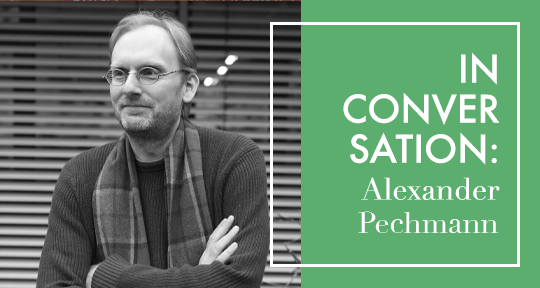
Fact and Fantasy in the Black Forest: An Interview with Alexander Pechmann

The Austrian author’s latest spiritual adventure story asks readers to consider the nature of time.

Die Zehnte Muse (The Tenth Muse), published by Steidl in 2020, is a genre-bending novel set in the Black Forest in the late nineteenth and early twentieth century. The story focuses on two main characters, Algernon Blackwood and Paul Severin. Blackwood is modelled on the twentieth-century supernatural author of the same name, well known for his short stories “The Willows” (1907) and “The Wendigo” (1910), while Severin is modelled on the German expressionist painter Karl Hofer. The novel centres on the mystery of Talitha, a timeless figure both men develop fixations on, twenty years apart, after glimpsing her in the forest.

Pechmann deftly weaves together strands of philosophy and layers of storytelling in under two hundred pages. On some levels, the book feels like a classic gothic ghost story. There are all the major elements: a forest; restless, disillusioned young men; a creepy, strict religious boarding school; a supernatural presence. But the book also covers the nature of time, dreams, spiritualism, and the occult, the psychological, Gnosticism, art history, translation, and Yenish culture. The Yenish are a nomadic people from central Europe, whose distinct culture emerged in the early nineteenth century, although the Yenish language predates this. Here, Pechmann discusses the many-layered novel and the enduring mystery of Talitha.

Anna Rumsby (AR): How would you classify this genre? I’m tempted to say neogothic, but it’s also a fairy tale, historical fiction, a semi-biography, and in some places almost a philosophical essay.

Alexander Pechmann (AP): In some reviews, the book was called a “Künstlerroman” (art novel) or a psychological ghost story. That’s OK, but I like to call it—as well as my other novels—a “spiritual adventure” or “adventure of the soul,” in contrast to “adventures of the mind,” such as detective stories or science fiction, or “adventures of the heart,” such as stories about love and relationships.

Adventures of the soul are rooted in dreams and make use of ancient traditions, fairy tales, superstitions, and religious ideas. Algernon Blackwood and Arthur Machen wrote this kind of fiction, and Blackwood also had a certain love for symbolistic paintings. Symbolism had a strong influence on me while I was working on the novel, but I feel also close to the Romantics with their deep love for nature, and classic Austrian writers like Leo Perutz who mixed historical facts with fantasy.

AR: How did your experience as a translator and linguist inform this novel? There’s a huge attention to language—I’m thinking specifically of the Bible translation chapter regarding Talitha, but there’s a great blend of English, German, French, and Yenish throughout.

AP: I have a special interest in writers who move freely between cultures and languages. I’m thinking of Lafcadio Hearn, who was born in Greece, grew up in England, went to the USA, and ended up in Japan, or Marmaduke Pickthall, who went to Syria as a young man and would be the first English translator of the Holy Quran. Algernon Blackwood spoke German and French fluently and was also a traveller between cultures. The attention to language in Die Zehnte Muse grew naturally out of the fact that the school of the Moravian Brothers in Königsfeld was and still is visited by students from all over the world. Also, the Black Forest, the background of the novel and place where I live, has always been a melting pot of different languages, dialects, and cultures. While working on the novel, I learned more about Yenish and was astonished that this language uses both Hebrew and Yiddish words. This fit in perfectly with my idea that Talitha was accepted by the Yenish, even though she obviously came from some other ancient culture.

AR: Who or what is Talitha?

AP: In my first draft, she was just a wild child, living in the forest. I knew she was somehow related to the Yenish, so I was searching for typical Yenish names. I liked Talisha or Talitha best, and then I read the story of a priest’s daughter named Talitha who was raised from the dead by Jesus. This opened up new possibilities for my story. Could someone who was resurrected by Jesus grow old and die like a normal person? What if this girl was damned to live on and on? I do not answer this question in the novel and leave it up to the reader to decide whether she was just a lost Yenish girl, the ghost of a murdered girl, or the resurrected biblical Talitha. She might also just be a fantasy of Paul Severin, she might have stepped right out of Maurice Denis’s painting, or she could be even an incarnation of time itself. READ MORE…

Emma Bovary’s Adventures in Saigon, Part I

Hoàng Hải Thủy’s 1973 Vietnamese translation of Flaubert’s classic complicates perceptions of domestication and foreignization.

This is the first in a two-part series that explores the indeterminate translation effects of foreignization and domestication, as illustrated by Hoàng Hải Thủy’s 1973 Vietnamese adaptation of Madame Bovary. Read the second part here.

Note: The below version has been revised to reflect important corrections. Lawrence Venuti’s theoretical framework, as reflected in the revised essay, does acknowledge the subaltern’s perspective and show that domestication and foreignization encompass both discursive approaches and their multifaceted effects.

Since the earlier version did not fairly reflect the full implications of Mr. Venuti’s work, the author owes Mr. Venuti an apology and would like to thank him for his forbearance and collegial support.


In 1813, Friedrich Schleiermacher, the German translator of Plato, had proposed that a translator has two choices, “either such translator leaves the author in peace as much as possible, and moves the reader towards him; or the translator leaves the reader in peace as much as possible, and moves the author towards him.” The former technique could be defined as foreignization, and the latter domestication. Today translation scholar Lawrence Venuti has expanded on Schleiermacher’s perspective by constructing an ethics of difference in translation. According to Venuti, translations geared toward domestication effects risk perpetuating certain uncontested beliefs in the maintenance of the status quo. As a corrective, he has proposed a meticulous yet adaptable theoretical framework that can illuminate any translation, regardless of language and culture, regardless of their status as dominant or dominated, major or minor. In his view, foreignizing translations can expand the linguistic and stylistic resources of the translating language by broadening the parameters of readability.

If we define foreignizing as a translation approach that creates noticeable effects and variations from the prevalent standard, and domesticating as conforming to pre-existing norms, how do we gauge these effects against a translator’s stated intention, his unconscious bias, inadvertent omissions or errors? My essay attempts to illustrate these questions by discussing Hoàng Hải Thủy’s Người Vợ Ngoại Tình—his 1973 adaptation of Gustave Flaubert’s Madame Bovary.

READ MORE…