Translation Tuesday: Two Poems by Antti Salminen

Insurgent, effective, obedient stronghold... And we built it all.

This Translation Tuesday, we present fragments of poetry found embedded in text and in testimony, pried from their source and polished to a sheen. Two poems by Finnish poet Antti Salminen, translated by José Luis Rico,  “Autoethnographical Sketch of the Pipe” and “Reminiscence of Settlement History” , evoke a diamond mine deep in the Siberian hinterland, a cold hell: the frost, the sludge, the desolation of the frozen pit, the hasty brutish ingenuity of the Soviet mining engineers, and the miners’ deadly toil.

Autoethnographical Sketch of the Pipe, Fragment from the Second Chapter

Mir, Mirny, open pit mine, mineshaft. 62º31 45.95 N 113º59 36.74 E: funnel-shaped ravine and artificial crater, the abyss the last people dug for themselves.

A small airport with its brief runway on the massive mining landscape’s earthwork. A glider hangar. There, where a small mining town had been, now a silent, mossy, pebble beach made of cement. No building was left standing, the purpose being to render the place as repulsive as possible for at least a thousand years. The magnitude of the risk was unknown, but there was no alternative.

When the place was initially dug, says Junifer, the mining engineers melted the winter frost from the ground with turbojets. There’s no rush to go further down, we’re already at the bottom. Work continues underground, slowly. Now we work with our hands, in small gestures. The shovels are less than weapons, and the excavators sit idle like a mighty beast’s skeleton at an open-air museum.

The serpentine road leads downward to the funnel, down to the bottom, to the pond’s gravelly beach. The road is ridden with sinkholes, which are patched and driven over however possible. In the molten-ground season: sludge, sludge everywhere. From October to April the amount of ice is impossible. The struggle against the ground frost can’t be won. But when you live through a permanent sinkhole, you learn to harness gravity. READ MORE…
Violence and Devotion: A Review of Love Never Dies by Eka Kurniawan

Kurniawan portrays heterosexual love at its patriarchal, misogynistic extreme.

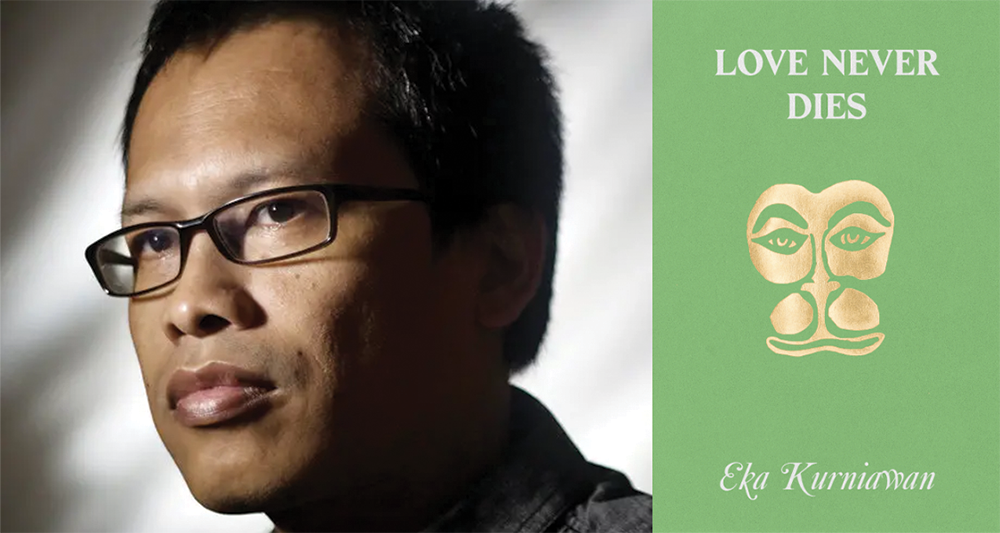
Love Never Dies by Eka Kurniawan, translated from the Indonesian by Annie Tucker, Hanuman Editions, 2025

The Indonesian writer Eka Kurniawan has been prolific in the novel form, having looked at the forces that negate death in Beauty is a Wound, translated by Annie Tucker, and the forces that create death in Man Tiger, translated by Labodalih Sembiring. However, while working on his third novel, Vengeance Is Mine, All Others Pay Cash (also translated by Tucker), the gifted author published two collections of short stories—the second of which begins with the novella Love Never Dies. Stripped of its surrounding stories, this novella is now appearing in English as a standalone volume.

Perhaps the choice to publish Love Never Dies separately was a choice made by Tucker, Kurniawan’s long-time translator, or perhaps by the publisher, Hanuman Editions—but either way, the text now appears more important in its English edition, as a volume on par with Kurniawan’s novels and a distinct step in the author’s career. Indeed, Love Never Dies should be considered as such. It cleanly synthesizes the themes of Kurniawan’s first two novels, determining that the forces creating and negating death are the same thing, and names that force “love”—or specifically, a man’s love toward a woman. From the first pages, it will be clear to any reader familiar with Kurniawan’s work that Love Never Dies is in conversation with its predecessors; Mardio, the seventy-four year old protagonist, seems to recall Margio of Man Tiger, and although the characters are different, the association between their names hints at the former’s future, and the murder predestined to take place at the novella’s end.

READ MORE…

Weekly Dispatches From the Frontlines of World Literature

The latest literary news from France, Palestine, and Kenya!

This week, our editors report on a busy literary season, filling us in on awards to watch for, considering the politics of prizes, and reporting on exciting literary festivals. Read on to find out more!

Kathryn Raver, Assistant Managing Editor, reporting from France

The French literary awards season is upon us! Over the course of the last few weeks, the juries of prizes such as the Prix Goncourt and the Prix Médicis have announced their shortlists and/or laureates. Though the Goncourt is arguably the most well-known and prestigious of France’s literary awards, there are countless others awarded each year, from those awarded by the Académie Française to those given by individual bookshops, each of them celebrating Francophone and world literature in their own way.

Les Deux Magots, a well-renowned Parisian literary café with 140 years of history behind it, awarded its 92nd yearly prize last week to Swiss author Joseph Incardona for his recent novel Le monde est fatigué. The novel follows a young woman who acts as a mermaid at aquariums, but whose fake tail hides a body damaged by a grievous accident for which she is determined to seek revenge. Le monde est fatigué has also been longlisted for the Prix Femina, alongside works by other celebrated Francophone authors such as Jakuta Alikavazovic’s Au grand jamais and Nathacha Appanah’s La nuit au cœur. The prize’s shortlist is set to be announced on October 21st, with the winner announced November 3rd.

The prize that I, personally, am watching most closely is the Prix Décembre, which defines itself as a sort of “anti-Goncourt”. The longlist includes works such as Laura Vazquez’s Les Forces (whose poetry appeared in Asymptote’s October 2022 edition) and the newest novel of Wendy Delorme (whose work was recently translated and featured in one of Asymptote’s Translation Tuesday columns). Last year, the Prix Décembre went to Moroccan author Abdellah Taïa, a past laureate of PEN America’s Literary Translation Award who has also appeared in several of Asymptote’s past issues. The laureate is set to be announced on October 28th.

Shatha Abd El Latif, Editor-at-Large, reporting on Palestine READ MORE…

The Powerful Motion of the Text: An Interview with Martina Vidaić and Ellen Elias-Bursać

[The novel's] not about the war or the post-war era, nor any of the themes that readers usually expect from the Balkans or from Croatia.

In Bedbugs, Croatian writer Martina Vidaić applies the epistolary to full-throttle effect, drawing out nearly two hundred pages of a woman’s complex and impassioned pursuit of selfhood and liberation. Through a voice that is humorously inviting, incisively driven, and utterly idiosyncratic, the novel draws from the architecture of Zagreb, the “unhappy villages” of the countryside, the omnipresent strangeness of the world and its people, and the turmoil of an intelligent, haunted mind to iterate our contemporaneity, its violence, its absurdity. Ellen Elias-Bursać’s English translation is alluring in its freneticism, all resulting in one hell of a ride.

The Asymptote Book Club aspires to bring the best in translated fiction every month to readers around the world. You can sign up to receive next month’s selection on our website for as little as USD20 per book; once you’re a member, join our Facebook group for exclusive book club discussions and receive invitations to our members-only Zoom interviews with the author or the translator of each title. 

Ellen Sprague (ES): I’m really glad that a Croatian title has come to the Asymptote Book Club. And this is not just any book for so many reasons; one of them being the fact that it won the EU Prize for Literature in 2023. I wonder if you might have anything to say about how this book came to the attention of the EU Prize and its ultimate awarding.

Martina Vidaić (MV): I wrote this book in 2021, and with the Croatian edition, there were some critics who liked it, and some others not. It didn’t have a lot of success, actually, with the Croatian awards—but I didn’t expect much because Bedbugs is a pretty unconventional book for the Croatian context.

Still, I hoped for a little bit more regarding the reception in general, and I was very, very surprised when a Croatian jury for the European Union Prize for Literature chose this book to be nominated. The prize is mostly for emerging authors—such as those who haven’t been translated much or at all. The authors don’t have to be young, but there are a number of criteria; if they’re nominating a novel, for example, then it has to be at least the author’s second novel. It’s a very nice award for young poets and writers, because it then offers the opportunity for translation. Obviously, I was very happy when I was nominated, but I really didn’t expect anything. The Prize isn’t limited to just countries in the EU—other European countries are included, forty-one in total, but divided into cycles. Every year, the cycle has thirteen or fourteen countries, and in 2023, Croatia turned out to be included, with my book ending up as the overall winner.

I was very lucky that Ellen was translator of the sample pages submitted. I think that was very important, because the jury decided based on those forty pages.

Ellen Elias-Bursać (ESB): Also, Sandorf Passage were very pleased when they were able to publish it, and the translation itself of the winning book is subsidized by the European Union, so that makes it nice for everyone. It’s a wonderful thing to be part of the whole operation.  READ MORE…

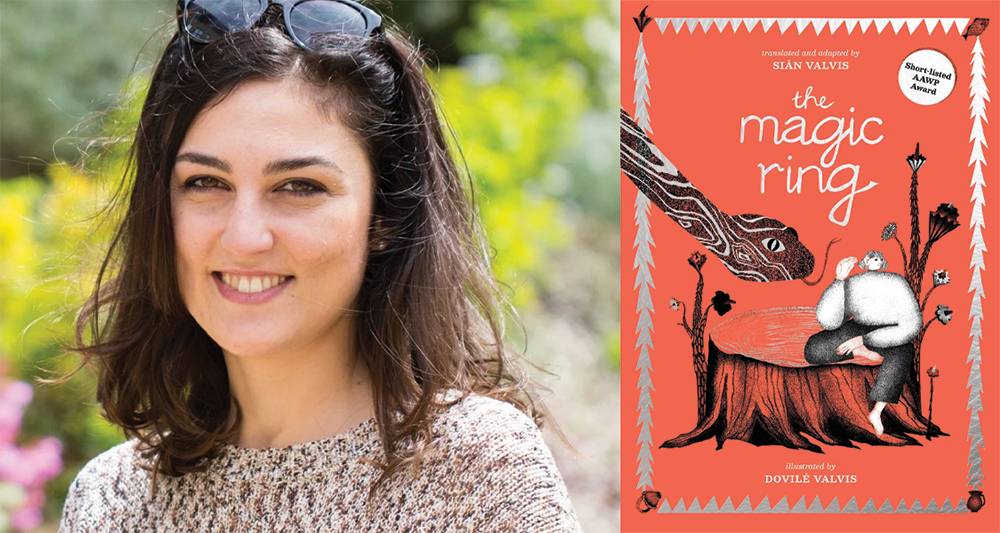
Magic in Dialect: A Review of The Magic Ring

Shergin extolls the ordinary individual and honours the Pomorye dialect. . .

The Magic Ring, translated and adapted by Siân Valvis, illustrated by Dovilė Valvis, Fontanka, 2025

Enter Boris Viktorovich Shergin, Soviet Pomor writer, folklorist, and illustrator from Arkhangelsk, hailed as The Bard of the Russian North (Певец Русского Севера). Shergin was famous for his vivid storytelling for children, specifically regarding various facets of traditional Pomorye life, delivering his tales in a native Pomor/ White Sea dialect that was praised by some of his greatest admirers—including the sculptor and puppeteer Ivan Efimov, who stated that through him, we can hear the ‘undistorted voice of our ancestors’ («неискаженный голос предков»). Although originally penned in 1930s, many of Shergin’s stories, including ‘The Magic Ring’ (‘Волшебное кольцо’), did not appear in print until much later, with Russification standardising the Moscow dialect while suppressing minority and regional languages.

Shergin’s work was finally brought to us in English this past summer by publisher Fontanka and translator Siân Valvis in The Magic Ring, in which one of Shergin’s stories stands alone from its sibling folklore. The tale begins with Vanya, the protagonist sent to pick up his mother’s pension, only to be distracted by a muzhik mistreating various animals. The first time Vanya encounters the man, he saves a dog; the second, a cat; and the third, a snake. However, the latter is no ordinary serpent; she is Skarapeya, a magical snake queen prominent in Russian and Slavic folklore. In expressing gratitude, Skarapeya instructs Vanya to return her to her father and kingdom with some crucial advice: READ MORE…

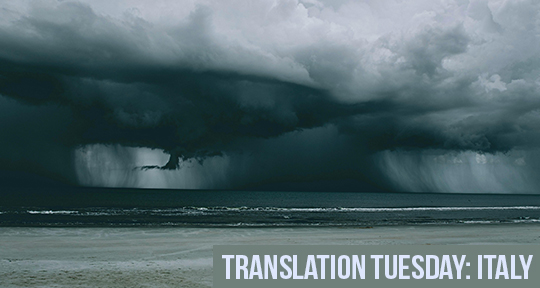
Translation Tuesday: An Excerpt from Lord of the Waters by Giuseppe Zucco

So, this was where all the rain we’d been missing for months had got to...

For this week’s Translation Tuesday, we bring you a story of the calm before the storm. Picture the sky moments before a fierce downpour: dark, oppressive, hanging over your head like a threat. This excerpt, taken from Italian writer Giuseppe Zucco‘s novel Lord of the Waters, imagines a life suspended in that moment, where the rain never comes. As the external world slows to a standstill, one family’s internal world begins to change. Freed from the obligations of social conventions, work, and school, they quickly descend into a chaotic, easy existence of games, junk food, and neglect, rewriting their familiar dynamics. Beneath their frantic cheerfulness is a persistent anxiety, as they wonder when the amassed rain will finally hit. Translator Antonella Lettieri smoothly captures these currents, refracted through the child narrator’s unaffected voice.

Amongst all the children, I was the first to look up at the sky and see it rear up. I didn’t quite see but rather felt a vast wave soar above me.

I ducked immediately, covered my head with my arms, and, thus crouching, prayed that that wave would not pull me under and wreck me upon the lamp posts and the buildings.

As I closed my eyes, I tried to picture my mother and father, hoping it would help me muster up some courage. All I could see, though, was that gurgling scene, which yet had a certain cheerfulness to it: all the other children and I doing mad somersaults inside the roiling heart of a wave fallen from the sky, our little heads bobbing atop the horrific crests of that brilliant white foam.

My sorrow lasted a second or two; then, since no water came upon us and no dreadful flood crashed down on my head, I opened my eyes again.

READ MORE…

What’s New in Translation: October 2025

New titles from Haiti, Argentina, the Netherlands, Japan, Germany, Italy, Norway, Turkey, Mexico, Taiwan, Hungary, South Korea, and Latin America!

This month, we bring you thirteen reviews from thirteen countries: a poetry collection that reimagines friendships with long-gone revolutionaries, a tender and incisive rumination on disappearance, the latest novel on the inexplicability of love from a Nobel laureate, a story of Silicon Valley-fueled descent, a compilation of Latin American feminist thought, and much much more!

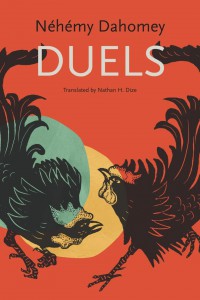
duels

Duels by Néhemy Dahomey, translated from the French by Nathan H. Dize, Seagull Books, 2025

Review by Timothy Berge

Néhémy Dahomey’s Duels is set in 1842, thirty-eight years after Haiti’s independence—a storied liberation that came through one of the largest slave uprisings in history. France withdrew, but issued an absurd debt of one hundred and fifty million francs. Paying off a debt while attempting to modernize a new country was a tough balancing act, so Haiti imposed high taxes on its citizens and forced them into unpaid labor.

Duels takes place in Böen, a small town in the Cul-de-Sac Plain that evaded a census for several years. As a result, no one in the town had fallen victim to the government’s schemes—until a local official decides that he needs laborers for a new project. From there on, in the context of freedom, economic entrapment, and postcolonial growing pains, the events of Duels unfold. Nathan H. Dize’s translation reads like a yarn spun out by an old relative with a deft deadpan humor, aptly navigating the tense shifts between past and present, and generating a sense of perpetuity for these characters and their stories. Here, the historical and the contemporary connect and blur. READ MORE…

Weekly Dispatches From the Frontlines of World Literature

The latest from Italy, Sweden, and Central America!

This week, our editors from around the world bring news of Palestinian solidarity and the necessity of individual action against genocide, debates surrounding culture and national identity, and the latest laureates of prestigious literary prizes. 

Veronica Gisondi, Editor-at-Large, reporting from Italy

Calls to end Italy’s complicity in Israel’s genocidal politics have intensified in recent weeks. While Italy’s economic and political ties to the Zionist regime are well known, citizens have been reclaiming public spaces with renewed unity and force. From statewide demonstrations on September 22—which drew more than half a million to the streets—to the general strike on October 3, many Italians have reached a breaking point underpinned by enduring forms of political grief. As the genocide in Gaza reaches its most advanced stages, the commitment of scholars such as Majed Abusalama reminds us why continued discussion is crucial: first, to anticipate how the neocolonial project will unfold—not only Israel’s, but that of its global allies—and second, to question our own role in it at “the harshest time of erasure,” both within and beyond cultural work.

Abusalama’s talk, titled “Il futuro di Gaza, la Palestina e noi” (The future of Gaza, Palestine and us), took place at CSA Vittoria, one of Milan’s squats—part of a network facing increasing threats (Leoncavallo’s eviction being a clear example) from municipal and state policies that accelerate urban privatization and erode the city’s relationship with its people. Abusalama, an award-winning journalist, human rights defender, founder of Palestine Speaks in Germany, and president of the Coalition of Lawyers for Palestine in Switzerland, described our present moment as the “last stage” of “a timeline of colonial violence” that has crushed past and future, scarring generations of Palestinians for nearly a century. By refusing to normalize their oppression, Palestinians have become experts in resistance and agency, effectively shaping models of struggle that had been later taken up by movements such as the Black Panthers and South Africa’s anti-apartheid groups. For Abusalama, to never know peace means to know one’s enemy well: for those who stand with Palestine, the enemy is imperialism, it is fascism; a fascism that “did not start on October 7,” but “has been there all the time, from the founding of Zionism until today.” READ MORE…

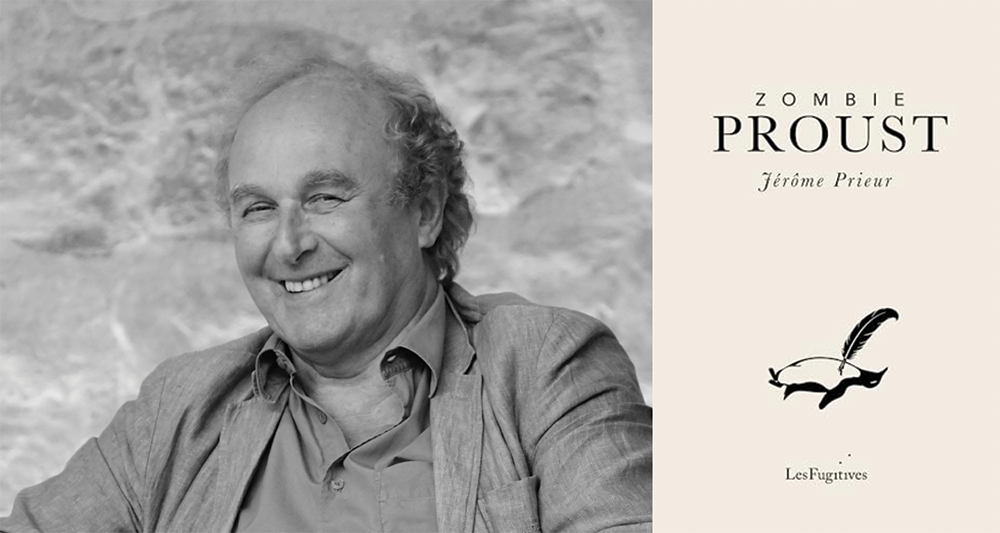
Desire and Possession: A Review of Jérôme Prieur’s Zombie Proust

Proust saw glittering Parisian dinners and costume balls as “great massacres.” His society models posed for him and were in turn “devoured” by him.

Zombie Proust by Jérôme Prieur, translated by Nancy Kline, Les Fugitives, 2025

 “Marcel Proust was never filmed at all,” asserts Jérôme Prieur in Proust fantôme, his 2001 French text rendered into English by Nancy Kline in 2025 as Zombie Proust. In 2017, however, a Canadian professor claimed that he had found Proust’s moving specter in the silent footage of Countess Élaine Greffulhe’s 1904 wedding to the Duke de Guiche. Entering the frame about 35 seconds in, Proust, or his mustached double, wearing a pearl-gray overcoat, black vest, and black bowler hat, looking somewhat less formal than the other guests and in a hurry, descends the stairs, overtakes some older folks, and exits the frame.

The discovery of this possible Proust, occuring in the interval between Prieur’s originally published text and its translation, seems to be especially meta. Whenever we talk about Proust and his seven-volume novel, In Search of Lost Time, there exists always a splintering tension between chronological and subjective recollections, motion and stillness, analogous to the temporal, spatial, and linguistic gaps between an original text and its translation. In short, there are many ways to interpret Prieur’s statement that Proust “was never filmed,” just as there are many ways to read Zombie ProustREAD MORE…

Translation Tuesday: Excerpt from This City of Dolls by Clare Azzopardi

One day the nation will be bereft of dolls

The dolls leave and don’t come back “because life in the city is unbearable.” Who cannot sympathize with their choice? In this week’s Translation Tuesday, we bring you a haunting poem by the Maltese writer Clare Azzopardi, translated into plain, elegiac English by Albert Gatt. In presenting a city mourning the exodus of the dolls, Azzopardi’s poem draws us into the spectacle of objectification, the reduction of living creature to inert, inscribed surface that precedes all mass violence. Here as elsewhere the doll is the perfect image of womanhood under fascism, but what sets Azzopardi’s poem apart is not just its mastery of the elegiac tone, but a gesture, so small it’s almost imperceptible, towards the possibility of communication with fascism’s despised other: “sometimes the protagonist is also I / and sometimes / sometimes / words are.” Read on.

The dolls migrate once a year.

They come out of their houses and walk to the shore.

It’s an auspicious day, the day the dolls migrate.

Little boats await them along the shore.

Twenty dolls take their leave, give or take.

Year after year.

READ MORE…

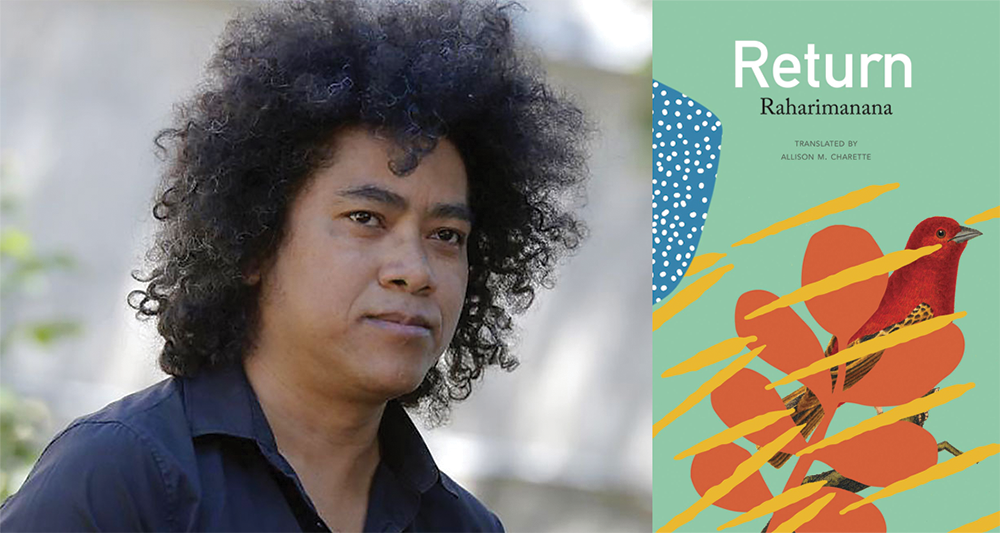
Collateral Damage: A Review of Return by Raharimanana

What would the symbols of the new nation be? Its language, its idioms, its tribes? And more, importantly, who isn’t Malagasy?

Return by Raharimanana, translated from the French by Allison M. Charette, Seagull Books, 2025

A newly independent nation. The visions of building. The sacrifices, people, losses. If this invigorating spirit is unwaveringly intoxicating, its effects are as much generational as they manifest in the present. In his novel Return, Raharimanana knits together a young man’s memories of his father and the spirituous strides taken to uphold truth against power in the aftermath of colonialism—specifically when the nascent country of Madagascar erupted in revolution in 1972 after gaining independence from the French in 1960. Hira, around whom much of the story revolves, is hailed as an oscillatory reminder of the time since Madagascar’s freedom, forming an autobiographical arc in Raharimanana’s own reconciliation with his childhood. The author’s writing also carries the artfulness of music, an art that he engages in alongside being a novelist, poet, and playwright.

In an earlier book, Nour 1947 (2001), Raharimanana penned a closer engagement with the 1947 Malagasy Uprising, dealing with the deadly killings of 87,000 Malagasys by the French colonial rule. Return, which was first published in 2018 in French as Revenir, now puts on a vivid image of Hira’s life as a touring writer and his recollections of the transitioning state of Madagascar. As he travels, he is disturbingly reminded of his father’s torture and the price paid by his family, and these fragmented recollections do not let him collate a neat history. Hence, the sections of the present are reeling with the irredeemability of time, a fracturedness that also speaks to the inability to write of a violence that is both collective and overpowering. As the novel moves on, this position culminates into renewed impetus for his writing, rife with image and poetic terseness. Being born after independence, Hira is part of a nation attempting to blossom a life out of the ruins—and this is true for Hira’s own family as well as for the country. For him, it is tiring: “But also weariness. He’d had enough of all of that. Being confronted with his country’s violence.” READ MORE…

Weekly Dispatches From the Frontlines of World Literature

The latest literary news from Spain, Belgium, North Macedonia, and India!

This week, our editors-at-large give us a window into discussions about the importance of literature in translation across cultures—as something that connects people, responds to disaster, and creates community. Read on to find out more about a conference in India, one in the Balkans, new poems and essay collections, and more!

MARGENTO, Editor-at-Large, reporting from Spain and Belgium

Asymptote contributor Felix Nicolau translated a selection of poems by the Spanish poet Fulgencio Martinez for the latest issue of the Romanian journal Apostrof. Martinez visited the Romanian Language and Culture Centre (led by Nicolau) at University of Granada back in June which triggered a fruitful international conversation. Nicolau’s exquisite renditions bring witness to the Spanish poet’s vision of the lyric as both a haven from and a look into the world’s (and “any world’s”) political turmoil and injustice. Serendipitously, these translations speak to another groundbreaking event in the other literature I follow closely; the Belgian one.

The most remarkable recent event in Belgian Francophone letters is the release of Myriam Watthee-Delmotte’s collection of essays La littérature, une réponse au désastre (Literature, Response to Disaster) from Royal Academy of Belgium’s press. The internationally-awarded academic, writer, and essayist’s book has already received impressive coverage in Belgium and beyond. Watthee-Delmotte has also recently launched a novel, Indemne. Où va Moby-Dick? (Safe and Sound: Where’s Moby-Dick Headed?) with Actes Sud) and the two books are the subject of a two-episode interview podcast on Radio France Culture and also a streaming broadcast on for two weeks in a row (September 10th through the 25th). READ MORE…

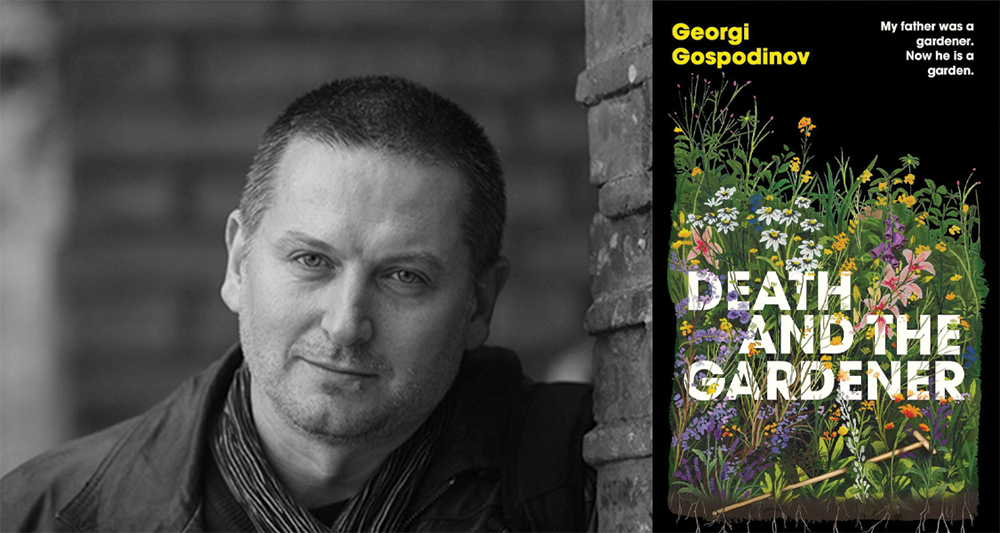
Growing, Growing, Gone: A Review of Death and the Gardener by Georgi Gospodinov

[T]he fiction of Death and the Gardener is suggesting that the only way to get through both death—and life—is by transforming experiences.

Death and the Gardener by Georgi Gospodinov, translated from the Bulgarian by Angela Rodel, Liveright, 2025

“What happens to the garden . . . when the gardener is gone?” asks the narrator of Georgi Gospodinov’s new novel, Death and the Gardner. After winning the International Booker Prize in 2023 for Time Shelter, the Bulgarian writer returns with a novel featuring a similarly famous Bulgarian writerwith the additional autobiographical detail of a father who has died from cancer, leaving his garden behind. Within this autofiction, the reader will not have to wait long for an answer to that primary, haunting question: “The garden will continue to flourish, even without its gardener, what he has planted will still grow, bear fruit, but wildness will also start to make inroads, after some time weeds and grasses will overtake everything.” The seasons will cycle the plants through life and death—and life again. In a garden, even without its gardener, there is still promise of spring; perhaps it’s this promise of revival that makes gardening an ideal outlet for grief.

I began my first garden three years ago as my dad lay dying of cancer in the living room. His friends—now my friends—had shown me how to hoe a straight line between two markers and brush in the seeds, then how to cover them with soil, going back down the lines. What they couldn’t do was prepare me for when the tilled dirt filled with weeds, for when my dad died and I inherited his house and its garden. That first summer, I ripped up endless roots, but the weeds kept on growing.

The narrator of Death and the Gardener does not work at his father’s garden after he dies, but he does use it as the central grounding image for the book that he writes. Though Death and the Gardener calls itself a novel on the cover, it reads with the intimacy of a memoir in Angela Rodel’s expert translation. Acknowledging this slippery approach to genre, the narrator admits, “This book has no obvious genre; it needs to create one for itself.” He too wonders “whether the kindling of those words cools [grief], or just inflame it all the more.” Writing, then, is taken to be like gardening after a death: a way to bargain for just a little more time with that person. This cathartic use of writing (and gardening) in grief is nothing new, but Gospodinov’s approach draws particular attention to the push and pull of the writing itself, and how this kind of detailed remembering both brings back his father and reproduces the trauma of witnessing him suffer and die. READ MORE…

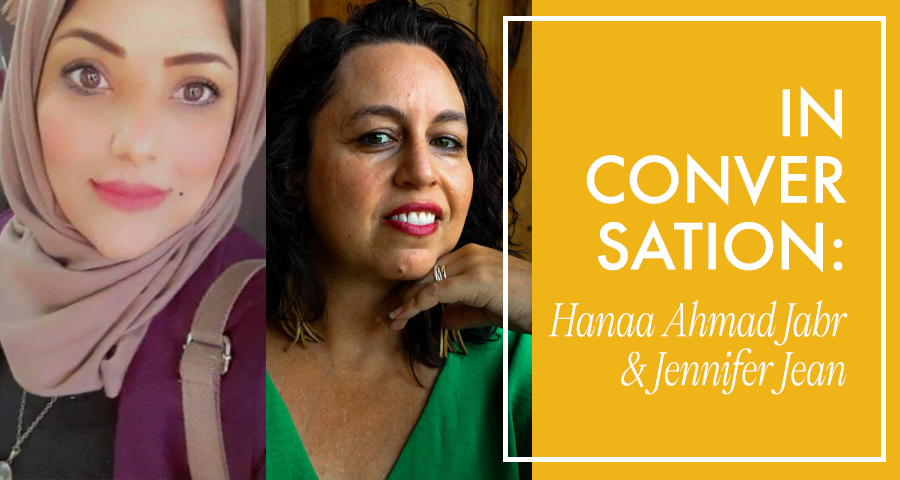
A clear sky so blue two bodies can bathe in sunlight: A Conversation with Hanaa Ahmad Jabr and Jennifer Jean about Where do you live?

I was translating life itself, each poem being written in the raw present, each a reply to another. . .

Where do you live? is a bilingual collection of collaborative epistolary poems between Iraqi poet Dr. Hanaa Ahmad Jabr (writing in Arabic) and American poet Jennifer Jean (writing in English), published earlier this year. Bridging language and borders, the collection begins and ends with the titular question, as two poets living in different countries exchange their “anger / at the way things are when they should be / better” with “one eye open / staring at the ruins of the old city,” while the “other eye is closed / hiding dreadful war scenes.” In this interview, I spoke with both poets on their collaboration, the revelations that come with the letter-writing form, and how literature serves to bridge distances.

Tiffany Troy (TT): The title of this collection is also that of the poems that begin and end the collection, and it is a provocative question because “Where do you live?” is similar yet completely distinct from “Where are you from?”. Here, where one lives becomes the space that one wants to embody. Can you speak to the decision to start the collection with the eponymous poem?

Hanaa Ahmad Jabr (HAJ): Every poem Where do you live? carries (whether directly or indirectly) an answer to that very question. When we chose this title for both my and Jennifer’s poem, it was a poetic decision, but also one that reflected deep reality; poetic, because the question reaches beyond mere geography, asking not only about place but also about the very essence of living—and reality, because between these two poems lies a rich, vivid life: one woven with memories, dreams, longing, exile, homeland, love, war, family, and friends. That’s why the collection had to open with “Where Do You Live?” for the English reader and close with “أين تعيش؟” for the Arabic reader.

Jennifer Jean (JJ): Since every poem appears in both languages, we spoke about the book being read from left to right for English readers, and also from right to left for Arabic readers. We even asked Arrowsmith Press to create two covers, one cover in English and—on what would be “the back” in America—another cover in Arabic. When I was a kid, these things were known as “flip books,” but the press wasn’t able to grant our wish due to technical difficulties. What remains of this wish is the placement of these title poems. The query in the title still opens and closes our “conversation in poems,” no matter the reader’s home language. Now that I think about it, these two poems are the furthest apart, but both explore the hometown of the heart and express the comfort of our conversations. As Hanaa says: “We are the two eyes together . . . forever.”

TT: In the epistolary-poetic tradition, prominent examples include Paul Celan and Nelly Sachs, Elizabeth Bishop and Robert Lowell, but in those relationships, the correspondence takes the form of letters rather than lyric poems. Can you speak about how you first embarked on the collaborative process, and how the need to translate back and forth added layers to that lyrical discourse? READ MORE…