Posts featuring Lawrence Venuti

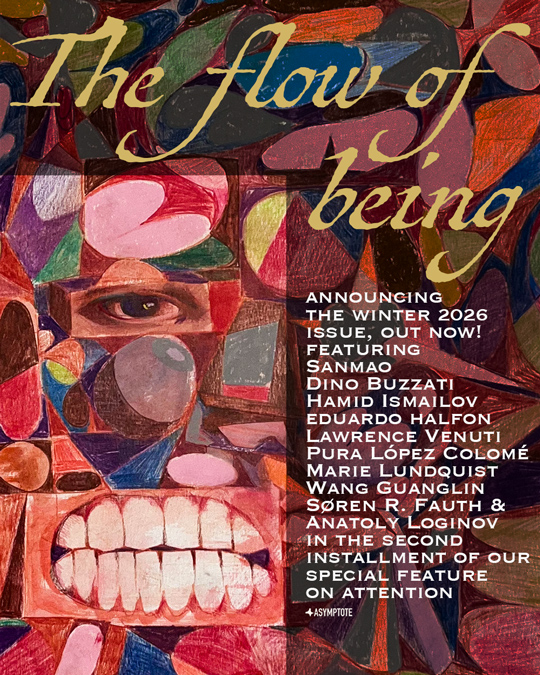
The Winter 2026 Issue Has Arrived!

World literature remains, at heart, a problem of attention: of who is seen, who is heard, and who is permitted to remain invisible.

As authoritarianism continues to take hold across the world, writers and translators are compelled to revisit an age-old question: What might art offer in response? Perhaps not answers, but something quieter and more resilient—a reminder of shared human frailty, and of the possibility that our “flow of being,” as Anatoly Loginov writes, might arrive at a “narrow neck” where attention itself becomes an existential force. Writing in our Winter 2026 Issue, which also marks Asymptote’s fifteenth(!) anniversary, Loginov turns to a literary and philosophical tradition that seeks “not mastery over an object, but communion with it, even if that communion burns.” For this second of our two issues devoted to attention, we bring together his tour de force survey of 200 years of Russian thought with a luminous travelogue by the beloved Taiwanese writer Sanmao, an excerpt from Guatemalan author Eduardo Halfon’s prizewinning Tarantula, an exclusive interview with Uzbek novelist Hamid Ismailov, a quietly devastating story by Italian master Dino Buzzati, and new translations of Milo De Angelis by Lawrence Venuti, alongside never-before-published work from 32 countries. All of it is illustrated by our talented Dublin-based guest artist Yosef Phelan.
Winter-2026_blog

If Loginov argues that attention, when cultivated deeply, can ground compassion toward others, Finnish playwright Minna Canth takes this ethical impulse further into the realm of collective action. In her barnburner drama, railway workers pushed beyond endurance channel their shared anger into defiant sabotage, making exploitation visible at last. Writing from a different frontline, Kurdish journalist Zekine Türkeri bears witness to life in the Mahmur refugee camp in the days preceding an ISIS attack, showing how attention to the living entails the inescapable labor of mourning the dead. Elsewhere, in Egyptian writer Mariam Abd Elaziz’s fiction, characters struggle to care for one another as they swim and sink in the deadly currents of maritime refugee smuggling. The issue’s arc closes with an interview in which China’s Wang Guanglin reflects on the difficulty of imagining a genuinely global literature at a moment marked by isolationism, xenophobia, and resurgent nationalism. World literature, he suggests, remains, at heart, a problem of attention: of who is seen, who is heard, and who is permitted to remain invisible.

For fifteen years, Asymptote has been organized around this problem. Founded on the conviction that literature across languages deserves sustained, serious attention, we have worked to widen the field of vision—introducing readers to voices beyond dominant centers, and treating translation not as a secondary act but as an ethical and imaginative practice in its own right. If this project has mattered to you—if you believe that attention, patiently given, can still resist the forces that would narrow our view—we ask you to help keep it alive by becoming a sustaining or masthead member. Your support ensures that the flow of being we trace here continues to move, freely and exuberantly, into the years ahead.

READ THE ISSUE

GET INVOLVED

What’s New in Translation: January 2025

Discover new work from Palestine, Sudan, Syria, Iraq, Greece, Italy, China, Sweden, Germany, Chile, and the Democratic Republic of the Congo!

In the first month of 2025, the offerings of world literature are as rich as ever. To help you on your year of reading, here are ten titles we’re most excited about—a new translation of a stargazing Greek classic; the latest from China’s most lauded avant-gardist; a rediscovered Chilean novel of queer love and revolution; a soaring, urgent compilation of Palestinian voices; surrealism and absurdism from an Italian short story master—and many more.

arabic between love and war

Arabic, Between Love and War, edited by Norah Alkharashi and Yasmine Haj, Trace Press, 2025

Review by Alex Tan

 Addressing itself to the subtle but immense interstice between the Arabic words for ‘love’ and ‘war’, which differ by only one letter, Trace Press’s community-centric poetry anthology is as much a testament to beauty and survival under the conditions of catastrophe as it is a refusal to perform or fetishize suffering for a white gaze. The bilingual collection is, further, an intergenerational gathering of voices: canonical luminaries like Fadwa Tuqan are assembled alongside contemporary lodestars like George Abraham.

Throughout the volume, language gives in to its fecundity, at times carried by a voice that “condenses history to the depths of silence”, at others seeded within a word that “alone was enough to wither a tree”. The whispered syllable, across utterance and inscription, temporarily suspends the cruelties of the real: “I love calling you habibi / because then I feel as though they haven’t destroyed our cities.” In shared intimacy, an interregnum emerges, fragile as the stroke of an ر.   

But how far can one measure the ruin and the specter of love in sentences? “I write rose and mean nothing,” the poet Qasim Saudi ventures, as if refuting the possibility of romanticism. The surveying ego can also be a trap—“my I wounding me”. Many of the writers here disclose a longing for dissolution, for blunting the edges of the self so that a liquid, collective consciousness might emerge in its stead. In Lena Khalaf Tuffaha’s idiom, “you never saw it coming, this cleansing, / how we have become this ocean”. Nour Balousha’s plangent question echoes, “Who told the wind that we were leaves?”  READ MORE…

Emma Bovary’s Adventures in Saigon, Part I

Hoàng Hải Thủy’s 1973 Vietnamese translation of Flaubert’s classic complicates perceptions of domestication and foreignization.

This is the first in a two-part series that explores the indeterminate translation effects of foreignization and domestication, as illustrated by Hoàng Hải Thủy’s 1973 Vietnamese adaptation of Madame Bovary. Read the second part here.

Note: The below version has been revised to reflect important corrections. Lawrence Venuti’s theoretical framework, as reflected in the revised essay, does acknowledge the subaltern’s perspective and show that domestication and foreignization encompass both discursive approaches and their multifaceted effects.

Since the earlier version did not fairly reflect the full implications of Mr. Venuti’s work, the author owes Mr. Venuti an apology and would like to thank him for his forbearance and collegial support.


In 1813, Friedrich Schleiermacher, the German translator of Plato, had proposed that a translator has two choices, “either such translator leaves the author in peace as much as possible, and moves the reader towards him; or the translator leaves the reader in peace as much as possible, and moves the author towards him.” The former technique could be defined as foreignization, and the latter domestication. Today translation scholar Lawrence Venuti has expanded on Schleiermacher’s perspective by constructing an ethics of difference in translation. According to Venuti, translations geared toward domestication effects risk perpetuating certain uncontested beliefs in the maintenance of the status quo. As a corrective, he has proposed a meticulous yet adaptable theoretical framework that can illuminate any translation, regardless of language and culture, regardless of their status as dominant or dominated, major or minor. In his view, foreignizing translations can expand the linguistic and stylistic resources of the translating language by broadening the parameters of readability.

If we define foreignizing as a translation approach that creates noticeable effects and variations from the prevalent standard, and domesticating as conforming to pre-existing norms, how do we gauge these effects against a translator’s stated intention, his unconscious bias, inadvertent omissions or errors? My essay attempts to illustrate these questions by discussing Hoàng Hải Thủy’s Người Vợ Ngoại Tình—his 1973 adaptation of Gustave Flaubert’s Madame Bovary.

READ MORE…

Coals to Newcastle: A (biased?) Slovak overview of a century in American literature

The ambition of the “American” issue of RSL was to resist preconceptions and cross boundaries.

Small cultures import disproportionately more texts—both translated and original—than they export. However, literatures using a language with a limited number of speakers are not just markets for globalised goods. Translations quite naturally also help them develop and sometimes even exist, as cases of small languages that ceased to be the target languages for translations show. Revue svetovej literatúry (Review of world literature) is a Slovak magazine founded in the “golden” 1960s that brought an abundance of new impulses to Slovak literature from all over the world for the past fifty years. Late last year, writer and translator (and Asymptote past contributor) Peter Macsovszky and literature and translation scholar Ivana Hostová edited and co-translated (with the help of a team of translators) an issue of the magazine with a focus on contemporary and twentieth-century Anglophone literature from the US.

In her Buying into English (2008), Catherine Prendergast analyses the semantics and economics linked to the ability of speakers of a minor language—in this case Slovak—to use the language of global communication. She compares the perceived value of English in Slovakia immediately after the fall of state socialism and then in almost two decades in the post-communist Slovakia. The strict restriction of the flow of information between socialist Czechoslovakia and the Western world gave rise to an idealised notion of the Anglophone (and, more specifically, American and capitalist) world. It came to signify freedom and prosperity and was—in the minds of many Slovaks—expected to embrace and accept with curiosity and eagerness the cultures and peoples freed from the socialist regime. Prendergast suggests that the notion was only abandoned after it slowly became clear that “the lingua franca is language-as-battlefield; it is the terrain upon which players in the global information economy grapple for property, respectability, and political voice.” Now it has become obvious that it takes more than pureness of heart and an admiration for the American culture and way of life to extract any interest from what Michael Cronin in his Eco-Translation (2017) has called the crowded Anglophone attentionscape.

The proportion of imported versus exported goods including cultural products can be very well illustrated by the amount of translations produced in the Anglophone countries as opposed to cultural spaces[i] like Slovakia. Therefore, wanting to import even more texts from the dominant to small culture might seem like carrying coals to Newcastle. However, if we try to differentiate between a piece of writing as a commodity that primarily generates economic profit and institutional legitimation and look at the autonomous sections of the literary field—at those works that were not created to make the author famous or rich, but which came into being in order to exist for themselves and in their own right—it may come as a surprise that not much American writing can really be found in Slovak translation. In this context, an issue of a Slovak literary magazine bringing translations of Anglophone writing from the United States seems redundant only at first glance. Most of the literature written in the US that gets translated into Slovak nowadays can best be described as a commodity—currently, the best-selling book in the biggest Slovak bookshops is the translation of Dan Brown’s Origin (2017)—it is the kind of writing that, although undeniably culturally domineering and shaping the receiving context, does not inspire in the sense of creating resistance to the existing (cultural) preconceptions or fluent strategies of reading.

READ MORE…