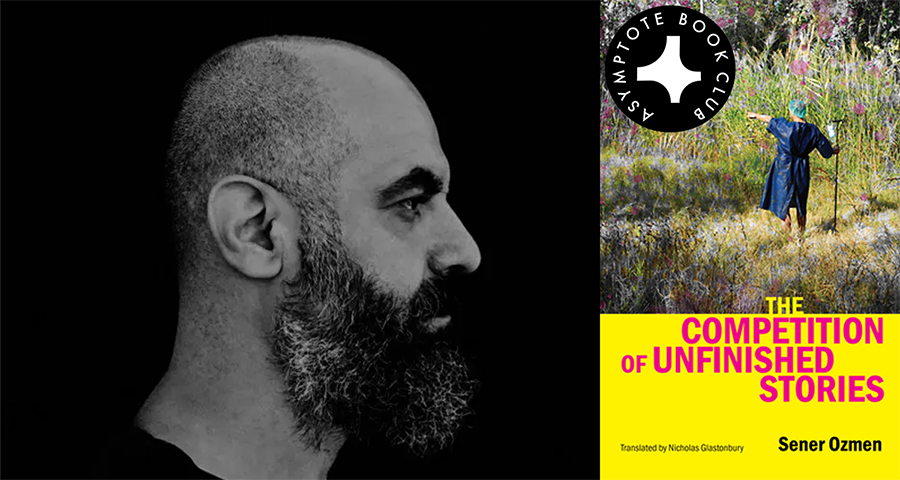
Announcing Our November Book Club Selection: The Competition of Unfinished Stories by Sener Ozmen

From a Turkish perspective, there is no Kurdistan . . . . Ozmen’s novel meditates on what this effacement does to someone’s subjectivity.

Dizzying, furious, scathing, and absurdist—artist and writer Sener Ozemen’s The Competition of Unfinished Stories is a testament to an identity, region, and language under siege. The novel, with its many layered narratives, confronts the Turkish state’s enduring violence against its Kurdish minority, illustrating the psychic and physical fractures of oppression with intellectual complexity and emotional clarity. In attempting to disentangle the knot of selfhood from a merciless assimilating power and a growingly fragmentary everyday existence, Ozmen builds the architecture of fiction to its most veering heights, capturing all the threads of reality’s illusions, and thus resulting in one of contemporary fiction’s most vivid portraits of psychological dissolution—that which still never turns away from the need to express its truths.

The Asymptote Book Club aspires to bring the best in translated fiction every month to readers around the world. You can sign up to receive next month’s selection on our website for as little as USD20 per book; once you’re a member, join our Facebook group for exclusive book club discussions and receive invitations to our members-only Zoom interviews with the author or the translator of each title.   

The Competition of Unfinished Stories by Sener Ozmen, translated from the Kurdish by Nicholas Glastonbury, Sandorf Passage, 2025

In her book Immemorial, Lauren Markham notes that “the feeling of grieving something that isn’t yet gone, and whose disappearance isn’t fully certain . . . is an eerie, off-putting one.” This liminality and its disquieting effect are what animates Sener Ozmen’s The Competition of Unfinished Stories, deftly translated by Nicholas Glastonbury. This is not only the author’s debut in the Anglosphere, but one of the first works written in Kurdish’s northern Kurmancî dialect to receive an English translation.

Ozmen is a prolific Kurdish writer and multimedia visual artist, the author of numerous books of poetry, novels and short stories, criticism, and artist books. Across his written oeuvre and artistic practice, he has drawn attention to both the urgency and difficulty of speaking from a position of marginalization; The Competition of Unfinished Stories, originally published in Kurmancî as Pêşbaziya Çîrokên Neqediyayî in 2010 and translated into Turkish as Kifayetsiz Hikâyeler Müsabakası in 2015, follows in this spirit. The novel dramatizes—in a challenging and disorienting way—that the stories one tells are always co-authored and situated, demonstrating the interrelatedness and imbrication of the self. As Judith Butler observes in Giving an Account of Oneself, “When the ‘I’ seeks to give an account of itself, an account that must include the conditions of its own emergence, it must, as a matter of necessity, become a social theorist.”  READ MORE…
Notes on the Literature of Migrant Workers

While it remains unclear if these migrant workers’ voices will enable significant social reform, their visibility is a promising start.

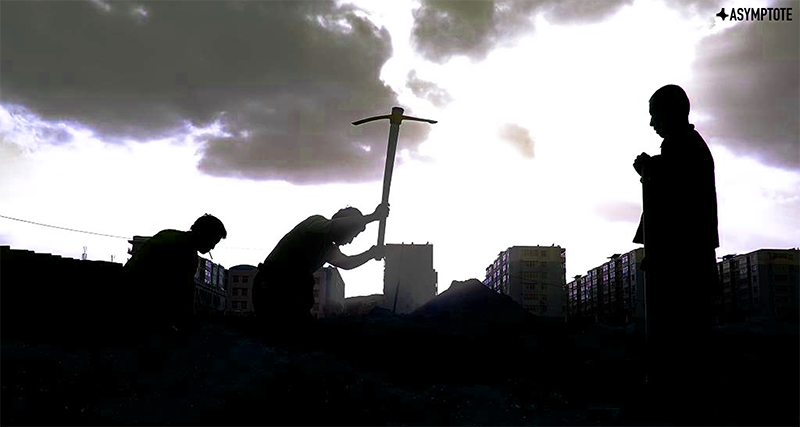
Chinese literature has recently experienced a boom of “migrant workers’ writing”—largely autobiographical works produced by individuals involved in the nation’s sprawling gig and service economy. From deliverypersons to housekeepers to drivers, these marginalized laborers reveal in their writing the hardships and intersectional complexities that their positions make them vulnerable to, testifying to the thanklessness and extreme demands of their essential roles, and thus giving a pivotal view as to what constitutes the nation’s varied and persistently hegemonic social fabric. In this essay, Jianan Qian gives background to this rise and its unveiling of public secrets—the truth of what it takes to keep the enormous engine of China humming.

1.

I first heard the voices of the migrant workers not through literary works, but through popular songs. In 2010, a music video of two men singing Wang Feng’s “In the Spring” went viral on Chinese internet; in the shaky images captured by a handheld camera, the singers—later known as the duo Xuriyanggang—stood bare-chested in a cramped rented room. They were tanned, their faces and necks reddish from long hours of outdoor labor. In raw voices, they sang the chorus:

If one day, I grow old

and have nowhere to turn,

Please bury me,

Bury me in the heart of the spring.

In the original music video, Wang—a Beijing native and now an established musician—is looking nostalgically back on the spring of his youth, when he was a nameless music school student dedicated to his dream. The line “having nowhere to turn” sounds melancholic in his voice, perhaps signaling the common anxiety of aging, but in Xuriyanggang’s version, it indicates a future of being aged and homeless, speaking to the literal reality of the migrant workers looking towards it. The hukou, or household registration system in China, restricts its citizens’ access to education, healthcare, and pensions to their place of birth; thus, for many rural-born Chinese whose truncated education have forced them to take up labor jobs in major cities (turning them into “migrant workers”), they may still be deemed illegitimate residents after spending most of their lives in the cities they helped build, and thus are subject to displacement.


2.

Around the same time in the early 2010s, the voices of migrant workers also began to gain attention in the literary world. By committing their raw experiences to writing, they introduced the reading public to a stream of narratives that outline the deprivation, denial, and reduction consequential to the hukou system. Amongst them was Xu Lizhi, a young assembly-line worker at the Foxconn factory in Shenzhen, who recorded his angst in poetry. In one of his most circulated pieces, he wrote:

I swallowed a moon made of iron

They called it a screw

I swallowed the industrial sewage, the unemployment files

and youth cut short by bending over the machines

I swallowed the hustle and the displacement,

the pedestrian overpass, and life overgrown with rust

READ MORE…

Translation Tuesday: Beanstalk by Dominika Słowik

On Thursday, a beanstalk started growing out of my nose.

Today’s Translation Tuesday Feature “Beanstalk”  is taken from Samosiejki (Self-Sowing, Wydawnictwo Literackie, 2021), an eco-critical short story collection by the emerging Polish author Dominika Słowik. Compared to the other stories within the same collection, translator Jess Jensen Mitchell says this particular piece “has an especially light comic touch as it riffs on  bodily sensations, capitalism, and the whims of a quirky midlife woman-turned-plant. It is an ASMR for the soul, an ode to joys vegetable, animal, and mineral.” Need we say more? Read on!

On Thursday, a beanstalk started growing out of my nose.

On Saturday, it reached halfway up my forehead.

On Sunday, I was overcome with the desire to dip my feet in a cool tub of water.

On Tuesday, the first leaves appeared.

On Wednesday, without realizing what I was doing, I ran out into the rain, turned my face to the sky, and just stood there like that with my mouth agape for a good fifteen minutes.

Then I remembered how I got an F in my third year of grade school because I didn’t hand in my environmental science project. I was supposed to grow a bean sprout on a piece of moistened gauze. As luck would have it, the bean disappeared. We blamed our dog at the time, because I couldn’t have stealthily inhaled a seed, right?

I did a brief round of soul-searching. Of course I could have. I never liked my environmental science teacher.

It explained a lot. Whenever I got sick, only one of my nostrils would leak. If I started to run, I’d lose my breath immediately. I had an excellent tolerance for unpleasant smells and I was always picking my nose—despite forty-odd years on this planet, I never kicked the habit. READ MORE…

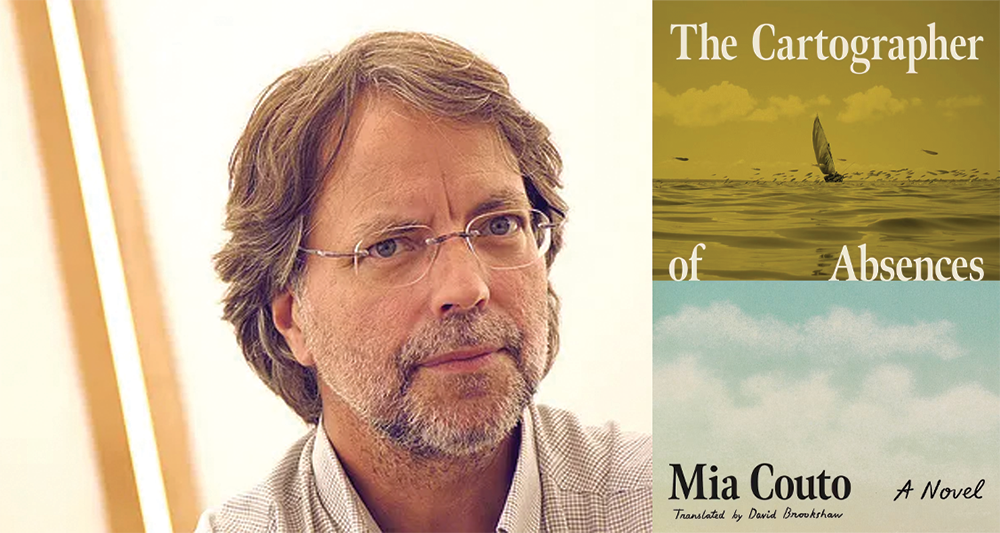
Mapping the Invisible: A Review of The Cartographer of Absences by Mia Couto

. . . Couto opens what we thought was settled, exposing what we buried, leaving us no choice but to witness the revelations.

The Cartographer of Absences by Mia Couto, translated from the Portuguese by David Brookshaw, Farrar, Straus and Giroux, 2025

In March 2019, as Cyclone Idai bore down on Mozambique, it arrived with a weight familiar to Mia Couto. The author, born in Beira—the country’s second-largest city—in 1955, had spent decades chronicling how both natural and manmade violence has torn through his homeland, leaving open, unhealing wounds. In his latest novel, The Cartographer of Absences, the cyclone’s approach is both the temporal frame and symbolic force of such persistent fractures; the storm unearths what has been buried and almost forgotten.

The novel follows Diogo Santiago, an internationally recognized Mozambican poet, who returns to his birthplace of Beira for a literary tribute. Suffering from depression and unable to write, he sets out on the journey to ostensibly “lay his memories to rest,” and expects a ceremonial homecoming. Instead, he receives a cardboard box from Liana Campos, a mysterious resident whose grandfather once served as an inspector with PIDE—Portugal’s brutal secret police. The box contains a trove of documents from the final convulsions of Portuguese colonial rule: interrogation transcripts, confiscated poems, bureaucratic reports, and family papers. Together, they reveal the hidden architecture of violence that has shaped both Diogo and Liana’s families, including the fate of the former’s cousin, Sandro, who disappeared during the war, and the suspicious death of the latter’s mother, Almalinda. READ MORE…

November 2025: Upcoming Opportunities in Translation

An open house with Queens College, and more of this month's opportunities in world literature!

EDUCATION

QC_MFA_Asym_Apply_700x150_

QUEENS COLLEGE MFA IN CREATIVE WRITING &  LITERARY TRANSLATION

The MFA Program in Creative Writing & Literary Translation at Queens College—located in the most culturally and linguistically diverse in the nation—will hold a virtual Open House information session, December 4, 5-6pm EST. The program is dedicated to crossing boundaries in genre, craft, and language. Our literary translation track offers students an opportunity to work intensively on craft and pursue professional opportunities in the field. Classes are small, and students work closely with faculty mentors. Translation students also take cross-genre courses in our other tracks in poetry, fiction, and creative nonfiction. Apply by March 15 for financial aid consideration; final deadline April 15. For a zoom link and more information, see their website.


EVENTS

BCLT RESEARCH SEMINAR: TRANSLATION AND MULTILINGUALISM IN INDIAN FRANCOPHONE WRITING

This coming Wednesday, November 26th, join author, translator, and past Asymptote contributor Sheela Mahadevan for a virtual exploration of the works of Indian writers in French. The talk will explore the “entanglements between French and Indian languages, literatures and cultures” that have arisen as a result of processes of translation and “transcreation” in the work of Indian writers writing in the French language. The impact of French literature on some literary traditions in India—a phenomenon arising from Indian writers undertaking acts of French translation during the post-independence period—as well as the role of multilingual translations in shaping certain political and cultural agendas, will also be discussed. The event will take place online from 4-5:30pm GMT. Register here. 

READ MORE…

Weekly Dispatches From the Frontlines of World Literature

The latest in literary updates from Bahrain and Puerto Rico!

This week, we are proud to introduce one of our newest Editors-at-Large, Amal Sarhan, for Bahrain, alongside first-time contributor Alejandra Camila Quintana Arocho, who gives us a dispatch from Puerto Rico. From a long-delayed book fair and ongoing discursive panels in Bahrain to the launch of a new book festival in Puerto Rico, read on to find out more!

Amal Sarhan, Editor-at-Large, Reporting from Bahrain

Bahrain is a quiet country to many. Dotted with date palms, surrounded by sea, and appearing as a mere speck of dust on the world map, it is natural for locals to feel an air of insignificance, including with regards to its literary scene. While the bellows of the recent launch of the 20th Sheikh Zayed Book Award, the Riyadh International Book Fair in October, and the ongoing Sharjah International Book Fair reverberate far into the Arabian Sea, the Bahraini equivalent has been delayed for years, our dismay at which has been cleverly captured in this very poignant caricature by the famed Bahraini artist Khalid Al Hashimi.

READ MORE…

Translating Time and Space: An Interview with Karen S. Kingsbury and Jie Zhang on Eileen Chang’s Time Tunnel

At times, it felt as if Eileen Chang herself was both absent and ever-present—not physically, but constantly in our minds as we negotiated. . .

Time Tunnel, the latest collection of the masterful Eileen Chang, furthers the English-language legacy of a writer dedicated to documenting life as it is lived: the multiplicity, the manifold, the vertical and horizontal journeys, the era as it intersects with the individual. Putting together both fictions and non-fictions, translators Karen S. Kingsbury and Jie Zhang present the late Chinese author in her many stylistic and thematic shades, cementing her contemporaneous concerns with her literary heritage, her peripateticism with her depth, and her reputation with her idiosyncrasy. In this interview, they speak on their intimate collaborative process, the global spread of Chang scholarship, and the aspects of self that they brought to this text.

The Asymptote Book Club aspires to bring the best in translated fiction every month to readers around the world. You can sign up to receive next month’s selection on our website for as little as USD20 per book; once you’re a member, join our Facebook group for exclusive book club discussions and receive invitations to our members-only Zoom interviews with the author or the translator of each title.  

Hongyu Jasmine Zhu (HJZ): How did the two of you first come to Eileen Chang’s work? What first drew you to her writing, and what keeps drawing you back to it?

Karen S. Kingsbury (KSK): I have a really long answer, because I’ve been working on Eileen Chang now for about three decades. I first got attracted to her when I was in graduate school in New York City; I was on a mission to find a modern Chinese writer—preferably a woman writer—who would really hold the attention of English department professors, the ones I had been trained under as an undergraduate, whom I would describe as fairly old-fashioned and very Britain-focused in their sense of literary value. So I basically had a chip on my shoulder. I was like: I want to show you that there are good things outside of English, that there are great things in China.

I feel that many years later, a lot of that has been accomplished—certainly not by me, but by Eileen Chang, and by a very large community of readers and translators. So I just want to let people know that Love in a Fallen City (which is not in this volume, but is in an earlier volume I worked on) is now in the Norton Anthology of World Literature. It was also saluted in Granta, which I have a lot of respect for, as “The Best Book of 1943.” And Goodreads, which is an interesting barometer of interested readers from a lot of different backgrounds, not only describes Eileen Chang as having a stark and glamorous vision, but calls her “a modern master.” So I think that some of my initial incentives have been seen through to fruition, and I’m really excited about that. READ MORE…

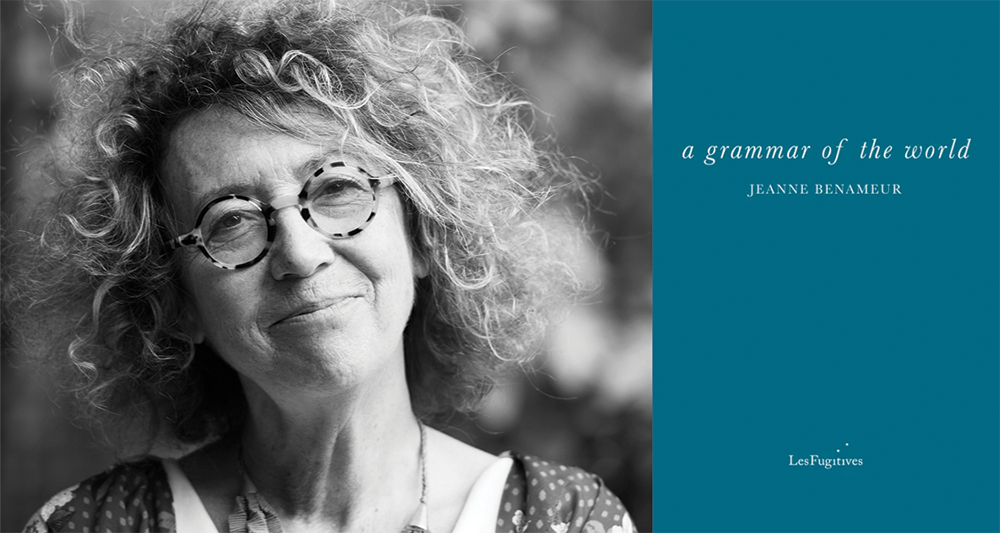
Beachcombing on The Shores of Belonging: A Review of a grammar of the world by Jeanne Benameur

Benameur . . . writes hoping for a third space where languages might meet and reconfigure one another.

a grammar of the world by Jeanne Benameur, translated from the French by Bill Johnston, Les Fugitives, 2025

The oeuvre of the Algerian-French writer Jeanne Benameur ranges from poetry (Naissance de l’oubli) to an award-winning novella (Les Demeurées) to various works of nonfiction, and in her latest work to be released in English, a grammar of the world, readers are introduced to her voice in verse. The collection details the author’s journey from Algeria—just before the declaration of Algerian War of Independence—to La Rochelle in France where she grew up, a transition explored with the complexity of migration and belonging, and suffused with potent mytho-historical narratives. Through her personal experiences of departure and a complex familial history (with both Italian and Tunisian-Algerian roots), Benameur explores the slow persistence of syntax both in life and in language, which—however displaced and fragmented—can still be reassembled into something habitable and meaningful. The lines of a grammar of the world unfold without punctuation, their sparse cadence travelling over the subsequent pages in soft tidal motions, culminating in a single long poem in free verse, with occasional phrasal recurrences to generate a momentum between its various contexts. Throughout, the voice shifts between ancient and contemporary, depending on whether it is situated in historical precedence or mythical imagery; the speaker gently walks between memory and myth.

We begin with an invocation of Isis, the Egyptian goddess who resurrects her slain brother and husband Osiris, and subsequently produces their son, Horus. According to one of the Egyptian myths, Isis helps the dead enter the afterlife, as she had once helped Osiris by collecting his scattered body parts from across Egypt—and this myth later gave rise to the earliest practice of mummification. In a grammar of the world, it is this act of harvesting and laying to rest that Benameur focuses on, envisioning Isis as the weary sister who bends to rescue what remains in the aftermath of war and displacement. ‘she gathers up what no longer belongs’, writes Benameur: “pieces // she braves that which is scattered’. READ MORE…

Translation Tuesday: “To Banvard’s Madness, Everyone” by Paola Silvia Dolci

The encounter / is fleeting / and momentary.

How closely can a poem capture the experience of seeing a film, and seeing one cut up at that? For this week’s Translation Tuesdaywe bring you an answer: a cycle of seven poems by Italian poet Paola Silvia Dolci, translated into English by the author herself. In these almost-ekphrastic verses, Dolci seeks not to describe the literal content of the film, but rather to capture the experience of seeing a film fragmented, reduced to a string of disconnected images—by damage to the film itself or constant interruption of the audience, we do not know. What we know, instead, is the hypnotic effect of the sequence, the dreamlike state induced by each isolated vignette, the plangent feeling that lingers as each slips away. Read on!

In the cinematic text, the scenes are fragments of a film; reality is never whole, but always broken down into details, movements, images that slip away.

It is a meeting between strangers, there’s a sense of waiting, of possibility, that intersects without ever belonging to one another.

1

In this scene of the film,
the two strangers
meet
at an abandoned little table
in front of the Splendid Mayer.

It’s almost winter, it’s cold,
and the sails are in regatta.
“By now November feigns nothing.”

READ MORE…

Poetry’s Combinations and Doublings of Reality: An Interview with Peter Cole

To translate is to listen past the statue and the slogans, until the poem’s raw anxiety and unexpected sympathy finally speak.

Peter Cole, a MacArthur Fellow and a Professor in the Practice at Yale, is a poet and a translator from Hebrew and Arabic. His past translation projects include the Hebrew poetry of Muslim and Christian Spain, the poetry of Kabbalah, and the works of the Palestinian poet Taha Muhammad Ali. In October, New York Review Books brought out On the Slaughter, Cole’s translated selection of poems by Hayim Nahman Bialik (1873-1934), the Ukrainian-born Jew who became not only the pre-eminent Hebrew poet of his time, but also the major cultural figure of both the Jewish diaspora and the nascent Jewish community in Ottoman and British Mandate Palestine. Bialik is still regarded as something of the patron saint of modern Hebrew literature.

Recently, I paid Cole a visit in New Haven. Walking along the harbor, sitting over tea and dried apricots at his table, and, later, conversing over email, we discussed the mists surrounding the complex and contested figure of Bialik; October 7 and its genocidal aftermath in Gaza; how translation fits into the matrix of history, poetry, and ideology; and more.

Daniel Yadin (DY): I’d imagine that many of our readers are hearing about Bialik for the first time, though he’s an institution in the Jewish world. Bialik is the poet of modern Hebrew—at least, the granddad of the bunch. In your introduction to On the Slaughter, you talk about the ways in which you present a counter-reading of the poet. I agree you’re reading against the grain here. Would you say you’re also translating against the grain?

Peter Cole (PC): At the most basic level I’d say I was actually translating with the grain of the poetry—and certainly its granularity, since translation as I know and love it entails the slippery business of trying to give an honest, if fabricated, account of one’s readings and what Blake calls their minute particulars. That’s “fabricated” as in constructed or woven, a made thing.

DY: Almost tactile.

PC: Almost and then some. I’m trying to bring a compound of literary and historical alertness to my encounter with these poems. At the same time, I’m also translating against the grain of the received version of Bialik, who—as you note—was a titan of Hebrew poetry in a public way that may be hard for Americans to wrap their minds around. Some 100,000 people attended his 1934 funeral in Tel Aviv—which is to say, half of the Jewish population of British Mandatory Palestine.

READ MORE…

Weekly Dispatches From the Frontlines of World Literature

The latest from Spain, Romania, India, and the Philippines!

This week, our editors bring news of publications with big reputations, celebrations of nature writing in the Himalayas, and a new city joining the prestigious line-up of UNESCO Cities of Literature. Read on to find out more!

MARGENTO, Editor-at-Large, reporting from Spain

From November 5 through 11, the Romanian Language and Culture Center at the University of Granada, Spain hosted a series of events featuring the major voices and rising stars of contemporary Spanish poetry, some of whom included writers with Spanish-Romanian identities, connections, or collaborations. Amongst them, the prolific and multiply awarded Romanian-Spanish poet and painter Mariana Feride Moisoiu was given top-billing, and people crowded in for her reading-performance.

Feride Moisoiu is the founder of the international festival Mujer, Manantial de Vida (Woman, Source of Life), in addition to coordinating the festival Grito de Mujer (Woman’s Scream) in Villa del Prado, Madrid, which focuses on women’s voices, empowerment, and gender equality. She serves as the executive director of the literary magazine Krytón (also published in Villa del Prado), while also being the honorary president of the Casa Nacional de Rumanía (Romanian House/Institute) in Getafe. The event in Granada presented an opportunity for Feride Moiosiu to launch the latest issue of Krytón, coedited with poet Cristian Mihail Deac, which pays tribute to the journal’s founder, Cornel Drinovan. During her reading, the poet moved the audience through a serene and relentless, indomitable cadence, one that placed lyric femininity at the heart of a multifaceted—political, sentimental, and cosmic—vision. READ MORE…

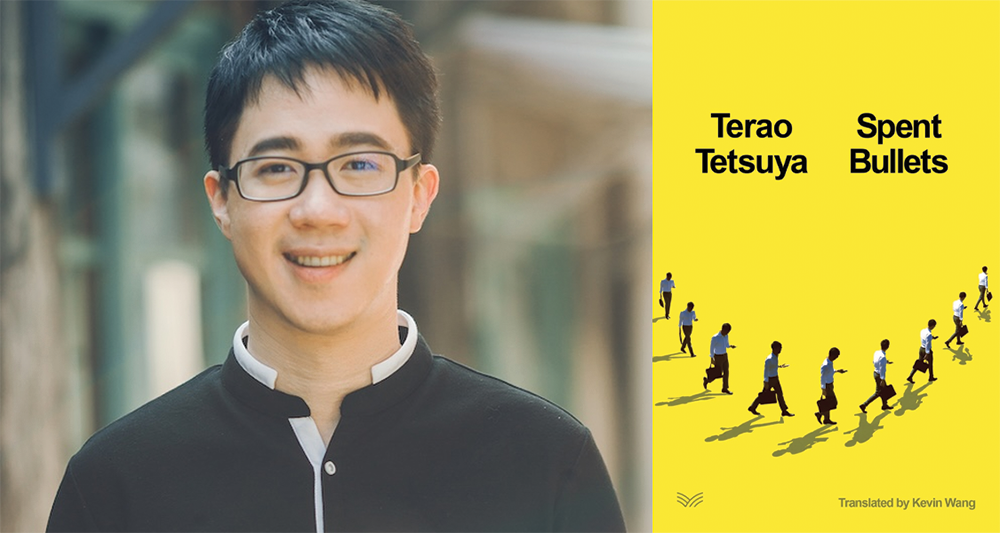
Not a Bit of Regret: A Review of Spent Bullets by Terao Tetsuya

Each of the stories . . . is a universe in and of itself, a crystalline snapshot of a life.

Spent Bullets by Terao Tetsuya, translated from the Chinese by Kevin Wang, HarperVia, 2025

In his now-ubiquitous essay “The Myth of Sisyphus,” Albert Camus compares Sisyphus to an office worker. “The workman of today works every day in his life at the same tasks, and this fate is no less absurd,” Camus claims, comparing middle management to his titular hero. Now, in Spent Bullets, a dystopian, propulsive short story collection, the Taiwanese writer Terao Tetsuya renders Camus’s absurd workmen as a contemporary group of computer scientists, whose extraordinary brilliance belies the banality of their striving. (“Terao Tetsuya” is the pen name of Tsao Cheng-hao, taken from the names of manga characters Koichi Terao in “Over Drive” and Tetsuya Kuroko in “Kuroko’s Basketball.”)

Spent Bullets contains nine interlocking stories, following its central characters from junior high school to National Taiwan University to Silicon Valley. They are loosely constellated around the suicide of the impossibly gifted Jie-Heng, who, after reaching the upper echelons of a Californian tech firm, throws himself off a balcony in Las Vegas. The core cast of characters is rounded out by Ming-Heng, a college classmate and juvenile Go champion, and the Machiavellian Wu Yi-Hsiang (the only character given a family name), lover and tormentor of Jie-Heng. Other characters float at the periphery, including Hsiao-Hua, a classmate whose botched suicide attempt leaves her paralyzed, and Hsin-Ning, a lesbian classmate with whom Jie-Heng enters into an engagement of convenience. READ MORE…

The Erosion of Meaning: A Review of Sympathy Tower Tokyo by Rie Qudan

In the novel we see the ways in which AI . . . neutralizes and algorithmicizes language, rendering it less precise and more ambiguous. . .

Sympathy Tower Tokyo by Rie Qudan, translated from the Japanese by Jesse Kirkwood, Penguin, 2025

Rie Qudan’s latest novel, Sympathy Tower Tokyo, garnered controversy in Japan when it won the prestigious Akutagawa Award in 2024. Questions immediately arose after the author announced that she used AI to help write parts of the story: around 5%, she specified. This led to the expected outrage regarding the dangers of AI in the arts, especially considering that the prize committee was unaware of its usage when they selected the novel. This is particularly interesting when at its center, Sympathy Tower Tokyo is a book about language—how words shape our thoughts and build our dreams—but it is also about the social consequences when language begins to lose its meaning.

Set in the near future, the novel’s igniting incident is a gigantic new prison being constructed in the heart of Tokyo. The commission for the building’s design has gone to celebrity architect Sara Machina, who wants to create a big beautiful tower, one that will stand in conversation with Zaha Hadid’s National Stadium. In this alternative Japan, Hadid’s stadium was built in time for the 2020 Olympics, which took place as originally scheduled (contrary to its delay due to COVID). The new prison, the titular “Sympathy Tower,” is intended to be a place of rehabilitation for those labeled Homo miserabilis, or “humans deserving sympathy.” It is thus meant to convey the idea that incarcerated prisoners are themselves victims of systemic economic and social injustice—including murderers and rapists. READ MORE…

Translation Tuesday: “Cinderella” by Kārlis Skalbe

When she had looked at the new moon, she saw a huntsman, who had gotten lost in the green forest and blew his horn with a golden cornet.

For this Translation Tuesday, we’re bringing you a new riff on a familiar story—minus the glass slippers and pumpkin coaches. In Latvian writer Kārlis Skalbe‘s reimagining, which draws on traditional folklore, Cinderella is a haplessly put-upon girl relentlessly bullied by her cruel stepmother. Forced to meaninglessly labor day and night, she nonetheless cultivates an inner life through song and fantasy. While there’s no fairytale ending to be found here, her emotionally rich, sensorial connection to the world offers a salvation of its own. Translator Ian T. Gwin would like to thank Marianne Stecher, Guntis Smidchens, Līga Miklaševica, and the students at the University of Washington for their assistance reading and translating this text.

Cinderella did dirty work and ate dirty bread. None of the tomcats in Riga came for her kļiņgeris, like they did for girls with real mothers. Cinderella’s days were bitter as bread baked from chaff. Morning and evening she sat by the stove, her hair uncombed, picking flaxseeds from the ashes. The ashes were hot, but she patiently sieved through them, blowing through her fingers and gathering the brown kernels in her palm. These her stepmother threw back into the cinders, so she would always have work to do.

Real daughters gathered dowries and took care of the folk. Stepdaughters worked from dawn to dusk, and slaved over nothing but tears and embers. She liked to sing when she stayed by the hearth, so as not go get weary from gathering her dowry of dust.

“Spinning a wreath, a wreath,
so I gathered my dowry,
Dressing my youth in cinders,
I spun a dowry of dust.”

She couldn’t hope to marry the sons of honest men. For who would want to dress in cinders and what young buck would throw ash back at a wretched child of loneliness? But Cinderella sang, imagining herself:

“When the bell of the suitors rings,
My prince in gold will sing”

READ MORE…