Posts featuring Yasmine Haj

The Four Colours of Blood: An Interview with Norah Alkharashi and Yasmine Haj on the Arabic Poetry of Love and War

The more we bridge our languages, the more effective our collective resistance can be.

In Arabic, the word for ‘love’ (حب) is nearly identical to the word for ‘war’ (حرب), differing by just one letter. The nearness and linguistic kinship between these two words is a felicitous metaphor for the tropes examined in the poetry anthology Arabic, between Love and War, published by Tkaronto, Canada-based trace press.

Arabic, Between Love and War assembles important voices from across the Arabophone world, such as Nour Balousha of Palestine, Najlaa Osman Eltom of Sudan, Rana Issa of Lebanon, Qasim Saudi of Iraq, as well as diasporic Arab poets in Canada, the United Kingdom, Sweden, and the United States. Edited by Palestinian poet Yasmine Haj and Saudi translator-scholar Norah Alkharashi, the anthology features poems translated from Arabic into English and vice versa, a number of which have garnered accolades such as the Lambda Literary Award, Atheer Poetry Prize, Arab American Book Award, and appeared in poetry collections published in Damascus, Beirut, Juba, California, Basrah, Algiers, and beyond.

In this interview, I spoke with both Haj (in Paris, France) and Alkharashi (in Ottawa, Canada) about the anthology and the ways in which the poetry of love and poetry of war converge.

Alton Melvar M Dapanas (AMMD): Congratulations to both of you on this riveting anthology, Arabic, between Love and War! How did this book come to be, and how is it particularly relevant and urgent today?

Yasmine Haj (YH): Thank you, Sam. This book is the epilogue to a workshop organised by trace press, ‘translating [x]’, in which Norah and I co-facilitated six online sessions on literary translation from Arabic. As we structured the workshop, we were drawn to the aesthetic of the words love and war in Arabic, and how the removal of one letter throws one word into its apparent opposite. We discussed the idea with the participants, some of which mentioned how tired they were of our world being discussed through the prism of war. This was in late 2022, early 2023, before Zionism heightened its genocide of Gaza and any reminder of indigeneity. We had no idea we would be editing this volume, with all its submissions, as we watched Palestine oscillate between those very two words, and other genocided lands fluctuate right along with it. Love of land, of people, and war waged upon that very existence, have been ongoing for more than a century, adding to the six hundred years of imperial annihilation and substitution. READ MORE…
What’s New in Translation: January 2025

Discover new work from Palestine, Sudan, Syria, Iraq, Greece, Italy, China, Sweden, Germany, Chile, and the Democratic Republic of the Congo!

In the first month of 2025, the offerings of world literature are as rich as ever. To help you on your year of reading, here are ten titles we’re most excited about—a new translation of a stargazing Greek classic; the latest from China’s most lauded avant-gardist; a rediscovered Chilean novel of queer love and revolution; a soaring, urgent compilation of Palestinian voices; surrealism and absurdism from an Italian short story master—and many more.

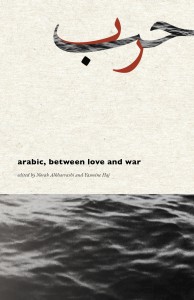
arabic between love and war

Arabic, Between Love and War, edited by Norah Alkharashi and Yasmine Haj, Trace Press, 2025

Review by Alex Tan

 Addressing itself to the subtle but immense interstice between the Arabic words for ‘love’ and ‘war’, which differ by only one letter, Trace Press’s community-centric poetry anthology is as much a testament to beauty and survival under the conditions of catastrophe as it is a refusal to perform or fetishize suffering for a white gaze. The bilingual collection is, further, an intergenerational gathering of voices: canonical luminaries like Fadwa Tuqan are assembled alongside contemporary lodestars like George Abraham.

Throughout the volume, language gives in to its fecundity, at times carried by a voice that “condenses history to the depths of silence”, at others seeded within a word that “alone was enough to wither a tree”. The whispered syllable, across utterance and inscription, temporarily suspends the cruelties of the real: “I love calling you habibi / because then I feel as though they haven’t destroyed our cities.” In shared intimacy, an interregnum emerges, fragile as the stroke of an ر.   

But how far can one measure the ruin and the specter of love in sentences? “I write rose and mean nothing,” the poet Qasim Saudi ventures, as if refuting the possibility of romanticism. The surveying ego can also be a trap—“my I wounding me”. Many of the writers here disclose a longing for dissolution, for blunting the edges of the self so that a liquid, collective consciousness might emerge in its stead. In Lena Khalaf Tuffaha’s idiom, “you never saw it coming, this cleansing, / how we have become this ocean”. Nour Balousha’s plangent question echoes, “Who told the wind that we were leaves?”  READ MORE…

I Carved A Girl Of Stone: Nuzhat Abbas on Feminist, Decolonial, and Anti-Imperialist Translation

What drives my work at trace is perhaps a desire to destabilize the spaces I was made to enter and reside in . . .

Since its inception in 2019, Tkaronto/Toronto-based trace press has published “literature that illuminates, in complex, beautiful and thought-provoking ways, contemporary and historical experiences of conflict, war, displacement, exile, migration, the environment, labour, and resistance.” Re-emerging after a brief hiatus during the pandemic, their first anthology River in an Ocean: Essays on Translation (2023) assembles emergent and experienced feminist translators, scholars, and writers from Palestine to Uganda, from Indonesia to Kashmir—spotlighted by, among others, Khairani Barokka, Suneela Mubayi, Otoniya J. Okot Bitek, and Yasmine Haj. In the foreword, the decolonialist historian Françoise Vergès describes the vestiges of imperialism, the dominance of the languages of Euro-American colonisers, the myths of globalisation, and the “hegemony of national languages” inflicted by neocolonial nation-states. Having read and reviewed the anthology myself, I think of it as a complex re-mapping of literary hemispheres “twisting through the atrocities of literary empires and post-colonial capitalism.”

In this interview, I asked trace press’ founding editor Nuzhat Abbas, a Zanzibar-born writer and critic of postcolonial mobilities and gender studies, about the literary publishing house she has founded; how independent presses can stay true to a transnational, anti-imperialist and decolonial feminist ethos; and writings from her archipelagic birthplace in East Africa and the Indian Ocean.

Alton Melvar M Dapanas (AMMD): Having founded trace press, in what ways do the values of decoloniality, anti-imperialism, feminism, and anti-racism occur as concrete practices in translation and in publishing? And what is the opposite of that?

Nuzhat Abbas (NA): I prefer to pose such questions to my writers and translators—to inquire how they, in their practice, think through such challenges, especially in relation to localized tensions and displacements, both historic and geographical. For example, trace is located on a forcibly white-settled and renamed space where Indigenous and Black resistance and creativity continues to resist and respond to histories of profound violence and displacement. As racialized im/migrant-settlers working with non-European literatures and languages, how do we ‘translate’ and write toward Black and Indigenous readers in the Americas, and toward each other, as people from the global majority, scattered around the globe, displacing each of our certainties? This is a question for me, a beginning question, one that can only be answered in practice—and differently—by each of the books we make and the conversations that emerge. Building space for these kinds of ‘after-publication’ conversations is very much part of what I want to create with trace

READ MORE…