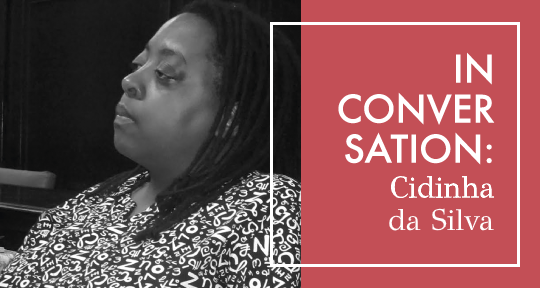
I first met Cidinha da Silva about a year ago, at the International Literary Festival of Paraty (Flip), in the state of Rio de Janeiro, Brazil. At the time, I had just begun translating Sobre-viventes! (Pallas Editora, 2016), a collection of crônicas that approach Brazil, past and present, through everyday lived experience. In 2010, Cidinha coined the neologism Exuzilhar, a verb that combines the Portuguese encruzilhar (“to cross”) or encruzilhada (“crossroads”) with Exu (an Orisha in the Yoruba religion, the divine messenger or gatekeeper). Exuzilhamento is indeed a driving force of Cidinha’s work, which, as she reveals here, “revolves around Africanities, Orixalities, Ancestralities, and the tension and dialogue between tradition (African, Afro-Brazilian, Afro-Diasporic, and Afro-Indigenous) and contemporaneity.” The interview that follows, conducted alongside my fellow translator Ana Luiza de Oliveira e Silva, showcases the complexity of Cidinha’s creative process and her critical place in contemporary Brazilian literature.
—Daniel Persia, Editor-at-Large for Brazil
Daniel Persia (DP): It’s great to connect with you again, Cidinha, especially after having featured some of your work in our Summer 2020 issue. Can you give us a general panorama of your career as a writer?
Cidinha da Silva (CS): I started publishing literature in 2006, in São Paulo, with a self-financed, independent book of crônicas, Cada tridente em seu lugar. It’s a book that still sells widely, fourteen years later. The fourth edition was just released, with Mazza Edições (Belo Horizonte, Brazil). I had always wanted to publish literature. I wrote crônicas for an online magazine and readers kept asking when we’d have a book. That’s what really got me thinking about publishing my first literary work; I had already published a book of essays in 2003, Ações afirmativas em educação—experiências brasileiras [Affirmative Action in Education: Brazilian Experiences] (Summus).
Ana Luiza de Oliveira e Silva (AO): Tell us about your creative process. Do you have a daily writing routine?
CS: My writing process has practical, creative, and other dimensions that are somewhat intangible. In practical terms, I’m a relatively organized and disciplined writer; I sit and write at predetermined times. I don’t have any problems with the “blank page,” but sometimes I’m faced with a lack of time to write. My writing routine depends on the volume of work at hand, on how much I need to accomplish to ensure survival: lesson planning; preparing and delivering lectures, workshops, and courses; reading; studying; traveling; keeping up with my online store and promoting my books. The time left for writing is very minimal, it boils down to just a few hours a week. I write very little on impulse; I usually write with a particular book in mind, one that I’m still developing or organizing. I also write a lot of commissioned work, for publications of the national press, primarily, but also theatre and essays.
As for the creative dimension, I prefer to write early in the morning, which is the best time of day for me. I write on my desktop computer, sitting in a comfortable chair in a large office, with a glass door on the balcony and the sun coming to visit me. I collect dictionaries and keep them in reach for consultation. My productivity is greatest in the morning, for about four to six hours (when I’m in a more intense process of production), but from the fourth hour onward, what I really do is reread, revise, consult reference materials. I read everything out loud, several times; that’s how I set rhythm and establish harmony. When I’m mulling over an idea for a new book, I tend to take a lot of notes in my notebooks—scattered things, like names for characters, beginnings of crônicas or short stories. I usually only write down ideas, but when I write down full sentences, they almost always unfold into one or two paragraphs at that very moment, when they’re first being recorded. And so there you have the beginning of a new text.
The unimaginable happens in dreams (of which I remember little or nothing), in conversations, in exchanges with real people, in observing the world, in interacting with stones, plants, flowers, water, earth and fire, and smoke, too. In intuition, which I’ve built over the years, in exercises and life tests, to pay full attention and remain confident. Spirituality communicates with me through intuition.
DP: What are some of the main themes in your work?
CS: Through two of my more recent books—Um Exu em Nova York (2018), a collection of short stories, and Exuzilhar (2019), the first volume in a series of selected crônicas—I’ve come to understand that my aesthetic interests revolve around Africanities, Orixalities, Ancestralities, and the tension and dialogue between tradition (African, Afro-Brazilian, Afro-Diasporic, and Afro-Indigenous) and contemporaneity. Other topics include racism, racial discrimination, and racial inequalities, though the central theme really is that tension and dialogue mentioned above. I’m also interested in themes of death, love, soccer, and politics. I write a lot about politics. READ MORE…



From Silly to Deadly: On Shalash the Iraqi by Shalash
. . .key to the humourist’s arsenal is none other than language itself—its malleability, its capacity for aggrandisement and diminishment alike.
Shalash the Iraqi by Shalash, translated from the Arabic by Luke Leafgren, And Other Stories, 2023
Anonymity fascinates and seduces. Endless speculations have circled invasively around who Elena Ferrante “truly” is; Catherine Lacey’s recent Biography of X reckons with erasing a layered past with a single letter of the alphabet; the first season of Bridgerton, the hit Regency-era romance on Netflix, has its narrative engine propelled by the question of Lady Whistledown’s real identity. These instances from the Global North exemplify the allure of mystery, but they fail to account for the stakes of remaining nameless in a political climate where to unveil oneself might be to threaten one’s own safety.
One might, in a moment of facetiousness, think of the eponymous chronicler of Shalash the Iraqi as the Lady Whistledown of Iraq’s Sadr City (or Thawra City, as it is lovingly christened by Shalash). Both issued frequent dispatches from within the epicentre of social disarray, guaranteeing the pleasure of gossip. More importantly, their pseudonymous veneers facilitated a lurid candour that might not otherwise have been possible.
There the similarities end. The respectable circles of upper-crust London did not live in the penumbra of foreign occupation. Nor were they plagued with the constant risk of spectacular sectarian violence, or hampered by a corrupt government that has “thieves, cheats, swindlers, traders in conspiracies” for politicians. It was against such chaos that Shalash released his explosive, timely blog posts, garnering a rapidly expanding local readership despite patchy Internet access in the country. The academic Kanan Makiya tells us, in his introduction, that people were printing out the posts, “copying them longhand,” “bombarding Shalash with questions and opinions.” Even high-ranking cadres could not resist partaking in the fanfare: one official expressed admiration while entreating Shalash not to mock him, for fear of his children’s potential disappointment. Another claimed that upon reading the daily communiqués, he would fall off his chair laughing.
Laughter, perhaps, can always be counted on to forge an affinity, if not a unity, beyond fractures of sect, status, and ethnic affiliation. Iraqis would “drop everything for a good laugh”; they gather in bars and down glasses of arak to immerse themselves in a “great, communal, and nondenominational drunkenness.” Shalash knows this, and abundantly turns it to his advantage. Nothing and no one is spared from the crosshairs of his ridicule, populated by a variegated cast that encompasses sermonisers, soldiers, suicide bombers, and donkeys. A vice-president’s verbal pomposity sounds like “he just ate a few expensive dictionaries and is about to lose his lunch.” A woman about to be married off to an Australian cousin is told, should her fiancé divorce her, “just tell everyone that he’s a terrorist and you’ll have nothing to worry about.” An odious neighbour, eager to save a spot for himself in paradise, proselytises the necessity of voting in the referendum for Iraq’s new constitution: “Don’t you know the going rate for rewards in heaven for helping ratify the constitution? It’s worth a hundred visits to the shrine of the Eighth Imam, and that’s on the far side of Iran!” When the narrator casually uses Google Earth, he is accused of lecherously spying on the women of his residence, sparking off a widespread hysteria—and court case—about the “violation of the morals of the block.” Each instance of mockery is a shard in a wider mirror of collective trauma.
READ MORE…
Contributor:- Alex Tan
; Language: - Arabic
; Place: - Iraq
; Writers: - Abu al-Qasim
, - Ahmed Saadawi
, - Catherine Lacey
, - Elena Ferrante
, - Emily Dickinson
, - Hassan Blasim
, - Kanan Makiya
, - Maya Abu al-Hayyat
, - Shalash
; Tags: - American occupation
, - anonymity
, - arabic literature
, - blogging
, - humor
, - Iraqi literature
, - social commentary
, - US Invasion of Iraq