

This week, our editors fill us in on the controversial withholding of a young writers short story prize in Egypt and an exciting new Canadian-led digital humanities initiative. Read on to find out more!
Ibrahim Fawzy, Editor-at-Large, Reporting from Egypt
The announcement of the winners of the twenty-first edition of Egypt’s Sawiris Cultural Awards was quickly overshadowed by the controversy surrounding the jury’s decision to withhold the first prize in the Best Short Story Collection (young writers category). This decision became a public cultural reckoning, reigniting long-simmering questions about literary authority, generational tension, and the role of prizes in a precarious literary ecosystem.
At the center of the controversy were remarks made by the chair of the jury, member Gerges Shoukry, an Egyptian writer and poet, during the awards ceremony. Explaining the decision to withhold the prize, Shoukry stated that “the overwhelming majority of submitted texts lacked the basic principles of the short story,” framing the jury’s decision as a message to young writers that “knowledge is the path to excellence.”
The backlash was swift. On social media, writers emphasized that juries have the right to withhold prizes; what they rejected was the tone of “generalization,” “rebuke,” and “moral instruction” that accompanied the decision. Questions also emerged about the jury’s process: if most submissions were deemed so fundamentally flawed, how did four short story collections make it to the shortlist in the first place? The collections in question were Pet Mice by Nesma Ouda, Violent Love by Hoda Omran, A Distance Fit for Betrayal by Noha El-Shazly, and Death Has Three Knocks by Iman Abu Ghazala. For the writers, the announcement felt less like a neutral judgment and more like a public invalidation of their efforts. READ MORE…

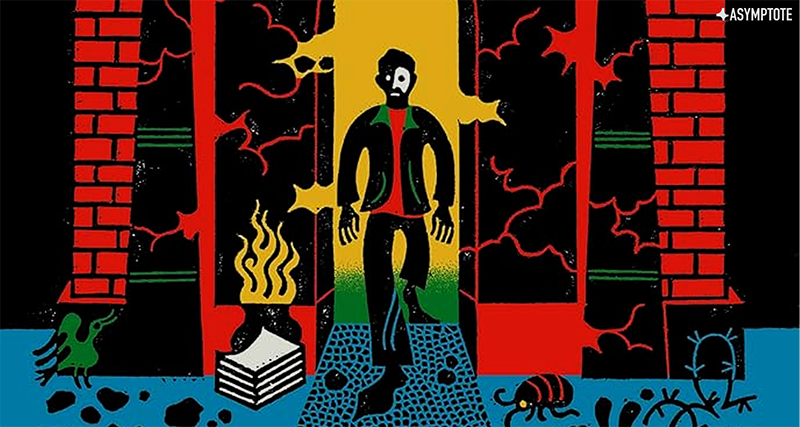
Announcing Our September Book Club Selection: A Long Walk From Gaza by Asmaa Alatawna
Alatawan’s novel is both personal and political; at its heart, it’s a story about freedom.
In Asmaa Alatawna’s mesmerizing and clear-sighted debut novel, A Long Walk from Gaza, the long journey of migration is revealed as a dense mosaic of innumerable moments—a gathering of the many steps one takes in growing up, in fighting back, and in learning the truths about one’s own life. From the Israeli occupation to the daily violences of womanhood, Alatawna’s story links our contemporary conflicts to the perpetual challenges of human society, tracking a mind as it steels itself against judgment and oppression, walking itself towards selfhood’s independent definitions. We are proud to present this title as our Book Club selection for the month of September; as Palestine remains under assault, A Long Walk from Gaza stands as a powerful narrative that resists the dehumanizing rhetoric of war.
The Asymptote Book Club aspires to bring the best in translated fiction every month to readers around the world. You can sign up to receive next month’s selection on our website for as little as USD20 per book; once you’re a member, join our Facebook group for exclusive book club discussions and receive invitations to our members-only Zoom interviews with the author or the translator of each title.
A Long Walk From Gaza by Asmaa Alatawna, translated from the Arabic by Caline Nasrallah and Michelle Hartman, Interlink Publishing, 2024
There are some books that grab you from the very first line and hold your attention tight, right through every single word to the end; even once you’ve finished reading them, they keep delivering with their exquisite phrasings and stunning imagery, their deft, original storytelling. Asmaa Alatawna’s A Long Walk from Gaza, co-translated by Caline Nasrallah and Michelle Hartman, is one such novel. Through her enthralling and thoughtful prose, Alatawna unfolds idea after idea, fact after fact, emotion after emotion, recounting a tumultuous upbringing and journey that moves with both personal and universal resonance.
A Long Walk from Gaza is Alatawna’s debut in both Arabic and English—a semi-fictionalized, coming-of-age novel. Originally published in 2019 as Sura Mafquda, it explores the struggles of a teenage Gazan girl as she rebels against her surroundings, both at home and at school, and her heartbreak as she leaves Gaza for a new life in Europe. Her escape doesn’t resolve her problems but instead introduces new challenges, revealing the persistent, ongoing internal conflict of exile. While portraying life and a childhood under Israeli occupation and oppression, Alatawna also takes an incisive, knowing look at the patriarchal system of her own people. READ MORE…
Contributor:- Ibrahim Fawzy
; Language: - Arabic
; Place: - Palestine
; Writer: - Asmaa Alatawna
; Tags: - exile
, - feminism
, - Interlink Publishing
, - liberation
, - migration
, - occupation
, - social commentary
, - War
, - Women Writers