
Posts featuring Motoyuki Shibata

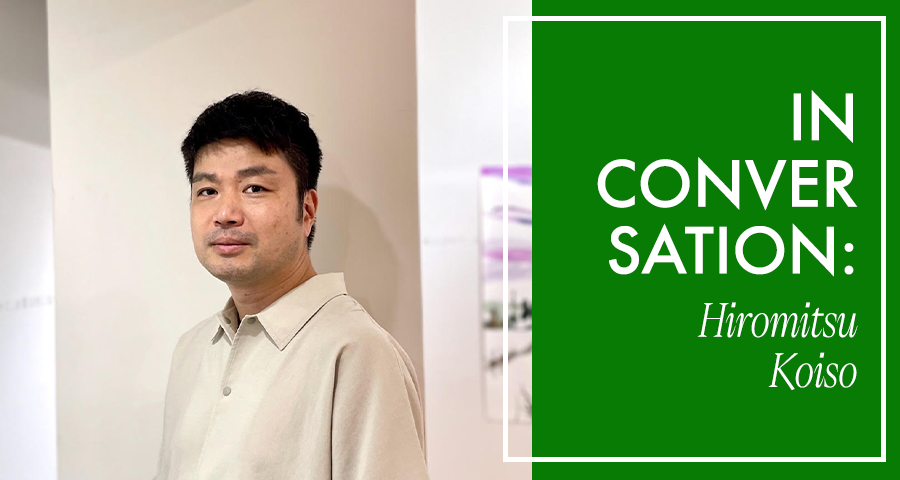
Desire is No Light Thing: An Interview with Hiromitsu Koiso on Translating Anne Carson and Teju Cole into Japanese

Rather than being shaped by any single figure, I’m more interested in how one’s present moment can be placed in relation to a much longer history.

Hiromitsu Koiso’s path to becoming one of Japan’s most ruminative literary translators was anything but linear. It began, as he recounts, in the second-hand bookshops of western Tokyo, poring over paperbacks and comparing translations by seasoned Japanese translators, a sort of discipleship that would later lead him on a peripatetic route to the MA in Literary Translation and MA in Creative Writing (Poetry) programmes of the University of East Anglia in Norwich, United Kingdom. His body of work reveals a translator who is attuned to works of hybridity and gravitas, from the Sebaldian solivagant of Teju Cole’s Open City to the mythopoetic vestiges of Anne Carson’s Autobiography of Red. This extends to the works of Ocean Vuong, Isabella Hammad, Grayson Perry, Noor Hindi, and Ursula K. Le Guin, as well as more recent translation projects like Carson’s Wrong Norma (published on 10 January by honkbooks’ thoasa) and Bryan Washington’s Memorial (forthcoming in Spring 2026). He has also co-translated Japanese poets Kamiyu Ogyu, Naha Kanie, and Ayaka Satō into English.

When asked about influence, Koiso speaks less of particular poetic lineages and more of situating himself within and against literary history, and of navigating the orientalising gaze directed at Asian writers: a “gaze [that] shapes both how we are read and how we respond, creatively and intellectually.”

In this interview, I spoke with Koiso (who is in Tokyo) about his unorthodox career trajectory, the immersive craft behind recasting specific genres and texts, and the poetic reflection underpinning his work as a poet and translator who seeks to meditate on “how one’s present moment can be placed in relation to a much longer history.”

Alton Melvar M Dapanas (AMMD): Koiso-san, I want to begin with how you started as a translator. As a university student, you pored over Paul Auster and J.D. Salinger paperbacks at the second-hand bookstore Nishi Shoten in Kunitachi. By comparing your early attempts with the translations of seasoned practitioners like Motoyuki Shibata and Takashi Nozaki, you developed an appreciation for the craft. Yet you didn’t pursue translation right after university. So, what were the key moments that ultimately led you here?

Hiromitsu Koiso (HK): After graduating from university, I wanted to work in literary translation, but I had no idea how to enter the profession. Throughout my twenties, I worked various jobs while studying and trying to find my way into the field. I took temporary positions, worked in offices, saved money, and eventually decided to pursue postgraduate studies at the University of East Anglia in the UK.

I first learned about UEA’s MA in Literary Translation program and a particular centre for literary translation through the Japanese translations of W. G. Sebald. Discovering that Sebald had taught at UEA and helped establish the translation centre made a deep impression on me. I felt strongly that I wanted to study Literary Translation in the very place where he had lived, taught, and built a community for translators. READ MORE…
Weekly Dispatches From the Front Lines of World Literature

Translation competitions, new publications, and poetry readings from Japan, Guatemala, and El Salvador!

This week, our editors from around the globe report on a translation competition and an event to support Ukraine in Japan, the publication of a harrowing new memoir from Guatemala, and a celebration of women poets in El Salvador. Read on to find out more!

Mary Hillis, Educational Arm Assistant, reporting from Japan

Give Artists a Voice was held on March 15 at the Goethe-Institut in Tokyo and live-streamed on social media. Organized by EUNIC Japan and E.U. member cultural institutions and cultural departments in Japan, artists expressed their support of Ukraine through music, film, poetry, dance, and talks. Joining from Kharkiv, contemporary artist Olia Fedorova read text in Ukrainian documenting life during the war. Poet Marie Iljašenko read “Five poems from collection St. Outdoor” in Czech and Yoko Tawada read “Auszeit von Menschheit” (“Timeout from Humanity”) in German. Michal Hvorecký, author of the novel Troll (published in Slovak in 2017), delivered a message on disinformation and literary translation as a vehicle for deeper understanding.

Earlier in the month, at Bungaku Days Spring 2022, the award winners of the JLPP (Japanese Literature Publishing Project) sixth International Translation Competition were recognized: English grand prize winner Grant Lloyd and Spanish grand prize winner Eduardo López Herrero. Contestants translated two texts, “Namiuchigiwa made” by Maki Kashimada in the fiction category and “Ojigi” by Kuniko Mukōda in the criticism and essay category. The original texts and winning translations can be read on the JLPP website.

Designed to both recognize and provide support for emerging translators of contemporary Japanese literature, the event began with a prerecorded video showcasing comments from the judges and messages from the top three awardees in English and Spanish respectively. Former contest winners Polly Barton and Sam Bett joined this year’s winner, Grant Lloyd, for a symposium on the topic of becoming a translator, moderated by Yoshio Hitomi of Waseda University. They discussed Lloyd’s prize-winning translations and also analyzed the challenges of working with stories, novels, and essays from Japanese, while revisiting steps on their journeys to becoming literary translators. The publishing panel was moderated by Allison Markin Powell and included Anne Meadows (Granta Books), Yuka Igarashi (Graywolf Press), and Tynan Kogane (New Directions), who discussed their points of view on pitching, the acquisition process, and barriers to publishing literature in English translation. The seventh edition of the competition is now in progress and entries are being accepted in English and French.

READ MORE…

Fall 2011: The Pleasure of Literary Engagement

Featuring Lydia Davis’ first translation from the Dutch, an excerpt from Haruki Murakami’s 1Q84 and Dubravka Ugrešić on Croatian novelists

Miraculously, word spreads. Asymptote is selected as The Center for Fiction’s international journal of the month for September 2011. Publishers Weekly features us in a writeup. We are a Paris Review staff pick: apparently, poetry editor Robyn Creswell has been “poking around in Asymptote” and has especially enjoyed the (very) short story by Robert Walser, translated by Susan Bernofsky, Adonis’s “Ambiguity,” translated by Elliott Colla, and an essay about riddles by the Russian formalist Viktor Shklovsky, translated by Shushan Avagyan(!)” Literary heavyweights Jane Hirshfield and John Kinsella, whom I don’t know personally, write to offer blurbs in support. I discover that Parul Sehgal, an award-winning literary critic I admire, has a Singaporean connection. Had she been based in Singapore, would her talent in literary criticism have been recognized? Would it even have flourished in the first place? This inspires me to move to Taiwan for the lower cost of living. Here to introduce the first issue that I edited out of Taipei (and that also features my translations of Jing Xianghai and Belinda Chang) is contributing editor Sim Yee Chiang. 

As I re-read the interview I conducted with Motoyuki Shibata for the Fall 2011 issue of Asymptote, I am catapulted at once to the terror of that late summer afternoon at the University of Tokyo. Why on earth had I insisted that we speak in Japanese? I was armed with notes, even a few jaunty segues, but I knew my adopted tongue could abandon me at any moment, just as it had abandoned me six months before at a disastrous interview for prospective Ph.D. students.

What prevented disaster that day was hearing Professor Shibata talk about the “pleasure” of literary engagement and translation. Translators tend to fall prey to all kinds of pesky anxieties: of influence, of equivalence, of legitimacy etc. Even now, years after that conversation, I still find the principles of pleasure and humour not only useful defences against said anxieties, but also indispensable qualities of a successful translation. READ MORE…