
Posts featuring Bill Johnston

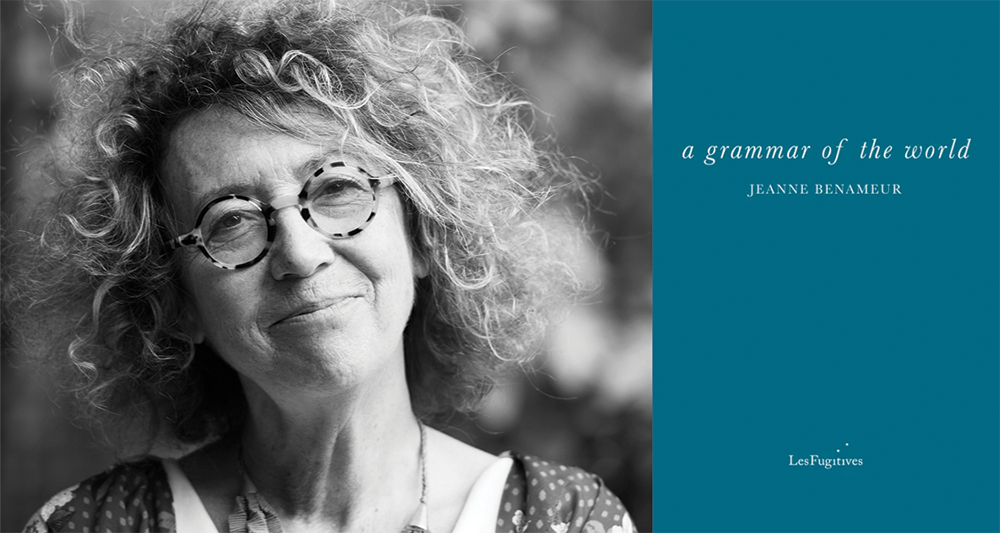
Beachcombing on The Shores of Belonging: A Review of a grammar of the world by Jeanne Benameur

Benameur . . . writes hoping for a third space where languages might meet and reconfigure one another.

a grammar of the world by Jeanne Benameur, translated from the French by Bill Johnston, Les Fugitives, 2025

The oeuvre of the Algerian-French writer Jeanne Benameur ranges from poetry (Naissance de l’oubli) to an award-winning novella (Les Demeurées) to various works of nonfiction, and in her latest work to be released in English, a grammar of the world, readers are introduced to her voice in verse. The collection details the author’s journey from Algeria—just before the declaration of Algerian War of Independence—to La Rochelle in France where she grew up, a transition explored with the complexity of migration and belonging, and suffused with potent mytho-historical narratives. Through her personal experiences of departure and a complex familial history (with both Italian and Tunisian-Algerian roots), Benameur explores the slow persistence of syntax both in life and in language, which—however displaced and fragmented—can still be reassembled into something habitable and meaningful. The lines of a grammar of the world unfold without punctuation, their sparse cadence travelling over the subsequent pages in soft tidal motions, culminating in a single long poem in free verse, with occasional phrasal recurrences to generate a momentum between its various contexts. Throughout, the voice shifts between ancient and contemporary, depending on whether it is situated in historical precedence or mythical imagery; the speaker gently walks between memory and myth.

We begin with an invocation of Isis, the Egyptian goddess who resurrects her slain brother and husband Osiris, and subsequently produces their son, Horus. According to one of the Egyptian myths, Isis helps the dead enter the afterlife, as she had once helped Osiris by collecting his scattered body parts from across Egypt—and this myth later gave rise to the earliest practice of mummification. In a grammar of the world, it is this act of harvesting and laying to rest that Benameur focuses on, envisioning Isis as the weary sister who bends to rescue what remains in the aftermath of war and displacement. ‘she gathers up what no longer belongs’, writes Benameur: “pieces // she braves that which is scattered’. READ MORE…

Weekly Dispatches from the Frontlines of World Literature

The latest in world literature can be found here in Asymptote's weekly roundup!

This week, our weekly dispatches take you to Poland, France, Mexico and Guatemala for the latest in literary prizes, and literary projects, featuring social media, and indigenous poets in translation.

Julia Sherwood, Editor-At-Large, reporting from Poland:

Hot on the heels of a US book tour for her International Man Booker Prize-winning novel Flights (translated by Jennifer Croft), the indefatigable Olga Tokarczuk appeared at a series of events to mark the UK publication of her newest book. The “existential thriller” Drive Your Plow Over the Bones of the Dead, translated by Antonia Lloyd-Jones and published by Fitzcarraldo Editions, is fast garnering rave reviews, and London audiences had an opportunity for a Q&A with the author combined with a screening of Spoor, the book’s film adaptation. There was also a lively conversation between Olga Tokarczuk and writer and chair of the International Man Booker judges, Lisa Appignanesi, at the Southbank Centre. Meanwhile, Flights has been shortlisted for the National Book Award for translation as well as for the Warwick Prize for Women in Translation, the shortlist of which includes another book by a Polish author, Żanna Słoniowska’s The House with a Stained Glass Window (also translated by Antonia Lloyd-Jones).

Anyone who may have been afraid to tackle the classics of Polish literature will no longer have any excuse now that Adam Mickiewicz’s epic poem Pan Tadeusz has appeared in a new and highly readable English version. “I undertook this translation out of the conviction that Pan Tadeusz is fundamentally an accessible poem for twenty-first-century non-Polish readers. It’s witty, lyrical, ironic, nostalgic, in ways that seem to me quite transparent and universal,” writes multi-award-winning translator Bill Johnston in his introduction. At a book launch at the Polish Hearth Club in London on October 8, Johnston compared notes with poet and translator George Szirtes, who introduced his translation of the Hungarian classic The Tragedy of Man by Imre Madách.

READ MORE…