Posts filed under 'indigeneity'

What’s New in Translation: December 2025

The latest from Japan, Peru, Germany, Austria, Czechia, South Korea, Brazil, and Hungary!

In our final round-up of the year, we present a thrilling novel capturing the margins of Germany as the nation begins to veer into fascism, a collection gathering the voices of powerful Hungarian women poets, a Brazilian novel testifying to the colonial erasure of indigenous language and being, a series of essays considering the act of reading as an oppositional force against capitalism, and more!

kappa

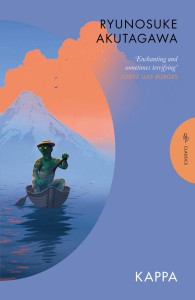
Kappa by Ryonosuke Akutagawa, translated from the Japanese by Geoffrey Bownas, Pushkin Press, 2025

Review by Kaelie Giffel

Even if one is unfamiliar with his work, English readers will recognize the name Ryonosuke Akutagawa from the prestigious Japanese literary prize, named after him posthumously by a friend. Kappa is a novella published in the final year of the author’s life. Pushkin Press’s reissue of Geoffrey Bownas’s 1970 translation comes on the heels of a 2023 retranslation by Lisa Hofmann-Kuroda and Allison Markin Powell, published by New Directions in 2023. Multiple, competing translations indicate the continued importance of Akutagawa’s work, which has a renewed urgency in our time.

Kappa is a philosophical meditation on whether difference can be encountered without violence and how we might meet others in the strange in-between spaces. Structured as a frame narrative, its inciting incident is the testimony of a patient in an unnamed mental institution. The patient speaks about meeting strange creatures with tummy pouches called Kappas. The Kappas have their own cultural, historical, and philosophical institutions and orientations to life, and the narrator lives among them for a while, alternately admiring, baffled, or repulsed as he learns more about their existence. They oppose birth control for silly reasons; sacrifice workers who have been laid off by literally eating them; prohibit artistic performance because they believe the general public to be hopelessly stupid; and are generally misogynist—female Kappas are cast as libidinous huntresses that oppress male Kappas. The narrator is bewildered by the similarities and differences between himself (Japanese) and the Kappanese. Hence, the mental institution.  READ MORE…

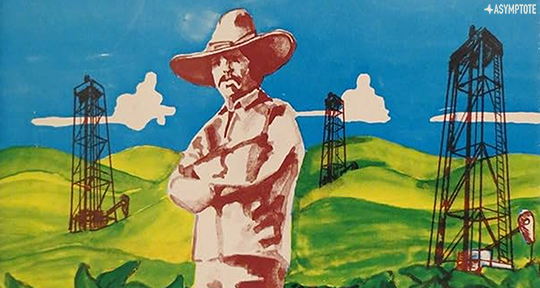
Between Languages: The Politics of Class, Race, and Translation in the Novels of B. Traven

Such is how the frontier in Traven functions: an arena of capital that both equalizes and reproduces extant racial hierarchies.

The identity of novelist B. Traven has spawned a delightfully layered and debated array of theories, stipulations, and investigations. Best known as the author of The Treasure of the Sierra Madre, later adopted into a well-loved film by John Huston, Traven was the pseudonym of a German- and English-language writer who, in various hypotheses, has been the collaborative result of several individuals, an imprisoned actor, an enthusiastic explorer of Mexico, and a translator from Acapulco and San Antonio. The most fascinating aspect of this mysterious identity, however, lies not solely in the individual’s life, but also in the entangled multiculturalism and various iterations of his works, which render American landscapes in German language, examine the intersection of class and race politics, and create narratives in which complexities of social agency are examined in both local and international contexts.

If you’re reading B. Traven’s The Treasure of the Sierra Madre in its English translation, it would be be hard to guess that it was written by a German author, let alone intended for German-speaking leftists, living in German-speaking countries in the interwar period. Even in the original German, the book bears no obvious trace of Europe or European culture—aside from the language, of course. It feels, on the contrary, quintessentially American, falling easily into the category of the western and full of the genre’s tropes and generic dictates. At least for this reader, it felt odd to be reading one’s way through many of the familiar elements of the western, in a language not commonly associated with it.

The novel takes place in a post-revolutionary Mexico during the interwar years, and its protagonists are white American vagabonds, property-less and looking for work. There are oilmen, Mexican “Indians” and Mexican ladinos, or mestizos. There are bandits, train heists, and Federales. There is gunplay. And there is gold. The Treasure of the Sierra Madre was originally written and published in German as Der Schatz der Sierran Madre by Büchergilde Gutenberg in 1927, and was part of Büchergilde Gutenberg’s mission to provide impoverished workers with access to cheap entertainment and Bildung. The current Büchergilde Gutenberg website tells us, for example, that the publisher was founded in 1924 to facilitate easier access to Bildung for members of the working class, doing so by means of affordable but well-crafted, premium books. Bruno Dreßler, Büchergilde’s first chairman, had in mind the idea of a proletarian cultural community, a “proletarische Kulturgemeinschaft”; the publisher saw itself as part of proletarian literature and culture at a time when such a thing perhaps still existed, though its contours and possibility—or impossibility—were, even then, debated by Marxist critics and thinkers of every stripe. Even Diego Rivera, a card-carrying communist, argued that, properly speaking, there could be no such thing as proletarian art within capitalism. Only after the dictatorship of the proletariat has “fulfilled its mission,” Rivera writes, after it has “liquidated all class differences and produced a classless society,” can there be a proletarian art. READ MORE…