Language: English

In Conversation with Annie Zaidi

"...it became apparent at once that women have always used writing as a form of politics and activism."

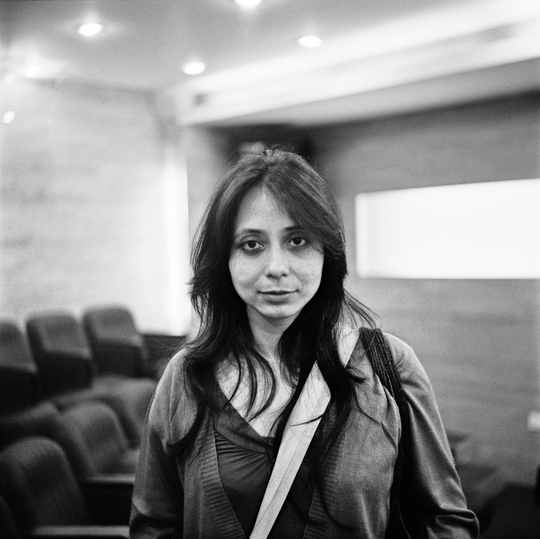
In a conversation about a younger generation of Anglophone writers in India, Annie Zaidi’s name is bound to come up. From poetry to non-fiction to drama to a novella that is both ghost story and romance, her writing continually shifts forms, landscapes, and languages. Zaidi is the editor of Unbound: 2,000 years of Indian Women’s Writing and the author of Gulab, Love Stories # 1 to 14, and Known Turf: Bantering with Bandits and Other True Tales. She is also the co-author of The Good Indian Girl. Her work has appeared in several anthologies including Eat the Sky, Drink the OceanMumbai NoirWomen Changing India, and Griffith Review 49: New Asia Now. Zaidi spoke with me about her influences, process, and literary interests in an email interview. 

***

Poorna Swami: Your grandfather was a well-known Urdu writer, and you have said in the past that literature was a big part of your childhood. How has that culture of language and literature influenced your career as a writer? Although you write primarily in English, does Urdu shape your work in any way?

Annie Zaidi: Literature was a big part of my childhood, but not in the sense of literature with a capital L. My family had some literary background, and there were a lot of books around but there were no literary discussions and for many years, I did not have access to a good library. But books were seen as a good thing and we were bought books and comics from an early age. Books were my main source of entertainment and, later, my main solace. I read almost all the time and that turned me into somebody who didn’t know much except the world of words and stories. Turning to literature as a vocation was a very short step from there. READ MORE…

The Afrofuture, for the Time/Being: In Conversation with E. Jane

"...the Internet was always the space where I could mostly engage all of my selves."

Much of my fascination with contemporary Afrofuturism revolves around studying the ways in which Black artists in the field are utilizing the Internet to complicate the idea of ‘alien space.’ Afrofuturism necessarily points to an-other space—traditionally, outer space—as the destination point for the Black human-being, who, being so totally extradited from Earthly society, requires a more total severance in form of a physical migration. The cosmos has, for decades prior, served as the primary landing space for the Black alien migrant, but in recent years, the Internet has made its way to the forefront of the Afrofuture. Relative to cosmic space, the Internet has served as a perhaps closer and seemingly just-as-expansive alternate realm to which to escape. And in fact, the ‘proximity’ of the Internet calls into question whether ‘escape’ is really the dominant motion; rather than, for example, the motion of transformation. (I don’t think that anyone doubts anymore that the relationship between meatspace and cyberspace is mutually mutative.) The contemporary fugitive as shapeshifter and space-shifter.

E. Jane is one such artist who has made the Internet a primary medium. Creating cyber-installations across multiple social media platforms, as well as video, and sound-based works, E. Jane’s work is a seminal voice in the growing field of Internet-based Afrofuturism. Not to mention, E. is also one half of the Philadelphia-based sound-duo named SCRAAATCH—the other half being their partner, chukwumaa. Notably, the duo recently appeared The Fader in a feature titled, “The Voices Disrupting White Supremacy Through Sound.”

E. and I met in cyberspace to chat about their most recent work. We began with a quote from Toni Morrison, whom E. had spent the day reading.

READ MORE…

Translation as Firework: A Prismatic Rendition of Anna Weidenholzer

"The original is dead. Long live the original."

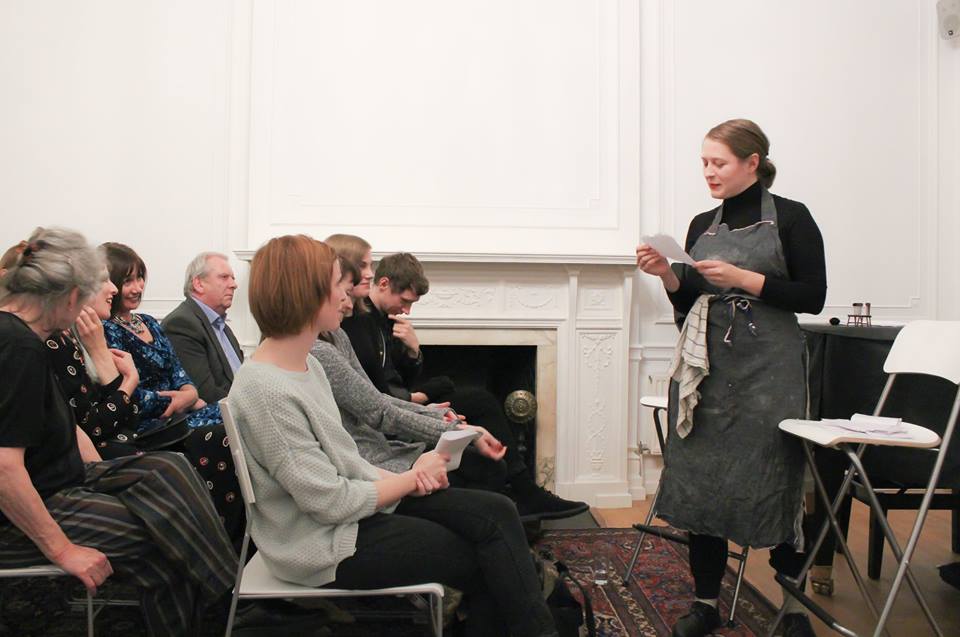
For my latest event as the Austrian Cultural Forum London’s guest literary curator, I commissioned and curated work for an exhibition presenting multiple translations of a short story by Austrian author Anna Weidenholzer in forms including sound, ceramics, textiles, video, sculpture, photography, text, and even tattoo designs and recipes. A reading and performance event in the ACF’s Salon celebrated and closed the exhibition this week and let the audience all be translators for an evening.

The incredibly affecting short story “Sessel und Sätze” (“Chairs and Sentences”) from Anna Weidenholzer’s collection Der Platz des Hundes (Where the Dog Sits) follows aging school caretaker Ferdinand Felser’s preoccupations with his passive position in the world. Having been mocked as a schoolboy by pupils and teachers for his dialect—and by his parents for trying to change it—Ferdinand is now secretly learning nine languages in his office and is troubled by the climate of xenophobia surrounding him at work, in the news, and among close friends. You can read the story tomorrow on the Asymptote blog.

Posing as a metaphor for the multiplicity of possible translations of any story, the exhibition on display in the ACF’s gallery encouraged the visitor to see how each “translation” altered and added to their reading of the story (which they also read in translation) or how the exhibition could be one multifaceted translation. It considered a translation as a personal reading, extension, destruction or an attempt at honing into an essence of the original text by a “translator,” and also explored the fallibility/adaptability of linguistic translation by further experimenting with alternative translations. READ MORE…

Issue Spotlight: Interviewing Uyghur Poetry Translator Joshua Freeman

"A lot of what's really vibrant and interesting in Uyghur poetry right now is happening primarily on the web, and even on phone messaging apps."


Your translation of Merdan Ehet’éli’s poem “Common Night” is Asymptote‘s first piece from the Uyghur. I want to point out two words from the poem: “pig iron” and “hellfruit.” Can you tell us about these words and how you translated them?

The Uyghur word choyun (also chöyün) refers to pig iron or cast iron, and for me it calls to mind something hard and rough. The connotations are much less positive than the words tömür (iron) and polat (steel), both of which are used in Uyghur personal names. In speaking of “a night poured into our spines like pig iron,” Merdan Ehet’éli may be alluding to Tahir Hamut’s well-known poem “Summer Is a Conspiracy,” in which Tahir refers to fear’s “pig iron voice”, which “seeps into the marrow / and hardens.”  READ MORE…

Translation Tuesday: “Breaking Through the Drum” by Bohumil Hrabal

"and everything suddenly seemed so bizarre I thought my ticket-taker’s demon must have come back to play with my mind."

I never felt better than when I was tearing the stubs off people’s tickets and showing them to their seats. In primary school, I loved to make seating plans for the teacher. Then during the war, a weird thing happened to me. A kind of ticket-taker’s demon lit on my back and right in the middle of the newsreel, when the voice announced that eighty-eight enemy aircrafts had been shot down over Dortmund and only one German plane had gone missing, the perverse little imp whispered something in my ear, and I said in a loud voice: “Aw shucks, it’s bound to turn up again.” My voice sounded like it belonged to somebody else, so I turned up the house lights and ordered the person who’d said it to come forward. The other ushers and I walked through the audience, but no one confessed and so, invoking our official powers—we actually had such powers—I declared that the entire program, including the feature film, was hereby cancelled, the tickets were null and void and, as punishment, everyone had to go home without a refund. READ MORE…

Translation Tuesday: “We Are Trouble’s Obedient Children” by Lut Ming

"The army is the dreams we share / Our tent is the sky (we have nothing to hide) / Take a deep breath."

There are no city gates here

No city walls, no army, no tanks

There are the people, there are things they care about, there are tents

There is the night sky with no wind, an empty, empty sky

You can watch the TV, the one and only CCTV,

To learn about the world and

Watch live-edits of people hurting people,

The Tape Recorder looks stuck up

In his suit and tie. He’s getting ready to lie

But his eyes are flickering (tape’s stuck, won’t play)

READ MORE…

Translating Indigenous Mexican Writers: An Interview with Translator David Shook

"I suspect many casual bookstore readers might not know how many languages are still spoken in Mexico. The sheer diversity is astounding."

David Shook is a poet, translator, and filmmaker in Los Angeles, where he serves as Editorial Director of Phoneme Media, a non-profit publishing house that exclusively publishes literature in translation. Their newest book is Like a New Sun, a collection of contemporary indigenous Mexican poetry, which Shook co-edited along with Víctor Terán.

Seven translators in total—Shook, Adam W. Coon, Jonathan Harrington, Jerome Rothenberg, Clare Sullivan, Jacob Surpin, and Eliot Weinberger—translated poets from six different languages: Juan Gregorio Regino (from the Mazatec), Mikeas Sánchez (Zoque),  Juan Hernández Ramírez (Huasteca Nahuatl), Enriqueta Lunez (Tsotsil), Víctor Terán (Isthmus Zapotec), and Briceida Cuevas Cob (Yucatec Maya). I corresponded with Shook over gchat to speak with him about the project.

Today is Columbus Day, a controversial holiday in the United States. Several cities have recently adopted Indigenous Peoples’ Day over Columbus Day, clearly a victory for recognizing indigenous cultures in the United States. Which leaves me wondering: how are the indigenous Mexican writers recognized today in the Mexican literary landscape?

As someone who regularly visits Mexican literary festivals and also translates from the Spanish, I’ve observed the under-appreciation of indigenous writers firsthand. Mexico’s indigenous communities make up 10 to 14% of its total population, and you certainly don’t find anywhere near that percentage of literature being published in Mexico today. READ MORE…

Translation Tuesday: “Miss Chapati Queens” by Bino A. Realuyo

"Her accent sounds like it comes from the deepest part of a rock."

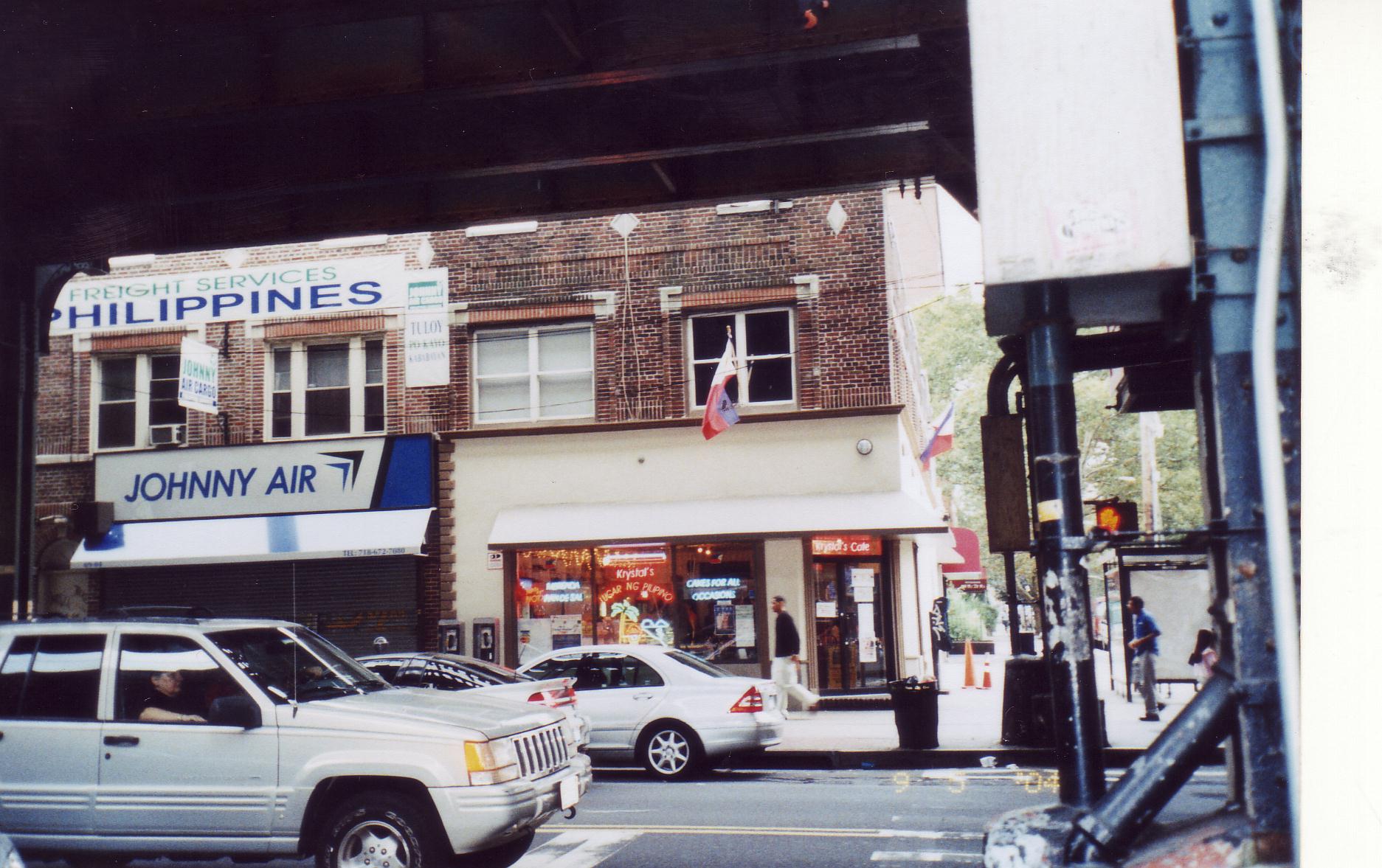
“Miss Chapati Queens” is part of a fiction manuscript titled The F.L.I.P Show, an interconnected collection of stories about the Filipino American community on the East Coast. The Philippines is an archipelago of 175 languages and/or dialects. Most of us are at least bilingual.  In my household alone, five major Filipino languages, including English, are spoken.  As a former colony of the United States, the Philippines has been using English as a lingua franca—the language of power, and of the media and the government—for over a hundred years, further complicating its multilingual tradition.

Although set in Queens, “Miss Chapati Queens” explores Filipino multilingualism. The protagonist, Rosario, is half-Indian, half-Filipino but grew up with a Filipino mother, and thus understands and speaks Tagalog. Her voyage into becoming more “Indian” coincides with her decision to join a beauty contest called Miss Chapati Queens. There are almost four million Filipinos in the U.S., some of whom are of mixed heritage, like the character in this story.  These households reflect the multilingual backgrounds of the Filipino people.  I speak English, Filipino (Tagalog), and Spanish, but understand Bicolano and Chabacano (language of my maternal heritage from Zamboanga City, a former Spanish port).   READ MORE…

Translation Tuesday: شیرین و فه‌رهاد by Agri Ismaïl

"Chilly pastels that hung lower than she was used to seeing in a sky threatened to erupt in a glorious display of technicolor."

شیرین SHIRIN SHIREEN


The trees that stood guard on each side of the road that led to the house where شیرین  and Farhad now lived had in recent weeks been stripped of their green girth, pared down to their brown skeleton, their branches stretching up to the sky in a plea for the sun to reappear.

شیرین  left the house, immediately feeling her face grabbed  by the icy palms of late October, her breath emerging visible in smoke-signal bursts. The few remaining leaves that hadn’t already been reduced to a mushy paste were scattered like the victims of a great battle over the winding bicycle lanes, amputees crushed under her boots, boots more utilitarian than anything she had purchased in a decade. Soon it would snow, the air had that singular electricity to it. Chilly pastels that hung lower than she was used to seeing in a sky threatened to erupt in a glorious display of technicolor.

READ MORE…

Translation Tuesday: Multilingual Poems by Peter Wessel

Translated by Elena Feehan.


Select translation:

Bedstefar


Ma petite fille,

Salome, mit barnebarn,

mi nieta

para ti soy “Bedstefar”,

tu única palabra en danés.

Le meilleur père, père

de ta mere,

ton grand-père danois

en danois.


Cubana de padre, francesa

de madre

y yo, tu raiz nórdica.

doce por cien

y medio, lo que hay de danés

en mi poesía

ou d’alcool

dans une cépage de bonne qualité.


De moi t’as déjà herité

Plus que ta mere:

un mot, an

heirloom du nord:

“Bedstefar”

avec tout ce que celà

veut dire

y con todo lo que tu dirás

cuando me llames,

quand tu m’appelles.


When you call my name.


Blodets bånd, siger vi.

Barnebarn, grandchild, petit en–

fant,

blood of my blood

a bond which cannot be severed.

Más que un vincula, plus que un lien,

yet nada

nothing

rien

unless we invest it with meaning.


So, what sense

qué sentido tuvo para mí

tu nacimiento?

Hvad betød din fødsel for mig,

en far

der aldrig er blevet kaldt, har

hørt sig kalde

far

og kun sjældent

rarement

a pu agir, actuar,

como père?


¿Qué tal te sientes como abuelo?,

me preguntaban,

and I was at a loss, no supe contestar

comment je me sentais.

I didn’t feel any different, no notaba

ninguna diferencia

and could not see why I should have changed.


Pasaron cinco años, cinq ans

sans practiquement se voir

y solo ahora me doy cuenta,

only now,

gazing back at a gap of five years,

do I realise how you, ou plutôt

ta presence,

changed the perspective of my life,

gav mit liv

et dybere perspektiv

making both past and future unfold.


Probablement, je n’ai jamais occupé

la place du père,

dans la vie de tu mama.

Like a fool I offered her up

as a sacrifice for my love to her mother

y su abuelo, mi suegro, me la arrancó.


That man, tu bisabuelo, now dead,

rife with heirs and hardly mourned

stole my daughter and supplanted me

leaving me,

dejándome,

a childless, self-deceitful

papa chatré.


Salomé, nieta mía,

para ti soy todavía poco más

que una palabra, but a word which,

ahí dedans,

contains,

esconde,

gemmer et løfte, a

meaning and promise

that we both must explore:


din “Bedstefar”,

la meilleur père

de ta mere.

***

Offering


The pain,

el dolor de esas dulces disonancias.

Le ton aigu, den skærende

intonation

pa nippet til… a breath

from keeling over.


Et smertefuldt, jublende skrig.


Like Coltrane

we must squeeze the reed, estrujar

nuestra alma

hasta que la nota se quiebre, indtil

kernen spaltes, permitiéndonos

seguir fluyendo


indtil

sjælen kælver

og døden os skiller


until we cave in

and death do us part.

 ***

Django’s Lullaby


Toutes les chansons d’amour,

todas las flores de primavera y los

colores de otoño

que je t’aurais cueilli

se me han marchitado.


The songs that my thoughts of you

stirred in the wind

are now a dry rustle, an autumn lullaby

perhaps.

Fugle som trækker mod syd,

pájaros,

birds of passage.


Que venga la nieve, la

neige, la manta suave y blanda,

the sweet, forgetful snow

that will cover all the wounds

calmará el ardour de las heridas

and the broken stems

with its cool whiteness,

su fría blancura.


La neige de noviembre,

november

sur les petals bleus de mes pensées

de nous.

Bedstefar

My granddaughter,

Salomé – ma petite fille,

mit barnebarn,

mi nieta –

for you I am “Bedstefar”,

the only word you know in Danish.

The best father”, your mother’s

father,

the Danish for

your Danish grandfather.


Cuban on your father’s side, French

on your mother’s

and me, your one Nordic root.

12.5%:

like the Danish in my poetry;

or the alcohol content

of a fine wine.


You’ve already inherited

from me

more than your mother ever did:

a word, a Northern heirloom:

“Bedstefar”

and all that word means

and all that you mean

when you call me,

when you call me it.

When you call my name.


Blood ties, we call them.

Barnebarn, grandchild, petit en-

fant,

blood of my blood

a bond which cannot be severed.

More than a bond, more,

yet nothing,

nada,

rien

unless we invest it with meaning.


So,

what did it mean for me,

your birth?

What did your birth mean for me,

a father

who has never been called,

never heard himself called

father,

and has only

rarely

been able to act

as a father?


How do you feel about being a grandfather?

people would ask me,

and I was at a loss, I didn’t know how to answer,

how I felt.

I didn’t feel any different, nothing

tangible,

and could not see why I should have changed.


Five years passed

and we scarcely saw one another,

and only now do I realise,

only now,

gazing back at a gap of five years,

do I realise how you, or rather

your presence,

changed the perspective of my life,

made that perspective deeper,

making both past and future unfold.


I suspect I never really fulfilled

the role of father

in your mother’s life.

Like a fool I offered her up

as a sacrifice for my love to her mother,

and her grandfather, my father-in-law, tore her from me.


That man, your great-grandad, now dead,

rife with heirs and hardly mourned

stole my daughter and supplanted me

leaving me,

dejándome,

a childless, self-deceitful

papa chatré ­– a castrated father.


Salomé, little one,

for you I am still scarcely more

than a word, but a word which,

deep inside,

contains,

conceals,

holds a

promise and a meaning

that we both must explore:

your “Bedstefar”,

the best father

of your mother.


***

Offering


The pain,

the pain of this delicate discord.

The pitch set high, the intonation

cutting,

on the verge of… a breath

from keeling over.


A painful, joyful cry.


Like Coltrane,

we must squeeze the reed, wring out

our souls

until the note cracks, until

its core is cloven, so we can

keep on flowing


until

our souls cave in

and death do us part.


***

Django’s Lullaby


All the love songs,

All the spring flowers and

                  autumn colours

I gathered for you

have withered in my heart.


The songs that my thoughts of you

stirred in the wind

are now a dry rustle, an autumn lullaby

perhaps.

Birds that fly south for winter;

birds of passage.


Let the snow come,

its soft and tender blanket;

the sweet, forgetful snow

that will cover all the wounds,

soothe the stinging cuts

and broken stems

with its cool whiteness.


November snow,

on the blue petals of my thoughts

of us.

 

***

Illustration by Dinah Salama.

******

Peter Wessel is a Danish-born poet who has divided his life between his homes in Madrid and the Medieval French pilgrim’s village of Conques-en-Rouergue (which he considers his second birthplace) since 1981. He teaches a university course titled “Rooted in Song—the Role of African Americans and Immigrant Russian Jews in the Creation of the American Dream” and defines himself as a musician who expresses himself through poetry. Peter’s last two books Polyfonías (2008) and Delta (2014) are multilingual poetry collections both of which include recordings of his readings in dialogue with the musicians from Polyfonías Poetry Project. He blogs at www.pewesselblog.com.

Resurrection Song: William Tyndale

Fifth in Josh Billings's "Lives of the Translators" series—on God, death, and translation.

One morning in October 1536, in the Flemish town of Vilvorde, William Tyndale was led by his guards from his cell to a cross in the public square, to which he was tied at the ankles and waist with chains, and at the neck with a loose hemp cord.

Contrary to popular legend, he was not burned alive. Thieves and beggars were burned alive, women were burned alive, but Tyndale was a scholar and degraded priest: he was afforded the courtesy of being strangled first. When the procurer-general gave the signal, an executioner standing behind the cross pulled the hemp cord tight around Tyndale’s neck until he was dead. Then he lit the pile of brush and gunpowder that had been built up around the cross, and stood back.

Translation has always had its fair share of occupational hazards, but the execution of William Tyndale is one of rare examples in literary history of a translator killed for his work. It happened in an era when translation was taken extremely seriously, not just because it allowed ordinary people to read the Bible in their own languages, but because it implied those languages were as capable of containing God’s Word as Latin, Greek or Hebrew. Tyndale’s New Testament didn’t just imply this: it proved it, giving readers a Gospel that was both noble and familiar—a book of shepherds, the kitchen, the market, sons. READ MORE…

Translation Tuesday: “Mal Paso” by Hugo López Araiza Bravo

Spanish/French/English—a multilingual Translation Tuesday, translated by criticism editor Ellen Jones


Select translation:

“But why do you want to go to Haiti?” they asked her in Santo Domingo. “You crazy?”

She only smiled like a naïve foreigner, mumbled something about a sociolinguistic interest in the borderlands, and went out of the department with her Lotman under her arm. While she waited for the bus to the coach station she looked over the timetable that her classmates had reluctantly given her. It was going to take the whole day. The first thing she had to do was leave the city by the Carretera Sánchez.

“I’m only going as far as Barahona,” the driver warned her when he heard where she was going. “From there, you’re on your own.”

She didn’t mind. She sat on the left hand side so she could say goodbye to the sea; she fixed her eyes on the waves while the vehicle moved over the concrete. The blue was giving way little by little to green. When nothing but mountains was visible, she fell asleep. She woke up just in time to see the Arco del Triunfo.

She had a hard time finding someone to take her the rest of the way. Finally she ended up with a lorry driver whose job was to supply sugar cane to the city’s sugar factory. He was loading his vehicle with big water bottles.

“There’s not enough water over there,” he explained. “I’m going to make more on this trip than I make in a month going back and forth like crazy.”

They set off when the driver was sure that he’d made use of every cubic metre of his hold. They left the city behind and went into the sugar plantations. The lorry’s cabin shook with a wave of vituperation against the sugar industry. How they were worked from sun up to sun down. How bateyes still existed. How people were dying from machete wounds. How even after everything slavery still persisted, it’s just that now they called it minimum wage. Then the Laguna del Rincón appeared, and the criticism was directed towards uncontrolled fishing and the loss of heritage as a result of greed.

“They extract gypsum from that mountain,” he concluded signaling towards the other side. “Don’t get me started on the mines.”

She didn’t. She wasn’t about to get involved in ethical debates with a man who was trying to sell water at the price of mercury to the victims of an earthquake. Besides, enough people had confided in her their misfortunes for her to know that all of Latin America was singing from the same song sheet: each country had its own versions of the same general ills.

They stopped in Duvergé for something to eat: rice and pigeon peas. As soon as their plates were clean her companion stood up.

“We’ve got to get to Jimaní before nightfall: it’ll be hard to find somewhere to spend the night.”

They could barely make out the city when it became clear that something was out of the ordinairy. It was seething. For the second biggest cité in the municipalité, there were too many people. And people in the streets. They had to réduice their speed to avoid running someone over. They soon understood that they were principalment refugees. They stopped in front of a house d’aspect humble.

“They’re distant relatives” her guide excused himself. “Tomorrow you can go to the border. It’s only two kilometres away.”

She passéd the nuit on a pallet in the cuisine.

She sortied early, with only a piece of manioc in her estomac. She calculated that she’d have to marche for three quarts of an hour. The streets were as full as the précéding nuit. The soldats from the Fortaleza looked suspicieusely at the people going past. She commenced to move between the multitudes, parfaitly aware that she was swimming à countercurrent. Quand she left the last houses behind, the route became more sauvage. Elle décida to walk on one side so it would be more facile to mouve. Those who were coming in the opposée direction looked like they hadn’t eaten in days. They came with almost zéro, with seulely the robes they were wearing quand tout had se passé. On her right était the Étang Saumâtre, et elle imagina that if the dominicain gouvernment had not permetted the réfugiés to entrer, these waters would now be full de illegaux swimming pour their survie.

Elle could déjà see Mal Paso. Le nom was apt: négliged constructions that spat out misérables, infernal portes. She made her way à travers the réfugiés et entréed a totalement chaótique square. There were pleine de gens en the mouve, here et là camions could be seen, still trying to continuer with their commerce. Among them were the improviséd campements for those who still pensaient que they pourraient retourn. Elle parcrossed le perimetre lentement, completely submergéed. Vraiment Mallepasse. Elle vint more proche à la frontière. Un point de contrôle de Casques Bleus garded le passage.

“Eh! La fille!”, lui hurla l’un des soldats. “Tu peux pas passer! Rien que de l’aide internationale y peut traverser! C’est pas du tourisme, une catastrophe pareille!”

Elle resta immobile. De l’autre côté, elle vit l’Ayiti. Tout te sanble diferan de lót bò a.


–¿Pero por qué tú quieres ir a Haití? –le preguntaron en Santo Domingo–. ¿Estarás tú loca?

Ella sólo sonrió cual extranjera ingenua, balbució algo sobre el interés sociolingüístico de la frontera y salió de la facultad con su Lotman bajo el brazo. Mientras esperaba la guagua hacia la central de autobuses repasó el itinerario que a regañadientes le habían dado sus compañeros. Le iba a ocupar todo el día. Lo primero que tenía que hacer era salir de la ciudad por la Carretera Sánchez.

–Yo voy sólo hasta Barahona –le advirtió el conductor cuando se enteró de su destino–. A partir de ahí, se ampara sola.

No le importó. Se sentó del lado izquierdo para poder despedirse del mar; clavó los ojos en las olas mientras la máquina avanzaba por el concreto. El azul fue cediendo poco a poco al verde. Cuando no se distinguía más que monte, cayó dormida. Despertó justo a tiempo para ver el Arco del Triunfo.

Le costó trabajo encontrar quién la llevara el resto del camino. Finalmente dio con un camionero encargado de abastecer de caña al ingenio de la ciudad. Estaba cargando su vehículo con garrafones.

–Allá hace falta el agua –explicó–. Voy a hacer más con este viaje de lo que gano en un mes dando vueltas como loco.

Partieron cuando el conductor estuvo seguro de que cada metro cúbico de su caja estaba aprovechado. Dejaron detrás la ciudad y se adentraron en los cañaverales. La cabina del camión se removió con un vendaval de vituperios al sistema azucarero. Que se trabajaba de sol a sol. Que seguía existiendo la raya. Que la gente moría de una herida de machete. Que después de todo se mantenía la esclavitud, aunque ahora le dijeran salario mínimo. Entonces emergió la Laguna del Rincón, y la queja se dirigió hacia la pesca indiscriminada y la pérdida del patrimonio por culpa de la avaricia.

–De ese monte sacan yeso –concluyó señalando hacia el otro lado–. No me haga comenzar con las minas.

No lo hizo. No estaba para meterse en debates éticos con un hombre que pretendía venderles agua a precio de mercurio a los damnificados de un terremoto. Además, ya había protagonizado suficientes confidencias de desgracias como para saber que toda Latinoamérica cojea del mismo pie: cada país tiene sus propias versiones de los males generales.

Pararon en Duvergé por algo de comida: arroz con guandules. En cuanto limpiaron el plato su compañero se paró.

–Hay que llegar a Jimaní antes que anochezca: nos va a costar trabajo encontrar dónde pasar la noche.

Apenas divisaron la ciudad se dio cuenta de que algo había fuera de lo commún. Bullía. Para ser la segunda ciutat más grande del municipio, le sobraba gent. Y gent en las calles. Tuvieron que diminuir la velocidad para evitar atropellar a alguien. Pronto comprendió que se trataba en su majoría de refugiados. Se detuvieron frente a una casa d’aspecto humilde.

–Son parientes lejanos –se excusó su guía–. Mañana tú podrás ir a la frontera. Está apenas a dos kilómetros.

Passó la noche en un catre en la cuisina.

Sortió temprano, sólo con un trozo de yuca en el ventre. Calculaba que devía marchar tres quartos de hora. Las calles estaban tan plenas como la noche précédente. Los soldats de the Fortaleza miraban méfiantes las gens que pasaban. Commenzó a moverse entre la multitude, parfaitamente consciente de que nadaba à contrecorriente. Quand dejó atrás las últimas casas, el chemino se devenió más agreste. Décidió andar par un lado, de sorte que le fuera más fácile déplazarse. Los que veníaent en sens contrairio paraîcían no aver mangiado en varios días. Veníaent casi sans nada, seul con las robes que portaban quand tout se avía passado. À su derecha étaiba el Étang Saumâtre, et se immaginó que si el gouverno dominicain no hubiera permis la entrée de refugiés, esas aguas serían ahora pleines de illegaux nageando pour la supervivencia.

Elle veía déjà Mal Paso. Lui iba bien el nom: unos bâtiments négligéados qui escupían misérables, unas portes al enfer. Se ouvrió paso à travers de los réfugiés et entró en une plaza totalement chaótique. Étaiba pleine de gens en mouvemiento, aquí et là se apréciaban los camions que avían todavía essayé continuer con el commerce. Entre eux étaiban les campaments improvisés de los que pensaient todavía que pourraient retournar. Parcourrió le pérímétre lentement, duramente impressionée. Vraiment Mallepasse. Elle vint más proche à la frontière. Un point de contrôle de Casques Bleus vigilait le passage.

«Eh! La fille!», lui hurla l’un des soldats. «Tu peux pas passer! Rien que de l’aide internationale y peut traverser! C’est pas du tourisme, une catastrophe pareille!»

Elle resta immobile. De l’autre côté, elle vit l’Ayiti. Tout te sanble diferan de lót bò a.

***

Hugo López Araiza Bravo is a Mexican writer and translator. His first book, Infinitas cosas, won the 4º Virtuality Literario Caza de Letras. His second will be out soon, and he's been shadow-boxing with a novel for over four years. In 2012, he won the Concurso 43 de Punto de Partida in literary translation, with a fragment of a novel by Amélie Nothomb. He's currently studying for a Masters in Translation at El Colegio de México.   Ellen Jones edits the criticism section of Asymptote, and contributes the occasional translation. She has a B.A. in English literature and Spanish, and an M.St. in English Language from the University of Oxford. She is now a Ph.D. candidate at Queen Mary University of London, researching English-Spanish code-switching in contemporary fiction, and the particular challenges associated with reading, publishing, and translating this kind of writing.

Different Beauty, Equal Beauty

Can you translate beauty if it isn't beautiful otherwise?

A Ming Dynasty vase and an ancient Greek urn share beauty but not aesthetics. The artisans of the different styles might have appreciated each other’s work—and yet they might have stuck to their own ways, perhaps because they saw no reason to change or perhaps because they simply lacked the material and equipment to produce anything else.

Languages also have different rules for beautiful prose, based both on cultural inheritance and on the possibilities and limits of each language within its grammar and vocabulary.

I translate Spanish to English, and I often face the delightful task of transforming beautiful Spanish prose into beautiful English prose. To do that, I have had to learn to appreciate the standards of beauty for each language, which share little in common due to different historical trajectories.

Spanish emerged from a local dialect of Latin. King Alfonso X the Wise, who reigned from 1252 to 1284, made Spanish (Castilian, to be precise) the preferred language for scholarship in his realm, replacing Latin. To cement that change, he funded scholars in Toledo and elsewhere to translate literature from other languages into Spanish and to write new books. He himself wrote some important works, knowing that a language must have literature. READ MORE…

Translation Tuesday: Multilingual Poems by Ann Cotten

In honor of our July Issue, a super-special multilingual Translation Tuesday—Ann Cotten translates Ann Cotten, and back again!

Ann Cotten is a multilingual poet based in Berlin. These poems hail from Fremdwörterbuchsonette, her first book of poems. Inextricably multilingual, maddeningly compelling, borderline cantankerous—her poems are all unique valences of self-translations that interrogate place and language in way that evokes both the familiar and the jarringly new.

Select translation:

nonesuch I (from Fremdwörterbuchsonette)


The ghost entered me like a kind of shirt.

It hung next to the dancefloor and was opposite

to all. That sounds a bit odd, not quite

credible, certainly I cannot say it right.


Something was backward in the whole construction

of what I happened to be working on.

Time seemed to have some purpose further on

with me, wrung me and couldn’t work it out.


And so I leant against the wall and smoked,

and watched the Russendisko on and on and smoked

too much. And I was much too bored to write.

Still not at all ill at ease, squandering my light

I thought of never going home to better-lighted dirt

and suddenly began to see the ghost in the shirt.


“O ghost,” spake I, “please understand my wonder!

I didn’t know that ghosts would deign to wander

casting their eyes perplexingly asunder,

in shirts, our fears and echoings to pander.”


The ghost just stared at me. A girl came over

and asked me for a light. My boyfriend came

and told me he was going home. It was the same

to me. I nodded, quite the midnight rover,


knowing myself to have become rather a dud,

my self’s long-empty shell, and how my words

rustled and shifted, like rice in gourds,

vague and conceited like smoke from a cigarette,

cold and precise like condensation.


And I awoke, as cold as ash, in my own tub.

***

nonesuch II (from Fremdwörterbuchsonette)


In my own tub I lay and dreamt of girls

who come around and ask you for a light.

Their little souls rotate inside their eyes

as my lighter renders them closer than the night


which is the reason why I love these rituals

in which the incomparables and I unite.

And all the while I know my cigarettes are all

exactly the same length, and they seem to invite


their and my own interconfoundability,

white, lightweight, full of discontent,

rattling and wheezing when they’re full of tea

and, taken, all desire just to be spent,

as air races through them, they wake the ghosts

and attract minutes, posted between the lips’ red boasts.


The ash upon the water forms a brittle film.

Mein Liebling, erklärst du dich zu meiner Giraffe,

verspreche ich, dass ich dich immer lachen mache.

The past has risen and is lapping at my chin.

Die Biber haben alle Bäume abgenagt, mein Lieber, sieh,

noch während wir hier stehen, beknabbern sie meine Knie.


The tap presses a lullaby into my nape,

the boiler hums a low and dismal tune,

I watch myself scratch myself like an ape,

and fall asleep into the arms of monster rune:


It isn’t realistic to be lying here.

In all the fog and damp time seems to override itself.

I cannot reach you, not with beer, nor animals, nor jokes;

everything runs out; the ghost of the night lives to side with itself, but chokes.

nonesuch I (from Fremdwörterbuchsonette)


Der Geist betrat mich wie eine Art Hemd.

Es hing am Rand der Tanzfläche und bildete

den Gegenpol zu allem. Das befremdet,

wirkt unerklärlich, wenn ichs schildere.


Es war etwas verkehrt an dem Gebilde,

an dem ich zu der Zeit gerade arbeitete;

die Zeit führte mit mir etwas im Schild,

wrang mein Gebein und kriegte es nicht raus.


Und so lehnte ich rauchend an der Wand,

schaute der Russendisko zu und rauchte

zu viel. Zum Schreiben war mir viel zu fad.

Ich war trotzdem nicht unzufrieden, dachte

entfernt daran, eher nicht heimzugehen,

plötzlich begann ich diesen Geist im Hemd zu sehen.


“O Geist,” sprach ich, “verstehe mein Befremden:

Ich wusste nicht, dass Geister auch in Hemden,

die großen Augen gegenteilig wendend,

Widerhall, Trost und Unbehagen spenden.”


Der Geist indessen starrte mich nur an.

Ein Mädchen kam zu mir und bat um Feuer.

Meine Begleitung kam und sagte, dass er heimgeht.

Ich nickte nur, als ging es mich nichts an:


Ich war schon lange nur mehr eine Panne,

die Schale meiner selbst, und ausgehöhlt

klimperten geistermäßig meine Worte,

vag und geziert wie Zigarettenrauch,

kalt und präzise wie Kondensation.


Ich wachte auf, wie Asche kalt, in meiner Badewanne.

***

nonesuch II (from Fremdwörterbuchsonette)


Ich badete und träumte von den Mädchen,

die herkommen und mich um Feuer bitten.

In ihren Augen rotiern ihre Seelchen

in meinem Feuerschein in kurzen Augenblicken.


Deswegen liebe ich ja diese Sitten,

in denen unvergleichlich sich vereinen

jene und ich. Und meine Zigaretten

sind glatt und alle gleich lang. Bescheinigen


sie ihre und meine Vertauschbarkeit,

weiß, leicht und voller Unzufriedenheit,

klappernd und rauschend, wenn sie altern,

und jung voller Verlangen, wenn der Atem

sie schnell durchzieht, so wecken sie die Geister,

binden künstelnd Minuten, an Lippen gekleistert.


Die Asche auf dem Wasser bildet einen Film.

My darling, if you will be my giraffe,

I’ll promise to do things to make you laugh.

Mir reicht Vergangenheit bis an mein Kinn.

The beavers, dear, have gnawed off all the trees,

and as you look at me they’re working on my knees.


Der Hahn drückt mir ein Schlaflied in den Nacken,

der Boiler summt den Bass betrübt und wüst,

ich schaue mir beim Dösen selbstgesprächig zu,

gleich wird das Brainmap mich mit den Tentakeln packen:


Es ist nicht realistisch, hier zu sitzen

im Dunst, im Nass hebt Zeit sich aus den Angeln.

Erreich dich nicht mit Tieren, nicht mit Witzen, es läuft aus und

der Geist der Nacht sitzt tief im letzten Gurgeln.

Ann Cotten, born 1982 in Iowa, U.S., grew up in Vienna, Austria and moved to Berlin in 2006. Her first book of poems—excerpted here—consisted of 78 double-sonnets and made waves in the German poetry scene. She then published her diploma thesis on concrete poetry (Nach der Welt, Klever Verlag 2008), a second book of poetry and prose ostensibly written by a palette of characters (Florida-Rooms, Suhrkamp 2010), a 1-Euro elegy (Das Pferd, SuKultur 2007), part of an underground-bibliophile "Schock" edition (Pflock in der Landschaft, 2011), and a book in English: I, Coleoptile (Broken Dimanche Press, 2011). In 2013, she published The Quivering Fan, a collection of short stories with erotic, philosophical and political content. In 2014, she started a project on mnemotechnical poetry working with Japanese Kanji. This year will see her second English-language publication, Lather in Heaven (Broken Dimanche Press).