Posts featuring Youn Kyung Hee

Our Top Ten Articles of 2025, as Chosen by You: #7 Love and Mistranslation by Youn Kyung Hee

This seamless work of lyrical criticism charts a path that begins with this: poems as gifts.

Poems, they are also gifts—gifts to the deeply attentive. Fate-carrying gifts. 

—Paul Celan, letter to Hans Bender, May 18, 1960


Merry Christmas! #7 is a perfect pick for today. A crowning jewel of our Spring 2025 issue, The Gift, is  “Love and Mistranslation”  by Youn Kyung Hee (tr. Spencer Lee-Lenfield). Youn’s prose is beyond gorgeous—translator Lee-Lenfield described it best, saying she “revels in tight and rhythmic choreography of long sentences, in menageries of carefully chosen vocabulary, in sheer love of the expressive capabilities of Korean.” Complementary to the season, this seamless work of lyrical criticism charts a path that begins with this: poems as gifts.

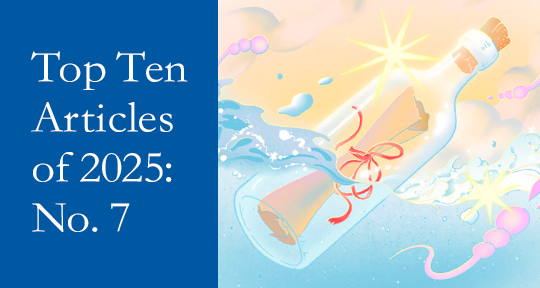
The concepts of ‘poem’ and ‘gift’ are flipped inside out as Youn flows from one point to the next, enlightening us further with each progression. Key observations point to the ‘postal essence’ of gifts, and poems as ‘words in motion.” Youn likens the latter to the message in a bottle—the poem is adrift, a precious gift for the reader who meditates on the meaning, and impassioned by the art, pays it forward through translation.

A poem-gift is only unlocked by the deeply attentive. The reader becomes a poet through translation, and in turn, the sender-poet becomes the recipient. In the process of engagement, ‘mistranslation’ is poetic embellishment, born out of a love for the message.

Youn deeply appreciates the artistry of exchanging one term for another, the symphony of finding words that capture the ‘right’ meaning. After all, “What should we call this person, who says in poems what the poet does not say, if not “a poet”? And so, mistranslations increasingly disappear. Even mistranslations are a different language turning into a poem.”

READ MORE…

Spring 2025: Highlights from the Team

Where to start with our bountiful Spring 2025 issue? Here are many entry points—courtesy of our team!

What struck me most about Anton Hur’s interview (conducted by Sarah Gear) was his clarity on AI’s role in translation. I also loved his stance on both translation and politics; every answer felt like a manifesto in miniature. Lately, I’ve been trying to delve deeper into Korean literature, and now I’m eager to read more of his work.

Jeremy Jacob Peretz and Joan Cambridge-Mayfield’s “Jombii Jamborii” was my first encounter with Guyanese Creolese in translation, and its rhythm lingers like a half-remembered song. The poem’s playfulness isn’t just aesthetic: it feels like reclamation, turning colonial language into a game where the rules keep shifting.

Youn Kyung Hee’s “Love and Mistranslation” (tr. Spencer Lee-Lenfield) unfolds like a slow revelation, each paragraph a new turn in the labyrinth of love and language. You can almost see her turning words over in her hands, testing their weight: Is this what I mean? Is this what you heard? The way she intertwines translation and love is fantastic.

Federico Federici’s asemic scripts aren’t just “unreadable” art, they are experiments in how meaning persists when grammar dissolves. When he describes languages as living organisms, I think of my own work: translation as metamorphosis, not just a bridge.

Rosario Castellanos was the first Mexican author I translated into English, so I’ll always have a soft spot for her. Translating her taught me how her quietest lines could cut the deepest. These letters (tr. Nancy Ross Jean, which I haven’t read in Spanish, by the way) feel so intimate: you sense her love for Ricardo, but also her simmering bitterness. I don’t know if this was intentional, but the timing feels poignant, as her centenary will be celebrated across Mexico later this month.

—René Esaú Sánchez, Editor-at-Large for Mexico

I grew up listening to the cadences and lingo of Guyanese Creolese and, in turn, learning to speak it myself, and I’m delighted to see Guyanese Creolese recognized as a language that merits translation in Jeremy Jacob Peretz and Joan Cambridge-Mayfield’s work. I can’t wait to read the full collection of their co-written and co-translated poems. I have had to affirm that, yes, Guyana is a country that exists, many times in my life while explaining my mixed heritage, and I’m grateful to Asymptote for bringing literary attention and awareness to this rich part of the world.

I’m only beginning to be introduced to her work, but it’s such a treat to get a glimpse into Rosario Castellanos’s private correspondence (tr. Nancy Ross Jean). Castellanos is of particular interest to me given her engagement with feminist thinkers from around the world. In the letter, Castellanos articulates a moving and beautiful relationship of love, trust, and care with Ricardo, all the while reflecting on the implications of being called his “wife” (a topic of particular interest in the feminist theory she read). Her private writing is as rich as her public work.

Youn Kyung Hee’s stunning genre-bending essay (tr. Spencer Lee-Lenfield) is one of my favourites in recent Asymptote history. It’s no accident that the tagline of this entire issue, The Gift, is taken from this work. Bookended by poetry and reflections on translation, Youn Kyung Hee manages to tackle a myriad of topics in a mutually enriching way. The idea of translation as generosity is very compelling, and I like thinking of translation as a mode of creating and sustaining a shared world through literature. This passage in particular will stick with me: “More than need, sheer innocent longing keeps me translating. Far more often, in fact. For how wonderful it would be if you, too, love the poem I love? Like sharing pastries at a nameless bakery.”

READ MORE…

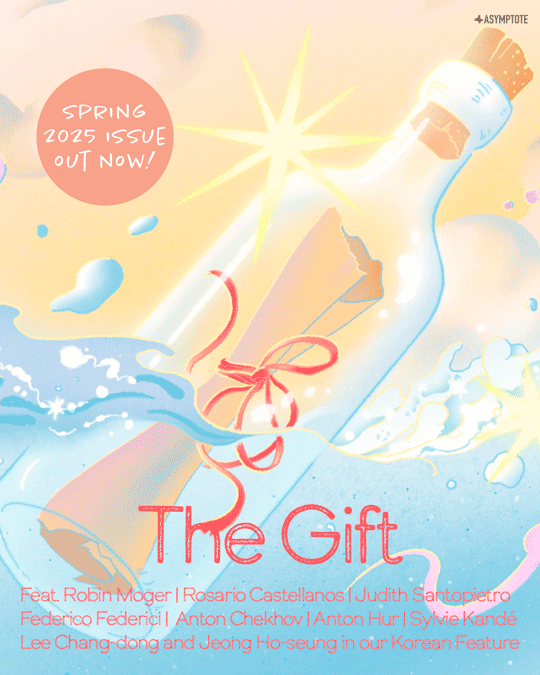
Our Spring 2025 Issue Is Here!

What’s the antidote to a world of trade wars and closed borders? Quite possibly our Spring issue, celebrating the free circulation of ideas!

What do we need from each other? What do we gain if we give? At the dawn of a new age of tariffs, the dominant mode of exchange has become a kind of brute transactionalism—before one hands over anything, one must demand something of equal value in return. But what if simply giving is the better way to flourish—the way to a richer commons? It is in this spirit that we proudly unveil “The Gift.” Gathering new work from as far afield as ParaguayLesothoSenegal, and Guyana, our Spring 2025 edition centers the generosity of translation—an act that Youn Kyung Hee, invoking Paul Celan, rightly compares to a gift: “For Celan, the event of poesis goes beyond receiving a gift from some unnamed sender; it also comprises the work of sending it out once more, a transmission bottled in glass.” How fitting, then, that our interview section, which usually features major authors in the world literature canon (such as the recently deceased Mario Vargas Llosa, in our Spring 2018 issue), cedes the floor to two of the most prominent practitioners of the art working today: Robin Moger, acclaimed translator of contemporary and classical Arabic literature, and Anton Hur, who went from debuting as a translator in these pages nine years ago to becoming the Booker International Prize-nominated voice in English of Korean authors like Sang Young Park. Hur’s interview pairs perfectly with our Korean Literature Feature, organized in partnership with LTI Korea, whose many highlights include Jeong Ho-seung’s bittersweet “sorrow by special delivery” and talented director-writer Lee Chang-dong’s absurd comedy in which a scrounging couple on vacation return to find their house burgled.

blog_Spring_2025_issue-announcement

Elsewhere in this edition beautifully illustrated by South Korean guest artist GLOO / Yejin Lee, the theme of gifts—often passed down from the generation prior—persists. The opening trio of pieces (Men and BreadLong Shadows, and Taxidermy) each consider the tendrils of paternal legacy, but the title of most dad-haunted narrator might be a contest between Pierric Bailly tracing the real-life events leading up to his father’s death in the woods and Song Seung Eon’s imaginary fisherman addressing his macabre haul (“Skull, are you my father? Are you something that was my father?”). In Christopher Carter Sanderson’s sparkling update of Anton Chekhov’s drama The Gull, by contrast, Treplev wrestles with having a celebrity for a mother. (“On her own, she’s a sexy young actress. When I’m near, she looks like a soccer mom.”) Monica Ong—whose visual poems drawing on astronomy have been featured in  Scientific American, among other places—likens her parents to intrepid “cosmonauts” for migrating from their native Philippines to a new home in the US. Finally, against the backdrop of brutal deportations from the US, poet Judith Santopietro calls attention to the gifts inherent even in the most dangerous of international journeys, juxtaposing a glimpse of black orchids from atop a freight train with the eventual hardship of “distributing food and christmas gifts” in a foreign land. Too often portrayed as mere victims, Santopietro’s poem reminds us of the agency of immigrants, inviting us to recognize their journeys as choices they have made, and to consider that these, too, may be gifts, if we allow that possibility.

If Asymptote has been a gift to you, consider helping us stick around so that it may be a gift to others down the road. Remember: the best way to support us is to join us as a sustaining or masthead member (and signing up only takes three minutes, but the good it does reverberates through time).

READ THE ISSUE

GET INVOLVED