
Posts filed under 'holidays'

What’s New in Translation: December 2025

The latest from Japan, Peru, Germany, Austria, Czechia, South Korea, Brazil, and Hungary!

In our final round-up of the year, we present a thrilling novel capturing the margins of Germany as the nation begins to veer into fascism, a collection gathering the voices of powerful Hungarian women poets, a Brazilian novel testifying to the colonial erasure of indigenous language and being, a series of essays considering the act of reading as an oppositional force against capitalism, and more!
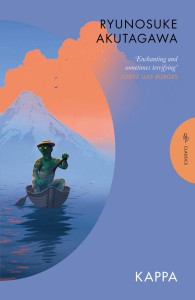
kappa

Kappa by Ryonosuke Akutagawa, translated from the Japanese by Geoffrey Bownas, Pushkin Press, 2025

Review by Kaelie Giffel

Even if one is unfamiliar with his work, English readers will recognize the name Ryonosuke Akutagawa from the prestigious Japanese literary prize, named after him posthumously by a friend. Kappa is a novella published in the final year of the author’s life. Pushkin Press’s reissue of Geoffrey Bownas’s 1970 translation comes on the heels of a 2023 retranslation by Lisa Hofmann-Kuroda and Allison Markin Powell, published by New Directions in 2023. Multiple, competing translations indicate the continued importance of Akutagawa’s work, which has a renewed urgency in our time.

Kappa is a philosophical meditation on whether difference can be encountered without violence and how we might meet others in the strange in-between spaces. Structured as a frame narrative, its inciting incident is the testimony of a patient in an unnamed mental institution. The patient speaks about meeting strange creatures with tummy pouches called Kappas. The Kappas have their own cultural, historical, and philosophical institutions and orientations to life, and the narrator lives among them for a while, alternately admiring, baffled, or repulsed as he learns more about their existence. They oppose birth control for silly reasons; sacrifice workers who have been laid off by literally eating them; prohibit artistic performance because they believe the general public to be hopelessly stupid; and are generally misogynist—female Kappas are cast as libidinous huntresses that oppress male Kappas. The narrator is bewildered by the similarities and differences between himself (Japanese) and the Kappanese. Hence, the mental institution.  READ MORE…
Festive Reads: Holiday Writing from Around the World

The Christmas season can be oppressive in everything from familial expectation to brow-beating advertising to relentless good cheer.

For many of us, Christmas is a time for gathering with family, giving gifts, and singing carols. For others, however, the holiday isn’t a snowy Love Actually postcard scene; in some parts of the world, it features tropical weather and end-of-year department store sales, while in others, it’s a just a regular day. You’ve read the blog’s Summer Ennui reading recommendations, and now we’re back with a list of our favorite Christmastime reads from Assistant Managing Editor Rachael Pennington, Communications Manager Alexander Dickow, and Editors-at-Large Alice Inggs and Barbara Halla.

Alice Inggs, Editor-at-Large for South Africa

Picture this: it’s December 25 in South Africa and there is drought somewhere in the country. Farmers pray for rain, sink boreholes, shoot dying sheep. The acacia in the bushveld to the north is bone-white and the grass invites fire. The heat is a white heat and cattle bones glare in the sun. The paint on Father Christmas statues outside shopping centres begins to melt and pine cuttings out of water droop. Tempers crackle and flare. The roads are too busy and the accident death toll climbs. White-robed umnazaretha worshipping in the open veld stand out against the brown-grey earth. It is hot and bleak and houses are full because all the family came to visit.

“It is a dry, white season” begins South African Black Consciousness writer Mongane Wally Serote’s poem “For Don M. — Banned.” It was written in the early 1970s for Don Mattera, a Xhosa-Italian poet and friend of Serote’s who had been banned by the apartheid government. The first line of Serote’s poem was later borrowed by Afrikaner André Brink for his 1979 novel ’n Droë Wit Seisoen (A Dry White Season). The book was banned too, as well as a subsequent film adaptation starring Zakes Mokae and Donald Sutherland. It’s been two and a half decades since those laws were repealed and the cultural whitewash acknowledged, but that line—“It is a dry, white season”—still echoes through summer in South Africa, the season in which Christmas falls; a reminder of the oppressive atmosphere that back then was not limited to the months when the temperature climbed.

READ MORE…