Language: Korean

What’s New in Translation? June 2016

This month's hottest titles—in translation

The Clouds by Juan José Saer, translated from the Spanish by Hillary Vaughn Dobel, Open Letter, 2016

Review by Hannah Berk, Digital Editor
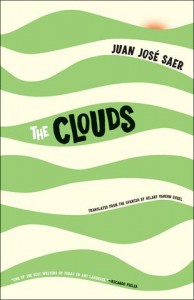
Clouds-front-frame_large

The Clouds begins with the destruction of a mental asylum and ends with an arrival at its threshold. Its central journey takes place across a vast expanse of flatlands, every horizon so much the same that progressing and doubling back lose their distinction. This is a novel of contingent geometries. In some respects, it is linear: there is a journey in which a doctor leads a crew of five mental patients, two escort soldiers, and a guide across a desert to a mental hospital. At the same time, it carves layer upon layer into itself. The manuscript we read is a file on a floppy disk being read by one Pinchón Garay in a Paris apartment, haphazardly annotated by the man into whose hands the thing haphazardly fell.

Our narrator is Dr. Real, who works under a psychologist renowned for experimental treatment methods that mostly seem to entail allowing the mad live their lives just like anyone else. He is tasked with leading a group of patients on a long journey to a mental health facility in 1804 Argentina. His charges include a delusional narcissist, a nun convinced that the only way to approach consummate divinity is by consummating as many earthly relationships as possible, two brothers as incapable of communication as they are of silence, and a distraught philosophy student unable to unfurl his fists. Dr. Real promises a scientific account of their ailments at the outset, but the moment their journey begins, we are forced to question whether their responses are so outlandish for their circumstances, or, at their core, much different from our own.
READ MORE…

What’s New in Translation? March 2016

So many new translations this month!—Here's what you've got to know, from Asymptote's own.

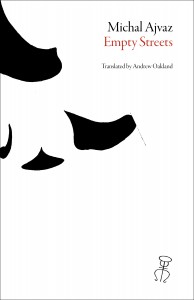
Michal Ajvaz, Empty Streets (Dalkey Archive). Translated by Andrew Oaklandreview by Ellen Elias-Bursac, Contributing Editor

Empty_Streets_AI_cover

Empty Streets, originally published in Czech in 2004, sets its writer-protagonist out on a search for a missing woman. However, in typical Ajvaz fashion, the quest begins as a search for a mysterious symbol. Early in the novel, the unnamed narrator stumbles, literally, on a double trident, a three-foot-long object that pierces his foot while he’s walking through a dump. This kicks off a sequence reminiscent of “This is the house that Jack built”: a double-trident logo appears a few days later when the narrator is using his friend’s computer; the friend tells the story of spotting the symbol in a mysterious painting; the owner of the painting, an elderly literary professor, tells him about the work of art and also adds a story about the disappearance of his daughter, whom he asks the narrator to find; the search takes him to the painter, who tells the narrator a story about . . . and so on, from one playful and inventive twist to the next, through 14 stories over the course of 470 pages.

In keeping with the novel’s sense of abundance, the prose brims with sensory experience in passages that translator Andrew Oakland renders with delicacy and precision. Notably, Oakland also leaves room for the narrator’s lack of precision, in instances like the “strange fragrance, one that is terribly difficult to describe” which he says has “several components including the scent of roses and the sharp smell of steel.” Similarly, when describing sound, the narrator says he “unpicked from the blocks of silence various rustlings, creakings, something somewhere knocking into something, something rolling around something and then stopping, something pointed that was scratching, something crumbling”—all noises that “might have been tiny sounds on the outer wall of a house, or a din softened by a great distance.”

But most pervasive are images of light and shadow, such as the observation of a sunset descending on the city, leaving only the upper-floor balconies in sunlight: “I had the feeling I was looking up at a distant shore from the bottom of a deep lake whose waters were crystal-clear.” READ MORE…

Translation Tuesday: Two Poems by Kim Seung-Hee

Avantgardists are dreadfully fierce though they do not mean to be.

In Poetry’s Emergency Room

Poetry is emergency room, poetry is oxygen tent, poetry is red blood inside a cold apple,

sorrow is like fertilizer

that must be sprinkled here and there on poetry,

poetry is a pregnant woman’s day,

the day of delivery nobody knows when it will be;

poetry comes racing embracing a bomb,

racing over the clouds.

Yet in one tiny paddy-field,

yellow heads of rice are ripening.

A field the size of a bowl of rice, small enough for a conical hat to cover,

a tiny bowl of a hat-field,

a gruel-bowl sized, rice-bowl sized gruel-field, rice-field,

hat-field.

Ordinary patients recover energy thanks to a bowl of gruel,

so by the power of a small strip of autumnal paddy

I am saved, you are saved,

so once again we lie flat on the field gleaning ears of language

then sow seeds of language

so that golden paddy-fields rise in tiers,

one of your poems,

a steaming bowl of rice, your collection of lyric poems. READ MORE…

Asymptote Spring 2014 Issue – Out Now!

…and it's packed with the most exciting new literary translations, critical pieces, and more from around the world.

What are you waiting for? Highlights from Asymptote’s Spring 2014 issue include new work by Nobel laureate Herta MüllerDavid Bellos (author of “Is that a Fish in Your Ear?”), and Prix Goncourt-winner Jonathan Littell. Plus, our annual English-language fiction feature spotlights Diasporic literature from Bosnia, China, India, Japan, and Singapore.

READ MORE…