Posts featuring Dino Buzzati

Blog Editors’ Highlights: Winter 2026

Blog editors weigh in on our latest issue!

We are not only celebrating the release of our newest issue, the fifty-eighth under our belt, but also fifteen years of working to promote global literature! This is a jam-packed issue, with two special themes and giants in the world of translation interspersed with up-and-coming voices. There is so much to discover, and our blog editors are here to help you navigate the rich offerings on hand!

In a heartwrenching ending to a long poem, Franz Wright wondered:

. . . but
why?
Why
was I filled with such love,
when it was the law
that I be alone?

And therein lies the bind of desire, which is solitude incarnate, which demands that the object of our affections remain distant and suspended, love being most absolute when it resides in wish and conjecture. We are most in love when we hibernate within our singular conception of it, alone. The pain of the unrequited condition consoles, then, by providing us with the most vivid chimeras, pursuing the indefinite with abandon, setting up its own precipitous stakes and utmost heights, the heartening glimpses at pleasure. Such speculations lead easily into self-indulgent ecstasies, but Dino Buzzati is fluent in dreams, and as such he knows that they are only interesting if relayed by someone who sees their truths.

In the earnest and lovely “Unnecessary Invitations”, one perceives the writer who had once said that he believed “fantasy should be as close as possible to journalism”—who understands that a head in the clouds remains connected to the two feet on the ground. The story, addressed to an unnamed lover, sets up several scenarios of the wonderful things the narrator would like to do with his beloved: “to walk . . . with the sky brushed grey and last year’s old leaves still being dragged by the wind around the suburban streets”; “to cross the wide streets of the city under a November sunset”. The scenes are rose-coloured, ripe with affection—but Buzzati follows up each with a cold splash of recognition, in a brilliant switching of registers captured by translator Seán McDonagh:

Neither can you, then, love those Sundays that I mentioned, nor does your soul know how to talk to mine in silence, nor do you recognise, in exactly the right moment, the city’s spell, or the hopes that descend from the North.
READ MORE…

The Winter 2026 Issue Has Arrived!

World literature remains, at heart, a problem of attention: of who is seen, who is heard, and who is permitted to remain invisible.

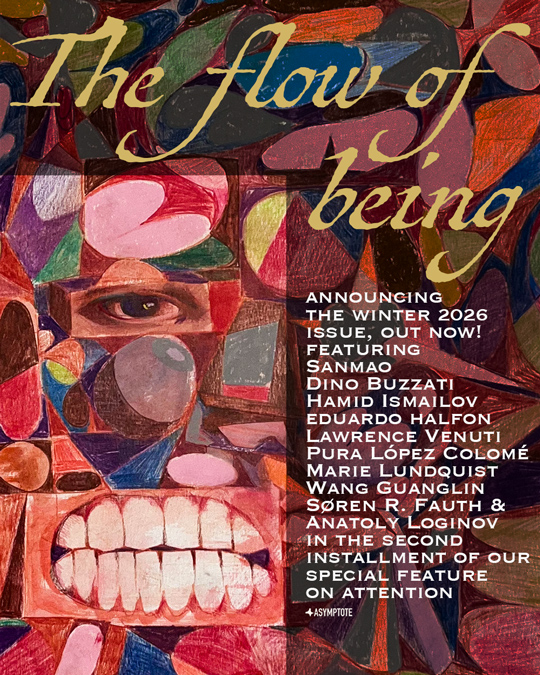
As authoritarianism continues to take hold across the world, writers and translators are compelled to revisit an age-old question: What might art offer in response? Perhaps not answers, but something quieter and more resilient—a reminder of shared human frailty, and of the possibility that our “flow of being,” as Anatoly Loginov writes, might arrive at a “narrow neck” where attention itself becomes an existential force. Writing in our Winter 2026 Issue, which also marks Asymptote’s fifteenth(!) anniversary, Loginov turns to a literary and philosophical tradition that seeks “not mastery over an object, but communion with it, even if that communion burns.” For this second of our two issues devoted to attention, we bring together his tour de force survey of 200 years of Russian thought with a luminous travelogue by the beloved Taiwanese writer Sanmao, an excerpt from Guatemalan author Eduardo Halfon’s prizewinning Tarantula, an exclusive interview with Uzbek novelist Hamid Ismailov, a quietly devastating story by Italian master Dino Buzzati, and new translations of Milo De Angelis by Lawrence Venuti, alongside never-before-published work from 32 countries. All of it is illustrated by our talented Dublin-based guest artist Yosef Phelan.

Winter-2026_blog

If Loginov argues that attention, when cultivated deeply, can ground compassion toward others, Finnish playwright Minna Canth takes this ethical impulse further into the realm of collective action. In her barnburner drama, railway workers pushed beyond endurance channel their shared anger into defiant sabotage, making exploitation visible at last. Writing from a different frontline, Kurdish journalist Zekine Türkeri bears witness to life in the Mahmur refugee camp in the days preceding an ISIS attack, showing how attention to the living entails the inescapable labor of mourning the dead. Elsewhere, in Egyptian writer Mariam Abd Elaziz’s fiction, characters struggle to care for one another as they swim and sink in the deadly currents of maritime refugee smuggling. The issue’s arc closes with an interview in which China’s Wang Guanglin reflects on the difficulty of imagining a genuinely global literature at a moment marked by isolationism, xenophobia, and resurgent nationalism. World literature, he suggests, remains, at heart, a problem of attention: of who is seen, who is heard, and who is permitted to remain invisible.

For fifteen years, Asymptote has been organized around this problem. Founded on the conviction that literature across languages deserves sustained, serious attention, we have worked to widen the field of vision—introducing readers to voices beyond dominant centers, and treating translation not as a secondary act but as an ethical and imaginative practice in its own right. If this project has mattered to you—if you believe that attention, patiently given, can still resist the forces that would narrow our view—we ask you to help keep it alive by becoming a sustaining or masthead member. Your support ensures that the flow of being we trace here continues to move, freely and exuberantly, into the years ahead.

READ THE ISSUE

GET INVOLVED

What’s New in Translation: January 2025

Discover new work from Palestine, Sudan, Syria, Iraq, Greece, Italy, China, Sweden, Germany, Chile, and the Democratic Republic of the Congo!

In the first month of 2025, the offerings of world literature are as rich as ever. To help you on your year of reading, here are ten titles we’re most excited about—a new translation of a stargazing Greek classic; the latest from China’s most lauded avant-gardist; a rediscovered Chilean novel of queer love and revolution; a soaring, urgent compilation of Palestinian voices; surrealism and absurdism from an Italian short story master—and many more.

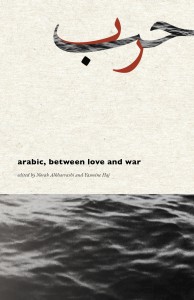
arabic between love and war

Arabic, Between Love and War, edited by Norah Alkharashi and Yasmine Haj, Trace Press, 2025

Review by Alex Tan

 Addressing itself to the subtle but immense interstice between the Arabic words for ‘love’ and ‘war’, which differ by only one letter, Trace Press’s community-centric poetry anthology is as much a testament to beauty and survival under the conditions of catastrophe as it is a refusal to perform or fetishize suffering for a white gaze. The bilingual collection is, further, an intergenerational gathering of voices: canonical luminaries like Fadwa Tuqan are assembled alongside contemporary lodestars like George Abraham.

Throughout the volume, language gives in to its fecundity, at times carried by a voice that “condenses history to the depths of silence”, at others seeded within a word that “alone was enough to wither a tree”. The whispered syllable, across utterance and inscription, temporarily suspends the cruelties of the real: “I love calling you habibi / because then I feel as though they haven’t destroyed our cities.” In shared intimacy, an interregnum emerges, fragile as the stroke of an ر.   

But how far can one measure the ruin and the specter of love in sentences? “I write rose and mean nothing,” the poet Qasim Saudi ventures, as if refuting the possibility of romanticism. The surveying ego can also be a trap—“my I wounding me”. Many of the writers here disclose a longing for dissolution, for blunting the edges of the self so that a liquid, collective consciousness might emerge in its stead. In Lena Khalaf Tuffaha’s idiom, “you never saw it coming, this cleansing, / how we have become this ocean”. Nour Balousha’s plangent question echoes, “Who told the wind that we were leaves?”  READ MORE…

Weekly Dispatches from the Front Lines of World Literature

Ecopoetry and code-breaking are capturing readers around the world in this week's dispatches.

In this week’s dispatches, Bulgarian readers brave the winter for an event highlighting environmental literature, Sweden commemorates the beloved children’s book author, Astrid Lindgren, and Italy celebrates what would have been Umberto Eco’s 90th birthday with a new publication. Read on to find out more!

Andriana Hamas, Editor-at-Large, reporting from Bulgaria

Believe it or not—it is already February, and despite the cold weather in Bulgaria, various cultural events are popping up here and there. With an ever-increasing focus on climate change and the dire consequences we are already facing, different local artists are attempting to highlight the need for conscious, collective action.

One of the strategies employed to combat phenomena such as global warming constitutes the recycling of different materials. Interestingly enough, the whole concept also happens to be at the heart of literary critic and professor of literary theory Amelia Licheva’s latest poetry collection, The Need for Recycling, which considers the act through the prism of creative impulses and intuitive journeys through one’s feelings and experiences. The book, officially published by Lexicon Publishing House on Christmas Eve, 2021, also contains illustrations by the painter Veselin Pramatarov. In an interview for the Bulgarian National Radio, Licheva revealed that the title could be interpreted as “the search for lost meaning.” She is fully aware that the formula is far from light, but insists that the initial shock—bound to rock the reader’s inner world—is in fact a sought-after provocation of sorts.

The launch of the book, which took place not long ago at Sofia City Library, was attended by over fifty people eager to hear the poetess’s newest verses. The lively discussion was hosted by the prominent writer Georgi Gospodinov (whose works have previously appeared in Asymptote) and translator Daria Karapetkova, with the actress Snezhina Petrova was in charge of recitation. After the long-anticipated premiere, the author used her social media profile to extend her gratitude to “all of my colleagues, friends, and students who attended the debut of my poetry collection. Thank you for the solidarity and for the unique privilege to be able to feel like a part of a meaningful community.”

Eva Wissting, Editor-at-Large, reporting from Sweden

A week ago today, on January 28, Sweden commemorated twenty years since the country’s most internationally known writer, Astrid Lindgren, passed away at the age of ninety-four. The creator of strong, ingenious, and unforgettable children’s book characters like Pippi Longstocking, Karlsson on the Roof, Ronja the Robber’s Daughter, and Lotta on Troublemaker Street, Lindgren has enthralled and inspired readers around the world for generations. Her books have been translated into 107 languages, including numerous translations into English by Joan Tate—who also has translated other significant Swedish writers like Ingmar Bergman, Kerstin Ekman, and P.C. Jersild. Lindgren has been awarded both national and international literary awards, as well as received honorary degrees from Linköping University in Sweden, the University of Leicester in the UK, and the University of Warsaw in Poland. On the year of her passing, the Swedish government instituted the Astrid Lindgren Memorial Award (ALMA), which awards a writer, illustrator, or promoter of reading in March every year. During her lifetime, Lindgren not only wrote for and about children, but she was also an activist for children’s rights––which is why the Astrid Lindgren estate today, together with Save the Children, continues to work on the Pippi of Today campaign for refugee girls. READ MORE…