Can Finnegans Wake be translated into another language? As the joke well-known amongst Joyceans goes, “Which language are you translating it from?”
If it is possible to translate Finnegans Wake, the next question might be: who on earth is willing and able to undertake such a task? Who even has the time to translate this work Joyce spent 17 years writing?
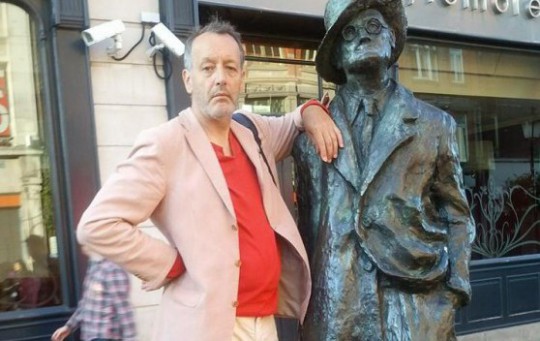
The Wake has been translated into French twice. Philippe Lavergne translated the book in the early 1980s, but unsatisfied with this edition, Hervé Michel has spent the last two decades working on a translation of his own.
Michel was born to French parents, in 1950s Morocco. He spent his youth “wandering across Europe, America, Africa and the Near East.” From 1979 until 1984 he lived in Casablanca, studying Arabic. Michel joined the French civil service in 1986 and eventually attended the Ecole Nationale d’Administration (ENA). With an annual acceptance rate of only 6%, ENA is an extremely elite graduate school for French government administrators and officials. After a decade of varied work ranging from finance to international relations, in 1996 Michel accepted a high-ranking position within the French Ministry of Defense.
In his spare time, Michel reads the Wake. He first encountered the book in 1980 and began translating the text in 1997. He has tried at various times to find a publisher for his translation, but the audience for Finnegans Wake translations is limited. In 2004 Michel decided to publish his translation as Veillée Pinouilles online, a format that allows him to make ongoing updates and revisions à la Leaves of Grass.
As Michel prepared to retire from his career in the civil service, he graciously took the time to speak with me about this longstanding fascination with the Wake. The interview was conducted over email, a format allowing for conversation as well as textual elucidation and analysis.
Derek Pyle (DP): How did you first get interested in Joyce?
Hervé Michel (HM): My interest first went to Finnegans Wake, not to James Joyce. By 1985, I had returned to Paris from a five-year sojourn in Morocco—a country where I happened to be born and raised from 1950 to 1962 and where I had returned with my newly-met wife Constance Hélène in 1980—where I had spent a jolly good time studying Arabic and reading the Qur’an. Back in Paris I felt compelled to go to the Galignani English bookshop on Rue de Rivoli to buy Finnegans Wake, on the back cover of which I discovered the man-in-the-street allure of James Joyce which was a sort of a shock. For me, Finnegans Wake was the Sacred Scripture of the Modern Era. I was not to be deceived by a text displaying all the phatic function I expected and smearing a thick semiotic matter, so I immediately felt the need to have it rendered in French.
DP: So you began with Finnegans Wake. Did you go the bookshop specifically seeking out the Wake? Or did it just one day catch your eye, while you were in the bookshop? Can you also explain a bit more what you mean that this was a text ”displaying all the phatic function… and smearing a thick semiotic matter”?
HM: Reference to James Joyce was paramount in the French literary critique between 1960 and 1980, people like Roland Barthes, Jacques Lacan, Philippe Sollers, Julia Kristeva, Hélène Cixous, Jacques Derrida, Michel Foucault, all drove me to consider Finnegans Wake as the nexus of the modern literary fabric, which I, with my gross ignorance of the finesse of the English language and of the encyclopedic richness of Joyce’s culture, took at first as the thick material somebody like Jackson Pollock smeared on his canvasses, but eventually I craved to emulate this latter Indian creation dance myself with the French language.