
Posts featuring Sarah Gear

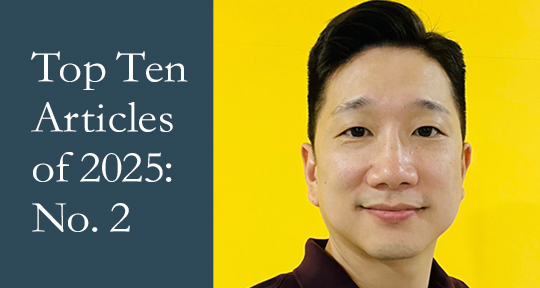
Our Top Ten Articles of 2025, as Chosen by You: #2 An Interview with Anton Hur

Hur holds language in the highest esteem. Rightly so, for when we all turn to dust, poetry is our final imprint on the universe.

Our runner-up for the title of most widely read article of 2025—also courtesy of Assistant Interview Editor Sarah Gear—is our interview with Anton Hur from the Spring issue. A Korean-English translator who debuted in our pages nine years ago, Hur’s work includes Cursed Bunny by Bora Chung, I Want to Die but I Want to Eat Tteokbokki by Baek Sehee, I Decided to Live as Me by Kim Suhyun, and Beyond the Story: 10-Year History of BTS (number one in the NYT’s 2023 bestseller list). Hur is a literary force with much to learn from, this enlightening interview takes us through his writing, thoughts on language, AI, activism, and his role as a judge for the International Booker prize.

Gear points to Hur’s blog as a boon full of advice for emerging translators, such as how to draft successful pitches to publishers, amongst other notes. In this interview, for one, Hur acknowledges the frustrations of the current publishing industry that is, to no one’s surprise, “racist and sexist and homophobic and xenophobic.” This is a gap that can be addressed by hiring more translators of color and those working from their heritage languages—Hur’s success is a testament against native-speaker elitism in the translation space.

In 2025, Hur has translated the likes of Bora Chung, Le Young-do, Sung-il Kim, Kim Choyeop and Park Seolyeon. With ‘at least five’ titles slated for 2026, Hur’s writing is the gift that keeps on giving. That includes, of course, his own exceptional novel, Toward Eternity.

The discussion of this novel offers profound takeaways. The plot explores the larger role of language and poetry through an AI machine named Panit, who learns how to understand poetry. Toward Eternity, as described by Gear, “explores the nature of what it is to be human and, I would argue, the intrinsic importance of literature—a reflection of Hur’s academic background in Victorian poetry, his experience of translation, and his belief in the power of language.”

READ MORE…

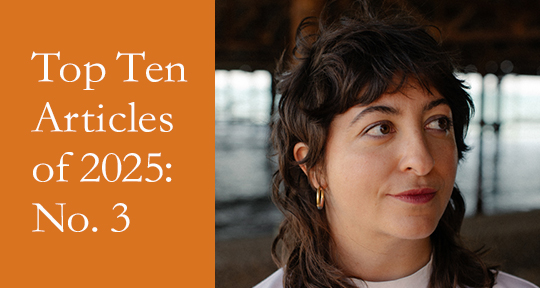
Our Top Ten Articles of 2025, as Chosen by You: #3 An Interview with Jen Calleja

Calleja is a worthy mentor for aspiring translators. Here, she offers a deeply informative dive into the niche.

Our third most widely read piece of 2025 hails from our Fall issue: a fascinating interview with literary translator Jen Calleja conducted by Assistant Interview Editor Sarah Gear. Much of this discussion is anchored by Calleja’s experimental memoir, Fair: The Life-Art of  Translation (Prototype, 2025), the summative advice of an industry veteran with a body of over twenty translated novels from German (including International Booker Prize nominee The Pine Islands  by Marion Poschmann).

Needless to say, Calleja is a worthy mentor for aspiring translators. Here, she offers a deeply informative dive into the niche. The distilled life lessons in Fair are many, and as Gear says, it reads as both an “inspiration and manifesto.” This interview also spans the lives of translators in general, challenges of the field, and the implications of AI.

A key theme to anchor the discussion: What does it mean to be a translator? Calleja boldly takes this on, describing the core of it as “holding hope for dialogue and understanding that is face to face.”

READ MORE…

Summer 2024: Highlights from the Team

Find out what our very own editors have to say about our bountiful Summer issue!

Last week’s Paris 2024 Olympics Opening Ceremony featured numerous nods to literature, art, and music, calling to mind Georgi Gospodinov’s statement in his interview for our Summer 2024 issue: “Culture is a continuous conversation, a hum of different voices, and it’s actually wonderful music, a sort of polyphony. We are not only immersed in that conversation, we are also part of it.” Indeed, as our very own Mary Hillis points out, this brand-new Summer edition is a “veritable parade of nations with works from 35 countries.” Read on to discover some of the highlights, courtesy of our multicontinental crew!

My favorite in this issue is Honora Spicer’s Spitting Sutures, with its mesmerizing fluid interplay of drafting a translation, selling a house, and experiences of the body. Fluidity also defines Olivia Sears’s in-depth historical exploration of Italian Futurist Ardengo Soffici in a conversation with Eugene Ostashevsky. Krzysztof Umiński’s Three Translators (tr. Soren Gauger) is also a wonderfully detailed dip into translation history, this time Polish. Two other texts I really enjoyed were Farah Ahamed’s The Day You Ate our Deliveroo Delivery and the dramatic excerpt Trinity by Hamid Ismailov (tr. Shelley Fairweather-Vega), the first for its many-faceted examination of an ethical confrontation, the second for its gorgeously translated insults and imprecations.

 —Ellen Elias-Bursać, Contributing Editor

I love the compact, compressed nature of Adelheid Duvanel’s The Poet (tr. Tyler Schroeder). It’s got an amazing opening line that hooked me right away. The journey of the story that goes from childhood vignette to the awareness of the narrator as poet is really striking, showing how transformative and creative language can be, how altering a shift in perspective can be.

Micaela Brinsley’s Nothing to Be Owed is such a unique piece of writing, hybridic in its tone and structure, lyrical and poetic prose. The reflections on care in italics intersperse beautifully what’s going on in the almost journal-like entries. The line “I’m trapped by the transactional” will stick with me for a while.

Sarah Gear’s conversation with Georgi Gospodinov (tr. Angela Rodel) is a huge interview for Asymptote and it was a privilege to get such intimate access to the Booker International Prize-winning author’s mind.

—Hilary Ilkay, Assistant Managing Editor READ MORE…