This month, we’re introducing thirteen new publications from eleven different countries. A strange and visceral collection of poems that distort and reimagine the body; a contemporary, perambulating study of the contemporary city; a novel that forsakes linearity for a complex exploration of chance and coincidence; a series that splits the act of storytelling—and the storyteller—into kaleidoscopic puzzle-pieces; an intimate and unflinching look at motherhood and its disappearance of boundaries; and more. . .
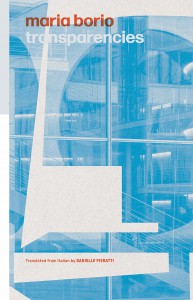
Transparencies by Maria Borio, translated from the Italian by Danielle Pieratti, World Poetry Books, 2025
Review by Jason Gordy Walker
Italian poet Maria Borio’s English debut, Transparencies, transports us to an Italy defined as much by glass, screens, and holograms as it is by history and landscape. Divided into three sections—“Distances,” “Videos, Fables,” and “Transparence”—Borio presents a world where past, present, and future converge toward an audible silence, where the self presents itself as genderless, morphable—the I becomes you becomes we becomes they—and the poet plays not a character nor a confessionalist but an airy, elegant observer, as illustrated in “Letter, 00:00 AM”:
At the end of the video, soundless voices,
hollowed-out faces scroll like the ground stumps
of legend: even people with desires
emptied like furrows in tar can carry
a fable. The screams are timbers, old water
they turn to bark, white knots, even.
Danielle Pieratti’s translations preserve the glassiness inherent in the Italian originals; she has strived for accuracy of voice and image, as evident in “Green and Scarlet” (“Verde e rosa”), an eight-part poem that considers natural, national, and human borders: “Between the trees there’s the border’s furrow / the heavy sign that stopped them / all around shapes spring up like nations.” In an interview at Words Without Borders, Borio recalls how she and Pieratti chose to use “scarlet” instead of “pink” when translating “rosa”: “ . . . in English it’s literally ‘pink,’ but . . . the color referred to the luminous atmosphere of a sunset in the woods, so ‘pink’ would have given too sharp an impression . . . Danielle came up with the word ‘scarlet,’ which . . . feels softer, more delicate, with a gradual outpouring . . . .” Such close attention to diction permeates the collection.
Although the book examines the modern world and its technology—recordings, photos, videos, cellphones—Borio refuses to be glitzy (she’s no Twitter-verse poet). Describing the London Aquatic Centre, she pens lines like, “The transparent organs overhead open / become a soft line chasing itself, / cleansing the breath’s dark colors . . .” and “Life is everywhere, in the curved line / we inhabit as though thinking.” Simultaneously detailed and abstract, her verse brings to mind Eugenio Montale and Wallace Stevens, two influences that Pieratti mentions in her illuminating translator’s note—although there’s some European surrealism rolling through her veins, too: “The cactus spines clench their vertebra of water.” Such accents only add to her poetry’s dreamlike magnetism, its cultured mystique. READ MORE…