Posts filed under 'World War II'

Weekly Dispatches from the Frontlines of World Literature

This week's literary updates from the Czech Republic, Iran, and England

This Friday, we present three very distinct reports from the world of literature. Slovakian Editor-at-Large Julia Sherwood looks back at what was a great year of Czech literature in translation and gives us a sneak peek at what to look forward to this year. Her Iranian colleague Poupeh Missaghi reports on language-related issues in a human rights Twitter campaign. And finally, the UK Editor-at-Large M. René Bradshaw tells us where to head for great readings in London this month and next.

Julia Sherwood, our Editor-at-Large for Slovakia, has good news from the publishing world:

Last year proved to be a big year for Czech literature in English translation, with no fewer than eighteen publications from eight different presses at the latest count. They include, to mention just a few, Worm-Eaten Time, poet Pavel Šrut’s elegy for his homeland after the Soviet-led invasion of Czechoslovakia, translated by Deborah Garfinkle, and symbolist poet Jaroslav Durych‘s (1886-1962) 1956 novella God’s Rainbow on the expulsion of the German-speaking population from Bohemia after World War II. First published in censored form in 1969, it is now available in full in David Short’s translation as part of Karolínum Press’s Modern Classics series, which also features Eva M. Kandler’s translation of the World War II literary horror The Cremator by Ladislav Fuks, a study of the totalitarian mindset that still resonates today (extract in BODY Literature), and served as the basis for one of the key films of the Czech new wave, directed by Juraj Herz.
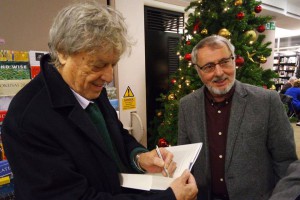
Stoppard_and_Bajaja,_photo_by_Pavel_Stojar

On 30 November, a packed audience at the launch of Antonín Bajaja’s Burying the Season (also translated by David Short) at Waterstones Piccadilly in the heart of London included the playwright Tom Stoppard. Stoppard’s father came from the town of Zlín, the setting for this novel depicting the early years of communism in Czechoslovakia. Czech literature scholar Rajendra Chitnis introduces the book as part of an Istros Conversations podcast on Audioboom, while Michael Tate of Jantar Publishing discusses on Czech radio the challenges of bringing Central European literature to English readers.

World Literature Today picked Czech writer Magdaléna Platzová’s The Attempt as one of its Notable translations of 2016, characterizing it as “historical fiction at its best”. In an interview with the Czech cultural bi-weekly A2, the novel’s translator Alex Zucker points out that while more books by Czech authors are now being published than ever before, they don’t necessarily reach many more readers since—like translated literature in general—quite a few are brought out by small independent presses and are therefore not visible in major bookshops and rarely reviewed.

In 2017, we can look forward to Zucker’s translations of two the most acclaimed contemporary Czech writers: Jáchym Topol’s Angel Station is due from Dalkey Archive in May, and Petra Hůlová’s taboo-breaking Plastic Three Rooms will be brought out by Jantar Publishing. Budding UK translators keen to be part of this unprecedented boom in Czech literature in English can participate in the fourth annual international competition for young translators, who this year are asked to tackle an excerpt from Bianca Bellová’s The Lake by 31 March (see their call for submissions). Budding Czech-to-English translators can also dip into the treasure trove of tricky issues, complete with solutions generously shared by Melvyn Clarke, in his blog post Translating Hrdý Budžes.

Acclaimed writer Zuzana Brabcová, who sadly passed away in 2015, was posthumously awarded the Josef Škvorecký prize for her haunting last novel Voliéry [Aviaries]. And as the year drew to a close, scores of students and literature lovers mourned the loss of the legendary Fišer bookstore in Kaprova Street near Prague’s Old Town Square, which closed its doors after selling books since the 1930s.
READ MORE…

Translation Tuesday: An excerpt from “The Midwife” by Katja Kettu

To this day I can’t say what spurred me into action the first time I helped bring a life into this world.

Today we’re thrilled to present an extract of Katja Kettu’s breakthrough novel, The Midwife—also Kettu’s debut in English, available from Amazon Crossing today. This Runeberg Prize–winning work depicts a passionate love story set against the severe backdrop of World War II’s Arctic front and the desolate beauty of a protective fjord. For a taste of this epic romance, and to discover the book that went on to become 2011’s most widely read title in Finland, read on.

We could hear Lisbet’s screams from the yard. I’d spent the journey sit­ting on the back of a green Tatra truck, my thighs caressed by the wind. Initially I tried to force my way into the cab beside you, Johannes, but Jouni forbade me. I didn’t protest. There’s no arguing with the greatest rumrunner in Lapland.

I didn’t wait for Jouni to haul his stout body down from the pas­senger seat. I barged through a sea of head scarves into Näkkälä’s rose-patterned bedroom. The air smelled of incense and blood. A candle flickered on the altar, and next to an icon, Greta Garbo gave a divine, papery smile. I gripped the white lintel decorated with lace, because the sight of Lisbet shocked me. She was still beautiful, but distress and pain were pushing forth from beneath the beauty. Her milky-white thighs were caked in blood and mucus, her hair stuck across her eyes, now wide with the fear of death. Without ceremony I slid my hand between Lisbet’s thighs. I recalled my very first delivery, at the Alakunnas house­hold, just as I did every time I midwifed.

READ MORE…

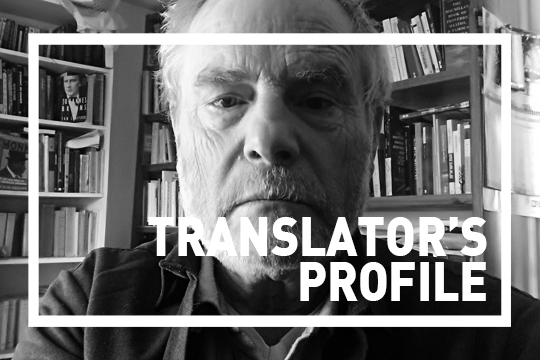
Translator’s Profile: Jeffrey Green

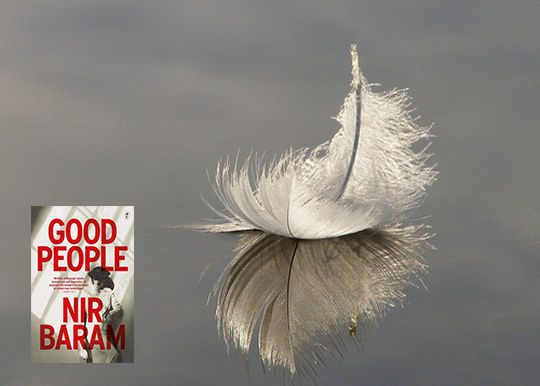
Our editor-in-chief talks with Jeffrey Green, the translator of Nir Baram's Good People

First of all, congratulations on the very fine translation, which I can recommend to Asymptote‘s readers without the slightest reservation. I was quite impressed by the deftness of your rendering; I found the book ‘unputdownable,’ riveted as I was by your skillful reconstruction in English of Nir Baram’s adman, and the meteoric ascent of his career in 1930s Germany. In fact, other than the odd German word or two every page, the writing didn’t seem to bear any trace of translation, for me at least, as I found it working perfectly well in English, both in terms of the story’s sitcom-like pacing and the sharp, precise English. I’m curious to know how much was lost in translation?

I’m grateful for your compliments, and I’m also very grateful to the editors at Text Publishing in Australia, who went over the manuscript with meticulous care and fine literary judgment. I always had the feeling that they were working with me (and Nir), not against me, with the aim of producing the most readable book possible. I’m glad you think that we succeeded.

With regard to this translation, I benefited from Nir’s input. Translators into English are fortunate, in that the authors they translate usually known the language, so they can correct misunderstandings, notice sentences that one has skipped, etc. Of course, this has a downside as well, because some writers (even Nir on occasion) think they know English better than their translator. Also, the writer always has the feeling that something has been lost, his voice, in the transition into another language. It must be somewhat distressing to hear one’s voice differently from the way one imagined it. On the other hand, sometimes writers discover things about their work when they see it in translation. But they have to accept loss of control inherent in the process of translation.

READ MORE…

Translation Tuesday: An Excerpt of “Good People” by Nir Baram

Frau Stein had been stabbed in every part of her body. She lay face down, her head cradled in her folded arm.

Good People is a globe spanning, wide-canvass novel that probes the depths of one of history’s darkest hours; its heroes are those members of the educated middle classes who sit behind office desks. With riveting narrative force, based on thorough historical research, this extraordinary novel spans World-War II Europe across time and space, boldly sketching an unflinching portrait of men and women and their times. In the extract presented below, our protagonist, Thomas Heiselberg, a Berlin adman, discovers a Jewish woman violently murdered in his home.

***

That night he returned home into a white cloud of feathers. He heard glass splinters grinding under his shoes. The windowpanes, china bowls, lamps, mirrors—almost nothing was intact after the visit by Hermann and his friends. Even the door hinges had been jimmied off. Wooden cabinets and dressers were smashed with hammers, the gas and electricity lines ripped out. At least a dozen jars of fruit preserves had been hurled against the bathroom wall, and flour mixed with soap powder and blood was strewn all over the sink and lavatory.

Frau Stein had been stabbed in every part of her body. She lay face down, her head cradled in her folded arm. He leaned down and turned her over. When he saw her face, coated with a layer of blood-soaked flour, he realised that after stabbing her they had smothered her in the sink with a mixture of flour and soap powder. She looked like a sad clown in the circus. They hadn’t even let her die with that stern expression of hers, well versed in suffering, that had always aroused people’s respect. He gathered some feathers and covered her face with them.

READ MORE…

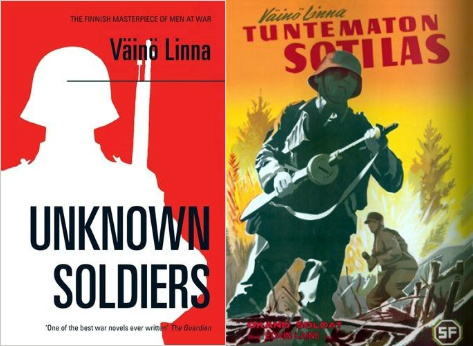
In Review: “Unknown Soldiers” by Vaino Linna

Daniel Goulden reviews a book "so good it hurts to read."

In November 1939, the Soviet Union invaded Finland in hopes of annexing Karelia, a strip of forested lands on the border of Finland. It wanted Karelia as a buffer to safeguard nearby Leningrad. Finland fought back fiercely, but ultimately had to surrender portions of its Eastern Lands. Two years later, in June 1941 (when the Nazis broke the Molotov-Ribbentrop pact), Finland was trapped between two authoritarian regimes. Allying itself with Nazi Germany, Finland entered the war against the Soviet Union and attempted to regain the territory lost during the Winter War.

The novel Unknown Soldiers by Vaino Linna presents the morally ambitious events of the Continuation War. The story follows a company of soldiers, some excessively patriotic—and others considerably less so—as they march through the forests of Karelia. The perspective seamlessly switches from character to character, so the reader witnesses the war from multiple perspectives. Despite their differences, each character quickly realizes that the war is horrifying and pointless. The only characters who do not realize this ostensible truth of war are the deluded officers, more concerned about medals and careers than the lives of their men. READ MORE…

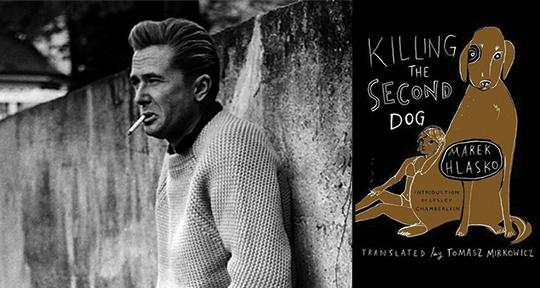
In Review: Marek Hłasko’s Killing the Second Dog

First published in Polish in 1965, Tomasz Mirkowicz's translation of a crime novel set in Tel Aviv is a delight.

Killing the Dog by Marek Hłasko, translated from the Polish by Tomasz Mirkowicz, New Vessel Press, 2014

Marek Hłasko’s novel, Killing the Second Dog, is set in Tel Aviv, but it isn’t any Tel Aviv that I know. Not only the years that separate my Israel (I was born there in 1982) from the novel’s newly independent Israel of the early 1950s account for this lack of familiarity. Nor is it the fact that Killing the Second Dog is, essentially, a crime novel. Hłasko’s Tel Aviv is an identity-less city, where a multitude of languages is spoken and a variety of currencies is exchanged. Still overcoming British rule and catering to the many post-war tourists financing its new path, this Israel offers itself up for grabs, trying, in spite of the suffocating heat and the shoddy infrastructure, to constitute as small an interruption as possible.

The central feeling of estrangement, however, the gnawing discomfort I felt as I read this book, came from the fact that my Tel Aviv, and especially the beach, where the bulk of the novel is set, is nothing if not laid-back. Traffic jams, bad parking, sweltering heat—they all fade into the feeling of a constant vacation, of beers on rickety wooden tables and sooty flip-flop-clad feet.

Hłasko, on the other hand, presents readers with a Tel Aviv that is constructed from bricks of anxiety. In a town cursed by the dry desert wind, Hłasko’s protagonists, Jacob and Robert, are surrounded by lowlifes, criminals and lost souls. Their Israel is one of jail time, seedy hotels, dirty deals and sweaty beds. Jacob is constantly looking for something of his own, but everything he ever has—the dog, his room, a towel—must be shared with another.

The plot is simple. Two Eastern European nobodies are romance con artists. Robert, a former theatre director who believes plays were meant to be performed in real life rather than on stage, writes lines for Jacob, the good-looking one, and with the help of a charming dog (which must be replaced with each iteration of their scheme), they trick rich American tourists into falling in love with Jacob and paying his fictitious debts off so that he may join them in the United States. The money is pocketed, the relationship falls through, on to the next victim.

But the script Robert had come up with is so inventively ridiculous that it creates a circus of sorts on the beachfront: Jacob is to play an angry, miserable and belligerent man in order to win the love of kindly women. In a fit of rage, realizing that he would never be able to join his beloved in America and wanting to hurt her and himself, making him appear cruel and heartless in her eyes, he must shoot the dog, his only possession, and then attempt suicide by swallowing sleeping pills. This is no fraud—the dog is now dead, and on at least one occasion Jacob alludes to, the forged suicide attempt had almost culminated in very real death.

And the most ludicrous part is, by Jacob’s own testimony, the two don’t ever do much with the money they swindle out of the women. Most of it pays for the dog’s food, and the rest is spent on cheap movies and cigarettes. While Jacob laments not having been born rich, while he is plagued with guilt for his lowly way of life and refuses to talk about one of his victims, who, after being admitted to a mental health institution, had killed herself over his betrayal, he never attempts to change his situation. He mentions previous occupations, all leading him in some way or another to serve time in prison. He enjoys conning his own partner, and has no interest whatsoever in finding real love. He is an aspiring actor who hates acting and an aspiring writer who won’t write. He dreams of a room of his own to disappear into with his books. But he, and all the other characters in Killing the Second Dog, know only how to dream, incapable of making their dreams come true. Whenever he stumbles upon a chance for real emotion and true bravery, he makes sure to squash it as best he can. In the book’s touching final scene, Jacob makes a weak attempt to take over the role of director of his own life, but it’s just another meaningless scene in the fiction of his life. In many ways, he is the second dog that must be sacrificed for the show to go on.

Unkempt, unwashed, unpleasant and unethical, Jacob and Robert appear not as the Big Bad Wolves of Tel Aviv. Instead, they read like two empty shells conjuring up the remains of their strength, whatever was left of them after communism and World War II had its way with them back in the home country. We learn little of their personal histories, but enough to know they have been traumatized in ways that, left untreated, lead men to nothing but more violence, more hate. In their pathetic aggressiveness, they manage to overcome readers’ distaste for them and become almost sympathetic.

This feat is greatly thanks to Hłasko’s talent of blending the old with the new in practically imperceptible ways. Bringing up small anecdotes from his characters’ past (“I didn’t learn anything in school. I misbehaved so badly they used to make me stand in a corner with my face to the wall. That was my punishment. You have to admit that under those circumstances I didn’t stand a chance of learning anything. Even the gym teacher would throw me out the door,” “My real father was a good and gentle man who died when I was six”), he accentuates just how empty their present is—their future, most likely, nonexistent. His cool, staccato style is held back for moments when one of the characters lets slip a sentimental run-on statement, puncturing a reader’s seemingly already-made-up mind.

Tomasz Mirkowicz has created a translation simultaneously exotic and familiar, resulting in a sense of pleasant disorientation. Without explaining too much about the time and place, avoiding the temptation toward footnotes, he serves English readers the colloquial style of dialogue and narrative in an easy, palatable and familiar way, only to then surprise them with a punch of that delightful strangeness, which is often the most pleasurable part of reading translated work. This is a novel that will haunt me, like a dog.

***

Yardenne Greenspan, Asymptote editor-at-large for Israel, has an MFA in Fiction and Translation from Columbia University. In 2011 she received the American Literary Translators’ Association Fellowship. Her translation of Some Day, by Shemi Zarhin, was chosen for World Literature Today’s 2013 list of notable translations. Yardenne’s translations include work by Rana Werbin, Gon Ben Ari, Nahum Werbin, Vered Schnabel, Kobi Ovadia, Yirmi Pinkus, Ron Dahan, Alex Epstein and Yaakov Shabtai. Her fiction, essays and translations have been published in Hot Metal Bridge, Two Lines, Words Without Borders, Necessary Fiction, Agave, World Literature Today, Shelf Unbound and Asymptote, among other publications. She is currently working on her first novel.