Language: Cebuano Binisayâ

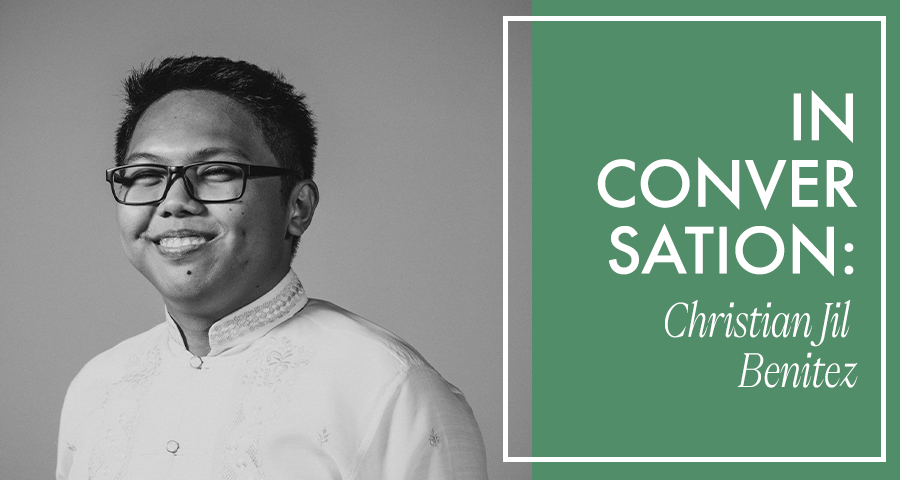
To Become an Afterlife: An Interview with Christian Jil Benitez on Filipino Literature in Translation

After all, with all the languages and cultures of the country, one can only speak of the ‘Philippine’ in partials. . .

Named Poet of the Year in 2018 by the Komisyon sa Wikang Filipino (Commission on the Filipino Language), Christian Jil Benitez is a queer Filipino poet, scholar, and translator. His debut book, Isang Dalumat ng Panahon (A Theory of Time, 2022), was awarded the Best Book of Literary Criticism and Cultural Studies at the National Book Awards in the Philippines, substantiating his important work in codifying the cultural formation of ‘Filipino time’ via the material, the poetic, and the tropical, in addition to finding an equilibrium between Western critical theory and indigenous epistemologies.

Beyond his scholarship, from positioning the bugtong (or the Tagalog riddle) as ecopoetry to recasting vernacular oral traditions as matrices of queer world-making, Benitez’s translations maintain that their critical role is not merely linguistic, but also results in a creative rebirth, of ‘translation that acknowledges, and relishes even, the transfiguration of the material as it is carried over from one containing language to another’.

In this conversation, I spoke with Dr. Benitez, traversing Bangkok and Manila, about the pressures and prospects of translation in neocolonial, multilingual Philippines, as well as the ethics of barkadahan, especially when familiarity and friendship become central to the labour and logics of literary translation.

Alton Melvar M Dapanas (AMMD): Your debut, Isang Dalumat ng Panahon (A Theory of Time), excavates the construct of time through Philippine-language dictionaries, poetry, historico-colonial texts, metaphors, and indigenous orality, revealing it as ecological, discursive, and material. How does ‘Filipino time’, as you’ve theorised it, diverge from Western, capitalist temporality?

Christian Jil Benitez (CJB): We commonly use ‘Filipino time’ to refer to the tendency of Filipinos to be late: to start an event in ‘Filipino time’ means to actually start one hour after the initially agreed time. The term was supposedly coined by the Americans during their occupation in the country to shame Filipinos for this behavior, but this habit has also been observed in many Southeast Asian (as well as other non-Eurowestern) contexts, and can be understood as the persistence of polychronic sensibility in these cultures despite the imposition of Eurowestern, capitalist, and patriarchal monochronicity. READ MORE…

Weekly Dispatches From the Frontlines of World Literature

The latest literary news from France, Egypt, and the Philippines!

This week, our team members take us to festivals around the world — from comics in France, to Filipino children’s literature in Italy, to Bedouin poetry in Egypt, read on to find out more!

Kathryn Raver, Assistant Managing Editor, reporting from France

A little over a year ago, I wrote a dispatch for this column about the 2024 Festival Internationale de la Bande Dessinée d’Angoulême, an annual celebration of the art of the graphic novel. Visual storytelling has always been a staple of French literature, going as far back as Renaissance-era illustrated manuscripts, but the modern art of the bande-dessinée (often referred to as the Ninth Art) is thought to have taken root in the early 19th century.

In countries like the US, graphic novels are often considered to be for children, which is a shame because they have the potential to add a fascinating element to storytelling. As someone who is incredibly passionate about the genre, I was thrilled to see the festival come back in full swing this past weekend for its 52nd year. As one of the largest comics festivals in the world, it hosted hundreds of thousands of participants and countless illustrators and authors for a weekend of workshops, exhibitions—including one on the work of last year’s Grand Prix winner, Posy Simmonds—and industry discussion. READ MORE…

Weekly Dispatches from the Frontlines of World Literature

The latest literary news from Mexico and the Philippines!

This week, our editors-at-large share reflections on prose from Mexico and an event on women in translation in New York. From the wise words of a beloved centenarian writer to a reading celebrating ‘minority’ languages, read on to find out more!

René Esaú Sánchez, Editor-at-Large, reporting on Mexico

“Prose is everything,” said Uruguayan poet Ida Vitale with cheeky irony. “I have a so-so relationship with poetry, but prose… it presents more challenges to me. Poetry is a matter of rhythm, of good or bad taste. But prose… prose is everything.”

Last year, Vitale reached the modest age of 100, and last week, with unparalleled lucidity, she inaugurated the Feria Internacional del Libro de las Universitarias y los Universitarios (Filuni), a book fair organized by the National Autonomous University of Mexico (UNAM) for students, academics, publishers, and writers. READ MORE…

Weekly Dispatches From the Front Lines of World Literature

Literary dispatches from the Philippines, Bulgaria, and Palestine!

This week, our editors on the ground report on the loss of a pivotal figure in the indigenous literature of the Philippines, the Palestinian Book Fair held amidst the politics of occupation, and the Autumn Salon of the Arts in Plovdiv. Read on to find out more.

Alton Melvar M Dapanas, Editor-at-Large, reporting from the Philippines

The Philippine literary community mourns the passing of Higaonon Manobo novelist, poet, and translator Telesforo S ‘T.S.’ Sungkit, Jr. Sir Jun, as we fondly call him, also wrote as Anijun Mudan Udan, and his work represented the voice of the Higaonon, one of the eighteen ethnolinguistic indigenous peoples groups collectively known as Lumad, original inhabitants of the southern Philippine supraregional island Mindanao.

Writing in and translating from four languages, Higaonon (sometimes referred to as Binukid), Cebuano Binisayâ, (Tagalog-based) Filipino, and English, Sir Jun received fellowships from the 2005 IYAS National Writers Workshop (De La Salle University—Bienvenido N Santos Creative Writing Centre) and the 12th Iligan National Writers Workshop (Mindanao State University-IIT and Mindanao Creative Writers Group). His first novel, Batbat hi Udan [Story of Udan], came out in 2009 and was considered as the first epic novel from Bukidnon, his home province. In 2007, he won the National Commission for Culture and the Arts (NCCA) Writers Prize for another novel Mga Gapnod sa Kamad-an [Driftwood on Dry Land] first serialised in Bisaya Magasin and later, self-translated into the English under the University of Santo Tomas Publishing House in 2013. Just this year, a translation of this novel from the Binisayâ into the Filipino secured the Rolando Tinio Translators Prize for the novel category.

Sir Jun’s third novel Ang Agalon sa mga Balod [The Lord of the Waves] bagged another NCCA Writers Prize in 2013, and is forthcoming from the University of the Philippines Press as Panginoon ng mga Alon—self-translated into the Filipino. (An excerpt is available from Likhaan: The Journal of Contemporary Philippine Literature.) In 2014, another novel Mga Tigmo sa Balagbatbat [Balagbatbat’s Riddles] received a National Book Development Board grant. In most of his short stories and novels, the structure veers away from the generic Western plot, being instead influenced by the nanangen oral storytelling ingrained to the Higaonon people and other Lumad. Other works of his can be read in Kabisdak: Cebuano Literary Lighthouse and BukidnonNews.net, where he once served as literary editor. (You can read his well-anthologised poem “I, Higaonon” from Australia-based Cordite Poetry Review here.) READ MORE…