
Looks like 2026 isn’t coming in slow. Despite the chaos, we’re looking forward to another year of illuminating the best of what world literature has to share—and we’re starting off with plenty to go around, with thirteen titles from ten countries. Find in the mix a new translation of one of the Peruvian canon’s most dazzling and convulsive works; a novel depicting the delicate indigenous customs of a region between Siberia and northeast China; a shocking, propulsive novella from a Japanese cult writer; a story of transformative grief from an enthralling Romanian voice, and so much more.
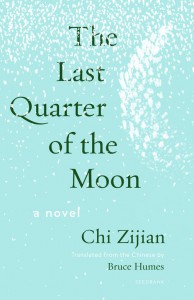
The Last Quarter of the Moon by Chi Zijian, translated from the Chinese by Bruce Humes, Milkweed Editions, 2026
Review by Mandy-Suzanne Wong
The opening lines of Chi Zijian’s wondrous novel, The Last Quarter of the Moon, set a carefully measured tone for this enchanted story of Evenki nomads: “A long-time confidante of the rain and snow, I am ninety years old. The rain and snow have weathered me, and I too have weathered them.” this rich and essential passage gently, and with deference, opens a window into a world where humans confide in rain. Chi and translator Bruce Humes indulge the word weather in at least three of its meanings, conveying the narrator’s resilience and hinting at her costly intimacy with other-than-human energies.
A word exchanging its meaning for other meanings—as if adopting different bodies to slide between existential contexts—invokes the dynamism of the shamanic Evenki cosmos, wherein earth and sky, humans and nonhumans, the embodied and the disembodied, dance together in precarious balance and tender reciprocity. Everything is alive in the Evenki’s animist multiverse, every entity ensouled, each Earthling an embodiment of the Spirits, and every human owes a debt to the Spirits for the lives of nonhumans killed for food. In turn, when a human child goes missing, in danger of freezing to death, a reindeer child must go “to the dark realm on [the human’s] behalf,” in a mimetic exchange.
Taking place in the chaotic twentieth century, Chi’s novel follows an Evenki clan as they track their beloved free-range reindeer through the mountainous forests along the Arun river, which today forms a natural border between Siberia and China’s Heilongjiang province. Suffusing this space are soldiers, fur and gun traders, and researchers from China and Russia visiting or invading Evenki lands, but the Evenki’s dependence on manufactured items (chiefly flour and hunting rifles), as well as the destruction of ancient forests by loggers from both nations, wear down the clan’s resistance to colonial incursions. Industrial deforestation creates an imbalance in “our parched mortal world” that is beyond the shaman’s power to correct. Thus do colonialism and ecocide travel together.
When the clan abandons nomadism for an easier life in town, the narrator, widow of the clan’s last Chieftain, remains in the mountains with a handful of reindeer and ninety years of memories. She explains, at length, Evenki recipes for survival: how to extract sap from birch trees, how to imitate a raven to divert the Spirits’ wrath after killing a bear, how to use bats’ corpses to cure a reindeer’s cough. Indeed, reindeer are her clanspeople, just as her children are. “Not seeing [reindeer’s] eyes is like not seeing the sun in the day or the stars at night—it makes you sigh from the bottom of your heart.” She cannot condone the move to town, where reindeer will be “imprisoned” in paddocks.
She protests with silence. Has not her clan, throughout her existence, subverted colonial impositions by ignoring them, by deigning not to retaliate but continuing to be Evenki, to live as Evenki in Evenki ways? Abandoned by the clan, her stoic silence perpetuates the clan’s radical resistance. In such nomadic spirit, she delivers her story not as a legacy (“I didn’t tell you my name because I don’t want to leave my name behind”) but as a movement, a forward glide in her migration towards the Spirit realms, commending her history to the elements: “Let let the rain and the fire listen to my tale. For I know these foes, like human beings, have ears too.”
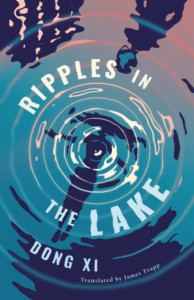
Ripples in the Lake by Dong Xi, translated from the Chinese by James Trapp, Sinoist Books, 2026
Review by Anna Mebel
When a woman’s body, her right hand severed, washes up on the shore of the West River, Ran Dongdong, a brilliant investigator who arms herself first and foremost with suspicion, picks up the case. Her incisiveness and acute vision have led her to solve the trickiest of mysteries, but it has also corroded her trust in the people closest to her. If everyone is lying to her as she heads her inquest, she reasons that her husband must be too.
Ripples in the Lake alternates between the murder investigation and the investigator’s interrogation of her own husband. She is unrelenting in her pursuit of the perpetrator, finding a web of men involved with the victim Xia Binqing, each of them a contributor to the young woman’s demise. Yet, as the case is prolonged, Ran Dongdong’s nerves become increasingly frayed; at the height of her paranoia, she thinks of her husband as perpetrator rather than lover: “She wanted to use interrogation techniques on him, but she was worried that if she did, he would most likely lie out of nervousness.”
Though the novel initially purports to be about the psychology of murder, what it really strives to explore and enumerate are different kinds of love—romantic love, maternal love, guilty love, misplaced love, imagined love, one-sided love, a victim’s love for her abuser, love that can withstand time, and love that cannot. The murdered woman’s question rings through the book: “How come I’ve been taught since childhood to respect the elders, care for the young, love my job, be kind to others, make money fairly and serve the people, but no one has taught me how to deal with love?” Every character in the novel suffers either from an excess or lack of it; one drives people to despair, the other to callousness. At times, the devotion Ran Dongdong’s husband shows her in the face of her paranoid scrutiny renders her doubts as shrewish and cartoonish, but she is right that Ma Dafu has secrets; all partners in marriage do. Ripples in the Lake takes love in handcuffs and brings it to the interrogation room, attempting to investigate its fundamental unknowability.
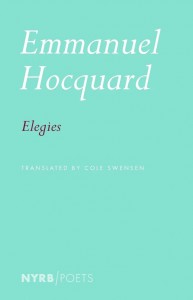
Elegies by Emmanuel Hocquard, translated from the French by Cole Swenson, New York Review Books, 2026
Review by Hilary Ilkay
Spanning around twenty-five years of Emmanuel Hocquard’s life, this dazzling collection pays homage to the elegiac poetic tradition while resolving to speak in the present tense. “Time has worn nothing out,” he observes in the first poem. The introspection that follows is replete with nostalgia and melancholy, occupying the liminal space between time periods and traditions.
Hocquard is a master of capturing the everyday—though an everyday that is suffused with surreality, bred from overlapping temporal realities. Throughout various poems, he imagines the obsolescence of death, which would indefinitely prolong the present and past, “. . . of avoiding / having to imagine the following day.” The past would then linger on, but only as a ghostly remnant that has been stripped of its mystery: “. . . as for the solitary gods / and the reputation of Pergamon . . . / But what’s the point, really, given that we all know / perfectly well / what happened to the Acropolis.” Hocquard’s references are trans-historical, spanning from Ovid to Sa’adi, from Propertius to Eliot, but in a way that recalls the latter’s “heap of broken images.”
The feeling of fragmentation extends to the form of the poems themselves, which tumble down the page in a cascade of words and line breaks, making use of capitalization, parentheses, and forward slashes. In crafting the poems this way, Hocquard recalls not just the canon of modernist poets, but the ancient poems that survive only in bits and pieces, each word on the page invoking others that are absent and lost to time.
In the later elegies, as the text becomes more and more fragmentary, the poet nevertheless asserts, “. . . I will bring the threads together.” The genius of Hocquard is that he does not let you see the invisible links that bind various traditions, figures, and places together, allowing you to occupy a poetic landscape that excavates what has been only shallowly buried beneath the present. Elegies is a literary odyssey through time from one of France’s most renowned poets, and it will reward an adventurous and faithful traveler.

Two Women Living Together by Kim Hana and Hwang Sunwoo, translated from the Korean by Gene Png, Doubleday, 2026
Review by Randle Browning
Two Women Living Together is co-authored by the multihyphenates Kim Hana and Hwang Sunwoo, the hosts of the podcast Two Women Talk and the collaborators in a shared life of platonic partnership. Having committed in their forties to cohabitating, the book that results from this unconventional choice is part-memoir and part how-to, detailing Hana’s courting of Sunwoo, their search for the right apartment, and the messy details of merging their lives.
The book’s tone is casual and friendly, more focused on lifestyle design and personal development than on cultural analysis—but their decision to build a life together, as well as the way they frame it, is radical in its context. Plummeting marriage and childbirth rates in South Korea have been well-documented, and Hana and Sunwoo have positioned their choice as a way out of a long-extant social bind: isolation or marriage, neither of which feels ideal. Marriage “felt like the most foolish thing to do,” Hana writes in the first pages, like “running straight into a draining world . . . one ruled by in-laws and patriarchy.” Filial piety and traditional gender roles are deeply ingrained in South Korean culture, where even women and mothers who work outside the home are often expected to run a household and provide care—not just for their own children and parents, but also for their husbands. “In South Korea,” writes Sunwoo, “going from the princess of the family, a competent worker or a care-free individual to a daughter-in-law is a significant drop in rank.” When Sunwoo’s male coworkers complain of their weekends spent with family, she fights the urge to remind them that “they aren’t the ones bearing the brunt of marriage, household labour, child rearing—it’s their wives.”
With chapter titles like “What If It’s Her,” “When Two Become One,” and “If We Broke Up,” Hana and Sunwoo’s friendship is weeded through with the familiar quagmires of a late-stage romantic relationship (the latter works long hours in the office; the former is doing too many of the chores, etc.), but the authors frame themselves as cohabitants rather than as partners, articulating their arrangement as distinct from same-sex romantic partnership. What they long for is a new path forward, a way to avoid loneliness without taking part in an institution they don’t feel serves them; what readers stand to gain from their story might not be practical guidance so much as permission to do the same.
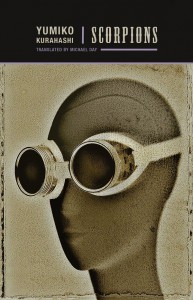
Scorpions by Yumiko Kurahashi, translated from the Japanese by Michael Day, Wakefield Press, 2026
Review by Xiao Yue Shan
In under a hundred pages, Yumiko Kurahashi’s lurid, wicked, lascivious Scorpions pummels its readers with provocations that highlight, in Japan’s rich universe of (sub)cultures, a characteristic mixture of horror and sexiness—specifically the ero guro nansensu (erotic grotesque nonsensical) phenomenon initiated in the Taishō era alongside decadence, political unrest, and a fascination with the West. True to its name, the writers and artists seizing upon this subversive current took carnality to its extremes, twisting an aesthetic lineage that had always been intrigued by the body, from the objectophilia hidden in traditional animist beliefs to the unrestrained depictions of ecstasy and savagery reminiscent of kaidan folklore. Kurahashi began writing in the aftermath of this desirous and rebellious literature, ascending in the 1960s, and her work further estranges its extremes to push back against the normative gender binaries of Foucauldian “biopower,” as well as the engine of post-war economic recovery that insisted its traumatized populace adhere to something called “common sense.”
The narrative of Scorpions is delightfully pulpy; a pair of sister-and-brother twins mock the world around them, indulge in a sexual relationship, and commit a series of murders that culminate in matricide. Written in a first-person confessional from the sister’s perspective, Kurahashi forbids any invasion of “common sense” from the start: “. . . is your aim to identify within me a uniquely modern anguish, pluck it out with tweezers, and display it to the world with an accusatory smirk?” Spiraling out with the twins’ descent into criminality and depravity, the text is stylistically audacious and fueled by adrenaline, never curbing to nicety, morality, or psychoanalysis. One could read Scorpions for the fun of it alone, but Kurahashi isn’t out to just entertain or titillate; as translator Michael Day describes in his foreword, the author had written that she “wanted the poisonous strains of thought she wove into her work to worm their way into the real world and undermine its logic.”
The foreword also makes mention of “On Incest,” an essay in which Kurahashi explains her fascination with the titular taboo, claiming that she feels “drawn to the topic of how to sanctify it.” Though unquoted by Day, that piece goes on to explicate its authors vision of what is transferred between a love sourced out of true equality—a complicity that veers into transcendence: “I want to stage a match between a noble prince and a princess, chosen accomplices who find exactly the same qualities in each other, and, in spite of that, can share love, the voltage of which is heightened by the consciousness that they are practicing vice.” If you can see past the illicitness and the brutality of it, Scorpions is really a romance. In a nation obsessed with prosperity, growth, and stability after the devastation of WWII, Kurahashi is suspicious of the capitalist and ideological bonds that had first instigated Japan’s horrific acts in the war, and advocated for normalcy and regulatory behavior after it. Instead, in Scorpions, there is a sense that the twins—however poisonous their mutuality is—have something purer than what the modern world often mistakes for love; it is the Platonian ideal of two halves joining as one, united by lust, cynicism, and the death drive. The false intimacies of profit motives and honor-bound obligations pale in comparison to their intensity, as if the only truth in a duplicitous and manipulative world can be found in two people who are willing to burn everything down together.
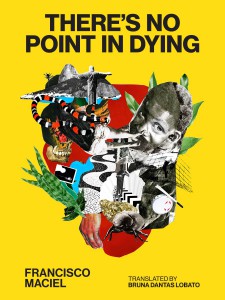
There’s No Point in Dying by Francisco Maciel, translated from the Portuguese by Bruna Dantas Lobato, New Vessel Press, 2026
Review by Randle Browning
In Francisco Maciel’s dizzying English-language debut, There’s No Point in Dying, pain rips through a crime-ruled favela in Rio de Janeiro. Comedy and tragedy change places as quickly as the narrative point of view, and the ill-fated characters “don’t even know how much they don’t exist.” The novel opens with the young Dafé running for his life, and within seven minutes and as many pages, he’s been shot and killed.
But time doesn’t play by the rules in Maciel’s world; Dafé returns a few pages later to argue over a botched robbery with six friends, and the subsequent short chapters veer between periods and across the minds of its characters—from the wily Guile Xangô, who could be the favela’s resident philosopher or a washed-up fraud; to “the Comadres,” five women who “drink from Friday night until Sunday afternoon” and have been doing so for ten years; to Targa, a stray dog and member of a canine gang who hides her pregnancy, careening between human kindness and humiliation. What results is a wheeling, collective novel where lives bleed together, the distinction between pursued and pursuer blurs, and private and public crises eclipse each other by the sentence.
Despite the novel’s fatalism, Maciel’s characters can’t help searching for meaning amid the chaos that orders their lives. They look to nature: “I’d prefer if the trees invade the cities,” says one character. Another wants “to understand the mechanics of the wind.” Others write poetry and samba, recite rap lyrics, quote Borges and reference Kafka, pen libretti about spurned mice. The operetta is “a closed circuit,” and the same could be said of Maciel’s novel; in its final pages, the orbiting bodies and disparate timelines cohere finally around a distinct event.
In the favela, original merges with copy, and individual agency capitulates to the communal. What’s surprising, then, is how buoyant these characters remain—the ways they find joy. In the novel’s final pages, a memorial-turned-party brings the many characters together. On this occasion, even the bereaved mother Mirtes, surrounded by community, could feel “her heart lighten, fill with a desire to sing and be happy.”

Volga Blues: A Journey into the Heart of Russia by Marzio G. Mian, translated from the Italian by Elettra Pauletto, W.W. Norton, 2026
Review by Anna Mebel
In Volga Blues, Marzio G. Mian journeys down the Volga River to probe the heart of the Russian people, wary of his safety as this is “. . . a semiclandestine trip to one of the most off-limits and dangerous countries in the world for journalists.” On his way, he interviews high-level Russian priests, factory bosses, academics, mercenaries, and the regular people in villages who enlist in the war in Ukraine to feed their families.
The prevailing refrain in Mian’s account of Russian history are the massive casualties the country has suffered, with people dying by the thousands and the millions during the Mongol occupation, Ivan the Terrible’s reign, the revolution, the brutal industrialization, World War II (or the Great Patriotic War, as Russians call it), and Stalin’s many purges. Under the Putin regime, the ideology of sacrifice for the motherland is coupled with a return to Byzantium, a Russkiy mir (Russian world) that centers Orthodox Christian values in favor of Western ones. While Putin does emphasize Eastern Christianity, his propaganda makes room for Russian Islamism too, both a strategic choice and further evidence of Russia’s Eastward turn.
As a Russian American with Ukrainian roots and family directly impacted by the war, my reading of Volga Blues was laced with additional horror; this is the rhetoric used to justify a senseless war and all of its death and displacement? Mian emphasizes the return of Stalin in popular mythology—his crimes newly erased from the textbooks, teenagers wearing T-shirts with his face, new statues installed in city squares—all to solidify a lineage from Ivan the Terrible to Stalin to Putin. At the same time, I bristled at Mian’s depiction of their travel companion, Katya, as a menacing, racist, potentially FSB-colluding drunk. It played too much into the Western depiction of Russian as mysterious and more than a little animal-like.
Yet, this doesn’t mean Mian’s warnings shouldn’t be taken to heart. Russia can’t be ignored culturally; its powers as a warrior nation are staggering. But, to quote a former philosophy professor Mian interviews:
I don’t want Russia to end up swallowed by this Russkiy mir nonsense. It’s as artificial as the idea of the ‘mysterious Russian soul’ that has so fascinated you Westerners. Mystery has been used to legitimize cruelty, the annihilation of the individual, the cult of the despot.
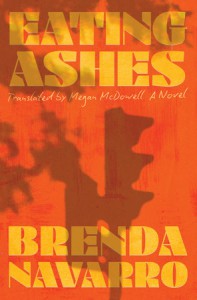
Eating Ashes by Brenda Navarro, translated from the Spanish by Megan McDowell, W.W. Norton, 2026
Review by Xiao Yue Shan
As any country in the global north will have you know, there are Good Migrants and Bad Migrants. Under the pride and propriety of nationhood, the Good Stalwarts of the Good Countries monitor the incoming masses with equal expectation and trepidation, as savior and superior. The new arrivals are thus privy to quite the show, starring charity and all its friends: the glee of power play, the exploitation of cheap labour, the saccharine veneer of pity, the fear disguised as epistemology, the expectation of endless gratitude, the xenophobia of protectionism, the purgatorial bureaucracy, and the linguistic and social dexterity involved in camouflaging the relatively basic exasperation of it all—oh why don’t you just go back to where you came from? The Good Migrant takes all this in stride. The Bad Migrant refutes.
There’s much to admire in Brenda Navarro’s Eating Ashes, but in our restless times, what is most outstanding in its pages is its refusal to pander to—or even locate—the construction of the Good Migrant. Her unnamed narrator, a young Mexican woman on a residence permit in Spain, is definitively avoiding building a future for herself. She’s not interested in studying, nor in working the few lowly jobs that are available to those of her ilk. She doesn’t care for romance; she’s alienated from her family; she’s directionless, miserable, borderline homeless, and utterly clear-sighted about what ambition means in the liminal space of exclusion: “What future? It’s really cabrón, it’s brutal, this having to live for the future because you felt useless in the present and felt miserable in the past.”
One could diagnose this aimlessness as a product of grief—but that would be only partial. The narrator’s younger brother, Diego, does kill himself in the first few pages of the novel, but she insists that the incident was not blinding, it was clarifying: “. . . because he made me see things I avoided, made me understand in one fell swoop . . . what my place was in the world . . .” As the layered events prior and post Diego’s suicide begin to cohere in the narrator’s fervent, lucid telling, it becomes growingly apparent that what killed him—and in a way, her—was what Toni Morrison describes in The Bluest Eye as simply “the Thing that made her beautiful, and not us.” The Thing being what most of us cannot fully articulate—the contracted and layered social conditions amalgamating the othering hierarchies of class, race, and gender. As the narrator and Diego live out their teenage years in Madrid, they are gradually introduced to the system of dominations a host country can inflict, from schoolyard bullying to precarious employment to threats of deportation—capitalism-meets-racism strategies to keep the migrant obedient, estranged, and afraid. It is the latter state that formulates the Good Migrant, who is always hardworking, eager to learn, and desperate to prove themselves; the defiance of Eating Ashes in betraying this trope is to insist on fearlessness.
In “Teaching Machine for the Wild Citizen,” the scholar Beatriz González-Stephan describes how colonial operations manufactured goodness and morality for a people they considered unruly and barbaric: “It was a matter of cleaning behavior of roughness, violence, familiarity, and incontinence. . . . What mattered were restrained appearances, with faces preferably inexpressive . . . revealing neither happiness nor repressed pain . . .” Navarro’s novel, then, is a revolt against the harmonious existence that is contingent upon suppression and stoicism. Chapter by chapter, the narrator demonstrates how Diego’s suicide illuminates the cracks in a pieced-together life: the dread of existing marginally, the pointlessness of assimilation, the Mexico that is now only a graveyard for their memories, the violence of never feeling at home. One of the novel’s most remarkable moments has the narrator’s mother explaining why Madrid, to her, was a lifeline: “Well, because here I’m me, and you’re you, and we don’t have to answer to anybody.” The narrator is frustrated by this response, but ultimately, through grief, through the elimination of her dreams, through rootlessness—she, too, no longer answers to anybody. It is a profound, albeit bleak, depiction of what liberation can look like for the ones whom society have determined worthless: it is the narrator’s complete apathy for her future, or it is Diego’s flight from a fifth-story window.
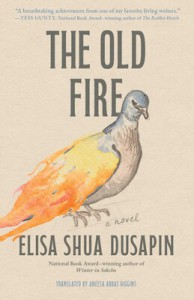
The Old Fire by Elisa Shua Dusapin, translated from the French by Aneesa Abbas Higgins, Summit Books, 2026
Review by Nicole Yurcaba
In the passionate and moving The Old Fire, Elisa Shua Dusapin examines the places, environments, and even the people one calls home. The novel sees its protagonist, Agathe, returning to her childhood home after her father’s death to help her sister Vera prepare the house before its demolition, and as the siblings navigate fifteen years of separation, they must also confront the plethora of secrets, violence, and resentment overshadowing their relationship. Agathe, however, eventually returns to France carrying secrets of her own about living in the USA, her struggles as a screenwriter, and the heavy weight of her own past.
Structurally, The Old Fire mirrors books like Megha Mujamdar’s kaleidoscopic A Guardian and A Thief; each brief chapter represents one day of Agathe’s return, with Dusapin’s lyrical, poetic writing blurring the days together in a fever dream of recollections, remembrances, and reflections. The form also creates a fluidity that parallels her personal journeys through hardship, her relationship with her sister, and even her transition between countries. As the novel progresses, and as Agathe reveals more and more about her and her sister’s complex relationship throughout their girlhood—a period tinged with neglect—the novel’s focus on storytelling as a means of preservation develops, becoming both a profession and as a personal coping mechanism. Agathe frequently recalls the stories her father told not only her and Vera, but also to tourists as he led them through many of France’s well-known caverns.
Thus, as she recalls these narratives and shares her own intimate personal details, The Old Fire becomes a means of familial—and, more significantly, of cathartic, personal—memorialization. Thematically, then, Dusapin takes up the torch—and the question— that writers have been asking throughout time: Why write and tell stories during times of trauma and adversity? The answer, in this brave and poetic novel, is perhaps to testify to emotion and experience, demonstrating that even the most spurious of tensions can make room for tenderness.
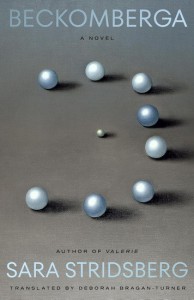
Beckomberga by Sara Stridsberg, translated from the Swedish by Deborah Bragan-Turner, FSG Originals, 2026
Review by Randle Browning
In Beckomberga, Sara Stridsberg—author of Valerie and The Antarctica of Love—tells the story of mental illness and its reverberations in a gorgeous, haunting reverie. At the center of the narrative is Jackie, a young teen whose father, Jim, is a long-term resident of Stockholm’s storied Beckomberga Hospital. The actual Beckomberga operated from the 1930s through the 1990s, housing thousands of patients and staff; the novel is structured as a fictional investigation of that institution and a poetic meditation on the people touched by it, with the writing maintaining the liquid and interior feeling of a half-remembered dream.
In the novel, Jackie’s mother, the aptly-named Lone, copes with the dissolution of her marriage through travel, while Jackie spends most of her time freely roaming the hospital grounds, only lightly supervised by Edvard, the well-meaning but ethically-ambiguous doctor who treats Jim. What, exactly, draws Jackie to the hospital is never fully clear, but it is “where Jim is,” and “where there is something unfathomable . . . brutality and an immense love.” That love, however, is not always easy to find; Jim is mired in his own depression, unable or unwilling to offer fatherly support. “Everything passed him by,” Jackie observes. He is more focused on his mother, who walked into the sea. The recurring image of a soaring seabird seems to offer a hope of escape even as it connects Jackie with that dangerous legacy.
The hospital, like Jackie, also exists in two timelines at once; it is an empty white ruin for an adult Jackie to explore with her young son, but alive with figures from the past—Jim, who becomes Jimmie Darling within the hospital gates; the tortured Sabina, beloved by Jim and Edvard but whose life culminates in tragedy; and Beckomberga’s last patient, Olof, who meets a similar fate shortly after discharge. In tackling these complexities of mental illness and its reverberations, the novel treats its subjects with delicacy and ambivalence, characterizing instead of passing judgment on their choices; Jackie, for example, makes no effort to intervene in the suicide Jim frequently predicts for himself, and the sexual threats women in the hospital face are voiced but not explicitly condemned. Narrating the book from a remove of several decades, Jackie’s impulse is not to cast blame but to remember the people shaped by an institution with the capacity to help and to harm.
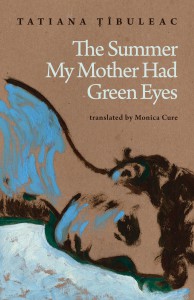
The Summer My Mother Had Green Eyes by Tatiana Țîbuleac, translated from the Romanian by Monica Cure, Deep Vellum, 2026
Review by Fani Avramopoulou
The winner of literary awards in both Moldova and Romania, Tatiana Țîbuleac’s debut novel tells the story of a young man, Aleksey, and his mother, a Polish immigrant who chose to raise her family in the UK. The Summer My Mother Had Green Eyes is the story of their last summer together, narrated by a future Aleksey at the suggestion of his psychiatrist.
Aleksey has a long history of mental illness, exacerbated by unbearable grief after the death of his young sister. At the start of the novel, the Aleksey we meet is full of rage toward the world, himself, and most of all, his mother: “That morning, when I hated her more than ever, Mum had just turned thirty-nine. She was small and fat, stupid and ugly. She was the most useless mother who ever lived.” Still, he agrees to forgo a planned vacation with his friends to accompany his mother on a birthday outing to France. Shortly after their arrival, she admits that she has gone there to die; she has been diagnosed with terminal cancer and given three months to live. Something changes in Aleksey upon his receipt of this news. Anticipatory grief softens him, and the two spend the summer in their rented home, getting entangled with the locals, running errands, sharing meals, lying in the grass.
Time warps in this book—the summer separates from time’s linear passage, becoming a space where Aleksey and his mother’s relationship can heal rapidly, and where complex grief can transform into tenderness and simple pleasure. At his mother’s request, Aleksey helps her cover her body in seashells at the beach and takes her to the lake on his motorcycle, her arms clinging to his neck “like a baby koala.” The book is also peppered with strange, poetic, single-line chapters, each propelled by an image of Aleksey’s mother’s eyes. “My ugly mum’s eyes were the remains of a beautiful stranger” comprises the entirety of chapter eleven, while chapter fifty-five reads: “Mum’s eyes were seashells that had grown on trees.” Like tiny spells—or perhaps more like stress fractures or fault lines—these recurring interludes lend a touch of poetic surrealism to the otherwise fairly realist novel.
The Summer My Mother Had Green Eyes is a season of ruptures—of immigrants in a third country, the fraught relationship between a mother and her mentally ill son, a body succumbing to illness, a family broken by loss. In Țîbuleac’s telling, these sites become the ground of profound transformation. Aleksey makes it clear in his prescient narration that it is not only his relationship with his mother that changes that summer; indeed, every facet of his life is upended. At times, the future that he describes seems entirely incompatible with the Aleksey we were originally introduced to, and this incongruity kept me hungrily turning the pages, eager for the next clue or revelation.
Trilce by César Vallejo, translated from the Spanish by William Rowe and Helen Dimos, New York Review Books, 2026
Review by Dan Shurley
César Vallejo’s Trilce has a reputation for being one of the most difficult books of poetry in twentieth-century Hispanophone literature. That reputation, I can attest, is well-deserved. Poorly received when it was first published in 1922—the same year as Eliot’s “The Waste Land”—Trilce is now considered an avant-garde classic, but one whose complexity makes it forever resistant to definitive reading. This year has seen two quite different English translations: Margaret Jull Costa’s selections in The Eternal Dice, which opts for lyric accessibility; and now this complete edition from William Rowe and Helen Dimos, furnished with glosses, which takes the opposite approach.
Rowe and Dimos have chosen exceedingly awkward fidelity over fluency, preserving Vallejo’s misspellings, neologisms, colloquialisms, and general air of syntactical unruliness. Their translation is in the literalist tradition established by Clayton Eshleman, whose 1992 version first brought Trilce‘s full strangeness into English. The result is a text that frequently confounds:
The created voice rebels and does not want
to be mesh, or love.
Let the lovers be lovers in eternity.
Then don’t strike 1, which will resonate to infinity.
And don’t strike 0, which will be so silent,
it’ll wake 1 up and make it stand.Ah bicardiac group.
With verse this cryptic, glosses are your friends. Here, Rowe and Dimos explain that “bicardia” denotes “. . . the condition of having two hearts in one body, a new impossible classification for humans.” The image is striking in its alienness; the poem’s arithmetic of desire calls to mind a hallucinating chatbot. That such a construction appears in a poem written in 1922 speaks to Vallejo’s prescient engagement with what we might now call posthumanism.
The glosses, which alternate with the poems, provide erudite commentary and trace allusions to biographical details (Vallejo imprisoned on riot charges, grieving the loss of his mother, the end of a romantic relationship), Peruvian cultural references, and resonances to other literary texts, from Whitman to Baudelaire and the French symbolists. They are curiously quiet on Vallejo’s Latin American modernist antecedents, Rubén Darío and Julio Herrera y Reissig—but then again, so was Vallejo.
The way the book is constructed, with the glosses directly following the poems, defers meaning-making to the translators. I found myself immediately consulting the gloss instead of puzzling over the poem at hand. Given Trilce‘s opacity, this is perhaps inevitable. But even with these hard-to-resist interpretive crutches, the poems themselves prove resistant to interpretation. What they offer instead is an encounter with language pushed to its limits, with grief that refuses consolation, and with a historical moment in Peru coloring its dissonant music.
Among the collection’s seventy-seven poems, a handful achieve a deceptive simplicity. Poem XXIV draws directly on Christ’s resurrection story:
Beside a flowering sepulchre
two marys go by weeping,
weeping oceans.The featherless ñandú of memory
holds out its last feather,
and with it Peter’s negative hand
etches on a palm sunday
resonances of exequies and stones.From beside a disturbed sepulchre
two marys go away singing.
Monday.
In a classic Vallejo move, the sanctified subject is deflated with the return to banal time. But it’s stranger than that. There’s the ñandú—a South American bird with a Guaraní name—which creates a dissonance that no translation should domesticate. Rowe and Dimos’s literalism serves the poem well here, as does their gloss, which connects Christ’s death and rebirth to Inca Garcilaso de la Vega’s seventeenth-century claim that the Incas believed in the Holy Spirit before European contact. Or, per Vallejo, Peter writes with a quill plucked from a sacrificial ñandú. The image collapses historical time while asserting Indigenous presence within a narrative that was used as a tool of colonization.
This is Trilce at its most lucid and most radical, and hints at what Vallejo would accomplish with Poemas humanos, his final, most politically engaged collection: formally innovative, not shying away from complexity but somehow breaking through to say something poignant about the injustice of life. For such poems alone, another translation of Trilce is worth being troubled by.
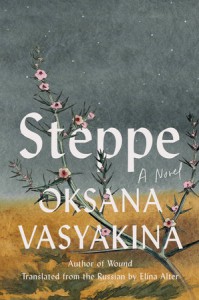
Steppe by Oksana Vasyakina, translated from the Russian by Elina Alter, Catapult, 2026
Review by Anna Mebel
Oksana Vasyakina’s Steppe is a searing autofiction, depicting both Southern Russia’s haunting landscape and the narrator’s shame-riddled relationship with her truck-driver father. Looking at the place through the people, Vasyakina brings an astute, lyrical eye to the time that father and daughter spend together, much of it on the road: “When you look at it now, it seems to be pure salt marsh wasteland, dotted with blue cloudlets of camel thorns. But that’s an illusion: if you give the steppe water, it can do a lot.” Like the shrubland, her father is inscrutable and harsh, but capable of kindness when given proper nourishment.
The novel doesn’t shy away from portraying the twisty complexities of the father’s character. As a worker, he craves peace, preferring to drive freights loaded with steel pipe rather than stinking watermelons or clucking chickens—yet he listens to the music at an inordinate volume. He is supportive of his daughter’s literary ambitions and is passive, even benign towards evidence of her queerness—but these instances of love and understanding do not erase his history of patriarchal violence, his physical cruelty towards the narrator’s mother, and his callousness towards his mistress.
Vasyakina is a poet and her autofictional “I” is akin to the roving, multifarious “I” of the poetic speaker. The novel moves associatively between the narrator’s road trips with her estranged father and her family history, tracing and retracing the story of a daughter scarred by the father’s criminal involvement with the post-Soviet mob (blatniye), his AIDS diagnosis, and his difficult mix of sentimentality and cruelty—all of which is tangled up, in Steppe, with the post-Soviet disintegration of order, Greek mythology, and class resentment. While she refuses to give us a straightforward narrative, she wants us to pay attention: “I have no desire to impress you, but I do want you to be interested.”
The novel takes a piercing look at what is typically ignored—the barren landscape of the steppe, working-class lives, and the shape of suffering of someone who refuses to treat his illness. Vasyakina writes, “In the absence of someone’s gaze and care, these things don’t stop being themselves. They don’t stop being . . . In this way my father has lain in his steppe grave for seven years, feeding the steppe salt soil and the groundwater.” Steppe is a poetic illumination of those who don’t stop being and those who don’t stop mattering, an ode to the harsh beauty of its titular landscape.
Fani Avramopoulou is a writer living in Philadelphia with roots in Baltimore and Athens, Greece. She is an outreach editor at Essay Press.
Randle Browning is a writer from Texas interested in art, family, and landscape. She teaches creative writing at Columbia and lives in Brooklyn.
Hilary Ilkay works in sales for the Canadian indie press Biblioasis, and she is an Associate Fellow in the Early Modern Studies Program at the University of King’s College in Nova Scotia. She is a Managing Editor for Simone de Beauvoir Studies Journal and a Blog Editor for Asymptote.
Anna Mebel holds an MFA from Syracuse University. Her writing has received support from the Vermont Studio Center and has appeared or is forthcoming in The Iowa Review, Gulf Coast, Wigleaf, and elsewhere. She is currently at work on a novel.
Xiao Yue Shan is a poet, writer, editor, and translator.
Dan Shurley is a writer and journalist in Philadelphia. His fiction, poetry, and criticism have appeared in Granta, BOMB, the TLS, the LA Review of Books, and a few other places. His writing on Indigenous cultural erasure in Philadelphia has been cited by the American Library Association.
Mandy-Suzanne Wong writes experimental fiction, essays, and poetry. Her books include The Box and Daughter of Mother-of-Pearl, both published by Graywolf Press.
*****
Read more on the Asymptote blog: