
Posts featuring Najlaa Eltom

The Four Colours of Blood: An Interview with Norah Alkharashi and Yasmine Haj on the Arabic Poetry of Love and War

The more we bridge our languages, the more effective our collective resistance can be.

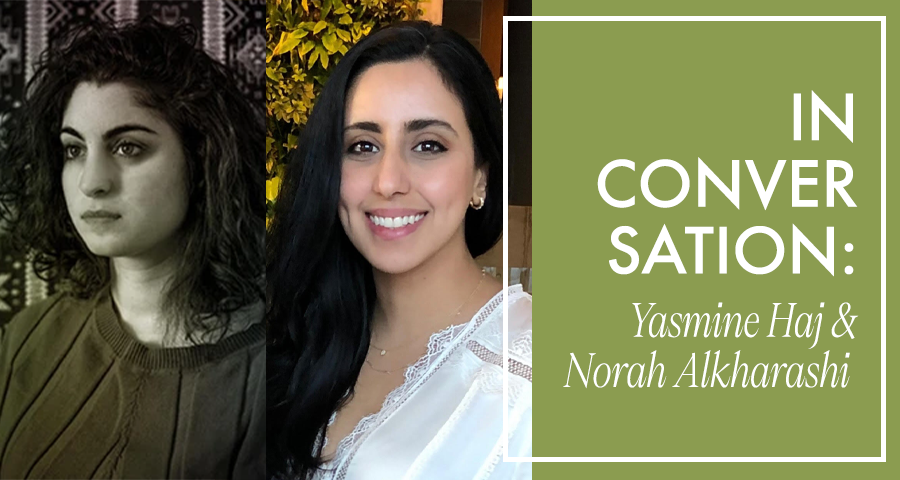
In Arabic, the word for ‘love’ (حب) is nearly identical to the word for ‘war’ (حرب), differing by just one letter. The nearness and linguistic kinship between these two words is a felicitous metaphor for the tropes examined in the poetry anthology Arabic, between Love and War, published by Tkaronto, Canada-based trace press.

Arabic, Between Love and War assembles important voices from across the Arabophone world, such as Nour Balousha of Palestine, Najlaa Osman Eltom of Sudan, Rana Issa of Lebanon, Qasim Saudi of Iraq, as well as diasporic Arab poets in Canada, the United Kingdom, Sweden, and the United States. Edited by Palestinian poet Yasmine Haj and Saudi translator-scholar Norah Alkharashi, the anthology features poems translated from Arabic into English and vice versa, a number of which have garnered accolades such as the Lambda Literary Award, Atheer Poetry Prize, Arab American Book Award, and appeared in poetry collections published in Damascus, Beirut, Juba, California, Basrah, Algiers, and beyond.

In this interview, I spoke with both Haj (in Paris, France) and Alkharashi (in Ottawa, Canada) about the anthology and the ways in which the poetry of love and poetry of war converge.

Alton Melvar M Dapanas (AMMD): Congratulations to both of you on this riveting anthology, Arabic, between Love and War! How did this book come to be, and how is it particularly relevant and urgent today?

Yasmine Haj (YH): Thank you, Sam. This book is the epilogue to a workshop organised by trace press, ‘translating [x]’, in which Norah and I co-facilitated six online sessions on literary translation from Arabic. As we structured the workshop, we were drawn to the aesthetic of the words love and war in Arabic, and how the removal of one letter throws one word into its apparent opposite. We discussed the idea with the participants, some of which mentioned how tired they were of our world being discussed through the prism of war. This was in late 2022, early 2023, before Zionism heightened its genocide of Gaza and any reminder of indigeneity. We had no idea we would be editing this volume, with all its submissions, as we watched Palestine oscillate between those very two words, and other genocided lands fluctuate right along with it. Love of land, of people, and war waged upon that very existence, have been ongoing for more than a century, adding to the six hundred years of imperial annihilation and substitution. READ MORE…

Baptism by Fire: An Interview with Mayada Ibrahim on Arabophone Africa in Translation

I’m interested in Black subjectivity, in works that challenge and problematise the hegemony of Arabic. . .

The translations of Mayada Ibrahim are essential acts of cultural mediation. Moving between Arabic and English, she brings a nuanced, discerning sensitivity to champion voices from Arabophone Africa, from co-translating award-winning novels like Abdelaziz Baraka Sakin’s Samahani (Foundry Editions, 2024) to inaugurating the Anglophone debut of Najlaa Eltom. Rooted in her Sudanese heritage and diasporic experience, Ibrahim’s work has consistently centred Black subjectivity. In doing so, she has contributed to expanding the range of Arabic writings available in the Anglosphere, illustrating a resolute commitment to bringing the philosophical and political heft of voices like Eltom, Sakin, and Stella Gaitano to the forefront.

Ibrahim sees translation not as a duty to educate, but as a creative responsibility to honour the original text and its culture. ‘I try to resist the notion that educating the reader is my responsibility, as it’s harmful to treat readers as passive, disengaged consumers hungry for entertainment dressed up as instruction,’ she confesses. Thus, she navigates through difficult ethical terrains, from interpreting the Sufism in Eltom’s work for a Western gaze, to maintaining the sharp wit in Sakin’s narratives of enslavement. 

In this interview, I spoke with Ibrahim on her corpus as translator, the ethical tightrope of rendering politically charged texts for an Anglophone audience, and what she envisions for an Arabophone African literary canon.

Alton Melvar M Dapanas (AMMD): Trace Press is set to publish your book-length translation of prose and poetry by Sudanese translator and poet Najlaa Eltom. Could you tell us a little of how this book came to be? Is this selected from her earlier Arabic-language collections – منزلة الرمق (The Doctrine of Thinness, 2007), الجريمة الخالدة ذات الأقراط (The Immortal Felony with Earrings, 2019), and ألحان السرعة (Melodies of Speed, 2021)—or does it feature entirely new material?

Mayada Ibrahim (MI): In 2023, I took a free workshop offered by Trace Press, to which I brought one of Najlaa’s poems. The workshop later culminated in the anthology Arabic, between Love and War, published earlier this year, and in the process, I was fortunate enough to meet the publisher Nuzhat Abbas, who showed interest in Najlaa’s work. Later we decided to collaborate on Najlaa’s collection, her first into English, which will be the first part of an ‘active archive’ on Sudan. READ MORE…

Weekly Dispatches From the Frontlines of World Literature

The latest in literary news from Nigeria and Palestine!

This week, our editors report on the literature that testifies to the ongoing genocide in Gaza, new initiatives to promote writing from the Global Majority, and exciting technological initiatives to preserve heritage and indigenous languages across Africa.

Carol Khoury, Editor-at-Large, reporting from Palestine

PEN’s spotlight on Palestinian literature is more vibrant than ever. In a recent dispatch, we featured Children of the Dew by Palestinian writer Mohammed Al-As‘ad, soon arriving in English thanks to translators maia tabet and Anaheed Al-Hardan, and the upcoming anthology Palestine – 1 (Comma Press, October 2025), which reimagines the 1948 Nakba through speculative fiction. Now, English PEN and the Booker Prize Foundation have announced the six winners of the brand-new “PEN Presents x International Booker Prize,” designed to support translators from the Global Majority. Among the winners are two Arabic-language books: the Sudanese title Ireme by Stella Gaitano, translated by Mayada Ibrahim and Najlaa Eltom, and the Palestinian title Playing with Soldiers by Tariq Asrawi, translated by Anam Zafar. As both Sudan and Palestine are sites of enduring crimes against humanity (to say the least), this announcement reminds us that literature is a profound test of our shared humanity. Both works have world English rights available, promising more stories—not only devastating news—for global audiences.

While Gaza City may be facing unimaginable challenges as we read and write these lines, the people of Gaza are definitely not off the map; they’re not “there,” they’re very much “here.” They’re making their voices heard loud and clear through literature that bursts with resilience and hope. Further evidence of this exists in We Are Still Here: An Anthology of Resilience, Grief, and Unshattered Hope from Gaza’s University Students, which gathers raw, courageous stories, poems, essays, and testimonies from students now living through unimaginable trauma. Edited by Jacob Norris and Zahid Pranjol, these pieces are like snapshots of real-time courage, proving that words can be a powerful act of survival and hope. READ MORE…