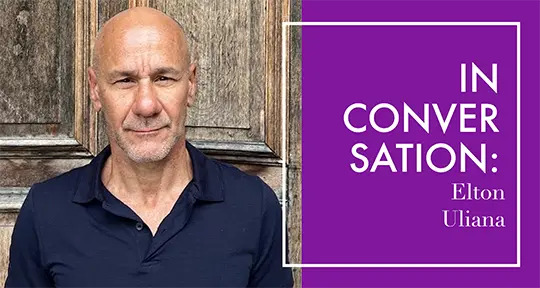
My first encounter with Prêmio-Jabuti-winning Brazilian writer and dramaturg Carla Bessa was through Elton Uliana’s translation of her “After the Attack, the Woman,” published in the first volume of The Oxford Anthology of Translation, for which I was also a contributor. In Elton’s translation, Carla’s genre-bending prose—part crime noir, part narrative poetry, part journalistic account—stretches its numbing hands towards the Anglosphere, cutting across the enclosures of language and making us rethink the ever-evolving questions of genre. Active in the Lusophone translation scene, Elton is also part of the Brazilian Translation Club (BTC) at University College London (UCL) and the Portuguese-English Literary Translators Association. In the HarperCollins anthology Daughters of Latin America, he has translated the prose of Carla Bessa, Alê Motta, Carolina María de Jesús, and Conceição Evaristo. His translation of Evaristo into English is also included in the Contemporary Afro-Brazilian Short Fiction (out last September from UCL Press).
In this interview, I spoke with Elton, currently in London, about his translations from and into the Brazilian Portuguese language, the landscape of contemporary Brazilian Lusophone prose, and the necessary confrontations among translators regarding ‘untranslatability’ and ‘equivalence’.
Alton Melvar M Dapanas (AMMD): There is multiplicity to the Brazilian Lusophone writers and texts you translate—actress and theatre director Carla Bessa, novelist and scholar Jacques Fux, short story writer Alê Motta, journalist Sérgio Tavares, children’s book author Ana Maria Machado, among others. I’m curious about your translation process: Are there parallelisms and variances, process-wise, in translating across the differing genres, aesthetics, and movements from which these writers write?
Elton Uliana (EU): I absolutely love working with the diversity of writers that are currently emerging from Brazil, like Carla Bessa, a writer that I have been working with a lot recently who has become a leading force in contemporary Lusophone fiction. (Bessa won the 2020 Prêmio Jabuti, the most prestigious literary prize in Brazil, and is currently being published globally).
I am also delighted to be working with Alê Motta, a master in concise social critique with a unique style of micro-fiction, and Conceição Evaristo, whose stories irresistibly incorporate the accents and oral tradition of Afro-Brazilian culture. All of them were recently published in Daughters of Latin America: An International Anthology of Writing by Latine Women, edited by Sandra Guzman and published by Amistad and HarperCollins.
It has also been wonderful to work with the incredibly talented Jacques Fux and his worldly-wise autofiction that, with touching lyricism and humor, takes us into a detailed and complex world of Jewish culture. Other favourites of mine that I have recently translated include Mário Araújo, Sérgio Tavares, and Ana Maria Machado, all prize-winning authors in their own right.
I am always interested in looking at authors who are doing something completely different with form. A common feature of my translation method, regardless of author, has to do with the musicality of the piece, the fine-tuning procedure of finding and developing appropriate aural features such as voice, rhythm, and tone in such a way that the translation becomes seductive and attractive to the reader.
For me there is a huge difference between translating, for example, a dramatic text, where words become physical and affect the body immediately, and a children’s story, which, even if it is meant to be read out loud, does not necessarily involve a performance. I guess it’s the same with poetry or a dialogue in a novel. I’m always aware of the context from which the piece I’m translating emerges and also the genre or kinds of genre it incorporates. Indeed the form develops and grows in the translation because of the context and the literary conventions and devices the author is exploring, experimenting with, or setting aside.
Another important translation focus for me is the dialogue. Patterns of speech in Portuguese are completely different to those in English. I find a useful technique is to read the speech out loud to myself—indeed, it is even more enriching and useful when I have other people or fellow translators to read the words out loud for me. Reflecting on how the rhythm can be configured and how the words sound and even feel in the mouth is something I am constantly considering as I progress with any translation, regardless of genre, sub-genre, or writer’s style.
AMMD: You are also a translator of legendary Afro-Brazilian storyteller Conceição Evaristo. Could you tell us about the experience of translating her work? READ MORE…