
Posts filed under 'University of East Anglia'

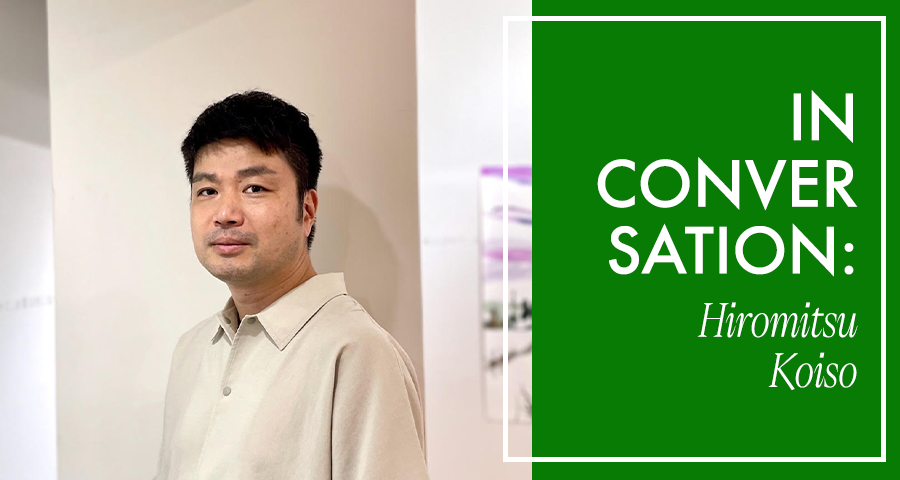
Desire is No Light Thing: An Interview with Hiromitsu Koiso on Translating Anne Carson and Teju Cole into Japanese

Rather than being shaped by any single figure, I’m more interested in how one’s present moment can be placed in relation to a much longer history.

Hiromitsu Koiso’s path to becoming one of Japan’s most ruminative literary translators was anything but linear. It began, as he recounts, in the second-hand bookshops of western Tokyo, poring over paperbacks and comparing translations by seasoned Japanese translators, a sort of discipleship that would later lead him on a peripatetic route to the MA in Literary Translation and MA in Creative Writing (Poetry) programmes of the University of East Anglia in Norwich, United Kingdom. His body of work reveals a translator who is attuned to works of hybridity and gravitas, from the Sebaldian solivagant of Teju Cole’s Open City to the mythopoetic vestiges of Anne Carson’s Autobiography of Red. This extends to the works of Ocean Vuong, Isabella Hammad, Grayson Perry, Noor Hindi, and Ursula K. Le Guin, as well as more recent translation projects like Carson’s Wrong Norma (published on 10 January by honkbooks’ thoasa) and Bryan Washington’s Memorial (forthcoming in Spring 2026). He has also co-translated Japanese poets Kamiyu Ogyu, Naha Kanie, and Ayaka Satō into English.

When asked about influence, Koiso speaks less of particular poetic lineages and more of situating himself within and against literary history, and of navigating the orientalising gaze directed at Asian writers: a “gaze [that] shapes both how we are read and how we respond, creatively and intellectually.”

In this interview, I spoke with Koiso (who is in Tokyo) about his unorthodox career trajectory, the immersive craft behind recasting specific genres and texts, and the poetic reflection underpinning his work as a poet and translator who seeks to meditate on “how one’s present moment can be placed in relation to a much longer history.”

Alton Melvar M Dapanas (AMMD): Koiso-san, I want to begin with how you started as a translator. As a university student, you pored over Paul Auster and J.D. Salinger paperbacks at the second-hand bookstore Nishi Shoten in Kunitachi. By comparing your early attempts with the translations of seasoned practitioners like Motoyuki Shibata and Takashi Nozaki, you developed an appreciation for the craft. Yet you didn’t pursue translation right after university. So, what were the key moments that ultimately led you here?

Hiromitsu Koiso (HK): After graduating from university, I wanted to work in literary translation, but I had no idea how to enter the profession. Throughout my twenties, I worked various jobs while studying and trying to find my way into the field. I took temporary positions, worked in offices, saved money, and eventually decided to pursue postgraduate studies at the University of East Anglia in the UK.

I first learned about UEA’s MA in Literary Translation program and a particular centre for literary translation through the Japanese translations of W. G. Sebald. Discovering that Sebald had taught at UEA and helped establish the translation centre made a deep impression on me. I felt strongly that I wanted to study Literary Translation in the very place where he had lived, taught, and built a community for translators. READ MORE…

Weekly Dispatches From the Frontlines of World Literature

The latest from Kenya, Canada, and Oman!

In this week of literary news, our editors on the ground are bringing stories of triumph, mourning, and commemoration. In Kenya and Ghana, readers mourn the loss of pioneering feminist author Ama Ata Aidoo; in Canada, a Quebec initiative supports readers in finding more books by Indigenous writers; and in Oman, a lauded author brings home the prestigious International Prize for Arabic Fiction. Read on to find out more!

Wambua Muindi, Editor-at-Large, reporting from Kenya

The end of May seemed to position itself as a direct communication to geo-literary production history; on May 27, a bilingual anthology of East African short stories, The Heart is A Bastard, launched at the Goethe Institut Library, Nairobi. Edited by Elias Mutani and Zukiswa Wanner, the collection is a result from the Kenyan writing workshop under the auspices of the Univerity of East Anglia International Chair in Creative Writing. The inaugural chair for Africa, Zimbabwean author Tsitsi Dangaremba, expressed her delight over the launch, which includes stories in English and Swahili translations. Some of the emerging writers featured in the anthology include Gladwell Pamba—from whose story the anthology’s title is taken, Fatma Shafii, Nyasili Atwetwe of Writers Space Africa Kenya, Charlie Muhumuza, Noella Moshi, and Sia Chami. The anthology not only holds space for these writers but also represents the creative breadth of the region, while simultaneously embedding a language politics given its bilingual character.

However, this joy was dislodged by the unfortunate news of a writer’s death. On May 31, Ama Ata Aidoo, the Ghanaian author of Our Sister Killjoy (1977), a pioneering feminist novel, died at the age of 81. As such, Africa is mourning; Ghana is mourning and Kenya, too, is mourning the novelist, playwright, short story writer, and committed radical feminist, who wrote to assert the agency of African women within literary history. As reverential eulogies have been paraded across the world, the Kenyan literary community joined in the outpouring of grief in a country where her influence not only transcends her writing, but is also compounded by a teaching stint she had at the then named Kenyatta College, now Kenyatta University, as well as the literary contributions of her Kenyan-born daughter, Kinna Likimani. Where Austin Bukenya, a leading East African scholar of English and literature, for instance, dubbed her “Queen of African literature”, Mukoma wa Ngugi, the author of Nairobi Heat and son to Ngugi Wa Thiong’o, sees her as a “pillar” without which “the African literary tradition wobbles”. While Joyce Nyairo, an academic and a cultural analyst, references the short story “Something To Talk About On The Way To The Funeral” as praise of her storytelling genius, Yvonne Owuor lamented, in proper proverbial fashion: “A great, and giant tree that sheltered many beings has fallen”. Moreover, her writings, which among others, include The Dilemma of a Ghost (1965), No Sweetness Here (1969), Anowa (1970), and Changes (1991) cut across the genres to show the depth of her imaginative oeuvre and demonstrate the commitment—in different but related ways—to the African woman’s cause, through literature and in society. Rest in Power Mama. READ MORE…

What I Learned: The Benefits of a Poetry Translation Workshop

Unlike in life, in translation you can generally decide what you can bear to lose, and you should know that there are multiple methods.

What should a budding translator read? What kinds of critical lenses should he or she apply to the process of translation? Assistant Editor Andreea Scridon shares some insights she gathered from the poetry translation workshop she attended this summer in Norwich, UK.

Every summer, the University of East Anglia in Norwich (home of the first Creative Writing program in the United Kingdom) holds an International Literary Translation & Creative Writing Summer School. This past July, the program was held in partnership with the British Centre for Literary Translation, and I attended the multilingual poetry translation workshopled by internationally translated poet and writer Fiona Sampsonas an emerging translator of Romanian and Spanish into English. Below I recount musings on the most significant things I learned, which I hope will be of use to those potentially looking to break into literary translation.

A sound starting point in this discussion is the question of considering what to read as a translator. It should go without saying that a literary translator must necessarily be a well-read person in order to be able to make the best possible choices in terms of context, likely more so than anybody else. Having established this as a point of consensus, we discussed, both officially in workshops and amongst ourselves, what exactly a translator should be reading today. In my opinion, the library of a(n) (aspiring) literary translator should include contemporary literature, non-contemporary literature (both classics and obscure-but-lovely older works), and, of course, translations, preferably in as many languages as possible. For instance, examples of each subsection in my current library include Lauren Groff’s Florida and Jenny Zhang’s Sour Heart (which are English-language works but useful examples of the spirit of today’s literary scene), Romain Gary’s The Kites and Mikhail Sholokhov’s And Quiet Flows the Don, and Anna Akhmatova’s various poetry collections in translation by Yevgeny Bonver, Richard McKane, and Alexander Cigale, to name only a few. I asked Ian Gwin, an emerging translator of Finnish, Estonian, Latvian, and Lithuanian who also participated in the Summer School, for suggestions. He recommends Keith Gessen’s A Terrible Country, noting that Gessen is himself a bilingual and that the theme of the two cultures meeting within the novel may be useful for a translator to consider. Regarding multiple translations, he recommends Robert Musil’s The Man Without Qualities, pinning the more linguistically faithful translation of Eithne Wilkins and Ernest Kaiser against the newer one produced by Sophie Wilkins and Burton Pike. He also suggests the high-quality recent translation of Alfred Döblin’s Berlin Alexanderplatz by Michael Hoffman, citing it as a long work that shows an attempt to render a specific style in a second language.

READ MORE…