
Posts filed under 'compassion'

The Winter 2026 Issue Has Arrived!

World literature remains, at heart, a problem of attention: of who is seen, who is heard, and who is permitted to remain invisible.

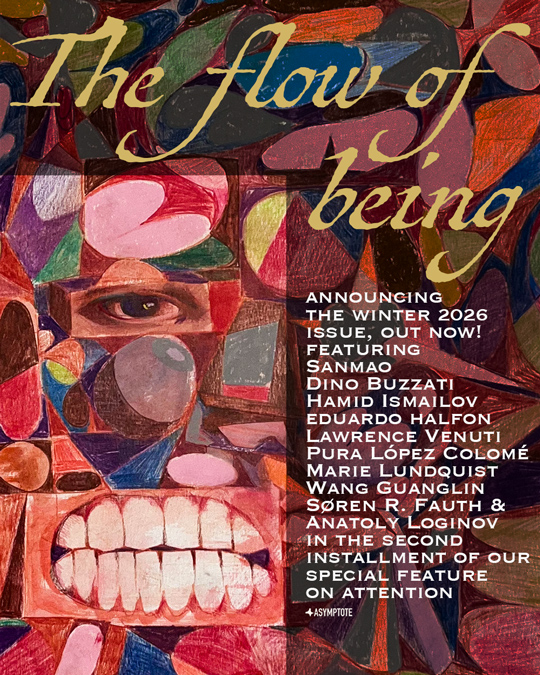
As authoritarianism continues to take hold across the world, writers and translators are compelled to revisit an age-old question: What might art offer in response? Perhaps not answers, but something quieter and more resilient—a reminder of shared human frailty, and of the possibility that our “flow of being,” as Anatoly Loginov writes, might arrive at a “narrow neck” where attention itself becomes an existential force. Writing in our Winter 2026 Issue, which also marks Asymptote’s fifteenth(!) anniversary, Loginov turns to a literary and philosophical tradition that seeks “not mastery over an object, but communion with it, even if that communion burns.” For this second of our two issues devoted to attention, we bring together his tour de force survey of 200 years of Russian thought with a luminous travelogue by the beloved Taiwanese writer Sanmao, an excerpt from Guatemalan author Eduardo Halfon’s prizewinning Tarantula, an exclusive interview with Uzbek novelist Hamid Ismailov, a quietly devastating story by Italian master Dino Buzzati, and new translations of Milo De Angelis by Lawrence Venuti, alongside never-before-published work from 32 countries. All of it is illustrated by our talented Dublin-based guest artist Yosef Phelan.
Winter-2026_blog

If Loginov argues that attention, when cultivated deeply, can ground compassion toward others, Finnish playwright Minna Canth takes this ethical impulse further into the realm of collective action. In her barnburner drama, railway workers pushed beyond endurance channel their shared anger into defiant sabotage, making exploitation visible at last. Writing from a different frontline, Kurdish journalist Zekine Türkeri bears witness to life in the Mahmur refugee camp in the days preceding an ISIS attack, showing how attention to the living entails the inescapable labor of mourning the dead. Elsewhere, in Egyptian writer Mariam Abd Elaziz’s fiction, characters struggle to care for one another as they swim and sink in the deadly currents of maritime refugee smuggling. The issue’s arc closes with an interview in which China’s Wang Guanglin reflects on the difficulty of imagining a genuinely global literature at a moment marked by isolationism, xenophobia, and resurgent nationalism. World literature, he suggests, remains, at heart, a problem of attention: of who is seen, who is heard, and who is permitted to remain invisible.

For fifteen years, Asymptote has been organized around this problem. Founded on the conviction that literature across languages deserves sustained, serious attention, we have worked to widen the field of vision—introducing readers to voices beyond dominant centers, and treating translation not as a secondary act but as an ethical and imaginative practice in its own right. If this project has mattered to you—if you believe that attention, patiently given, can still resist the forces that would narrow our view—we ask you to help keep it alive by becoming a sustaining or masthead member. Your support ensures that the flow of being we trace here continues to move, freely and exuberantly, into the years ahead.

READ THE ISSUE

GET INVOLVED

The Basic Color is Compassion: Ivana Bodrožić and Ellen Elias-Bursać in Conversation

I am apologizing to those who have been persecuted by this society.

Ivana Bodrožić’s latest novel, Sons, Daughters, is an astounding work of empathy and a masterful depiction of the deepest inwardness, tracing the always-shifting definitions of what we can and cannot say to one another. With three individuals at its center—a paralyzed but completely aware young woman, a transgender son, and a mother who has been irrevocably marked by the cruelties of patriarchal society—Bodrožić arranges the various storylines in a delicate and constellating balance, showing how singular truths in one’s own life can come to be mirrored in another, seemingly opposite, existence. Translated with precise lyricism by Ellen Elias-Bursać, Sons, Daughters is due out from Seven Stories Press in March, and we were proud to feature an especially moving excerpt in our Winter 2024 issue. Now, in this following interview, translator and author speak to one another about the psychological labyrinths inlaid throughout this narrative, and the writer’s role in bringing invisible consciousnesses to the forefront.

Ellen Elias-Bursać (EEB): Sons, Daughters examines the inner lives of three protagonists: Lucija, Dorian, and Lucija’s mother—all on a profoundly intimate and personal level. What was it like for you to create the dynamics of this very internal narrative, and how did the process compare to your other novels: Hotel Tito or We Trade Our Night for Someone Else’s Day?

Ivana Bodrožić (IB): I certainly spent more time researching for this novel than I did for my other works of prose. I have no personal experience with physical paralysis; I haven’t felt the sort of bodily dissonance I describe in the novel, nor can I know what it is like to be a sixty-year-old woman who was abused as a child in ways that were, at the time, socially acceptable. In order to create my characters and give them the necessary credibility and life, I spent a great deal of time reading, talking, and researching about all these things which have not been part of my own experience. But more important than research is to write from who you are—to draw on your own feelings. Indeed, I have, often, in my own life, felt paralysed, powerless to move, though only at a metaphysical level. Similarly, when I was growing up, I felt bad, wrong and uncomfortable in my body, stricken with shame and guilt that also stem from the patriarchy. And finally, there were times when I felt—and still feel—as though my life were flying before my very eyes, as if everything has already happened, as if the scars from my trauma and pain cannot be erased and I am passing them on to my children. These are authentic experiences which are crucial to my ability to write fiction, as well as to my attempts to feel my way in, empathize with, and hold deep respect for the themes I’m writing about; they matter much more than my research of facts. READ MORE…