Language: Marathi

Weekly Dispatches from the Front Lines of World Literature

Stay up to date with the literary world from Hong Kong to Palestine to India!

This week, allow our editors-at-large to take you around the world to find out about the most exciting literary news. From Hong Kong, the highly anticipated 21st Hong Kong International Literary Festival has announced its first slate of writers. New lyric dispatches allow us to hear from a variety of voices from Palestine. Finally, fellowships and festivals from India are worth your attention. Read on to learn more! 

Jacqueline Leung, Editor-at-Large, reporting from Hong Kong:

After a two-year-long hiatus with its main website, Cha, Hong Kong’s popular English literary journal, is open for submissions again from July for their Auditory Cortex 2021 special feature. Co-edited by Lian-Hee Wee and Tammy Lai-Ming Ho, the issue accepts poetry written in various Englishes, acknowledging the diversity of the language across multiple territories. The auditory cortex is the first point in the brain reacting to sound, and as such the publication is looking to document the acoustics of lesser known varieties through a series of recordings accompanying the texts. Cha is also calling for abstracts for the Backreading Hong Kong’s 2021 academic symposium, “Translating Hong Kong,” with Hong Kong Baptist University and The University of Toronto Scarborough this December. In addition to new insights into translation practice, the symposium hopes to explore the cultural and linguistic implications of interpreting works about Hong Kong, whether translation reiterates the colonial dominance of English and how it feeds into the city’s culture.

Back for its 21st year, the Hong Kong International Literary Festival just announced its initial line-up of writers and speakers. Held between November 5 to 15, this year’s festival is entitled the Rebound Edition and will focus on themes of resilience, recovery, and mental health. It has so far confirmed the appearance of Amor Towles, Paula Hawkins, Damon Galgut, and Mary Jean Chan, as well as local emerging writers Alice Chan, Virginia Ng, and Angus Lee, with more details to be announced in late September.

Beyond the page—and my usual reportage of Chinese-English translation happenings—Asia Society Hong Kong Center is hosting a series of six screenings and talks of Korean films with English subtitles between now and December. Titled “Beyond K-pop: Korean Families in Films,” the program features new and classic hits including Bong Joon-ho’s Parasite (2019), Ode to My Father (2014), and Minari (2021) which won the BAFTA Award for Best Film Not in the English Language. The films offer portrayals of Korean families in different eras and social contexts, addressing issues of historical strife, separation, and immigration. READ MORE…

Weekly Dispatches from the Frontlines of World Literature

All you the news updates you need—right here at Asymptote

Lots of things have been happening in the world of literature, but don’t worry—as always we’ve got you covered with news from far and wide. Maíra Medes Galvão serves up a rich helping of literary festivals and events around Brazil (and New York), including a celebration of Bloomsday. Sneha Khaund gives us the who’s who and the what’s what of India’s literary scene right now, including recently published authors and the most exciting literary readings and events. Stefan Kielbasiewicz provides some tragic, but at the same time uplifting news, and gets into the thick of prizes and festivals that have already happened and all that are yet to come. Strap yourselves in and enjoy the ride.

Maíra Mendes Galvão, Editor-at-Large, reports from Brazil:

As a plea to encourage people to acquire the habit of reading—famously said to be lacking in Brazil—four literature and entertainment blogs from Belém, capital of the State of Pará, have put on a literary festival dubbed a ‘Cultural Marathon‘, which started on June 17 and goes on until the 25th. There will be talks around themes such as sci-fi, the detective & crime genres, new Brazilian literature and others. The festival is hosted by the bookstore chain Leitura and supported by publishing houses Intrínseca, Pandorga and DarkSide.

Bloomsday did not go by unnoticed in Brazilian territory. The city of São Paulo traditionally holds its June 16 celebrations inspired by the initiative of brother poets and translators Haroldo and Augusto de Campos, who first brought the festive date over to São Paulo thirty years ago. Casa das Rosas, a cultural venue and museum dedicated to Haroldo de Campos, and Casa Guilherme de Almeida, dedicated to the eponymous translator and poet, have come together again this year with a program that included a festive wake (Finnegan’s wake, naturally) with live Irish music as well as conferences, talks and readings.

READ MORE…

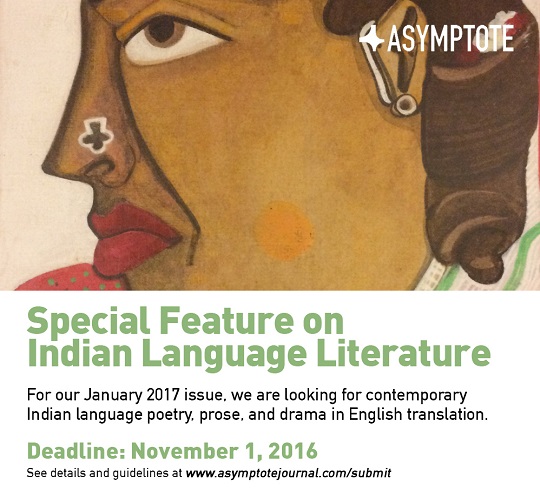
Calling All Translators of Indian Literature

Asymptote celebrates the diversity and dissent within Indian writing

Only two weeks left to submit to Asymptote’s first-ever Special Feature on Contemporary Indian Language Literature in English Translation!

Since we first announced the Feature in August, we have received some very exciting work from all across the Indian map. And we can’t wait to find more voices, because in a country so large, we know there are more out there.

Take advantage of these last two weeks to revise your best translations and send them in!

READ MORE…

Translation Tuesday: An excerpt of “Cobalt Blue” by Sachin Kundalkar

When you came into our lives, I was in a strange frame of mind.

Translated from the Marathi by acclaimed novelist and critic Jerry Pinto, Sachin Kundalkar’s elegantly wrought and exquisitely spare novel explores the disruption of a traditional family by a free-spirited stranger in order to examine a generation in transition. Intimate, moving, sensual, and wry in its portrait of young love, Cobalt Blue is a frank and lyrical exploration of gay life in India that recalls the work of Edmund White and Alan Hollinghurst—of people living in emotional isolation, attempting to find long-term intimacy in relationships that until recently were barely conceivable to them. Here, we present the opening pages of the novel.

*

That you should not be here when something we’ve both wanted happens is no new thing for me. Today too, as always, you’re not here.

The house is quiet. I’m alone at home. For a while, I basked in bed in the shifting arabesques of light diffusing through the leaves of the tagar. Then I got up slowly, and went down to the backyard, and sprawled on the low wall for a single moment. The silence made me feel like a stranger in my own home.

I walked around the house quietly, as a stranger might. The chirping of sparrows filled the kitchen. The other rooms were quiet, empty, forsaken. In the front room, the newspaper lay like a tent in the middle of the floor, where it had been dropped. At the door, a packet of flowers to appease the gods and a bag of milk.

Then I realized I was not alone. From their photograph, Aaji and Ajoba eyed me in utter grandparental disbelief. I took my coffee to the middle room window and sat down. That girl with the painful voice in the hostel next door—How come she’s not shrieking about something?

To savour each bitter and steaming sip of coffee in such quiet?

That you should not be there when something we’ve both wanted happens is no new thing for me. Today too, as always, you’re not here. READ MORE…