

It’s the shortest month, but we’ve got quite the list. Our reviewers are taking you through eleven titles and ten countries: the latest novel from China’s most famous avant-gardist, a classic Tolstoy triptych of war’s ceaseless horror, a fictionalized memoir from one of Mexico’s greatest chroniclers of violence and legacy, a lyrical and lucid portrait of growing up in one of West Bengal’s riverside villages, and many more. . .
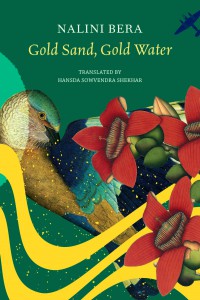
Gold Sand, Gold Water by Nalini Bera, translated from the Bengali by Hansda Sowvendra Shekhar, Seagull Books, 2026
Review by Xiao Yue Shan
Despite all the battering that reality has historically taken under the wrath of language, with its voracious appetite for possession and imprisonment, there remain writers who seek to be more humane stewards, who want to take reality in and treat it with hospitality, patience, to let it roam free range. In Gold Sand, Gold Water, there it is alive, in all its shimmer and multiplicity, as disorderly and liquid as anything wild. Gaston Bachelard said it best in The Poetics of Space: ‘Man lives by images. . . . We sense little or no more action in grammatical derivations, deductions or inductions. . . . Only images can set verbs in motion again.’ Through a compelling delivery that melds this kineticism of portraiture with the haptics of linguistic texture, Nalini Bera brings a childhood, its legends and headwaters and music and verdure, downriver to us.
The river driving this episodic fiction is the Subarnarekha, flowing through the states of Jharkhand, West Bengal, and Odisha before entering the Indian Ocean. For Lolin, the young narrator of Gold Sand, Gold Water, it is a site of endless questions and unexpected encounters, joining history and the future, as familiar as home and as otherworldly as myth: ‘Not at its origin, not at its estuary, but at its mid-flow—at its mid-flow, someone threw a salver of gold into a river, and that river was named Subarnarekha—the golden streak.’ Something hypnotic enters the prose when the river does, bringing along with it a flurried litany of leaves, vines, snakes, fish, fragrances, people, emblems, ‘the hair of the Barojia maiden, Bhramar, wrapped in a betel leaf’. So too do the stories Lolin tell mimic this movement, which lithely go from a precise ethnography of this village that speaks a mix of Bangla and Odia, to episodes of mischievous boyhood, to the intimate goings-on of family and neighbours, to the intersections between nature and industry, to long-told tales of snakes that drink milk. It’s restless, just like the young boy behind the surges: ‘I often felt like following those who went westwards. They would reach their destinations, the villages they were headed to. But my journey wouldn’t end with theirs. I would just go on, and on, and on . . .’ READ MORE…