Visual Art

Visual Spotlight: Mahwish Chishty on Challenging the Reality of Modern Warfare

Art is not detached from reality; it is reality, often dark and violent, that impels artists to create work that may address that reality.

As 2025 draws towards its close and we begin to reflect on the year, one unescapable fact is that it was another year of the world at war, when the terrors wrought by modern weaponry and those who deploy it has become only too clear. In this context, we would like to revisit our feature on the work of Mahwish Chishty from our Summer 2014 issue. In War Machines, Chishty painted traditional Pakistani ‘truck art’ over photos of military drones, calling attention to the terror of the modern war machine by contrasting it with a representation of beauty. Chishty’s work feels as resonant and relevant today as it did then, both as a way of giving voice to horror and of resisting it.

Screen Shot 2025-12-10 at 10.35.51 PM

Q&A with Mahwish Chishty

For those of our readers unfamiliar with Pakistani ‘truck art,’ can you explain what it is?

‘Truck art,’ sometimes referred to as ‘jingle art,’ has recently become a cultural phenomenon in Pakistan. In ‘truck art,’ trucks (but also rickshaws and buses) are painted inside out, in elaborate colors. The decoration of vehicles is, of course, common practice in many countries but Pakistani (and Afghani) truck art is unique because of the pervasiveness of its decoration. Virtually all privately owned trucks in Pakistan (and Afghanistan) are decorated in a way that varies from region to region. I was introduced to this cultural practice back in 1999 while I was attending the National College of Arts in Lahore and this phenomenon of myriad colors and styles superimposed over dull grey metal has always intrigued me.

Elsewhere you have mentioned that culturally loaded text sometimes accompanies the colorful ‘truck art’ and you appropriate both text and ‘truck art’ in your miniature paintings of military drones. Firstly, can you tell us more about this text, and secondly, what do you hope to achieve by appropriating ‘truck art’ in your depiction of war machines?

In the ‘truck art’ genre, certain texts are repeatedly written and, because of the beautiful way in which they are repeatedly written, aestheticized for the viewer. Content-wise, these texts may express the truck owner’s political or religious leanings; they may also be poetry, or movie trivia. In my paintings, I either borrow the imagery and texts wholesale, or improvise.

By presenting the colorful iconography and texts within the silhouette of a drone, I hope to open up a conversation about omnipresent ‘truck art’ and the not-so-visible presence of drones in that region. ‘Truck art’ originated in Afghanistan and spread across the border into Pakistan—the same Pakistan/Afghanistan border that is now a war zone. Truck drivers use their mode of transportation as a colorful form of self-expression; drone operators, however, are invested in remaining anonymous. In nature, bright colors attract attention; in art, they also serve the practical purpose of drawing viewers into the work. And just as in nature, where certain combinations of bright colors index an animal’s deadliness, here the coded visual language, upon closer examination, reveals sinister elements such as snakes, guns, swords, spears, grenades, and dead fish, among others.

Screen Shot 2025-12-10 at 10.36.02 PM

What is the significance, if any, of tea stains on many of these works?

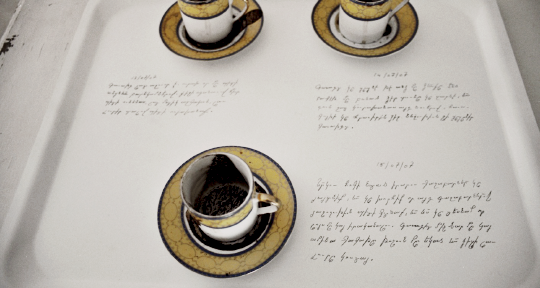
Tea staining has been used in traditional miniature painting for thousands of years as a way to start a painting with a neutral background instead of stark white. For these pieces, it works insofar as the texture and color of the tea stains depict well the aerial landscape of the Pakistan/Afghanistan border, i.e. the view that drone operators would see on their computer monitors 10,000 kilometers away from the war zone.

As recently as a month ago, Pakistani fighter jets carried out raids on suspected militant hideouts in the tribal North Waziristan region, killing 80 militants. What do you think art can hope to achieve, against reality?

Art is not detached from reality; it is reality, often dark and violent, that impels artists to create work that may address that reality. In fact, many artists from this region have altered their artistic practice to express their concern and dissatisfaction about the bloodshed in that region. As a Pakistani living in the US, I’ve found it even more necessary to create work about issues that concern my people and me.

Screen Shot 2025-12-10 at 10.37.18 PM

Revisit the feature on Chishty and the portfolio of her work here.

*****

Read more on the Asymptote blog:
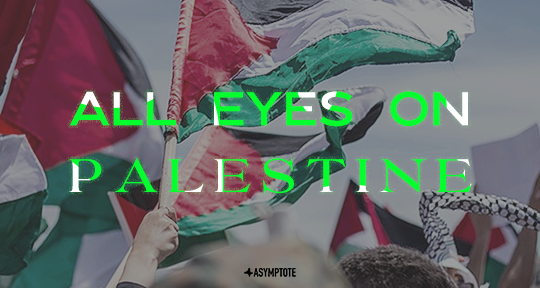
From The Bitter Landscapes of Palestine

At the heart of zulem is an unfairness that no human creature can understand or withstand.

These days, many of the images we see from Palestine are ones of unbearable violence—a necessary example of what Roland Barthes called “the experiential order of proof”. However, despite the vital role of these photographs in bearing witness and documenting the ongoing atrocity, there is an equally essential need to elaborate this unidimensional representation with the social soul and experienced terrain of these historically rich territories, and to thus unite the psychically separate fields of the unthinkable and the daily. 

As such, it is with great urgency that writers and scholars Margaret Olin and David Shulman have collaborated to produce The Bitter Landscapes of Palestine, a compilation of photographs and texts, to be published as part of the Critical Photography series by Intellect. In their brief introduction, they state only: “We will speak of what we have seen and heard directly and what we have experienced in our bodies.” From that dedication to perception, they illuminate the extent to which intersections of photojournalism and intimate speech can establish compassionate, mutual relationships between viewers and subjects, and how photographs and poetics can be used in ways that do not seek to control information, as in the mechanisms of tyranny, but that reassert their expressive, transformative function: impressing a fragment to open up interrogations into the whole; inducing the epiphany of recognition; and offering the potential of a unified political space.

In the following excerpt, which consists of the book’s fifth chapter, titled “Arabic”, Olin and Shulman describe the sonic and interpersonal fabric of language under occupation, pairing the text with an array of images that portray communication’s various appearances: books, letters, conversations. The resulting interplay is evidence of how a single word—injustice—can grow and grow until it contains an entire country; how there is no scale for such grief, just as there is no true physicality for words, but still it is felt and carried, every day.

1

Susiya, March 2016

First, the music. It changes from place to place. The city Arabic of Jerusalem and Ramallah becomes gruffer, rougher, in the desert, where the guttural “q”—often pronounced only as a glottal stop, that is, a quick catching of the breath in the throat—turns into a “g.” The shepherds’ language flows seamlessly into the cries and whistles and grunts they use to speak to the sheep. At the same time, they sprinkle their sentences with the astonishing formulas of courtesy that come so naturally to the tongue: May Allah heal you, give you peace, bless your hands. We thank you, you have honored us. Welcome, you are our guests. Go in peace. READ MORE…

Visual Spotlight: Mounira Al Solh on War, Refugees, and the Scatter

My work is a collection of hundreds of encounters, captured by writing and by drawing the moments with each individual and family I met. . .

The liquid condition of being stateless—whether as a refugee, a migrant, or a individual living on occupied territories—means that one’s life begins to revolve around questions: questions of where to go, how to act, what to claim, who the opposition is, who oneself is. In Lebanese-Dutch artist Mounira Al Solh‘s work, these inquiries are given vivid sonic and visual resonances, in the dizzying and hypnotic shot of a boat swaying back and forth, in the slow panning over an animal’s exposed ribcage, in a man that continually raises a foot to step forward or backward, before returning it to its place. Working with her own narrative of migrating from Beirut to Damascus as a child, and overlaying it with a contemplative blend of cultural archive, enactment, and linguistic sensitivity, Al Solh places a beating heart in the centre of displacement’s immense, abstracted web, illustrating not only origins or destinations, but the individual in the middle of becoming.

In any case, in the year 2006, as I was finishing my studies at the Gerrit Rietveld Academie in Amsterdam, I made a video piece, Rawane’s Song, in which I stated that “I have nothing to say about the war,” meaning the Lebanese civil war. At that time, everyone expected Lebanese artists to speak about that war. It was also generational, as people who grew up during the Lebanese civil war found the only way to survive was by not speaking about the war, but about survival instead. When I was a young teen, I had the privilege to live the changes that occurred on the ground in Lebanon, the abrupt and absurd end of fifteen years of civil war, and the shift to a postwar time (or perhaps to a suspended civil cold war, as some people called it).

Ironically, when I had finished making Rawane’s Song there was a war again in the summer, when Israel invaded Lebanon and bombed its bridges in a fight against Hezbollah, who had kidnapped a couple of soldiers to tease and provoke Israel. After this war, fighting factions would strengthen and become more popular. Anyway, at that time, I did not refrain from showing Rawane’s Song, and I did not refrain from taking a highly ironical position towards “speaking about the war,” even though we were being bombed and the country was devastated. READ MORE…

Visual Spotlight: Winnie Soon on the “In-Betweenness of Formal Logics and Natural Languages”

We wanted to problematize such distinctions of machine and human, living and non-living.

With technology perpetually advancing, questions are continuously raised about the relationship between art and computing. As artificial intelligence models gain increasing purchase, this discourse has been coming to the fore once again. The artist and researcher Winnie Soon is not interested in binary thinking about this relationship; instead, she is “interested in thinking with, and through, programming.” The discussion about art, literature, and technology often feels fraught and contentions; in this edition of our recurring series highlighting visual work from our archives, we revisit Soon’s visual feature from our January 2020 issue, which models a richer, more complex view.

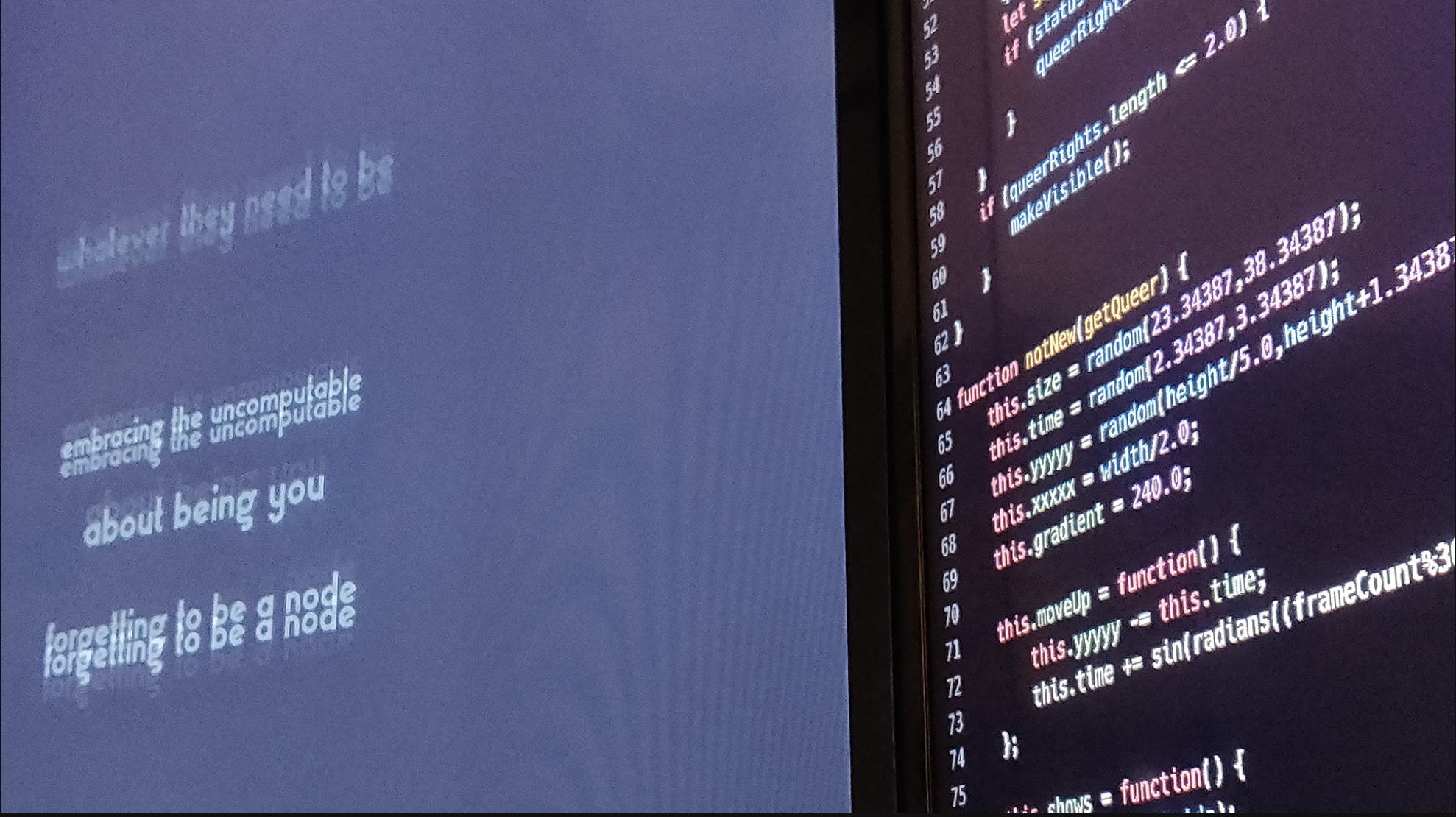
For me, the notion of queerness has to do with thinking beyond binary and normative categorization, questioning the assumptions behind such distinction. For example, some people might think that the computer is a functional tool and use it just to realize their thoughts or to achieve certain goals; or they might consider computer programming as a means to build platforms, apps, and gadgets in the neoliberal context in which we often come across these applications in contemporary culture. To invite various participants to donate their voices is a way of thinking about how we might challenge the norms of everyday practices, including computing. The project asks, what does it mean when human voices are computerized and performed within a formal logic, and how might I, as artist-programmer, play with the program code as the in-betweenness of formal logics and natural languages?

Screen Shot 2023-11-15 at 4.14.45 PM

Regarding the question of living and nonliving, we are less interested in that dichotomy, but in how the body is part of the integrated human-machine system. We wanted to problematize such distinctions of machine and human, living and non-living, questioning the concept of voices in the context of digital culture. In this work, there are humans and possibly bots that are represented, translated, or even mediated, via a real-time computational process. READ MORE…

Visual Spotlight: Mekhitar Garabedian on Linguistic Identity

I'm interested in the dynamics between comprehension and incomprehension.

As Mekhitar Garabedian told Eva Heisler, Asymptote’s former Visual Editor, “[b]ecause of the contemporary political, economic, and cultural situation of Lebanon and Syria, and of the Middle East in general, these places (and their histories) are meaningful, significant, and vital presences in my daily life. Diaspora means experiencing a disseminated, shattered, divided self.” This statement suggests that diasporic identity is both a geographic and historical condition and that it is marked by both continuous felt presence and continuous literal absence. It is, in this way, a condition of both the shattering Garabedian names and one of possibility, as demonstrated in the art that comes from so many diasporas, including Garabedian’s own. In this edition of our recurring series highlighting visual work from our archives, we revisit Garabedian’s feature from our July 2015 issue.

Without even leaving, we are already no longer there, 2010–2011, video installation, DVD, 3 screens, dimensions variable, 3 x 30min. Detail. With Nora Karaguezian and Laurice Karaguezian. Cinematography by Céline Butaye and Mekhitar Garabedian.

Without even leaving, we are already no longer there, 2010–2011, video installation, DVD, 3 screens, dimensions variable, 3 x 30min. Detail. With Nora Karaguezian and Laurice Karaguezian.
Cinematography by Céline Butaye and Mekhitar Garabedian.

In my research, I contemplate the conceptual possibilities of the work of art. I often use modes of repetition that reference literature, philosophy, cinema, pop culture, and the works of other visual artists—citing, replicating, and distorting references, exemplary modes, and works from art history and from my own history. I employ references as structures or elements upon which I can build, adding different layers, or contaminating them with altogether different contexts.

My interest in citation developed instinctively, probably through the experience of growing up with two languages, which engendered the feeling of always speaking with the words of others, perhaps also by encountering the early films, full of citations, of Jean-Luc Godard, at a young age, and through growing up in the nineties with the art of sampling as practiced in hip hop culture.

My use of citations or references also comes from my interest in the idea that identity is always a borrowed identity. One can never pretend to be someone out of the chain of the past. One is always speaking with the words of others. Talking with the words of others requires a library (and a dictionary) of the words of others. In my work, I use talking with the words of others and the construction of a (personal) library as a conceptual artistic strategy. My use of modes of repetition also relates to the Catastrophe; after a disaster, only thinking in ruins, in fragments, cut-outs or debris, remains possible. READ MORE…

Visual Spotlight: Some Artists on Developing a New Visual Language of Protest

The Some Artists page is proof of a dream, the dream of art and artists who will forever stay with the people and against the power.

Over the weekend, Iran’s Deputy Attorney General said that punishment for those who encourage others to remove their hijabs would face criminal prosecution, and only days before, it was reported that women who were not wearing the hijab were being barred from the Tehran metro, leaving many unable to go to work. This comes at a time when tensions surrounding the longstanding and long-protested compulsory hijab law are especially high; last year, after Mahsa Amini was killed in police custody following her arrest for allegedly failing to comply with the compulsory hijab law, protests against Amini’s killing and against the compulsory hijab law broke out and grew into a larger protest movement. While the protests were violently repressed by the government, the spirit of protest in Iran has both a longer history and a continuing energy. Many Iranian women continue to go without the hijab in public as a display of defiance, and even prior to the recent protests, resistance to the compulsory hijab law was inextricably linked to older Iranian protest movements. The visual histories of these interconnected protest movements are on display in the work of Some Artists, an anonymous group of artists who began using social media to disseminate art in solidarity with Iranian protesters following protests in 2018. In this edition of our series spotlighting visual content from our archives, we revisit our feature on Some Artists from our Winter 2020 issue

ff72c875706715acedc8ca66a2c2ee4c

Following the protests of January 2018 and the ensuing silence of the middle class, artists and intellectuals in the face of protests by workers and the rise of the afflicted, we aimed to become a bridge. A visual cry for the afflicted and a platform where artists and intellectuals would be translated beyond class.

The first piece uploaded on Some Artists’ Facebook page was a video clip dedicated to Sina Ghanbari, entitled “(Far)yad” [“Cry 1”], on January 27, 2018.

We realized a lack of precedence of visual language for what we hoped to do, and this made our process hard. Whatever existed before then was either the literature and visual arts belonging to the era of the 1979 Islamic Revolution, which felt aged, or the politicized visual language of the Green Movement of 2009; there was nothing else. To address the issue, we decided that a simplicity in form and content would be our only way to go. READ MORE…

Visual Spotlight: Guga Szabzon on keeping the world safe between pages

Every single thing, when taken seriously, is transformed and becomes eternal.

After a two-year hiatus during the COVID-19 pandemic, Carnaval do Brasil was poised to return in all its colorful pageantry across the country this past February. Yet, flooding across Brazil’s Sao Paulo state forced many cities to cancel their scheduled festivities as hundreds flee their homes. In a month that has witnessed devastation on a large scale stemming from catastrophic natural disasters, from the deadly quakes in Turkey and Syria to forest fires in Chile, it can feel like an unrelenting onslaught of uncontrollable circumstances. Enter the work of Guga Szabzon, a visual artist and educator from São Paulo, Brazil, whose works speak to the impossibility of naming experience even as they offer a way to keep the world “safe between . . . pages.” In the first installment of a new series spotlighting the stunning visual content from our archives, we revisit our interview with the artist from the Fall 2018 issue.

image1

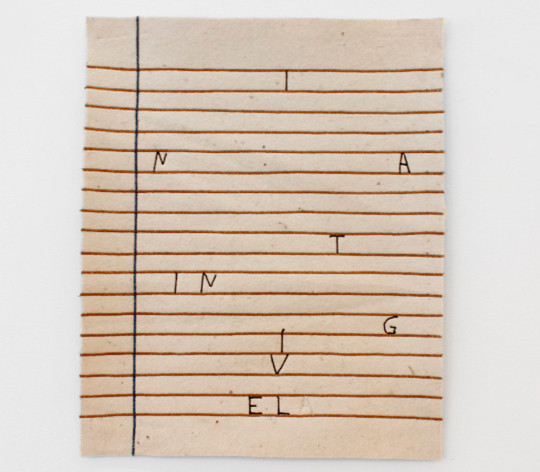
The lines in a notebook, in general, have a clear utility: to organize the text, to make the text comprehensible with a clear and sequential reading. I’ve never really followed that rule, but I always opted for notebooks with ruled pages. I discovered after some time that what attracted me to this choice was not having a blank page waiting for me. The lines were already a design. As time went by, I realized that the organizational forms of the world interest me. And I realized that there was a similarity between ruled lines and the coordinates of a map. Both have latitude and longitude. One organizes a text and the other organizes space.

The sensation that I had with this project was the same that I had with my notebooks. My own world kept safe between the pages. Everything I had lived. How many stories fit inside a notebook? How many stories can be written on the blank pages? An entire world awaiting the next word.

READ MORE…